
Building Blocks: The Basic Ingredients Behind Japan’s Flavors
The Root of Japanese Cuisine: The Crisp, Juicy Daikon
Food and Drink Culture Lifestyle- English
- 日本語
- 简体字
- 繁體字
- Français
- Español
- العربية
- Русский
The daikon is believed to have originated in the region between the Mediterranean coast and Central Asia. Centuries ago, this distinct white vegetable arrived in Japan via China. It is mentioned in Japan’s most ancient chronicles, the Kojiki (Record of Ancient Matters) and Nihon Shoki (Chronicle of Japan), indicating it has been consumed since ancient times. Suzushiro, included in nanakusa, the “seven herbs” of spring, is another name for daikon, derived from its white (shiro) hue. Raw daikon is known to contain enzymes that aid digestion, stimulating gastrointestinal activity, and so is said to prevent upset stomachs and hangovers.
Advances in cultivation techniques during the Edo period (1603–1868), along with active improvement of varieties suited to local soils and uses, have led to Japan having the greatest number of daikon varieties in the world. Even so, more than 90% of the daikon currently sold is aokubi daikon, with its “green-necked” head and top of leaves. Cultivation of this variety spread across Japan from the 1980s onward, due to it being highly resistant to disease and conveniently sized, with an average specimen weighing in at 1 kilogram and measuring around 30 centimeters in length. It can be grown anywhere in Japan, with the five major production areas ranging from Hokkaidō and Aomori in the north, to Chiba, Kanagawa, and down to Kagoshima in the south.
Sweeter in Winter
While improvement in the varieties and cultivation techniques mean that daikon is now available all year round, the peak season is primarily autumn through winter. Plump winter daikon is sweet and delicious, whether simmered or served raw in crunchy salads.
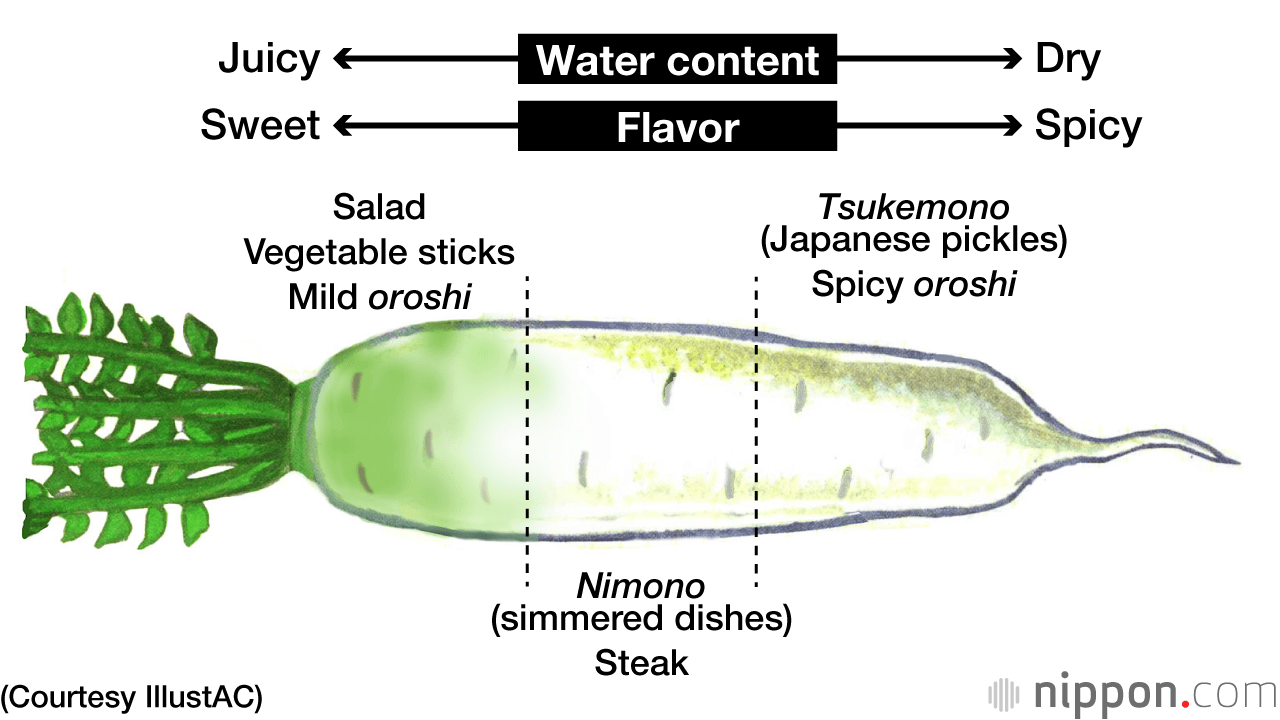
In summer, the flavor is a lot spicier, thought to be the vegetable’s way of protecting itself against pest damage. It also depends on what part of the daikon you eat. The juicer, sweeter section at the top near the leaves can be eaten raw, such as in salads or as vegetable sticks. The central section has a more balanced flavor, making it great for simmered dishes or as a main, such as cooking it in thick rounds like a “steak.” Meanwhile, the bottom section, closest to the root, packs more of a punch, and is delicious when finely chopped and added to pickles and miso soup.
Conventionally spicy, daikon oroshi (grated daikon) can be made milder by using the top section instead. For those wanting a refreshing accompaniment to fatty grilled fish like sanma (Pacific saury), using the very spicy tip of the daikon is an expert move.
Incidentally, Japan, as the powerhouse of daikon, has extra-large varieties recognized by the Guinness World Records. The Sakurajima daikon, hailing from Kagoshima Prefecture, is the world’s heaviest. Typically weighing 10 kilograms, this variety can reach 20 to 30 kilograms. In addition, the longest daikon in the world is the Moriguchi daikon from Aichi Prefecture, 1.2 meters long as a standard, but which can grow up to nearly 2 meters.
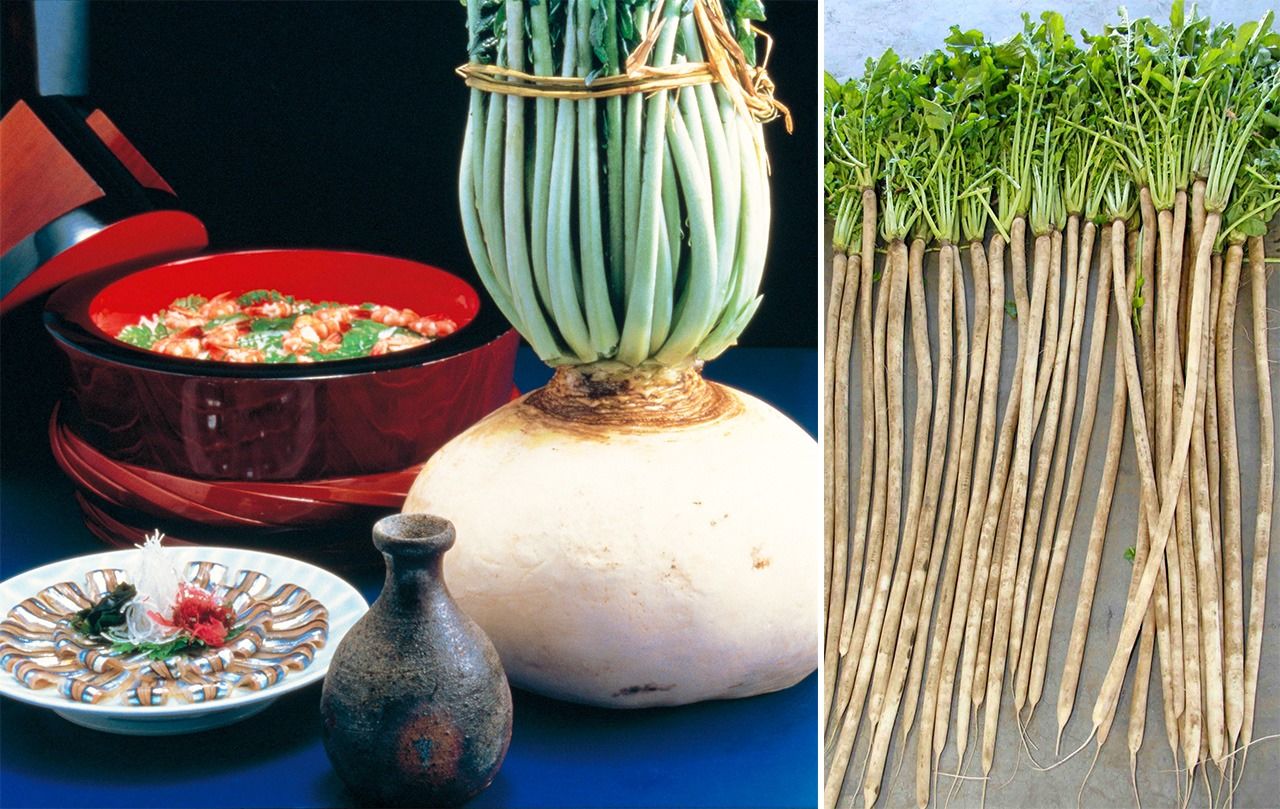
From left, Sakurajima daikon (courtesy Kagoshima Prefectural Visitors Bureau), and Moriguchi daikon (courtesy of JA Aichi Kita).
Data Sources
- This Month’s Vegetable: Daikon (Japanese) from the Agriculture and Livestock Industries Corporation.
- Daikon: A Vegetable for Autumn and Winter (Japanese) from the JA Group.
(Originally published in Japanese. Text by Ecraft. Banner photo © Pixta.)