Building Blocks: The Basic Ingredients Behind Japan’s Flavors
Himono: Enriching Japan’s Fish-Eating Culture Through Preservation
Food and Drink Culture Lifestyle- English
- 日本語
- 简体字
- 繁體字
- Français
- Español
- العربية
- Русский
With Japan surrounded by the sea, the culture of eating fish has flourished throughout every region. Himono, or dried fish, is produced by drying out seafood that would otherwise quickly spoil. As well as extending its shelf life, this process results in enjoyably unique flavors and textures not to be found with fresh fish.
Himono has a long history, with remains of dried fish and shellfish having been found at archaeological sites dating from the ancient Jōmon period (ca. 10,000 BC–300 BCE). It is documented in the Nara period (710–94) as an offering to the gods, while in the Heian period (794–1185), it is mentioned being enjoyed by nobility as an accompaniment to alcohol. During the Edo period (1603–1868), encouraged by the shogunate, production of himono increased across Japan and it became available to the general population. As this was still before refrigerated transportation, the dried fish brought inland from the fishing villages was a valuable source of protein.
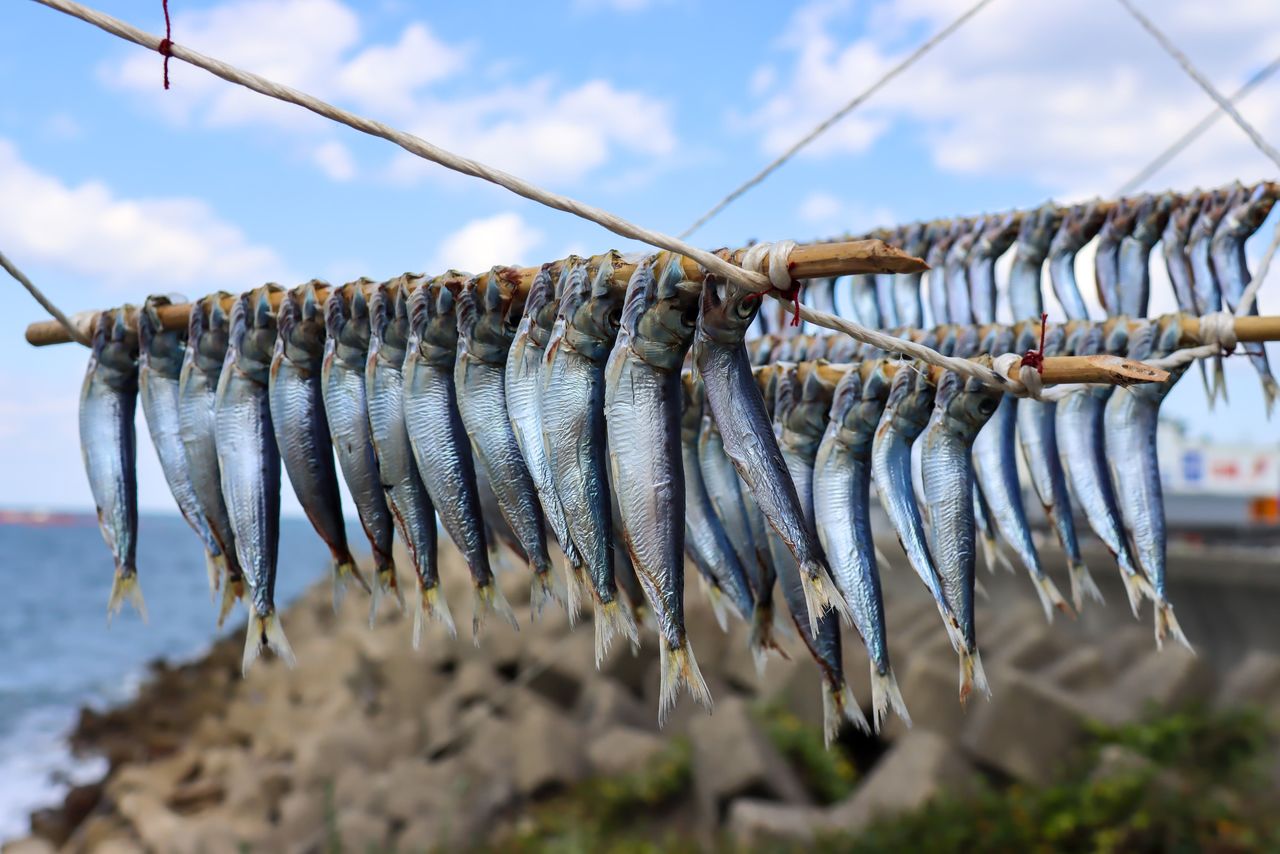
Iwashi no himono, sardines being dried. (© Pixta)
When using small fry to make himono, they are washed and left as they are, while comparatively small fish are left whole and dried, in a technique known as maruboshi. For larger fish, their innards are removed and the body cut and opened out so that it can dry more easily. It is standard to cut open a fish by slicing it from its belly; however, in the case of long, thin fish or those with tough heads, the head is left on and the fish cut open along its backbone. This style is known as Odawara-biraki, as Odawara in Kanagawa Prefecture was a well-established area for himono production. The strong influence of samurai culture in the Warring States period (1467–1568) in that area meant that it was regarded as inauspicious to slit open the belly, due to the similarity to seppuku, as was cutting off the head because it could be likened to decapitation.
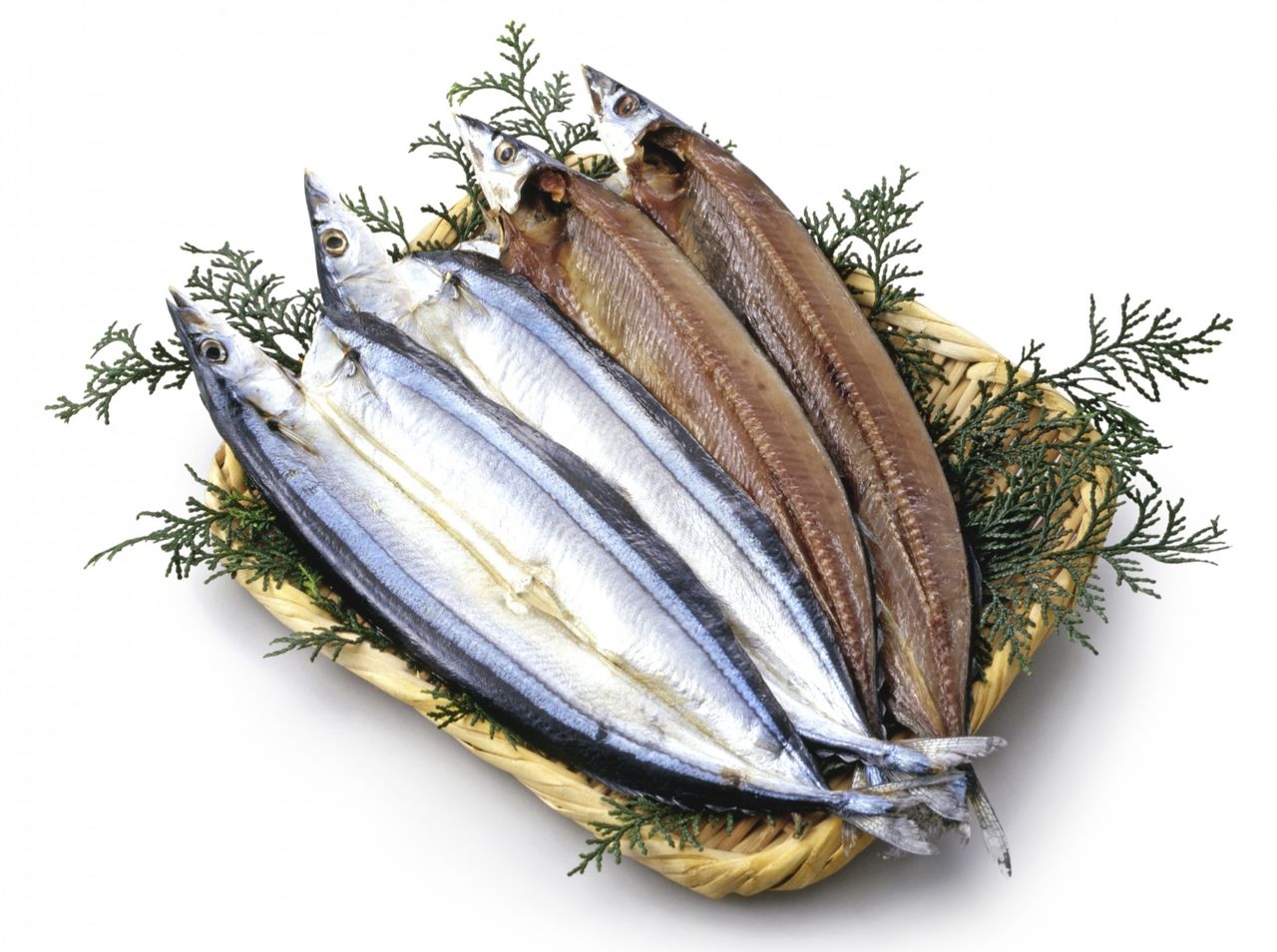
Sanma, or Pacific saury, that has been prepared in Odawara-biraki style. (© PhotoAC)
The traditional method for producing himono is tenpiboshi, drying the fish outside exposed to the wind and sun. This is dependent on weather conditions though, requiring considerable skill and making it difficult to maintain a hygienic environment. As Japan rapidly developed in the postwar period, it therefore became more common to use a machine-drying process.
A wide variety of himono is available, not only by type of seafood or shape, but also the processing method, including simply dried, salted-and-dried, seasoned-and-dried, simmered-and-dried, and grilled-and-dried.
A lot of the time, himono is rehydrated in water and then either simmered or grilled over an open flame, before being served as a side dish or as a snack with alcohol. The broth created when simmering the fry of sardines makes an excellent dashi stock. It is no exaggeration to say that himono has taken Japan’s fish-eating culture to much richer depths.
Data Sources
- Dried foods (Japanese) from the Ministry of Agriculture, Forestry, and Fisheries.
(Originally published in Japanese. Text by Ecraft. Banner photo © PhotoAC.)