
Japan’s Burgeoning Viticulture: International Interest is Opening Japanese Drinkers’ Eyes
Food and Drink Travel Global Exchange- English
- 日本語
- 简体字
- 繁體字
- Français
- Español
- العربية
- Русский
Burgundy Eyes on Japanese Wine
The Japanese wine tasting event Salon des Vins Japonais, or SVJ, took place in a historic church in the middle of Beaune, a key city in France’s famed Burgundy wine region. This was the second meeting after the event’s inception in 2023. The head of the executive committee, Iwasaki Genki, explains that 50 wineries submitted wines, among which 14 producers personally ventured to France to join in.
About 600 people attended, among them representatives from local wine shops, vintners, restaurant industry members, and wine collectors. There were also many Japanese citizens living in Japan to be seen. First-timers numbered 450, indicating a huge increase in the visibility of Japanese wine in France.
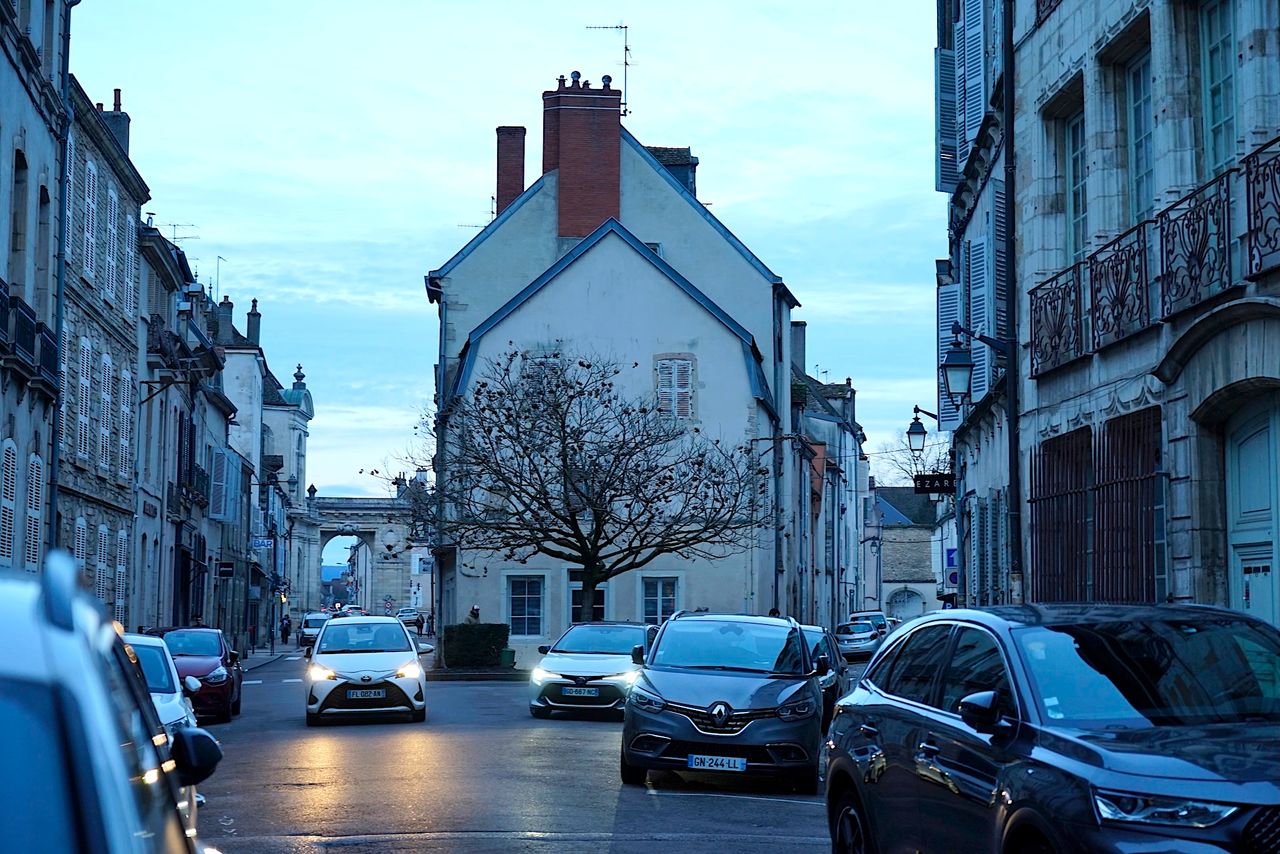
The area around the Chapelle de L’Oratoire of Beaune (visible at the right back), which hosted the Salon. (© Ukita Yasuyuki)
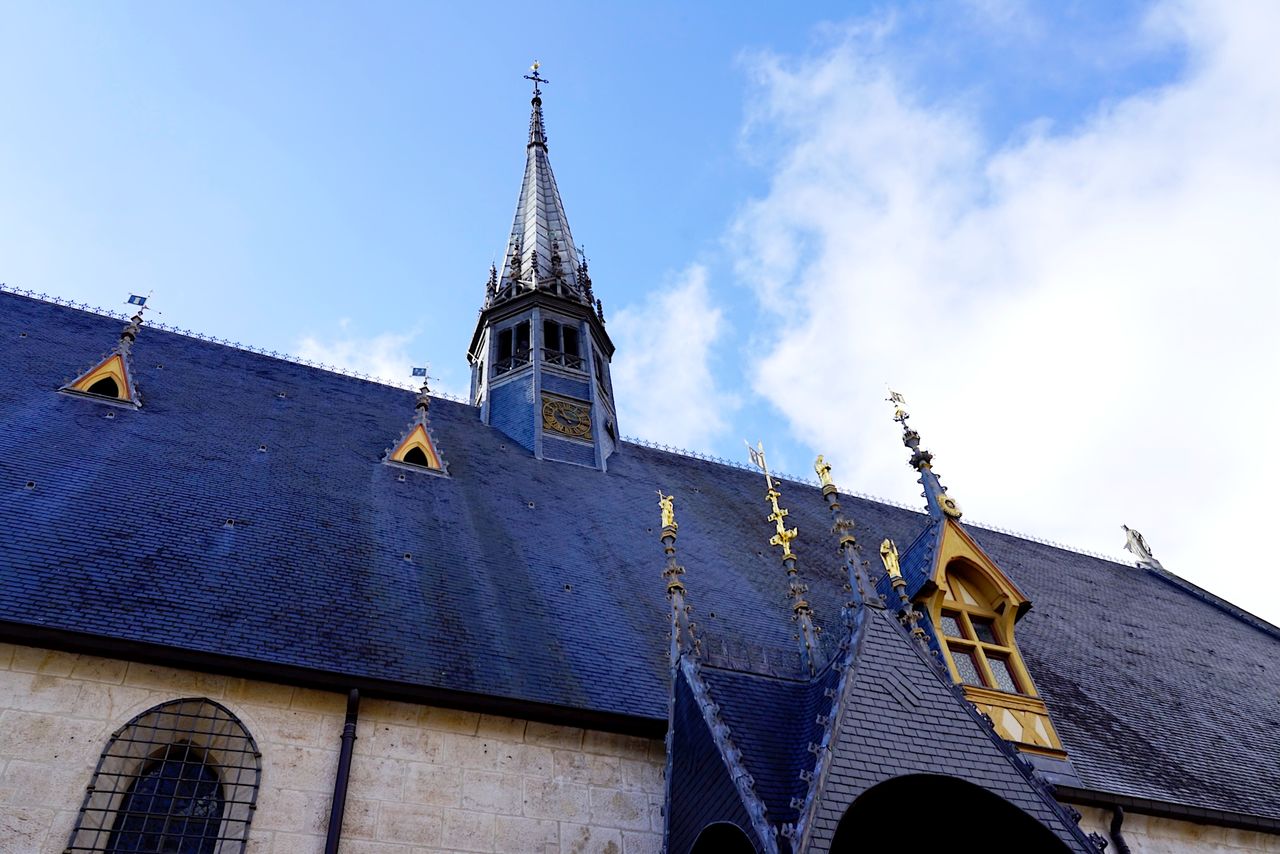
The Hôtel-Dieu of Beaune, once a free hospital for the poor, is now a popular sightseeing spot. It formerly made and sold wine to fund operations, so it retains deep connections to the wine industry. (© Ukita Yasuyuki)
Media outlets also came to cover the event, from French television stations to NHK’s Paris bureau. Among the vintners present were some of Burgundy’s most important names, such as natural winemaking master Philippe Pacalet, who has been interested in Japanese wine for the last decade.
Bertrand Dugat is current head of Domaine Claude Dugat, a winery with roots in Gevrey-Chambertin going back to the seventeenth century. He comments: “It’s fascinating how every region in Japan makes its own style of pinot noir. We here are somewhat constrained by the heritage of Burgundy, so when I learned how free Japanese winemakers are to make wine their own way, I felt quite envious.”
There was some concern over how Japanese wine would be received in Burgundy, one of the world’s great wine regions, but reaction at the site was excellent. Visitors seemed taken by the fact that Japanese winemakers were creating uniquely clean and delicate Japanese expressions using the same grape varietals as Burgundy, as well as by the flavors of wine made from Japanese varietals like Muscat Bailey A or those that only Japanese vintners are using for wine, like Delaware. A collector living nearby said, “The Black Queen I’m drinking now has a character I’ve never experienced before. I’d love to get some to add to my collection at home.” Black Queen is another varietal, like Muscat Bailey A, that was bred in Japan. It is a red grape with a deep color and results in a wine with a hint of spice.
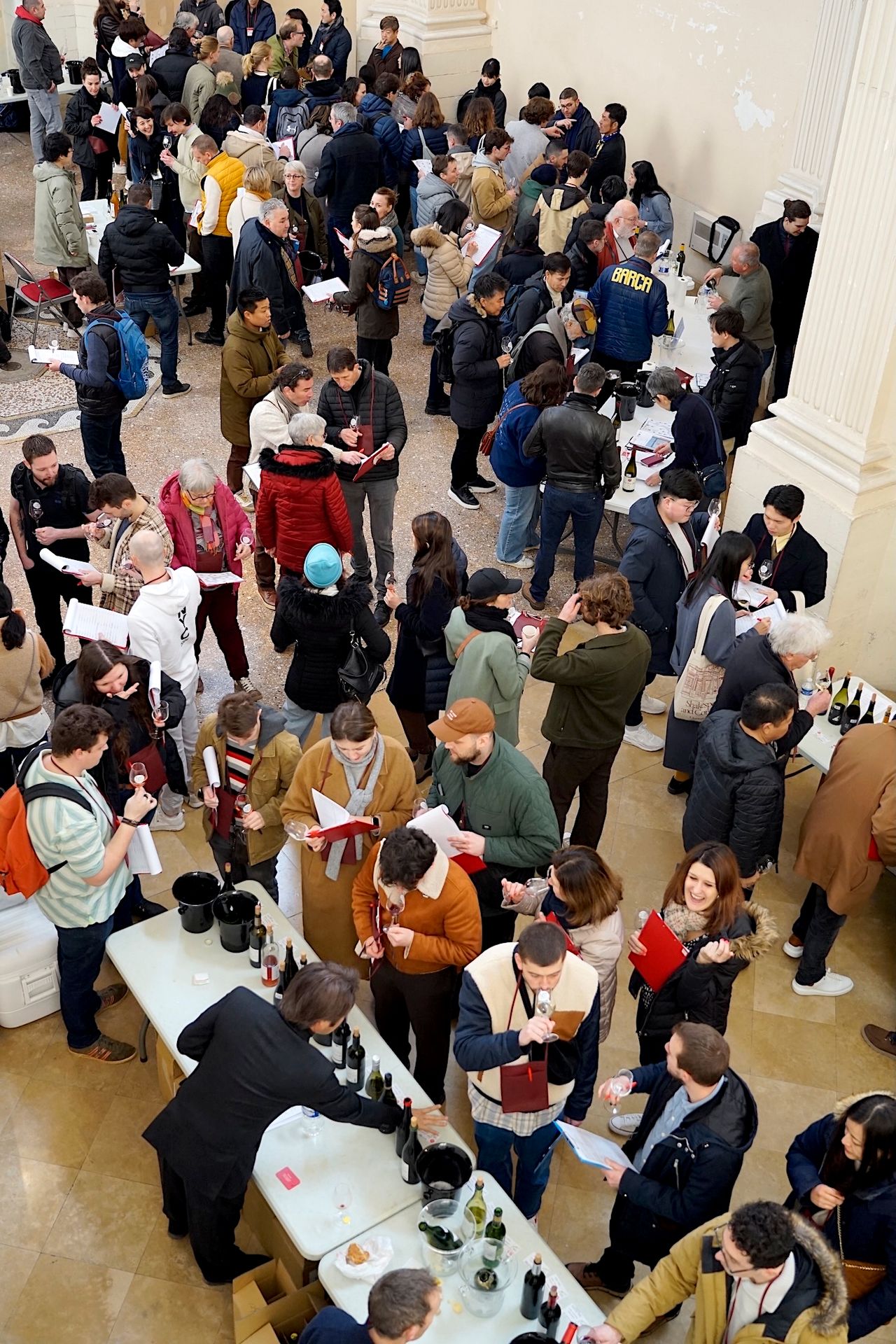
The Japanese community living in Burgundy helped to run the event. They served 600 bottles across 139 labels. (© Ukita Yasuyuki)
Expressing Japanese Terroir
The winery that got the most attention from visitors was one I mentioned in a previous article, Domaine Takahiko Soga. Its Nana-Tsu-Mori Pinot Noir and Nana-Tsu-Mori Blanc de Noirs are clearly becoming well known in France.
Other well-received wineries included Nagano Prefecture’s Nagomi Vineyards, Niigata’s Fermier, and Nara’s Kitani Wine.
Ike Toshihiro of Nagomi Vineyards says, “It seems that between last time and this, the public’s attitude has changed from simply curiosity about Japanese wine to genuinely liking it.” There were also apparently lots of practical questions about purchasing. Ike’s wine has been on the wine list at Michelin-starred Chakaiseki Akiyoshi in Paris since the last SVJ.
Honda Takashi of the Fermier winery comments, “Joining this event is a chance for many professionals, including Burgundy wine makers, to taste our wine and give feedback. I’d like to use that to help us improve. And if there are opportunities to make deals, I want to approach them in a free, unbiased manner. If they go through, that will help with branding, too.”
Kitani Kazuto of Kitani Wines has also joined both times, and says of the value of participation, “With the French evaluations we got at last year’s event as reference, we decided to boost the acidity of our wines, and have tried techniques like segmenting our harvest times to do that.”
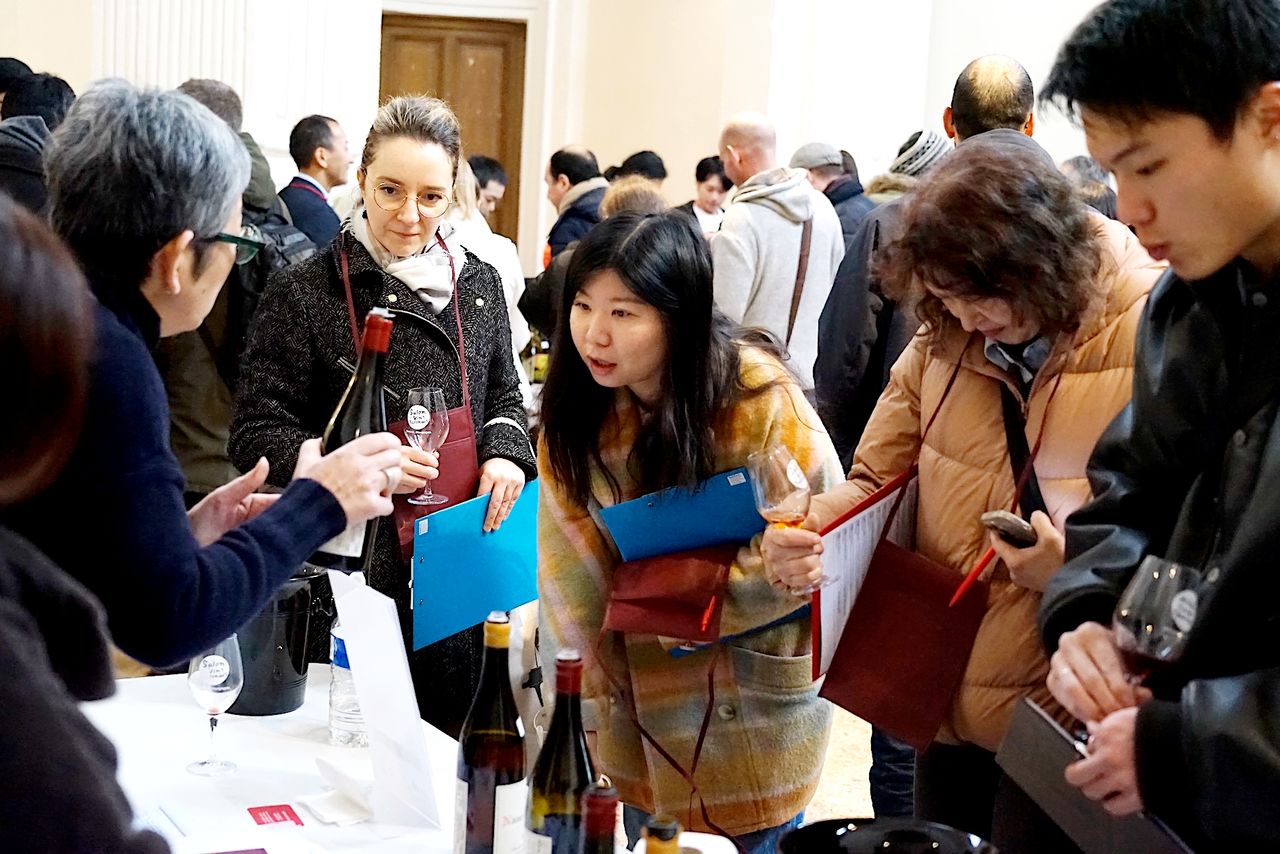
Visitors listen to explanations at the Domaine Takahiko booth. (© Ukita Yasuyuki)
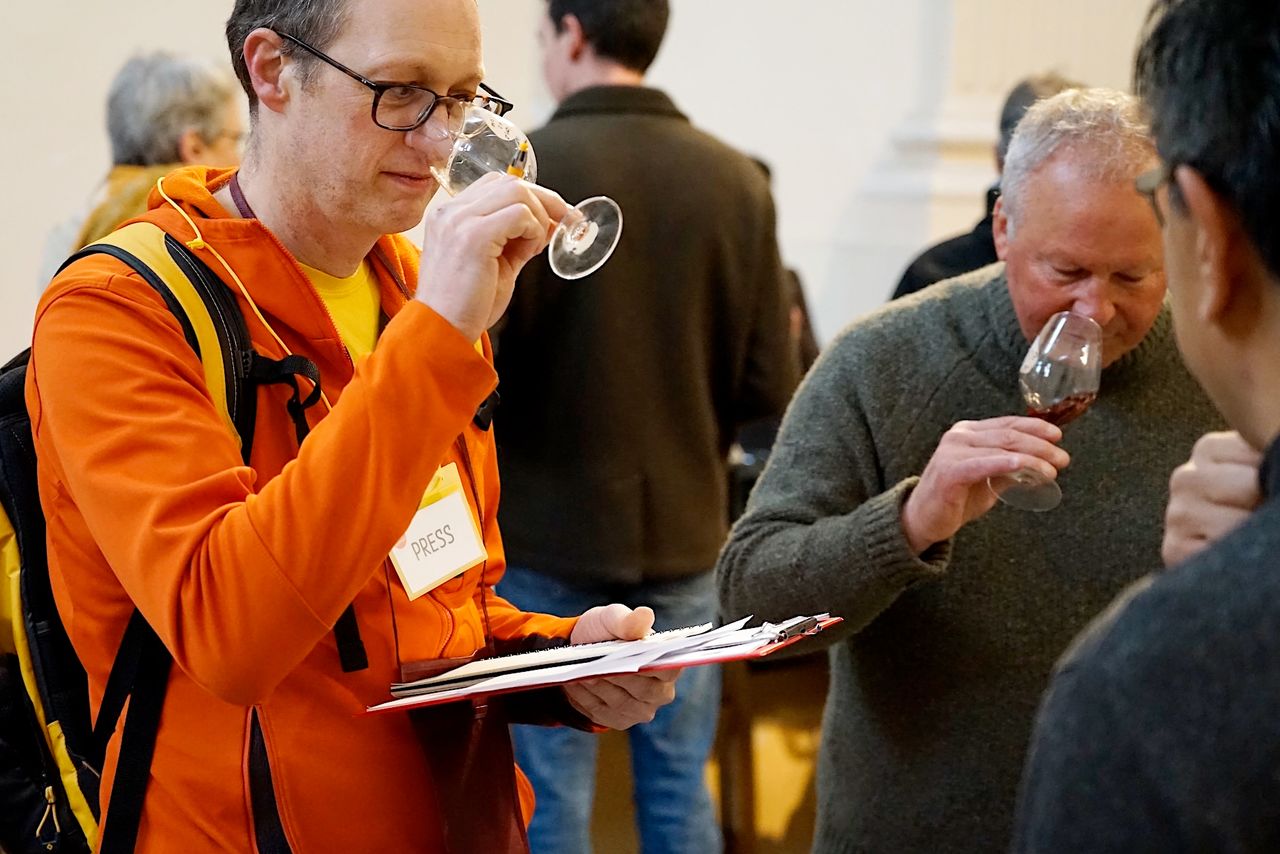
On the left is a wine journalist specializing in covering and talking about Japanese wine. On the right is Etienne de Montille, a Burgundy wine maker also making wine in Hokkaidō, whose wine was also being served at this event. (© Ukita Yasuyuki)
Yanase Mitsuru, chef/owner of Paris meat and wine restaurant Vertus, offered some tasting notes. “Many of the wines had a very distinct flavor of Japan, and I thought they expressed Japanese terroir clearly. I very much want to serve some at my Paris restaurant. Many Parisiens like Japan, and I think they will be interested.” Yanase quickly made a deal to handle Nagomi Vineyards at his restaurant.
Oka Noriyuki, the head of Gubi Gubi, a Dutch wine shop specializing in Japanese wine, also participated in SVJ. His booth was the only one actually selling wine at the venue, and his stock went quickly. Gubi Gubi’s unique business model is surely going to be important in raising the awareness and approval of Japanese wine in the future.
Motivation and Encouragement for Winemakers
After the tasting, many of the producers who attended SVJ went on to tour eight important Bugundy wineries, including Domaine Leflaive, Domaine Dujac, and Maison Philippe Pacalet. Sponsor Iwasaki explains, “The chance to tour local wineries stands alongside raising awareness and evaluation of Japanese wine as one of the main goals of SVJ.” After the experience, the participants shared the motivation and encouragement they got on social media.
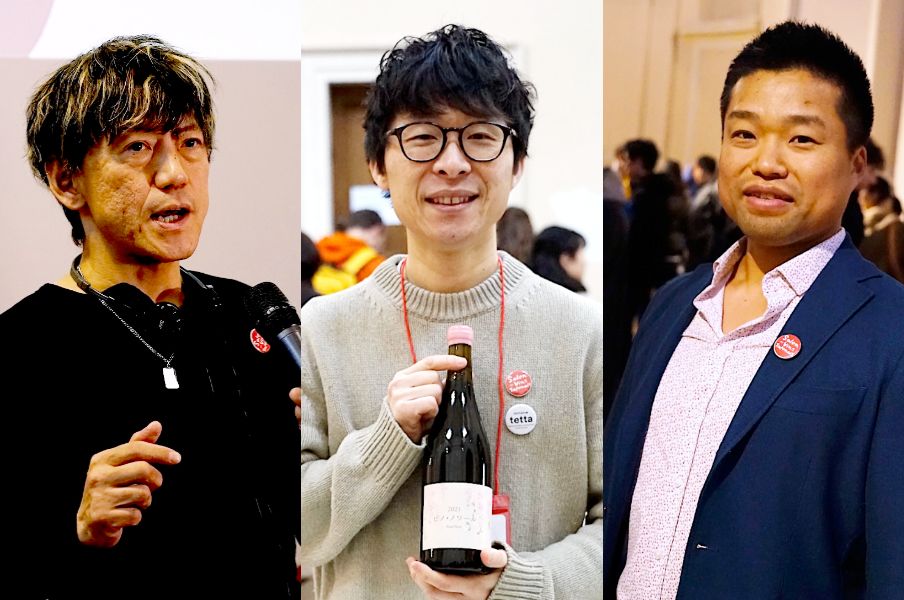
From left: Ike Toshihiro of Nagomi Vineyards, Oka Noriyuki of Gubi Gubi, and sponsor and winemaker Iwasaki Genki. (© Ukita Yasuyuki)
Iwasaki stayed in Burgundy for seven years studying winemaking and building his network, which led directly to planning and holding SVJ. He has since returned to Japan and is preparing to start making wine in his native Tochigi Prefecture. It seems likely that Japanese wine’s sudden rise is due in large part to the lifestyles and business models of young people just like Iwasaki, whose work so casually straddles national borders. Iwasaki says his dream is to hold similar events in major cities around the world, like Barcelona.
Japanese wine’s international reputation is growing far faster, and deeper, than awareness at home. Just as many overseas visitors are shining a light on and invigorating sightseeing spots that Japanese people barely knew about, we Japanese are being reminded of the value of our nation’s wine by information from outside. Such are the times we live in.

(Originally published in Japanese. Banner photo: Local restaurateurs intently tasting Japanese wine. © Ukita Yasuyuki.)