
Keeping the Sea Clean: Japanese Efforts to Recover Oil from Wartime Wrecks in Chuuk, Micronesia
Environment- English
- 日本語
- 简体字
- 繁體字
- Français
- Español
- العربية
- Русский
Pristine Waters with a Concealed Threat
The waters of the lagoon shift from deep blue through azure, with dazzlingly colored fish darting just below the surface and coral visible in the shallows.
Chuuk, a member of the Federated States of Micronesia some 5,850 kilometers west of Hawaii, is surrounded by such pristine seas, but its waters are at risk of an environmental disaster should the corroding oil tanks in dozens of Japanese ships sunk during World War II finally split open.
Kazunori Fukuyama, a member of the Tokyo-based Japan Mine Action Service team based on Chuuk, states that the JMAS aims is to remove as much oil as possible from the wrecks that still litter the floor of the lagoon before tragedy strikes.
And as time and the elements are inevitably taking a toll on the ships more than eight decades after they were sunk by US carrier-borne aircraft in Operation Hailstone, it is increasingly a race against time, he says.
An Environmental Time Bomb
The fear is that should one of the rusting ships experience a catastrophic rupture of key internal structures, perhaps brought on by a powerful storm, millions of liters of fuel could be released into one of the largest lagoons in the world.
The Kiyosumi Maru alone is believed to contain more than 60,000 liters of oil, says Fukuyama. Lying in just 30 meters of water off the northeast coast of the island of Fefen, this 8,614-ton passenger and cargo ship rests on its port side with a gaping torpedo hole in her forward section.
“Our three main activities are to recover oil from the wrecks, to monitor the ships to see if some appear to be close to collapsing, and to train Chuuk government employees so that they can continue this work if we withdraw in the future,” says Fukuyama.
Funded through Japan’s Ministry of Foreign Affairs, the project has pumped a total of 60,000 liters to the surface since 2017. The pace of the team’s work is picking up, with 21,214 liters recovered since June last year—a significant improvement on the target of 12,000 liters for the full fiscal year, Fukuyama adds.
The initial focus of the team’s recovery work was the Shinkoku Maru, a 10,020-ton tanker that sank upright in nearly 40 meters of water north of the island of Parem. JMAS divers believed they had recovered all of the oil from the ship before moving on to their next target, but during a subsequent descent on the ship, another leak was identified.
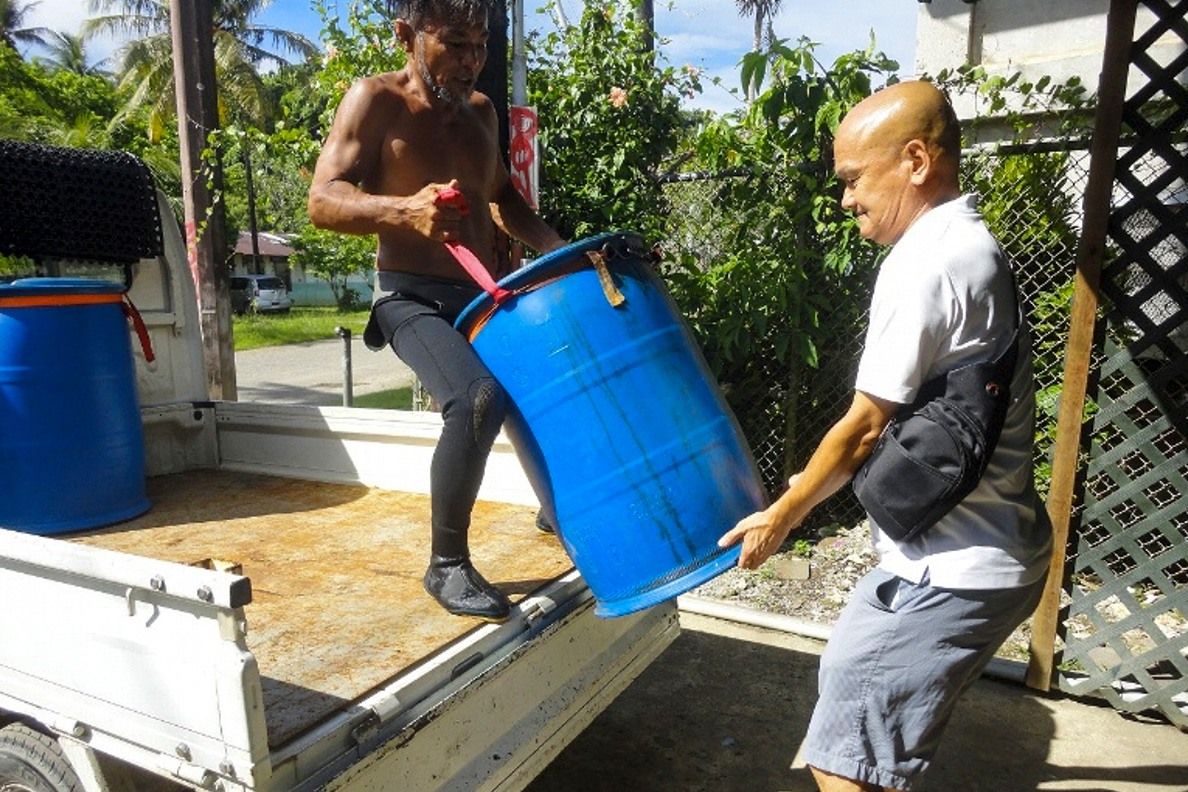
Fukuyama Kazunori, at right, helps unload recovered oil from a wreck. (Courtesy JMAS)
“The Shinkoku Maru should have no oil left on board, but there is still a leak somewhere, and nobody really knows exactly how much fuel is still left in each ship,” Fukuyama says. “We are working with best estimates.”
“Doing as Much as We Can”
JMAS divers—former members of the Japanese Self-Defense Forces—built the equipment that is being used to bring the oil to the surface, utilizing a diaphragm pump powered by compressed air from a dive cylinder. This is placed inside an oil tank, or directly into conglomerations of fuel that have built up in pockets in the upturned ships.
Using an electric pump is out of the question, Fukuyama notes, due to the risk of causing an explosion. Back at the JMAS facility, the oil is transferred to larger barrels to await disposal.
“We are doing what we can right now with limited resources,” says Fukuyama, who served as a warrant officer in the Ground Self-Defense Force until his retirement at the age of 60.
“What we are doing will not resolve all the problems that exist here, because if they really want to recover all the oil, that will cost billions of yen and require much larger pumps and tanks,” he says. “But we are doing as much as we can with what we have.”
Time is of the essence, agree local experts, who warn that the state and a vast swath of the central Pacific are at growing risk of an environmental catastrophe should the oil tanks rupture in one or more of the vessels in the lagoon.
Given the inevitability of the sunken ships continuing to degrade and break apart, the experts are warning that steps need to be taken immediately to avoid the worst-case scenario of more than 100 million liters of heavy fuel oil and diesel being spilled into the largely pristine waters of the lagoon.
Staving Off a Regional Crisis
“The environmental impact of a major leak would be disastrous,” says Peter Aten, head of the historic preservation office of the Chuuk State Government.
“The first reported leak from one of the ships was in 2007, and since then we have been trying to monitor other leaks,” he says. “We have asked the international community for help because this is a daunting task.
“This is a question of the livelihood of the people of Chuuk, as we depend so heavily on fish as food as well as the main source of income for the state,” he goes on.
“If the worst happens, then it will be a humanitarian disaster because the results of a major leak would be felt for years. It would take that long for fish stocks to recover.”
It would not solely be a crisis for Chuuk, he adds, with major oil leaks inevitably impacting Pacific states as far away as Guam and Papua New Guinea.
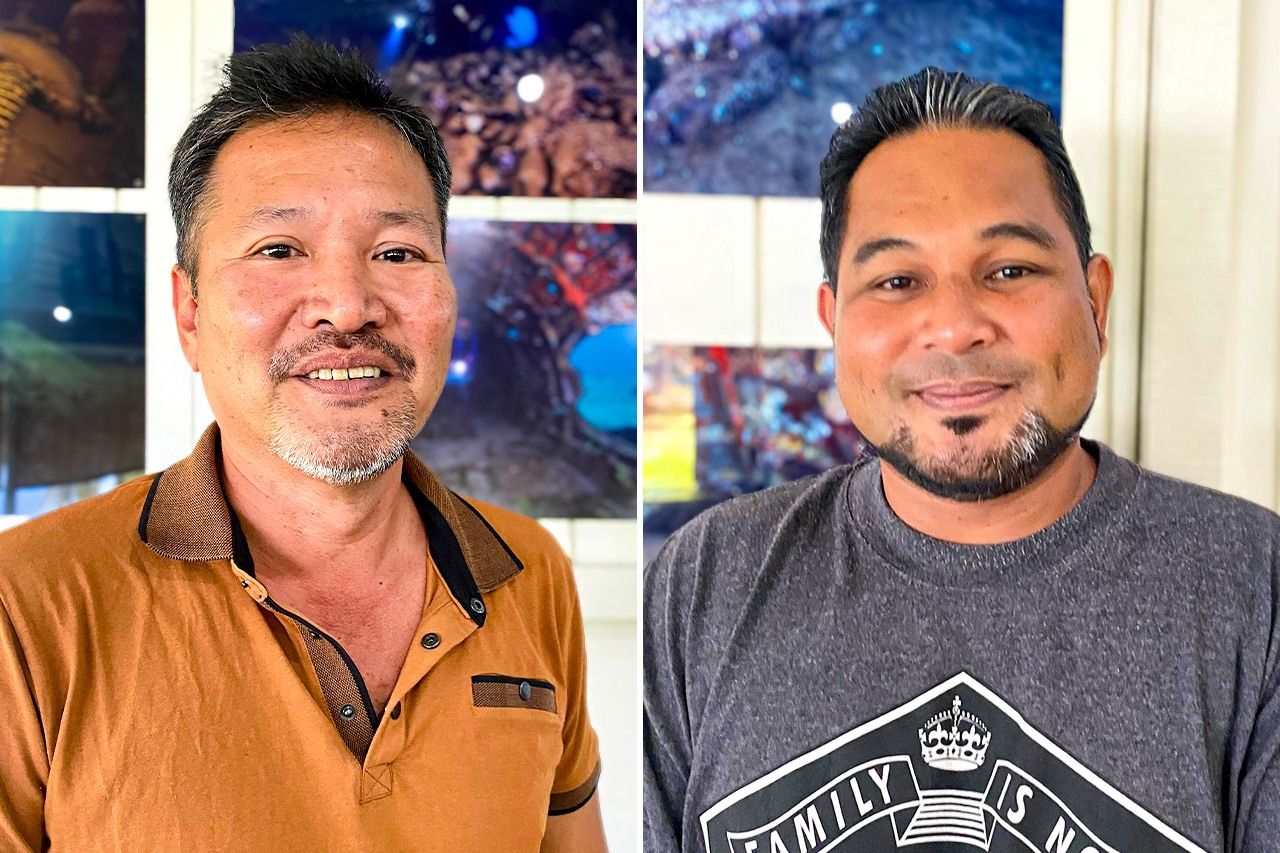
Chuuk historical preservation officer Peter Aten (left) and Chuuk Environmental Agency head Bradford Mori are deeply involved with oil recovery work and awareness campaigns. (© Julian Ryall)
Aten’s department is charged with identifying new leaks from the wrecks and helping to devise mitigation plans should a major leak occur, possibly as a result of a ship corroding to the point that oil escapes or after a major storm or powerful tides shift a vessel on the seabed.
An added concern is that the fuel in the ships still in the lagoon is the heavy oil that was commonly used in the 1940s, rather than the refined, lighter fuels that are typically used today. Tests have shown that while some spills have washed up on nearby beaches, an estimated 50% sinks to the seabed—“like a blanket,” Aten says—where it coats coral and other marine life.
An Eye on the Broader Ocean
Bradford Mori is executive director of the Chuuk Environmental Agency, the focal point for building international support for the campaign to remove the oil, and he shares Aten’s concerns.
“For us, this is a threat to the health and well-being of every community in the state,” he says. “The people of Chuuk rely on the marine ecosystem for their food and livelihoods, and we have received messages of concern from some of the remote islands about the safety of the ships. We urgently need action to make sure they are safe.”
One of the vessels that has been the focus of concern is the Hōyō Maru, an 8,691-ton tanker that was hit close to the bow by a torpedo, broke in two, and sank a few hundred meter off the northeast coast of Fefen island. Oil from the ship has washed ashore after strong storms and high waves, with local residents finding layers of oil as much as 7 centimeters deep on the shoreline in 2007.
Fifteen ships have been identified as priority targets for efforts to pump oil out of their tanks or from barrels that were stored in their holds, Mori says.
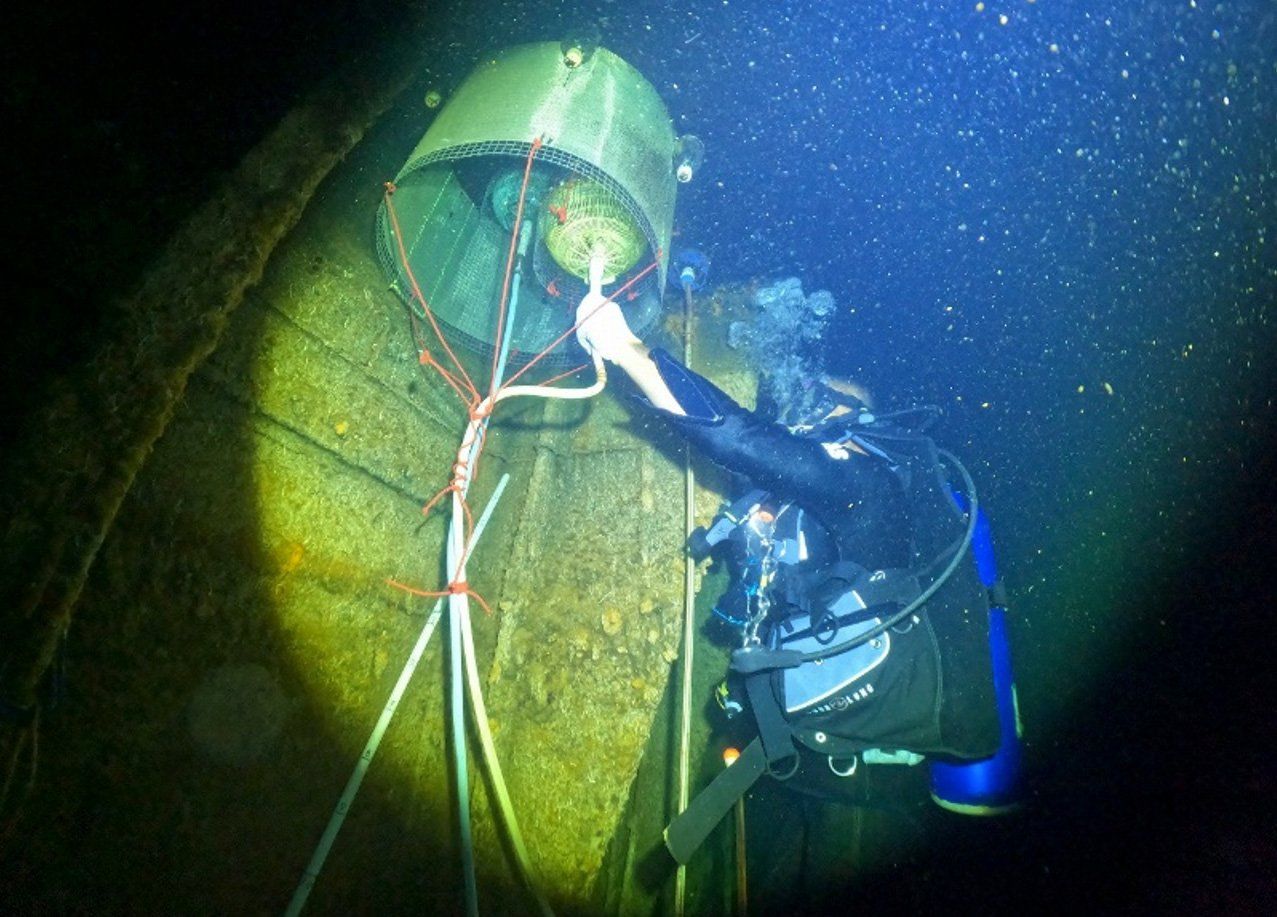
A diver sets up equipment to collect oil from a pocket inside a sunken ship. (Courtesy JMAS)
“These are the fifteen with the largest amount of fuel still on board, but it would be absolutely devastating if the storage tanks on several of these ruptured at the same time,” he stresses.
“We have a limited capacity to respond to that situation, and it would pose a major challenge,” he adds. Chuuk has been given some booms to be deployed in the event of a release and is hoping to receive more in the coming months.
Needed: An International Response
For the equipment it needs, Chuuk is in the hands of its international partners—primarily Japan, the United States, and Australia—although there is concern that the present administration in Washington may no longer be as financially supportive as previous governments as it seeks additional ways to reduce spending.
On August 27, 2024, then US Deputy Secretary of State Kurt Campbell and Kōmura Masahiro, Japan’s vice-minister for foreign affairs, met on the margins of the fifty-third meeting of leaders of the Pacific Islands Forum in Tonga and released a joint statement directly addressing the danger posed by the oil.
In the statement, the US side congratulated Japan’s efforts to date to remove oil from the ships, adding that the United States was looking forward “to working further to explore the possibility of a joint collaboration.”
The statement stressed: “As President [Joe] Biden and Prime Minister Kishida [Fumio] announced during the prime minister’s visit to Washington in April, the United States and Japan are celebrating a new era of strategic cooperation. These efforts are a testament to the benefit the US-Japan Alliance brings to the people in the Pacific and the world.”
Under an agreement with the Americans, oil recovered from some of the wrecks is due to be shipped off Chuuk in the coming months before being treated and safely disposed of. Officials declined to comment, though, on whether they believe that agreement will remain in place over the longer term.
The Australia-based Major Projects Foundation carried out an extensive study on the situation in the lagoon in February, and a report is due this year. Peter Aten says he hopes the results of that survey will “help to convince the world to help us.”
Aten agrees that the cost of the clean-up will be high—but insists that the cost of doing nothing will be far higher.
“Nobody seems to want to accept responsibility for doing the work,” he says. “We understand that it will be costly and will take a long time, but someone has to take that responsibility.
“We hope that the world will help us because the local people did not ask for these ships to be sunk here or for the war to come here,” he states. “This was literally dumped in our ocean, and the people here now depend on that ocean for their survival. We hope that the politics can be put to one side and that we can get help to do what must be done.”
(Originally published in English. Banner photo: The stunning waters of Micronesia lie above wartime wrecks that threaten to pollute them unless more is done. © Julian Ryall.)