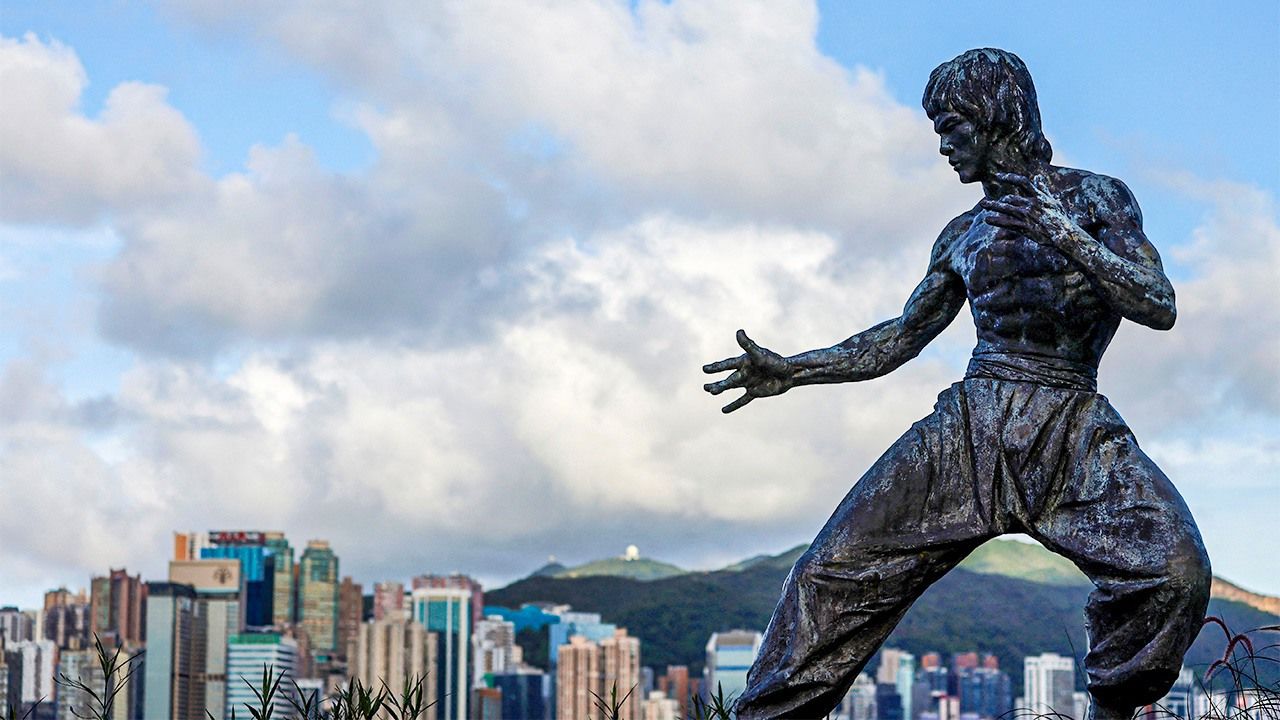
Embracing the Dragon: Japan’s Enduring Love of Bruce Lee
Culture Entertainment- English
- 日本語
- 简体字
- 繁體字
- Français
- Español
- العربية
- Русский
A New Power
I first encountered Bruce Lee when I was in the third grade. It was 1974 and my father took me to the cinema to see The Big Boss. I was transfixed as Lee defeated one foe after another, armed with nothing more than his own fists and graceful, lightning-fast kicks. He presented a completely new kind of hero, one that had no need for a gun or mask. His power was like nothing I had ever seen, and it blew me away.
This excitement was shared among my fellow moviegoers. Long lines formed outside the theater, while inside the corridors swarmed with people mimicking Lee’s punches, kicks, and high-pitched yells as if transformed into martial art masters.
Lee’s onscreen footwork was stunning to behold, combining the beauty of ballet with the power of martial arts. The speed and precision which he wielded nunchakus was equally mind-boggling to Japanese viewers, sparking a massive boom in the martial art weapon.
Lean and sculpted, Lee stood apart from the robust Hollywood action stars of the day. Japanese viewers could only wonder at the brawny figures of the likes of Charles Bronson, Kirk Douglas, and Charlton Heston. But Lee’s chiseled physique rewrote the script by displaying the power of the Asian body. His muscles were his calling card as a martial artist, and with his strength and fighting prowess, he made quick work of even the toughest Western foes. He was nothing short of revolutionary, and his appearance awakened in Japanese fans a newfound confidence.
The passion Japanese felt for Lee was made all the more intense by the fact that his most emblematic films were not released in Japan until after his death in 1973, robbing fans of the pleasure of knowing him at his prime on the silver screen.
Fading Memories
The year 2025 marked the eighty-fifth anniversary of Lee’s birth and there were a host of events in the lead up to commemorate the actor. For instance, the Hong Kong Heritage Museum and the US-based Bruce Lee Foundation teamed up for an exhibition titled “A Man Beyond the Ordinary: Bruce Lee” that drew fans of all stripes. Then there were the Hong Kong action films Twilight of the Warriors: Walled In and Stuntman, both of which paid tribute to Lee by including scenes featuring posters of the martial artist. While these demonstrate Lee’s ongoing influence, there is no denying that his legacy in Hong Kong, where he climbed to fame, is slowly waning.
The home where Lee lived with his family before he died, the Crane’s Nest, is now gone, having at one point been turned into a love hotel before being demolished in 2019. The Red Pepper Restaurant that featured in Game of Death is also gone, having closed its door at the end of 2020 due to the pandemic. Then in July 2025, the fan organization Bruce Lee Club was forced to shutter its archives for an unspecified period due to operating costs. Perhaps most telling, though, is Lee’s statue on Hong Kong’s Avenue of Stars. Overlooking Victoria Harbor, today it mainly visited by Japanese tourists and other oversea visitors to the city.
The situation is even more worrying outside of Hong Kong. There are hardly any theaters in Europe, the United States, and many parts of Asia left that show his films with any regularity, depriving moviegoers of the distinct experience of seeing him on the big screen. Japan is one of the few outliers. There remains a number of cinemas that show Lee’s films each year around the anniversary of his birth, and the publishing industry releases a steady stream of books and magazines dedicated to him. The sheer number and variety of special issue and collector magazines about Lee published in Japan stands out, and fans in the country are purported to have amassed the greatest number of Lee’s personal items anywhere.
A Knowledge of Japanese Martial Arts
What is behind Japan’s infatuation with Lee, then? Looking at the actor’s connection to the country helps shed light on the phenomenon.
Lee summed up his philosophy in the famous saying “Be water, my friend.” While the roots of the idea are Confucian in origin, with the characteristic of water to shape itself to whatever vessel it is poured into being a metaphor for the human ability to adapt to circumstances, Lee’s meaning is grounded in the fluidity espoused by legendary Japanese swordsman Miyamoto Musashi in his work The Book of Five Rings. Lee’s words reflect a more positive and proactive interpretation, calling on people to not give into their surroundings, but shift and change as needed to overcome them.”
Interestingly, Lee’s phrase gained new attention during the 2019 Hong Kong pro-democracy movement. Organizers had learned from the Umbrella Movement in 2014 that large groups of protesters could be easily rounded up by authorities and so called on activists to “Be Water” in adopting a more fluid approach. While not directly inspired by Lee’s quote, international media outlets were quick to draw parallels.
Lee developed a deep interest in philosophy while studying at the University of Washington and pored through all variety of martial arts books as he forged his own fighting style. It was during this period that he encountered The Book of Five Rings, which remained part of his personal library. He also studied jūdō and had an affinity for samurai dramas like Kurosawa Akira’s Sanjurō.
Another of Lee’s famous sayings is “The art of fighting without fighting” from the iconic boat scene in his masterpiece Enter the Dragon. Lee utters the line to an arrogant martial artist trying to pick a fight with him before luring his would-be adversary onto a dinghy that he then sets adrift, therefore avoiding a clash. The idea echoes the teachings of the ancient Chinese military strategist Sun Tzu, but the episode bears strikingly similarities to a Japanese legend about the sword master Tsukahara Bokuden. In the tale, Tsukahara is challenged to a duel while aboard a river ferry. At a sandbar, he allows his foe to step off the boat before pushing the craft away with a pole, stranding his agitator and delivering defeat without unsheathing his sword.
There is no telling if Lee knew of this story, but the scene resonated with Japanese audiences, who would have recognized the similarity. In other ways, too, Enter the Dragon expresses Lee’s distinct philosophical blend of Chinese thought and the spirit of Japanese bushidō, and this as much as Lee’s skill as a martial artist is what struck a chord with viewers in Japan.
This is in no way to suggest that Lee was enamored of Japan, though. In fact, his second major film, Fist of Fury, is set during the Japanese occupation of Shanghai and features openly anti-Japanese and pro-Chinese sentiments. In the film, Lee takes on the villainous Japanese oppressors, who attack his martial arts school and poison his master. In one iconic scene, Lee’s character approaches a park but is stopped by a guard who points out a sign reading, “No Chinese or dogs allowed.” When a passing group of Japanese mocks him, he unleashes his rage on his tormentors before shattering the sign with a powerful kick.
Despite its negative portrayal of Japanese, Fist of Fury was a huge hit in Japan. Fans were bowled over by Lee’s compelling performance and his incredible martial arts skills. Even today, the work stands as a testament to Lee’s broad allure for audiences.
Outsider Appeal
Lee was treated as an outsider wherever he went. Even as he rose to global stardom during the three years he was based in Hong Kong, the denizens of the city never fully embraced him as one of their own, seeing him more as an American than Chinese. He was perpetually snubbed in popularity polls in magazines, and his only major film award was a special jury prize at Taiwan’s Golden Horse Film Festival. In his native United States, as well, he faced discrimination for his Asian heritage. Even in traditional martial arts circles he was heavily criticized by many for teaching kung fu to non-Chinese.
At the same time, Lee transcended any one cultural identity. He spoke Cantonese and English fluently, and his mixed Asian and European ancestry gave his features an introspective calm on screen that contrasted the intensity of his martial art. Although a place he could truly call home eluded him, it was this lack of a clear national identity that infused his films with artistry that transcended borders and ethnicity.
Lee’s rise coincided with Japan reaching the pinnacle of its postwar “economic miracle.” Although the country was reengaging with the international community, many Japanese still harbored a sense of inferiority toward the West, and in many ways Lee symbolized to Japanese someone who had overcome this conflicted mindset. While a Chinese American star with international appeal, his ideas and philosophies also resonated deeply with the Japanese psyche. This dichotomy is a central aspect of Lee’s appeal and why he remains a beloved figure in Japan today.
Timeline of Bruce Lee’s Life
1940 Born in San Francisco while his father was working a theatrical project in the United States
1941 Family returns to Hong Kong
1948 Makes his debut as a child actor
1955 Starts training in Wing Chun (some sources say 1953)
1959 Returns to San Francisco to claim US citizenship
1961 Enters the University of Washington (later dropped out)
1962 Opens his first martial arts school in Seattle
1967 Opens a school in Los Angeles; introduces Jeet Kune Do
1970 Closes his schools in Seattle, Oakland, and Los Angeles
1971 Returns to Hong Kong; releases his first major film, The Big Boss, worldwide
1972 Fist of Fury and The Way of the Dragon released
1973 Dies on July 20; Enter the Dragon released
1974 Films released in quick succession in Japan, sparking a boom
1978 Final film, Game of Death, completed and released worldwide, sparking a second boom in Japan
1993 Biographical film Dragon: The Bruce Lee Story becomes a global hit, triggering a third boom
Created by Nippon.com based on data from Chow Sin’ichee.
(Originally published in Japanese. Banner photo: The bronze statue of Bruce Lee on Hong Kong’s Avenue of Stars. © Reuters/Tyrone Siu.)