Japan’s Women Golfers Taking On the World
Sports- English
- 日本語
- 简体字
- 繁體字
- Français
- Español
- العربية
- Русский
A Record LPGA Tour Season for Japan
The US Ladies Professional Golf Association Tour gathers the best women golfers from around the world. In 2025, four from Japan made their tour debut: Takeda Rio, Yamashita Miyū, and the Iwai twins, Akie and Chisato. Each one ended up with a victory. Along with Saigō Mao, who was in her second year on the tour, Japan reached five LPGA wins in total.
That is the most ever for Japan, beating three each in 2019 (for Hatanaka Nasa, Shibuno Hinako, and Suzuki Ai) and in 2024, when victories went to Sasō Yūka, Furue Ayaka, and Takeda Rio (who won an LGPA-sanctioned event held in Japan in the year before her American debut). As of October 4, five wins ties Japan with South Korea for first place in the international rankings. Two of Japan’s five victories were in major tournaments and four of its winners were making their tour debuts, showing that Japan is making enormous waves on the international stage.
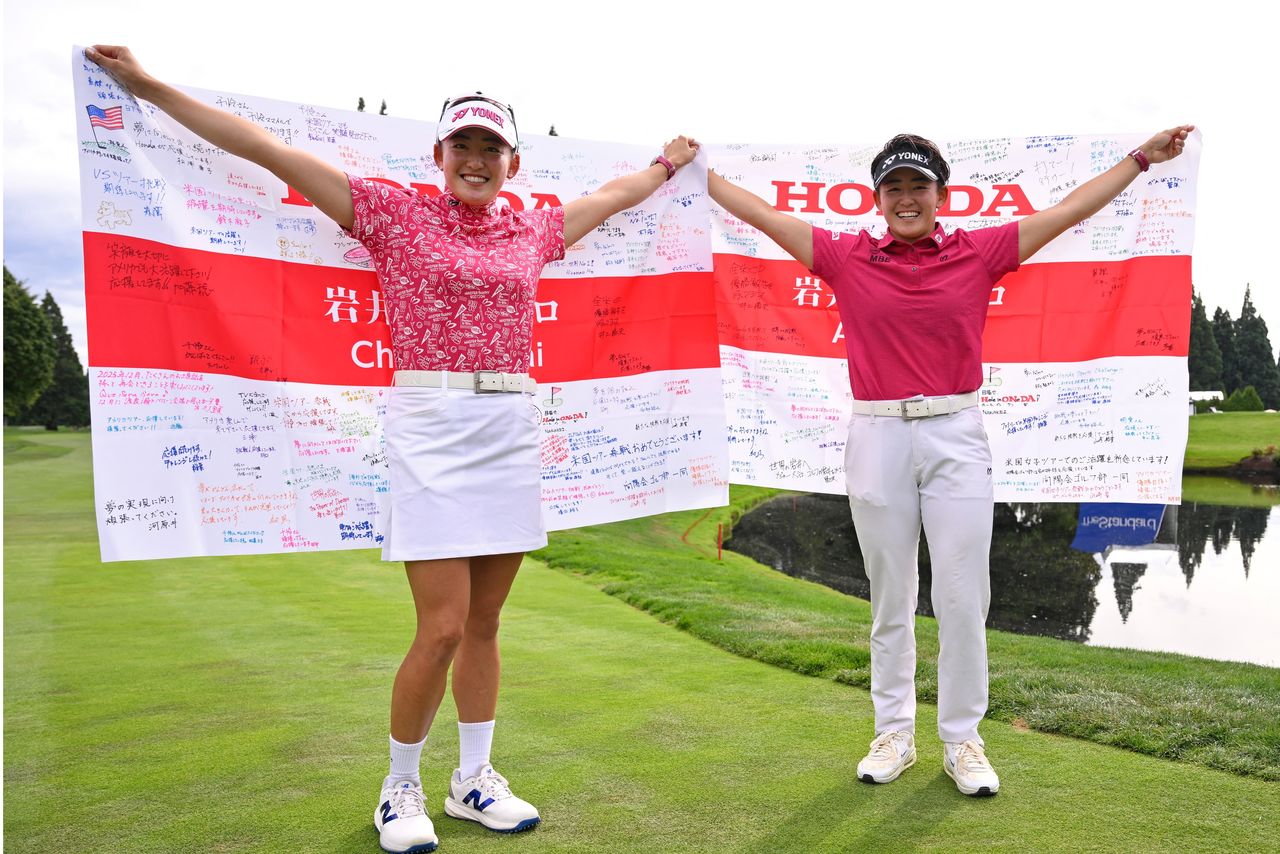
Portland Classic champion Iwai Akie (right) poses with her twin sister Chisato on August 17, 2025, in Portland, Oregon. (© AFP/Jiji)
Japan’s women are also performing strongly at the world’s five biggest majors, with Saigō’s championship win at Chevron and Yamashita taking the top at the British Open, alongside Sasō’s win at the US Women’s Open and Furue taking the Evian Championship in 2024. The Japan team has won 4 of the 10 major championships over the past two years, which marks a huge change for the national record, as well as a major lead over Australia’s two wins in the same period.
Shibuno’s 2019 Win Kicks Off a New Era
In a broad sense, we can trace Japan’s women’s golfers performing at the top of the global boards back to five reasons.
The first is simply that more golfers have been joining the LPGA tour. This season, there are 13 Japanese women taking their shot. On the course they may be rivals, but there is enormous benefit to being able to share information in Japanese.
Australian Karrie Webb, the only woman who has ever won all five of the majors, visited Japan in August this year. When talking about the Japanese team’s success, she talked about the importance of having teammates who challenge you and create synergy. With Hara Erika dominating the LPGA developmental tour this year, it seems likely that next season will see at least one more Japanese golfer adding her talents and keeping Japan’s momentum going.
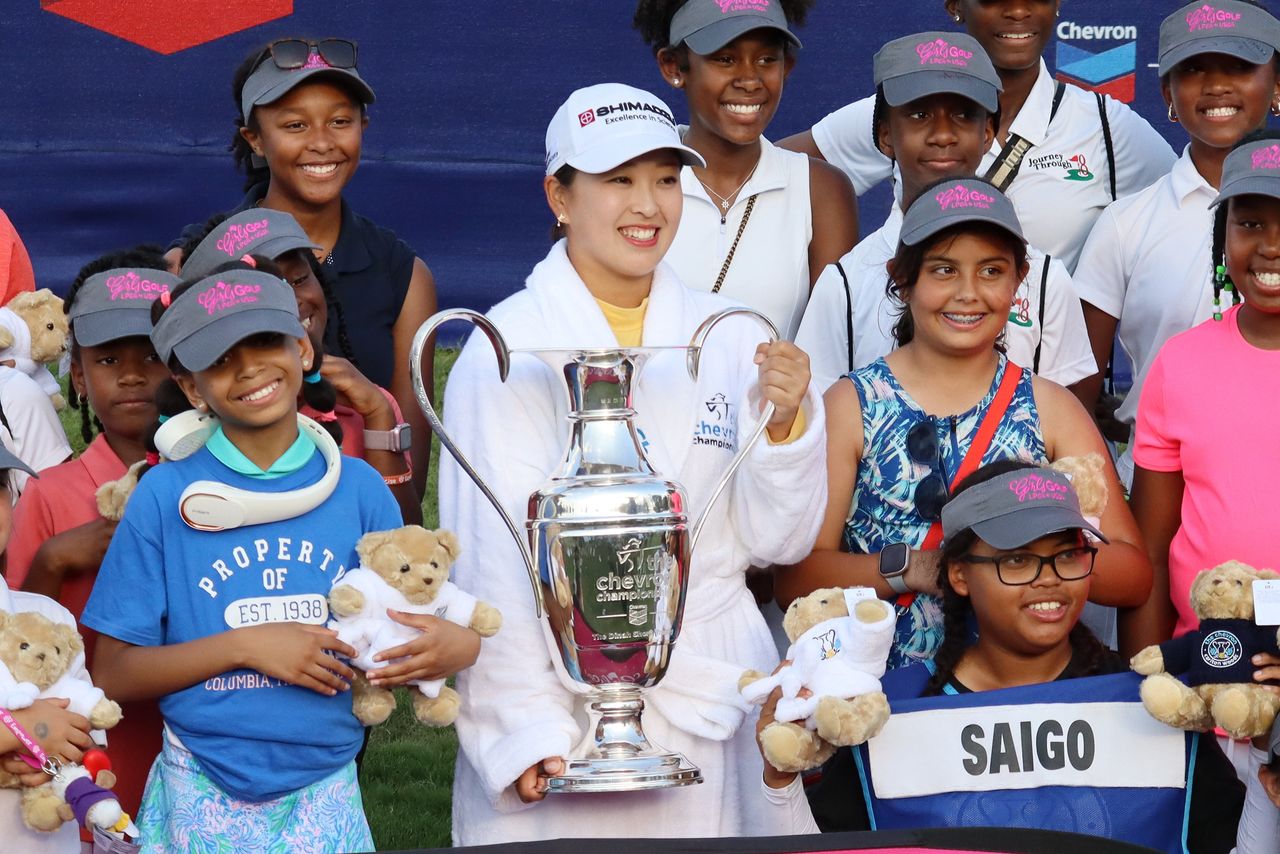
Saigō Mao posing with children after winning the Chevron Championship on April 27, 2025 in Woodlands, Texas. (© Jiji)
The second reason is probably Shibuno Hinako’s 2019 British Open victory. It was the first majors win for a Japanese golfer in 42 years, since Higuchi Hisako in 1977. Shattering that wall encouraged other Japanese women to believe they could do it, too.
In 2021, Sasō Yūka won the US Women’s Open, and in 2022, Baba Saki took the pinnacle of the women’s amateur golf world, the US Women’s Amateur Championship. The mental barriers to shooting for the big titles kept coming lower.
Better Domestic Tours Mean a Better National Team
The third reason is the influence of major changes in the Japan Ladies Professional Golfers’ Association. Following the lead of the US LPGA tour, from 2013 the Japanese tour has increased the number of four-day tournaments. It has also raised the general difficulty level by adjusting course settings like pin placement, green speed, distance, fairway width, and the length of grass in the rough. The resulting harder regular battles through 37 matches have undeniably done a lot to raise the general skill level of golfers on the tour.
The fourth reason I would offer is the trend toward golfers with rich experience of competing on the national team. Currently, many of the women playing at the top of the Japanese and US tours were members of the Japan Golf Association’s national team in their amateur years. They learned scientific training and management methods under head coach Gareth Jones and his staff. Those members have also played in many international tournaments, building experience and strong win/loss records on the global stage from their high school years onward.
A Boom That Broadened Horizons
Finally, the role of Miyazato Ai cannot be ignored. Miyazato won the JLPGA tour in 2003, when she was just a high school senior and still an amateur. That put an enormous spotlight on women’s golf in Japan.
At the time, the tour was packed with outstanding players: Yokomine Sakura, the same age as Miyazato; Moromizato Shinobu, one year younger; and Ueda Momoko. The JLPGA tour was on the threshold of a huge boom. The currently rising class of women golfers, born in 1998, represent a “golden generation” of players who have grown up looking at women pro golfers as role models, taking up the game and expanding its horizons still more.
Webb and Miyazato were fierce rivals during that heyday. Webb has called Miyazato an inspiration for the current generation and someone who helped build Japanese women’s golfing.
Ai’s father Masaru and Yokomine Sakura’s father Yoshirō are both interesting characters in their own rights, who inspired other fathers to nurture the women golfers of the day. This helped boost wider support for the dreams of young women golfers across Japan.
All five of these factors are linked. To put it on a general timeline, from the Miyazato boom we move on to more Japanese players joining the US tour, which has created a virtuous cycle.
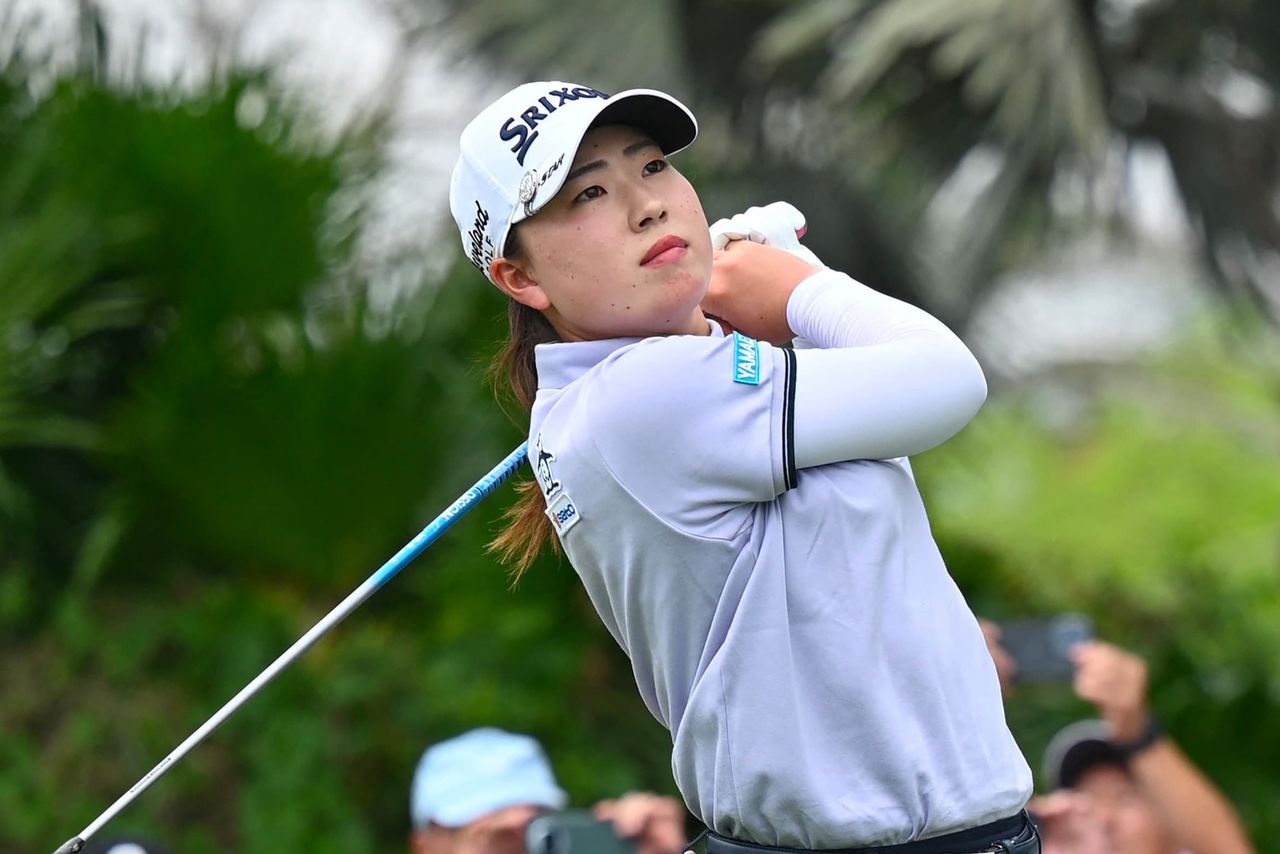
Takeda Rio tees off in the last round of the Blue Bay LPGA Tournament on March 9, 2025 on Hainan Island, China. (© AFP/Jiji)
Vital Family Support
Each player’s family has also played an essential role in this story of Japanese golfers going global.
The parents of British Open victor Yamashita traveled to Britain to watch and support her there. On the second day, her score was at a very good 65, but on the third day she barely managed to keep the lead at 74, leaving her just one stroke ahead of second place overall. That evening, she went out to dinner with her family. It was August 2, which also happened to be her twenty-fourth birthday. The family dinner ended up becoming a birthday party. The family gathering helped Yamashita forget the difficulties of the day and take on the final round with a fresh mental state. In her postwin interview, she tearfully thanked her family, saying, “My family, the people closest to me, have been my biggest support.”
Other players and their families have similar stories. Many players travel with their mothers, who bring rice cookers and get up early to make rice balls and offer other selfless acts of support.
Domestic Environment Key to Maintaining Momentum
External factors also have an impact, such as South Korea’s flagging energy. This season, the South Korean team is matching Japan’s five wins, but that is half what it boasted at its 2017 peak. One reason for that is many players are staying on the lucrative domestic tour, meaning there are far fewer Korean players heading out on the LPGA tour. The cycle of racking up domestic wins on the way to international success has been ruptured.
That is an issue that could hit the JLPGA in the future, as well. Some have expressed worries that star players will all head to the United States and leave the Japanese tour to flounder. For Japan to keep its team strong and preserve the momentum, though, it has to shore up its training environment and make sure nothing stops players from taking on the world.
Soccer offers a good reference. Many are calling Japan’s current national team the best it has ever been as it competes on the magnificent, magnificently tough stage of international tournaments like the World Cup. Most of the national team members play for European clubs during the regular season. But it was the J. League that raised those players and continues to support the national team by promoting youth development at the junior-high and high-school level and helping to train young players as they turn pro.
Past national team coaches and presidents of the Japan Football Association have all agreed, “The national team exists because the J. League exists.” It is domestic league play that has equipped Japanese players to make the leap to European clubs. It is an accepted truth in soccer that a stronger domestic league for a country directly leads to a stronger national team.
That holds true for golf, as well. Japanese golfers on the JLPGA tour build their skills and popularity here, then move on to the main battleground of the US LPGA tour, giving birth to generation after generation of heroines.
In Japan men’s golf, Matsuyama Hideki is the sole player on the world stage, and he has no successor in sight. Surely, there must be a connection to the slump in the men’s Japan Golf Tour. But the evolution and energy of the JLPGA tour is empowering Japan’s women golfers to shine on the global stage.
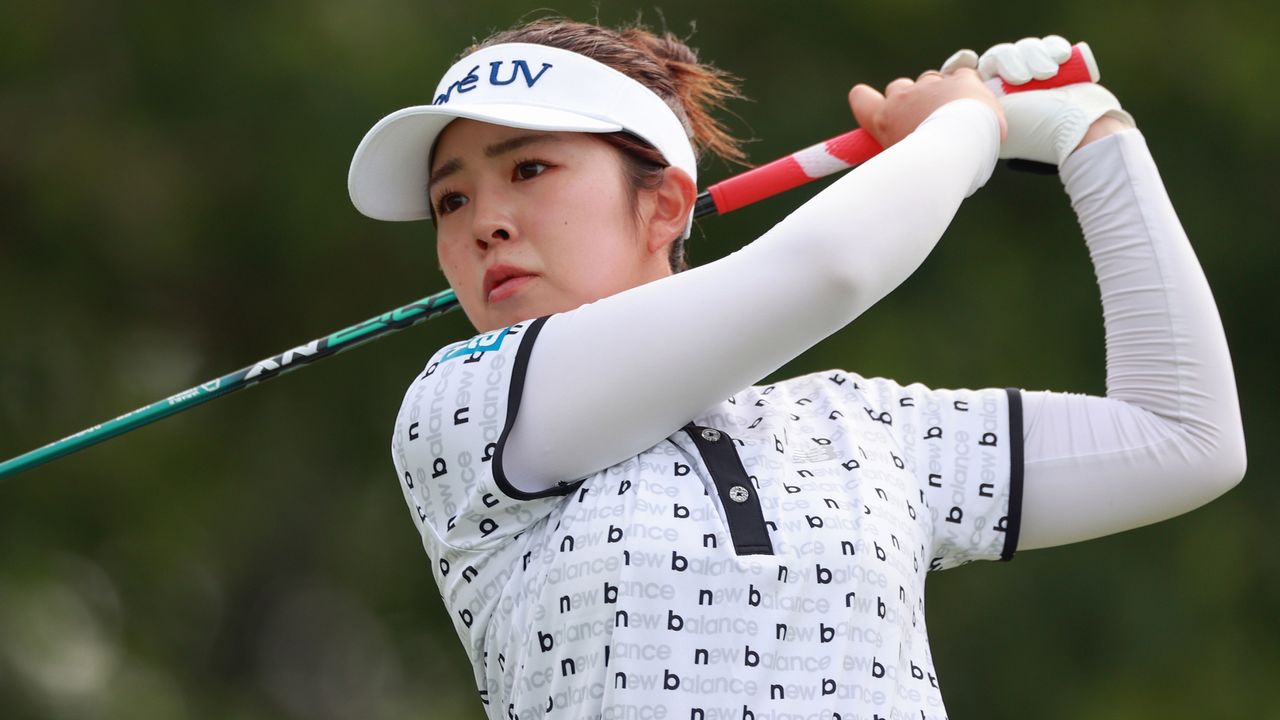
(Originally published in Japanese. Banner photo: Yamashita Miyū competing in the Meijer LPGA Classic in Michigan, on June 12, 2025. © Amy Lemus/Reuters.)