
How Japan’s Surprise Megahit “Kokuhō” Became a Record Breaker
Culture Entertainment- English
- 日本語
- 简体字
- 繁體字
- Français
- Español
- العربية
- Русский
Lifelong Rivalry
The movie Kokuhō is shattering Japanese entertainment records. Film distributor Tōhō reports that in the 172 days between its June 6 release and November 24, it earned over ¥17.38 billion, officially surpassing the previous record of ¥17.35 billion, set by 2003’s Bayside Shakedown 2.
The record was going to be broken one day, but the fact that a film like Kokuhō did it has been a real surprise. Its setting in the rarefied world of kabuki and length of approaching three hours seemed sure to hold it back at the box office, and no one would have predicted it becoming the huge hit it did. But the massive success of a production made in defiance of those risks has brought a fresh sense of hope to Japan’s film industry.
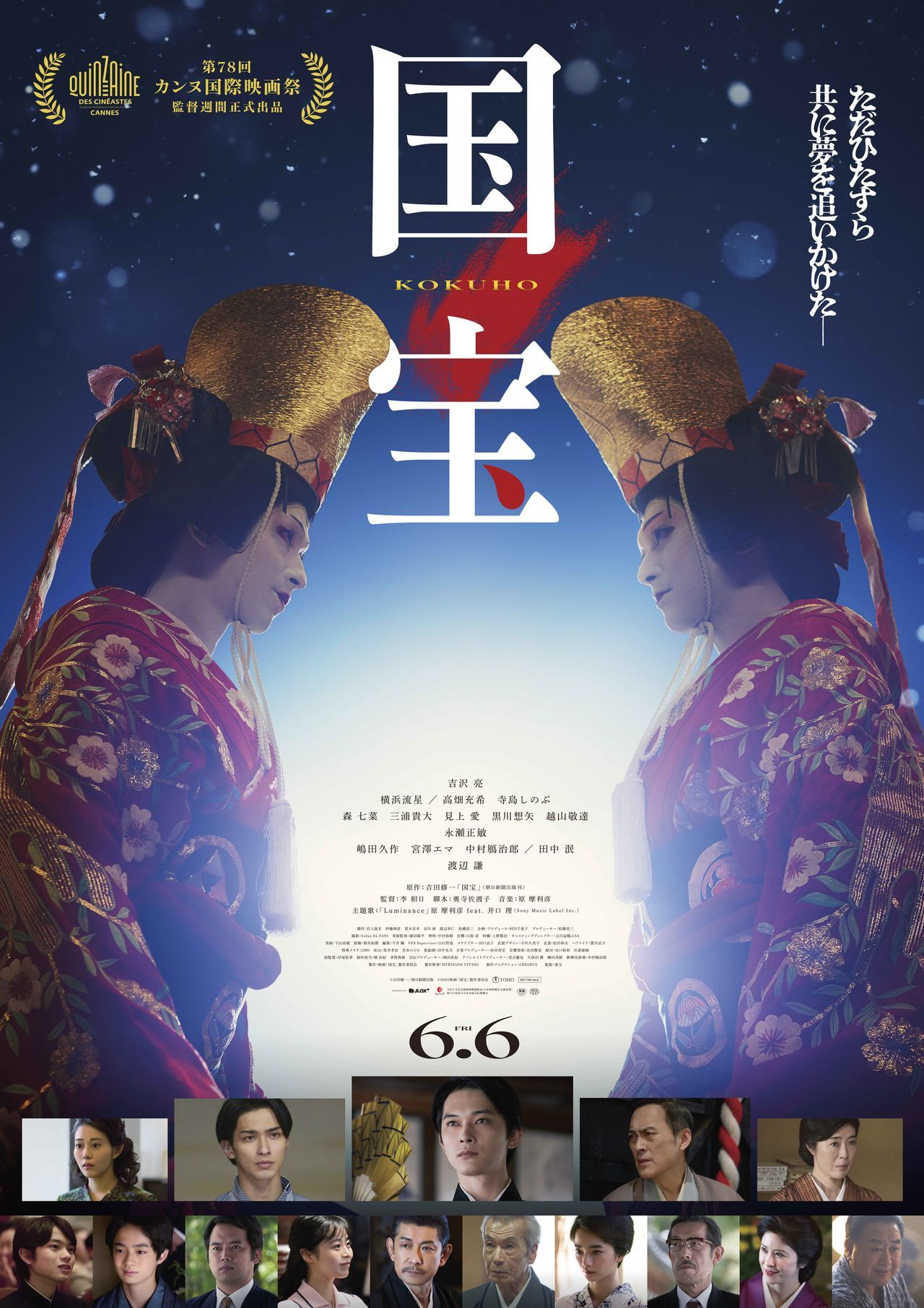
Let us begin with a short introduction to Kokuhō itself. It is based on a novel of the same name by Yoshida Shūichi, published in 2018 in two volumes. The kokuhō of the title means a “national treasure”; the greatest kabuki performers are formally recognized and revered as living national treasures.
The story begins in the 1960s. One of the protagonists is Kikuo, son of a yakuza. After his father is killed in a gang dispute, he is taken in by kabuki actor Hanai Hanjirō, who sees talent in the boy. Kikuo joins Hanjirō’s son and successor, Shunsuke, in a strict training regimen, and the two begin years of rivalry both in art and in popularity, as they rise to the pinnacle of their profession.
Bloodlines remain a powerful part of the kabuki world. Sons born into a kabuki acting family are trained in the art from a young age and expected to carry on the name of their father or relative. On the other hand, there are hardly any examples of anyone entering kabuki and inheriting a major name, or daimyōseki, from outside such a bloodline.
The traditional performing art of kabuki is filled with fixed styles and conventions. Mastering their performance takes endless hours of training, from basic movements through performance, and even physical conditioning. Distinct styles are passed down and preserved within families. Seen from outside, the world of kabuki can seem a tightly sealed and isolated one.
(© Yoshida Shūichi/Asahi Shimbun Publications; © “Kokuho” Film Partners)
Box Office Risks
The film also deals with this, as Shunsuke is set to be Hanjirō’s successor, but Hanjirō decides eventually to pass his name to Kikuo. Shunsuke turns his back on kabuki in despair, but then Kikuo is received with cold inhospitality as an outsider, so Shunsuke is called back. That, in turn, drives Kikuo from the stage. The film depicts this cycle of rising and falling fortune between Kikuo and Shunsuke alongside magnificent kabuki production and propulsive pacing. At its heart, though, is the question of which is more important in traditional performance: art or blood?
In the end, the film has proved a massive hit, but it took years from planning to production. The major issues were funding the significant production budget, and ensuring the work had the appeal and marketability to recover that money.
Japanese filmmaking once had a genre called geidōmono, or “performing stories,” set in the world of traditional performing arts like kabuki or rakugo storytelling, that grew popular for depicting behind-the-scenes drama or harsh training involved. However, such stories have all but disappeared since the 1970s. Even though kabuki is an art that every Japanese knows and performances have a stable fan base, it is a somewhat limited one that does not tend to overlap with filmgoers.
The runtime of almost three hours is also a hard sell to audiences and limits showings at cinemas. Although the domestic film business is seeing solid recovery after the devastation of the pandemic, the heart of the industry is now anime. Live-action hits are mostly seen in tie-ins to popular television series or genre films based on manga.
But here is a work depicting the unfamiliar world of kabuki with two men as the leads. It also needed a huge production budget to recreate the magnificence of the kabuki stage. And director Lee Sang-il is not exactly known as a major hit-maker, despite a record of highly regarded work like Unforgiven and Rage. No matter how you looked at it, the risks were significant, and one investor after another hesitated to say yes at first, including Japan’s biggest production company and eventual distributor, Tōhō.
International Ambitions
Myriagon Studio, the primary production company, is a subsidiary of Sony Music Group member Aniplex, which has made various anime hits like Demon Slayer. This is the company’s first live-action production.
The way Japan’s film industry works is that companies often start by setting a budget and exploring possible productions within that, rather than taking a script and figuring the production costs from there. The process tends to lead to compromises and resigned acceptance of limitations in the final product.
This time, though, Myriagon producer Murata Chieko sought to achieve director Li’s vision without compromise. The script was carefully crafted, with international ambitions baked in from the start. The goal was a world premier at the Cannes film festival in May of 2025.
The budget was set at ¥1.2 billion, including government subsidies. That is a significant sum for a Japanese film, particularly one without any extravagant CG action scenes.
After considerable preparation time, filming began on sets jam-packed with artistry. The actors Yoshizawa Ryō (Kikuo) and Yokohama Ryūsei (Shunsuke) both lacked any particular knowledge or skill in kabuki beforehand, so they started intensive training over a year before filming started. The work paid off, as they were able to perform scenes from actual kabuki pieces with the skill and presence of seasoned kabuki actors.
Outstanding Camera Work
The production built a massive theater set for the performance scenes, with designs and audience clothing that were changed to match the period of each scene. Tunisian Sofian El Fani, of Blue is the Warmest Colour fame, led the shooting as director of photography, bringing a fresh perspective on a traditional art.
His most notable innovation was bringing the camera onstage to show the audience over the performers’ shoulders. Film production usually uses the camera as a stand-in for the audience, taking the viewers’ perspective. But El Fani got on stage to record the action using a hand-held camera. This brought the actors in close, showing the tracks of sweat and their controlled breathing, as well as filming the audience watching the show. This is something impossible to experience at a real kabuki performance and shared a deeper sense of the art’s true beauty.
Screenwriter Okudera Satoko handled the script. She skillfully condensed the massive story to its most essential elements, bringing director Lee’s vision of the two protagonists’ dramatic fates to the screen without a sense of dragging. Lee is a third-generation Zainichi Korean, born and raised in Japan, but has spoken to the Korean media about how Kikuo coming from outside into the sealed world of kabuki overlaps with issues of marginalized identity.
Getting Audiences in Seats
The filmmakers succeeded in getting Kokuhō to Cannes, where it premiered during the Directors’ Fortnight held alongside the film festival. Stars Yoshizawa and Yokohama attended, as well as Hanjirō performer Watanabe Ken. That sparked talk of the film back in Japan, where the film opened June 6, just after the film festival’s conclusion.
The movie took in ¥300 million in its opening weekend in Japan, taking third at the box office behind Hollywood hits Lilo & Stitch and Mission Impossible: The Final Reckoning. Stakeholders were relieved by that powerful opening, figuring the movie would eventually earn a respectable ¥2 billion.
But then things went in unexpected directions. Defying common industry knowledge that audience numbers peak opening weekend, the numbers only kept going up for Kokuhō. The second weekend after opening saw attendance rise by 20%, and it continued to climb until the fourth week. In its third week, it took number one at the box office and stayed in the top 10 for 21 weeks in a row. While it slipped out in its twenty-second week, it climbed right back the following week.
The audience was initially dominated by middle-aged and older women, but it soon expanded to men and women of a wide range of ages. Many viewers expressed the desire for a rewatch, and social media was filled with countless posts sharing thoughts and impressions. It became a full-on social phenomenon, and buzz around this new “huge hit” only increased public interest. There are also signs of younger audiences increasing at actual kabuki performances.
Opening New Doors
The enormous success of Kokuhō has brought a breath of fresh air to the rigid world of Japanese film. With 1,200 films released and total revenues of over ¥200 billion a year, Japan has one of the largest film markets in the world, but most filmmakers here think only of recouping their production costs on the domestic market. Commercial films tend to have budgets in the ¥200 to ¥300 million range. Artistic works struggle to get funding, and it is common for them to stay in the super-low budget range, below ¥10 million. Companies thereby tend to play it safe and choose projects with the lowest risk.
Meanwhile, production budgets of ¥2 billion in Hollywood or ¥1 billion in Europe are the norm. It is also common to offer actors long prep periods to work on their roles, and construct massive sets for shooting. While the Kokuhō budget was called “extravagant” in Japan, it only cost ¥1.2 billion.
Many creators have decried this state of affairs, but box office failure can end careers in the business. There are plenty of examples from film history. Now, however, Kokuhō has gone from being a massively risky if meticulously polished project with a huge production budget to become a resounding success. It has been picked to represent Japan in the Best International Feature Film category at the Academy Awards with high hopes that it will make the shortlist
Many feel like the film has opened new doors in terms of subjects, as well. It may help trace a path for the Japanese industry out of its current malaise and offer an opportunity to enter the global market.
(Originally published in Japanese on December 5, 2025. Banner photo: Yoshizawa Ryō (right) congratulating director Lee Sang-il on winning the Kurosawa Akira Award at the thirty-eighth Annual Tokyo International Film Festival. © Laurent Hou/Hans Lucas via Reuters Connect.)