Hoping for Milano Cortina Gold: Japan’s Figure Skating Stars Take Aim at 2026 Winter Olympics
Sports- English
- 日本語
- 简体字
- 繁體字
- Français
- Español
- العربية
- Русский
A Japan Team Promising World-Beating Performances
In the four World Figure Skating Championships since the 2022 Beijing Winter Olympics, Japan has won a total of 14 medals, including Sakamoto Kaori’s 3 straight women’s golds and 2 victories by the pair skating team of Miura Riku and Kihara Ryūichi. Japan has established itself as one of the leading countries in the world of figure skating.
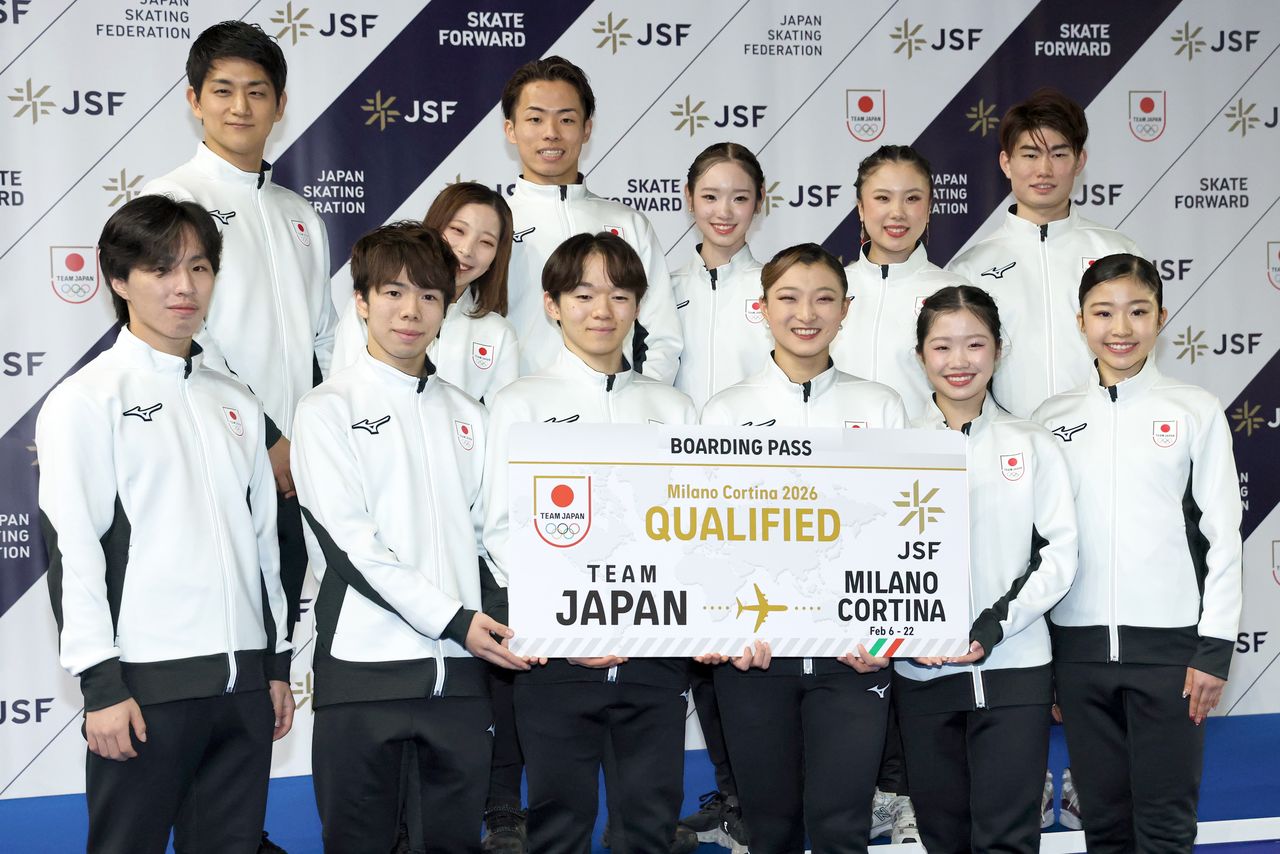
The athletes representing Japan in the upcoming Milano Cortina Olympics pose for a photo at Tokyo’s Yoyogi National Gymnasium on December 21, 2025. Front row from left: men’s skaters Miura Kao, Satō Shun, Kagiyama Yūma; women’s skaters Sakamoto Kaori, Nakai Ami, Chiba Mone. Back row from left: pairs skaters Kihara Ryūichi, Miura Riku, Moriguchi Sumitada, Nagaoka Yuna; ice dancers Yoshida Utana, Morita Masaya. (© Jiji)
Sakamoto: Aiming for Gold or Silver, “No Mistakes”
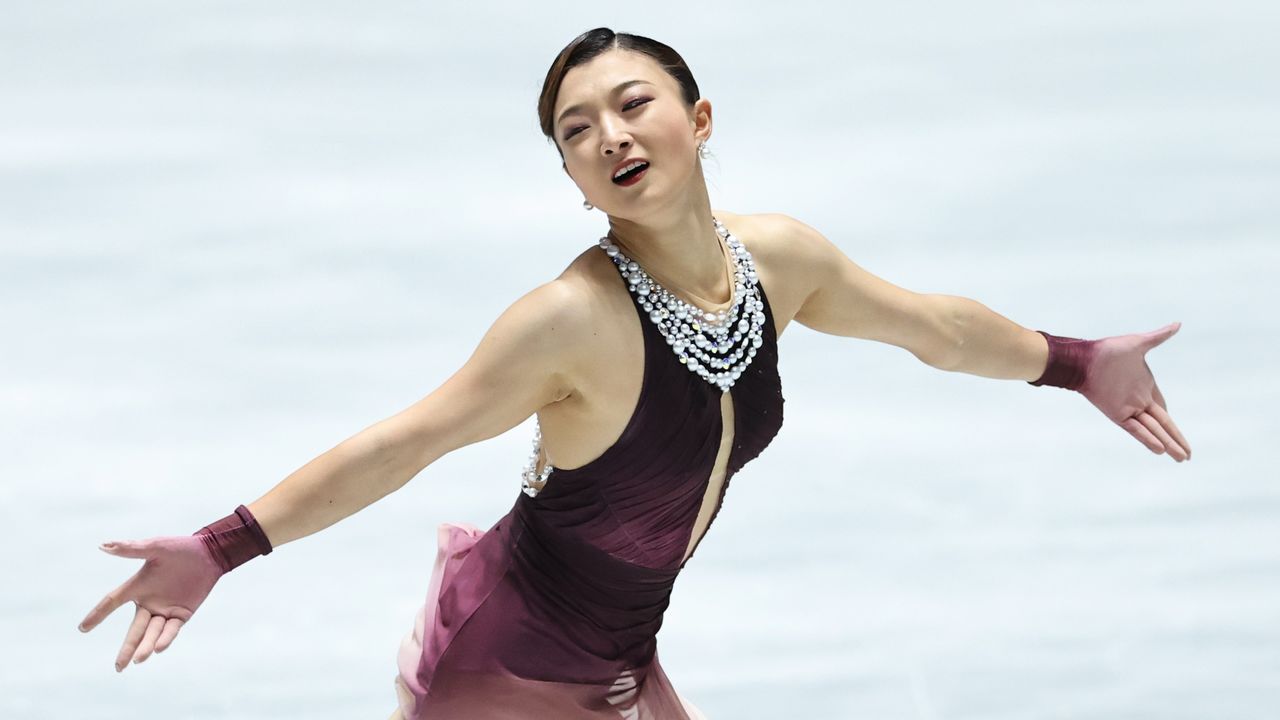
Sakamoto, the women’s ace, has delivered consistent results since taking third place in Beijing, while also experimenting with music from different genres and a range of expressions. With this season confirmed as her last in competition, she has chosen to return to her hallmark style, defined by flowing skating and powerful speed. In Beijing, she scored bronze, and Japan’s team medal was later upgraded to silver. Because of this, she has said that she wants to at least win silver this time, on the spot, both individually and in the team event.
Until just before this season, Sakamoto was practicing the difficult triple Axel. But now she is focused on honing her conventional style. At a time when many skaters depend on ever-harder jumps, Sakamoto holds fast to the advice of her choreographer, Benoît Richaud: even if you can’t do a particular jump, there are ways to get around it. With her scores steadily rising, winning titles has become easier, marking a breakthrough for her to the next level in her skating.
Adeliia Petrosian, a three-time Russian national champion, is expected to compete under a neutral flag at the 2026 Olympics. Petrosian has the quadruple Lutz, quadruple toe loop, and triple Axel at her disposal, all high-difficulty technical elements.
“It’s about how I can maintain my own chances of making it to the podium, even if other athletes are landing big elements,” says Sakamoto. “If I can increase the quality of what I can do and avoid all mistakes, I can put myself in a position to win. I started seeing things this way in the 2023–24 season when I won in all of the competitions, including the World Championships.”
Entering this season later than usual, she finished second at both the Challenger Series event in Japan in September 2025 and the Grand Prix series in France in the following month. However, she described them as “meaningful seconds,” going on to correct her spin errors that had cost her those wins and claiming gold at the November NHK Trophy with 227.18 points, the world’s highest for the season in officially sanctioned competition.
“In the Grand Prix series, I was scoring in the 220s from the start and building momentum from there. Before, it felt like I had to push hard once again, but now it feels like I can just ride this wave,” she says with confidence.
At the Grand Prix Final in December, an unexpected mistake in the short program landed her at third place, but that frustration fueled her performance at the Japan Figure Skating Championships, which she won with a total score of 234.36. Despite a slight error that prevented her from earning higher grades of execution on her triple Lutz, she was able to demonstrate her competitive strength.
At the upcoming Olympics, she will have to face and compete against Petrosian of Russia as well as Alysa Liu of the United States, who returned to competitive skating last season to capture the World Championships title.
Sakamoto has ample experience winning close battles on the biggest figure skating stages. “If I meticulously do everything I need to do, the results will follow,” she says, fully prepared for the fight ahead.
Two more Japanese athletes will take part in women’s singles competition. Nakai Ami made a sensational debut this season, winning the Grand Prix France event with 227.08 points by using the triple Axel, defeating Sakamoto. If she can deliver a performance like that on the Olympic stage, she could contend for a medal. Chiba Mone, whose strength is her consistency, also has the potential to score in the mid-220 range. If she performs to her full ability, she too could have a chance at a medal.
Kagiyama: Self-Conscious as Men’s Ace
Kagiyama Yūma was the top men’s performer among Japanese figure skaters during the Beijing Olympics, taking home silver. The medal carried special value, as he was competing alongside Japanese stars Hanyū Yuzuru and Uno Shōma.
After a left ankle injury, Kagiyama spent the 2022–24 seasons scaling back on highly technical jumps. Instead of focusing on difficult jumps, he emphasized quality—the polish of his overall program.
Meanwhile, overseas rivals like Ilia Malinin of the United States, who is able to land every type of quadruple jump, including the quadruple Axel, have been showing rapid evolution. Despite this tough competitive environment, though, Kagiyama has captured World Championship medals in four straight years since his debut in 2022, demonstrating his high potential. Milano Cortina 2026 will be the moment when the true measure of Japan’s men’s ace is put to the test.
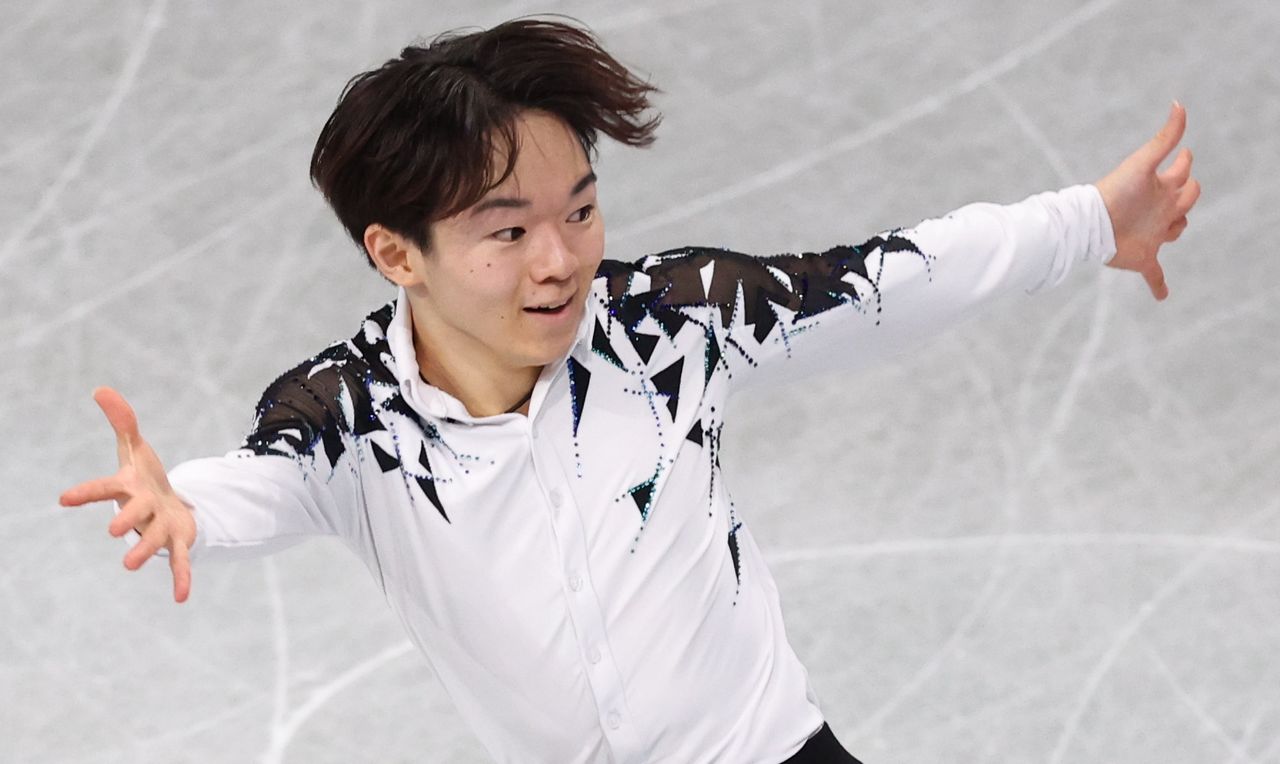
Kagiyama Yūma performing in the men’s short program at the Grand Prix Final on December 4, 2025, at IG Arena, Aichi. (© Jiji)
From the 2024–25 season, after Hanyū and Uno retired, all eyes turned to Kagiyama as the leader of Japan’s men’s figure skating. He began to feel the heavy pressure of fans’ expectations about how Japan’s ace needs to perform.
That pressure was evident at the 2025 World Championships. He finished second in the short program, trailing Malinin by 3.32 points. Then, in the free skate, repeated mistakes on quadruple jumps dropped him to tenth, leaving him third overall with a total score of 278.19. Looking back, he says, “The Japanese aces that I’ve seen were Hanyū and Uno. Each has his own style. For me, staying natural is most important, and I think it’s what makes my performance strong. Being myself and delivering what I’ve worked on is what matters most.”
In the first half of this season, his goal was to strengthen his foundation. In the free skate, he limited his quadruple jumps to two toe loops and a Salchow. His aim was to reach the 300-point range quickly and then close in on his personal best of 310.05 points from the Beijing Olympics.
From the opening Grand Prix series event in November through the Japan championships in December, he participated in four competitions without much recovery time between them. Initially, even reaching his target of 300 points seemed difficult. At the Grand Prix Final in December, however, he scored a personal-best 108.77 points in the short program and finished with a total of 302.41 points to claim silver, achieving his minimum goal.
Next, in the Japan nationals, he scored 104.27 points in the short program, moving him close to attaining his target. However, midprogram mistakes in the free skate limited his total to 287.95 points. Even so, he finished first domestically and secured his Olympic spot. He is ready for a fresh challenge.
“I really want to include a quadruple flip in the free skate, but the question is whether I’ll really have it down within a month,” says Kagiyama. “More than anything, I want to give my all on every element, in both the short and free programs. I want to live each day without regrets, give my best, and fully enjoy the Olympic stage.”
He believes that at least 300 points are necessary to win a medal. “That’s definitely a requirement. I want to achieve a personal-best performance. The results will then follow naturally, and a good score will be certain.”
Accompanying Kagiyama to the Olympics are Satō Shun and Miura Kao, both of whom he has trained with since their elementary school years. Satō, who is the same age as Kagiyama, has reached the level this season where he can aim for a medal, while Miura is a valuable mood setter. The fact that Kagiyama can compete at his second Olympics this time with his two good friends in a relaxed atmosphere is a major advantage.
Kagiyama’s vision is clear: “Instead of trying to protect my silver position, I intend to go on the offensive and aim for victory.”
“RikuRyū” Pair a Top Contender for Gold
Now in their seventh season together, the “RikuRyū” pair of Miura Riku and Kihara Ryūichi have steadily built a record of success. One month after placing seventh at the 2022 Beijing Olympics, they surged to second at the World Championships, an event where the top five pairs, including those from Russia, were absent. The following year, their scores rose sharply and they captured their first World Championships title. Despite injuries to both skaters, they finished second in 2024 and won again in 2025, maintaining consistent results.
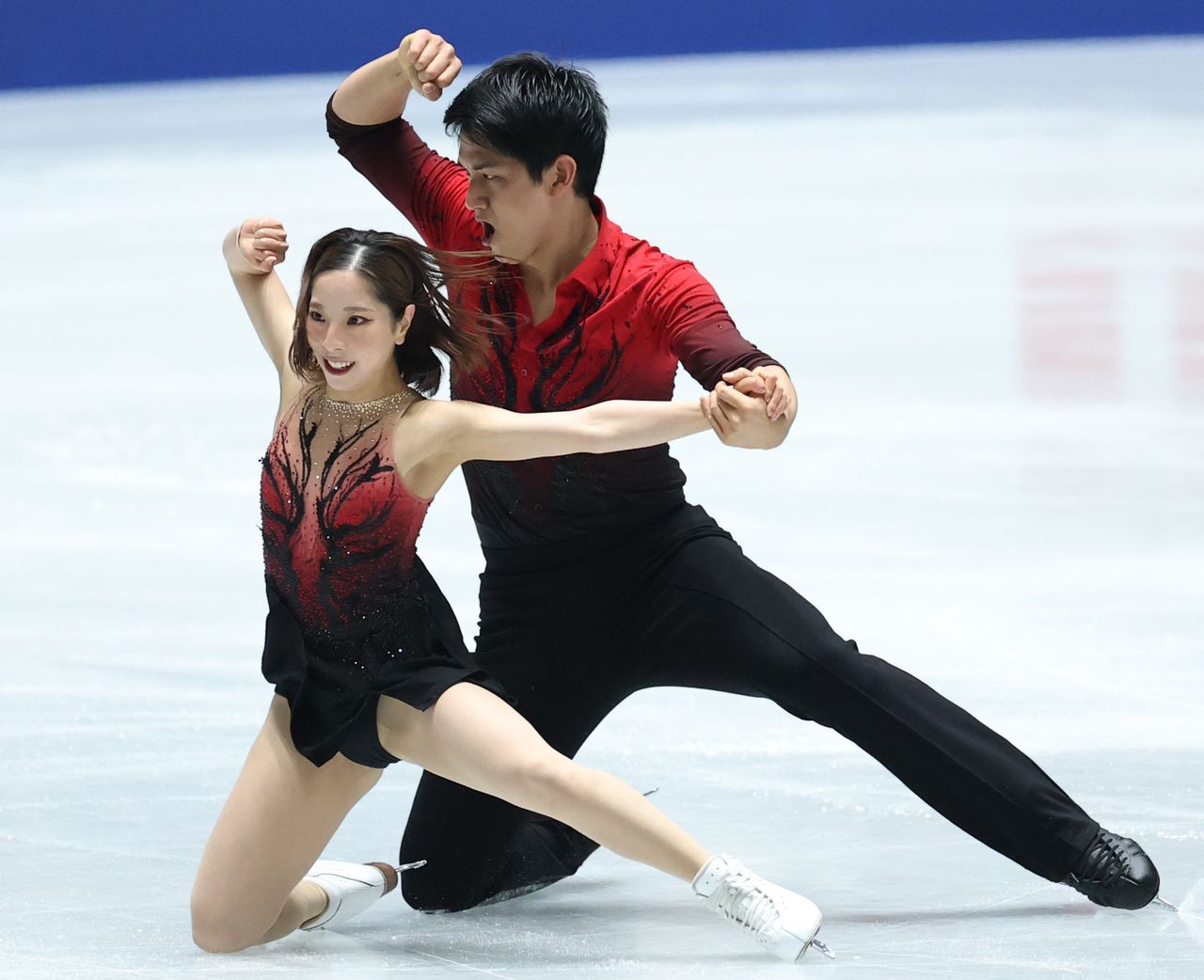
Miura Riku (left) and Kihara Ryūichi performing in the pairs short program at the Japan national championships on December 20, 2025, at the Yoyogi National Gymnasium, Tokyo. (© Jiji)
In summer, they were able to spend time training at their base in Canada to prepare in earnest. With that, they opened the international season at a September Challenger Series event by exceeding their previous World Championships score by more than three points to get 222.94. It was a spectacular start for the duo.
In the Grand Prix series, consecutive victories carried them to the Final, where they delivered a performance full of speed and power. They recorded a career-best score in the free skate. In the end, they totaled 225.21 points, just 0.84 short of their all-time best and a record for all competitors that season, to claim victory.
At the Japan Figure Skating Championships, Miura dislocated her left shoulder during the six-minute warmup immediately before competition. Despite this, they opened in first place in the short program with 84.91 points, nearly 4 points above their previous career best. They withdrew from the free skate to avoid further risk, but having experienced the same injury before, they know how to manage it. With even greater stability this season, they will be in the hunt for the gold medal if they are fully prepared.
The second Japanese pairs team of Nagaoka Yuna and Moriguchi Sumitada, who earned their Olympics spot at the final selection event, have made impressive progress this season. Their rise has added further excitement to Japan’s medal prospects.
(Originally published in Japanese on January 13, 2026. Banner photo: Kaori Sakamoto competes in the women’s free skate at the Japan Figure Skating Championships on December 21, 2025, at the Yoyogi National Gymnasium in Tokyo. © Jiji.)