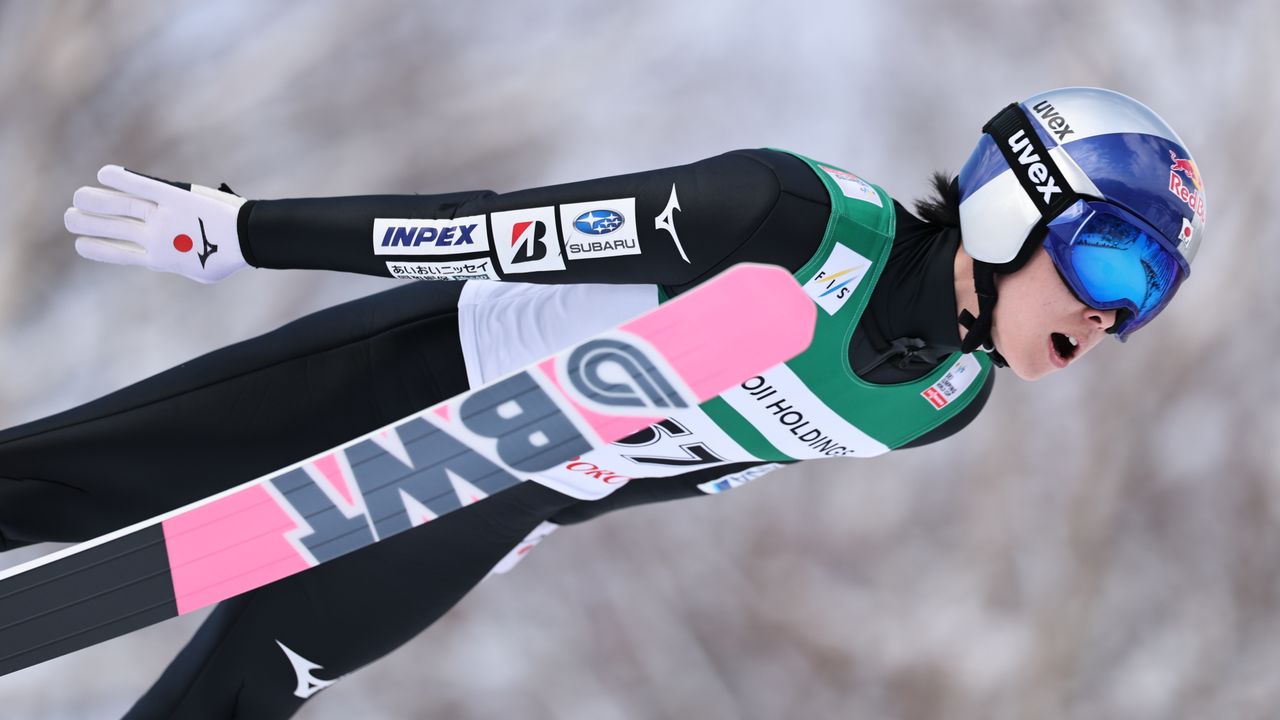
Taking to the Milano Cortina Skies: Japanese Ski Jumpers Kobayashi Ryōyū and Maruyama Nozomi
Sports- English
- 日本語
- 简体字
- 繁體字
- Français
- Español
- العربية
- Русский
Jumps Backed by Technique
Kobayashi Ryōyū’s athleticism and unmatched consistency in execution are among his greatest strengths as a ski jumper.
On the in-run slope, the Japanese ace holds a stable position with his center of gravity firmly set. At takeoff, he transfers power cleanly into the jump and launches with force. He soars through the air in an aerodynamic posture preserving his speed from the in-run. As he descends, he aligns his skis as parallel as possible to the landing slope, generating lift and extending his distance. At landing, he spreads his arms gracefully and executes a clean Telemark landing, one knee down and one ski in front of the other, earning high style points. This is a textbook example of a well-executed jump, backed by a high level of skill.
“My goal is to deliver big jumps at the Olympics and get the crowd excited,” Kobayashi said at a press conference in Tokyo on January 19, the day after the men’s Ski Jumping World Cup in Sapporo. “If I can do that, a medal is sure to follow.”
Kobayashi made his international debut at the World Cup in January 2016, a year after he graduated from high school. The name “Ryōyū” became world famous in the 2018–19 season, when he became the third person in history to win at all four venues of the Four Hills Tournament in Germany and Austria. He also recorded 13 World Cup victories during the season and became the first non-European overall World Cup champion.
He has since maintained exceptional stability, taking gold on the Normal Hill and silver on the Large Hill at the Beijing Olympics in 2022. It was the first time since Funaki Kazuyoshi at Nagano in 1998 for a Japanese jumper to win two individual Olympic medals.
Kobayashi has enhanced his strength as a jumper throughout his career by building experience into mental strength. Ski jumping is a sport that is contested under conditions that change with every competition, including differences in hill shape, snow quality, weather, and of course the athlete’s physical condition. Even during a single event, wind conditions can shift constantly and may even decide the outcome. Athletes and coaches must carefully read each moment’s conditions and make precise adjustments.
Adding to those variables are the yearly changes in equipment regulations, which can be a considerable source of mental stress. Athletes pay close attention to subtle changes in feeling and try to adjust, but for many, that very focus can disrupt their balance and work against them. The ability to prevent discrepancies from growing is what allows consistently strong results.
At the press conference on January 19, Kobayashi said, “In ski jumping, you never know what will happen on the day. My biggest rival is myself. If I can match or outperform myself, then I have a chance at winning medals.”
Kobayashi’s strong ability to adjust was clearly demonstrated at the World Championships in Trondheim, Norway, at the end of February last year. It was a slow-start season for him: His in-run buildup had been unstable since the opening of the World Cup, leaving him ranked eleventh overall. Although he had won back-to-back events at the preceding Sapporo World Cup event, this was an unusually low position for Kobayashi, who had typically remained in the top five.
During the first half of the World Championships, the in-run slope was unstable due to rain. After finishing thirteenth in the Normal Hill qualification, Kobayashi appeared relaxed, remarking, “Tomorrow’s winds will blow as they will.” Then, in the competition, he completed two jumps beyond the hill size of 102 meters—beyond which it is judged to be dangerous to land—and moved up to seventh place. On the Large Hill, he landed 2 meters past the hill size at 140 meters, rising to second place, just 0.4 points behind the leader. In the final competition, he executed jumps of 135 meters and 137.5 meters to land at third place, showing the world in the end the full extent of his skill in adjusting and making a comeback.
A Solid Second-Overall Position in World Cup Standings
In the current season’s World Cup, as of the Sapporo event in mid-January, Kobayashi has recorded two wins, two second-place finishes, and three thirds. He has placed in the top 10 in every event so far and sits second overall.
In Sapporo, he finished fifth in the first competition. In the second, he qualified in second place, took second after the first jump as the headwind weakened, and then for the second jump produced the longest jump of the day at 138.5 meters. He ultimately finished second overall, unable to overtake Slovenia’s Domen Prevc, who has nine wins this season. “I thought that if conditions permitted, I had a chance to win, so I was enthusiastic,” Kobayashi said.
Sakuyama Kento, head coach of Japan’s national team, commented on Kobayashi’s performance in that first competition: “His in-run posture didn’t connect well to the takeoff, but on the second day we corrected that with land-based training. In the competition, he jumped exactly as he envisioned. The second jump in particular was very good.” Once again, Kobayashi demonstrated his impressive ability to make adjustments and showed that he is competing at the level of a title contender.
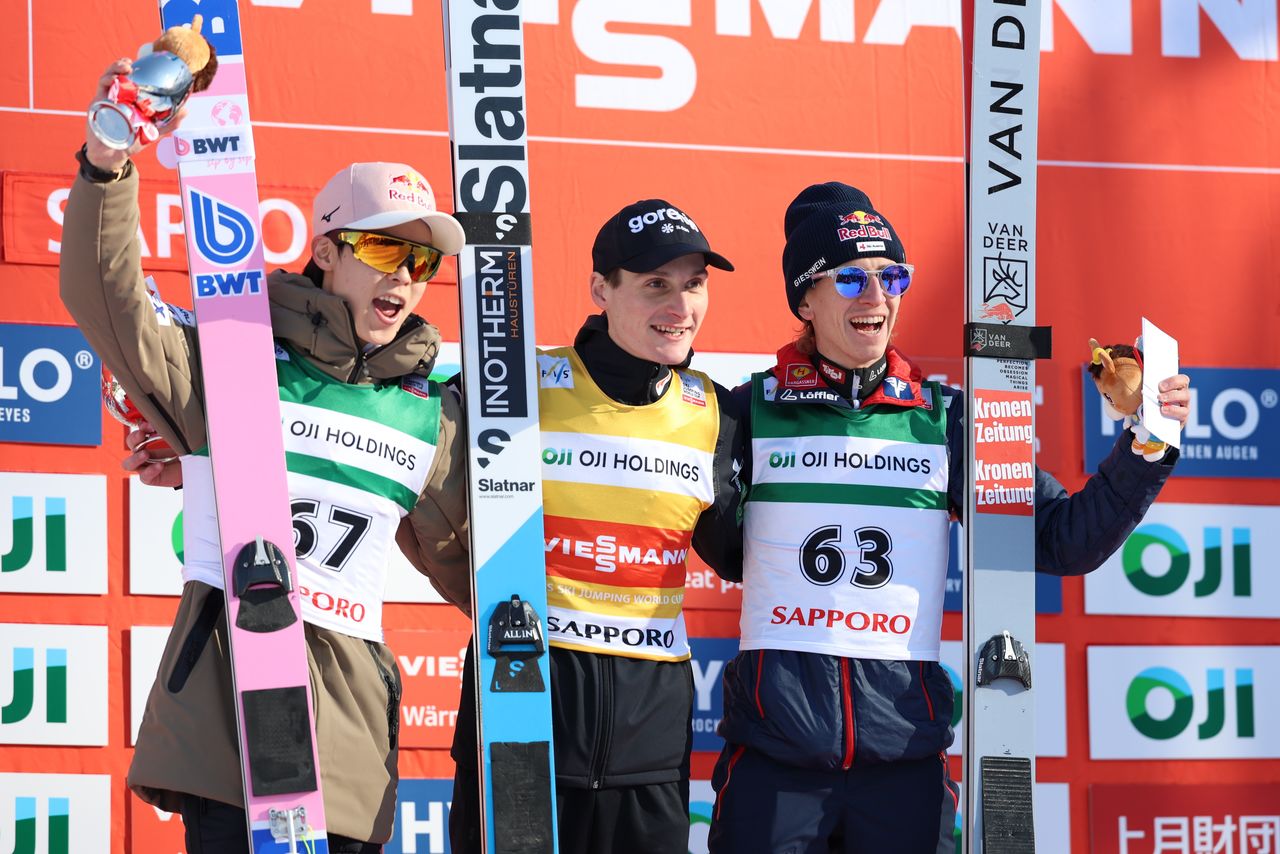
Kobayashi Ryōyū (left) stands second on the podium for Round 18 of men’s singles at the FIS Ski Jumping World Cup. Domen Prevc from Slovakia (center) took first place. Ōkurayama Ski Jump Stadium, Sapporo, January 18, 2026. (© Jiji)
A Natural Approach to His Third Olympics
The more evenly matched the competitors are, the more the results are shaped by the conditions on the day. Knowing this well, Kobayashi is facing his third Olympics with an easygoing mindset, keeping his approach as natural as possible.
Asked about his medal ambitions after his success in Beijing, he answered with a relaxed expression: “I know it’s a major event, but I’m not too fixated on a gold medal. I just want to hit big jumps. Everybody is aiming for gold, but only one can win it. It’s a once-every-four-years event, and it’s the only big ski-jumping competition broadcast into every living room in Japan, so I’m eager to deliver a good performance.”
Looking at the global competitive landscape this season, Austria, which swept the top three overall World Cup positions last season, has only three wins so far and sits no higher than fourth overall. Norway, which faced issues over jump suit violations at its home World Championships, remains without wins, with a best result of fourteenth. With this, Kobayashi and Prevc are widely seen as the leading favorites for Olympic gold.
But Kobayashi is not the only high-hope athlete on Japan’s men’s team. Nikaidō Ren, aged 24, reached the World Cup podium for the first time in Round 5 this season, and got his first win at Round 14, which was the Innsbruck event of the Four Hills Tournament. In the overall ranking, he currently sits right behind Kobayashi at third place. “I have confidence this season,” he said. “Now that I’m getting results, I stopped making the kind of overenthusiastic mistakes I made last year, and I can compete with more calm.”
Anticipations for Super Team Event
For the upcoming Olympic Games, the maximum quota per country was capped at four to reduce the total number of athletes, and Japan secured just three spots. The usual team ski jumping event, featuring four athletes from each country, has been replaced by a super team event, in which two athletes each jump three times. The Japan team of Kobayashi and Nikaidō looks well-positioned in this setting. They will match up against Slovenia, featuring Domen Prevc and Anže Lanišek, ranked first and fifth respectively, as well as a strong Austrian team.
On the women’s side, Maruyama Nozomi, who won the Summer Grand Prix this season, has carried her form into the winter. She collected multiple wins from the start of the World Cup and rose to the top of the rankings. In January, however, three consecutive eighth-place finishes allowed Nika Prevc of Slovenia to take the lead. After a brief break from competition, though, she returned to the podium, dominating the first event at Zaō and keeping herself in medal contention. Veteran jumper Takanashi Sara has also been consistently finishing within the top 10. In the mixed team event, where a team of two men and two women compete, Japan’s medal prospects are high, and a showdown with Slovenia is expected to draw attention.
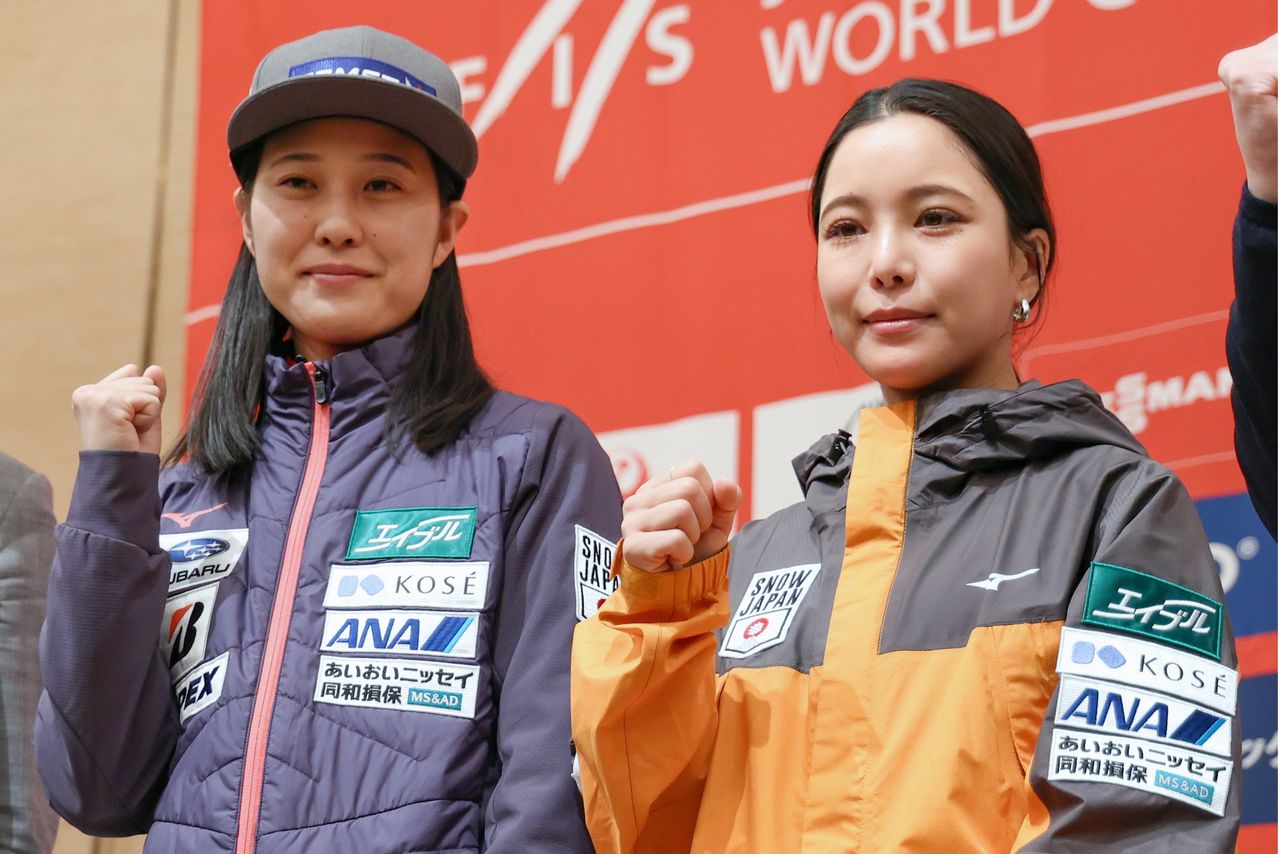
Maruyama Nozomi (left) and Takanashi Sara pose for a photo at a press conference in Yamagata the day before the Zaō event of the FIS Ski Jumping World Cup. Taken on January 19, 2026. (© Jiji)
(Originally published in Japanese on January 25. Banner photo: Kobayashi Ryōyū takes his first jump in the men’s individual competition in Round 18 of the Nordic Skiing World Cup on January 18, 2026, in Sapporo. © Jiji.)