Fermented Chili Pepper Sauce Karazō Brings a Spicy Taste of Tajima, Hyōgo Prefecture
Food and Drink Travel- English
- 日本語
- 简体字
- 繁體字
- Français
- Español
- العربية
- Русский
Japanese Jiang
When I tasted the brown paste offered to me, my first thought was: “It’s Japanese jiang.”
Jiang here refers to a class of fermented seasoning pastes born in ancient China and now spread across East Asia, including doubanjiang, tianmianjiang, and douchijiang. Such seasonings are widely used as core flavorings, to the point that jiang could be called “the taste of Asia.”
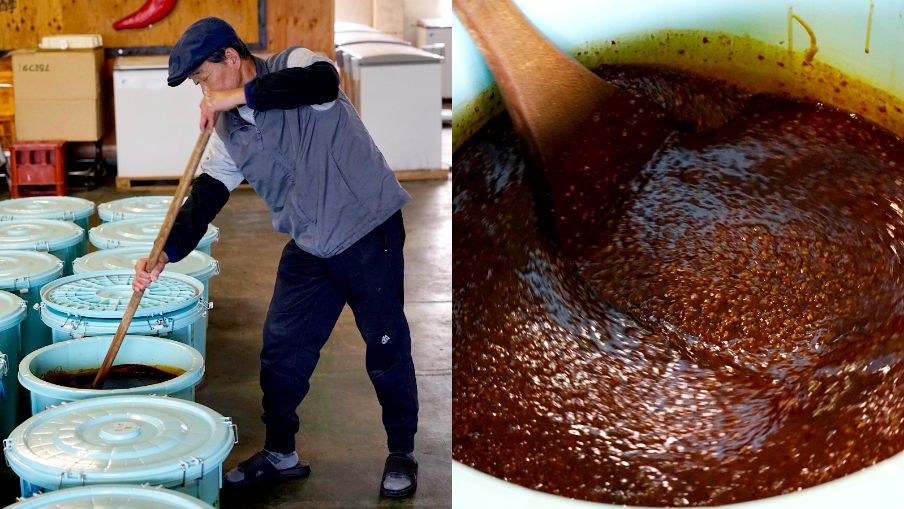
The paste I sampled was a base mixture for Karazō, a fermented chili-pepper seasoning made in the mountains of northern Hyōgo Prefecture. Spicy red chili peppers are mixed with rice inoculated with kōji—a mold that converts starch into sugar for fermentation—and soy sauce, then fermented and matured to produce complex flavors, aromas, and savory umami to complement the fire. This sauce is perfect not just for meat and fish dishes, but steamed vegetables, and even fresh-cooked white rice. The imagination runs wild . . .

Karazō variations. Bottom from the left: Karazō Tankara, which includes persimmon vinegar and ume for a clean, zippy flavor. Karazō Muchōsei Gen’eki is the unprocessed base mixture. Karazō Daikarakuchi levels up the spice with an increased dose of chili peppers. The upper jar is Karazō Aotōgarashi, made from early-harvested green peppers for a lighter aroma. (© Ukita Yasuyuki)
The Spice of Life
Japan’s food culture is richly diverse, with quite a few spices and herbs that bring sharp spiciness, from wasabi and ginger to sanshō pepper, karashi hot mustard, karami hot daikon, green chili peppers, and much more. Compared to neighboring South Korea, though, Japan’s use of red chili peppers is relatively limited. Still, they are grown across Japan, and there are several variations on fermented seasonings made from them.
The most well-known of the commercially released products is probably Kanzuri, made in Myōkō, Niigata Prefecture. Chili peppers that have been left to mellow in the snow, a practice called yukisarashi, are mixed with yuzu and fermented with rice kōji, then matured for three years. The process is said to date back to before the seventeenth century. The Tōhoku region in Japan’s far north also has a strong tradition of homemade chili pepper fermented sauces called sanshō. These are made by mixing 1.8 liters each of green chili peppers, rice kōji, and soy sauce to ferment. Most homes don’t age them, but set them out for use as soon as they have had a chance to ferment.
In contrast, Karazō is not an old local tradition. I spoke with Hirai Seiichi, the “father of flavor” at the workshop in the village of Ojiro in northern Hyōgo Prefecture—a region known as Tajima, which was a historic sake brewing center—about its birth.
The factory, complete with a kōjimuro room for growing the rice kōji, stands along the Yada River. I visited in autumn, just when the tree leaves were turning, and the riverside scenery was simply stunning. Ojiro is listed by the Japan’s Most Beautiful Villages NPO.
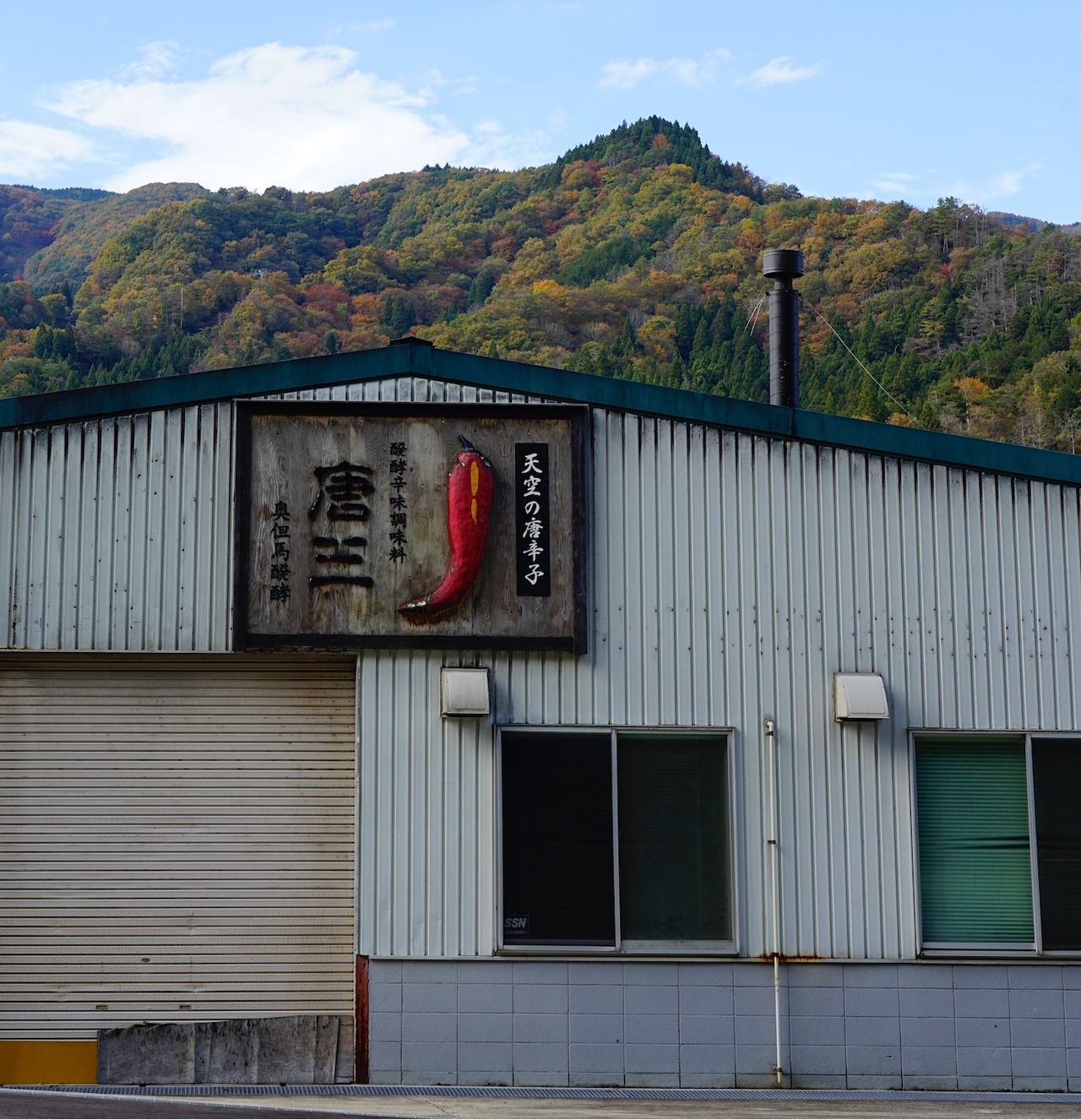
The Karazō factory, complete with maturation and fermentation barrels, in the mountains of Tajima. (© Ukita Yasuyuki)
“I wanted to bring out Tajima’s potential and make a truly outstanding ‘Tajima brand,’” says Hirai.
Hirai was born to a long line of liquor retailers in Himeji. He joined the family business after graduating from university and diligently pursued his work in the liquor industry. Every sector of the food business is guided by trends, and he found himself always inspired by stories of new product development, but he also felt a sense of futility.
A Slow Food Paradise
Then, in 2000, came a new career. The slow food movement that had started in Italy in the late 1980s reached Japan in the late 1990s. This was a reaction to the global spread of fast food, with a renewed focus on regionality in ingredients, local produce, adherence to traditional techniques, and small-scale production, as well as preservation of the diversity of produce.
Hirai caught onto the movement early and founded Slow Food Harima as a branch of the Japanese consortium Slow Food Nippon. As part of his work there, his eye fell on the relatively nearby Tajima area. He became convinced that Tajima could be a slow food paradise, with its beautiful if harsh natural climate, and the bounty of the mountains and sea it offered.
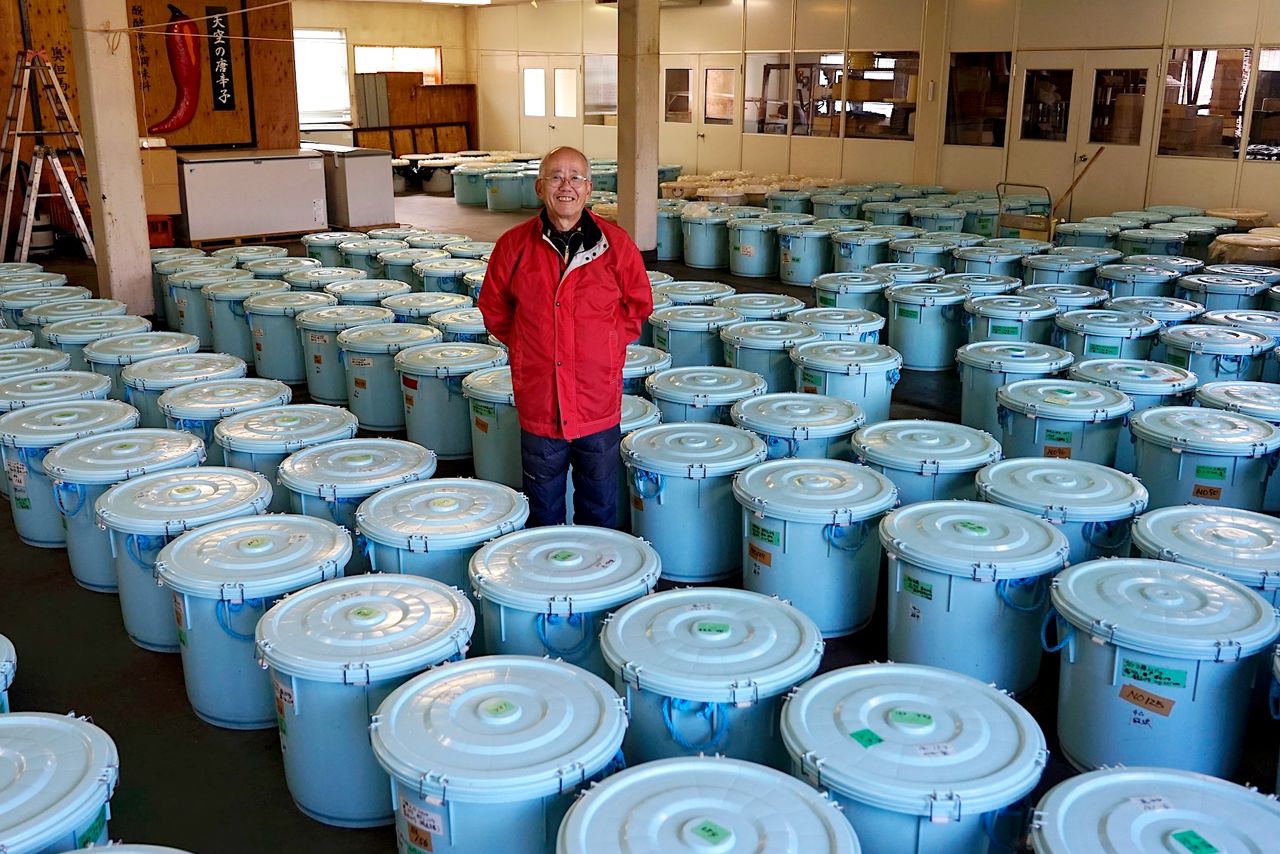
Hirai Seiichi surrounded by fermentation barrels at the Ojiro workshop. (© Ukita Yasuyuki)
One day in 2010, Hirai spotted a field of red chili peppers owned by Ojiro farmer Inao Minoru, who was test-cultivating a type of pepper introduced from South Korea.
Standing on a plateau 500 meters above sea level, Ojiro gets lots of sunlight and has excellent drainage, and the day/night temperature differential is large. That last factor leads to an increased level of capsaicin, the chemical that gives chilis their fire, as well as a powerful aroma. Hirai began to consider developing a product using these peppers.
Farming Next to Famed Beef Cows
Ojiro is already known as a place for raising Tajima cattle, the same breed that produces the famed Kobe beef and Matsusaka beef, and it also stands in the same Tajima region that has produced generations of outstanding sake brewers through the Tajima tōji (master brewer) guild. With winter snow piling up over a meter high, farmers have long had to find other work to do outside the growing season, and for many that was sake brewing.
Before his chili pepper venture, Inao himself was a sake brewer, the first tōji at Ōzeki’s plant in Hollister, California. Already a fermentation pro who had spent years of his life steeped in the liquor industry, Hirai felt that producing a fermented chili pepper seasoning was a natural next step for both men. In 2013, he set up a division under his liquor retail company Erdeberg Hirai to do just that, and spun it off in 2017 as Okutajima.
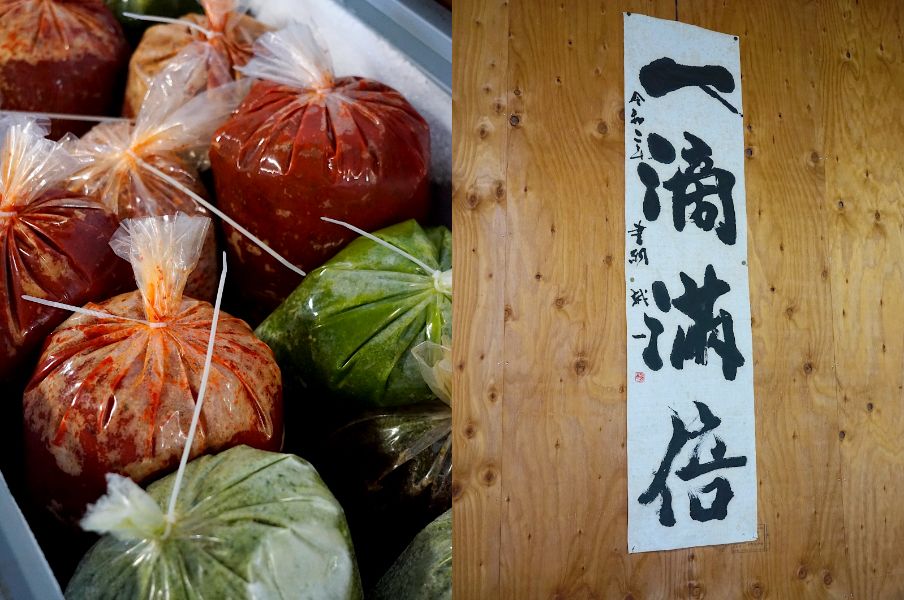
At left: A variety of frozen chili pepper paste. At right is a motto written in Hirai’s hand: Itteki manbai, or “From a single drop, plentiful returns.” (© Ukita Yasuyuki)
For the initial test products in Himeji, chili peppers harvested from summer through fall were frozen and then processed in winter, when the cold weather creates a healthier fermentation environment where harmful bacteria cannot thrive. Kōji was grown on rice, and then Hirai brought in additive-free whole-bean soy sauce from the nearby city of Yabu.
After one or two years, the fermentation settled down, and as the mixture inside those resin tanks matured, the flavor and aroma transformed. The aroma grew complex, with elements of sweetness, spice, acidity and astringency in a gentle balance. The mouthfeel grew gentler. Finally, after three years of maturation, the mixture was ready for release.
They opened the dedicated Ojiro workshop in 2016 and started full-on production. They branded the Ojiro peppers Tenkū no Tōgarashi, or “Chilis of the Heavens,” and named their product Karazō. That name combines the first character of the Japanese word for chili peppers with the one for “three” because of the three ingredients. The current product is a blend based on a paste aged for five years. After Inao retired, another local farmer with sake brewing experience, Imai Shirō, stepped in as the lead farmer and fermenter.

Imai Shirō standing in a field of Tenkū no Tōgarashi. (© Ukita Yasuyuki)
I was able to sample the midferment mixture. The young mixture had an orange color with the distinctive dry aroma of chili peppers. The spiciness was sharp and harsh on the tongue. Around the third year of fermentation, the color begins to brown and the aromatic complexity grows, while the spice mellows and smooths out. After five years, all the elements blend into a seamless whole with much greater depth.
I even got to peek into a “secret” barrel that has aged for even longer. This one is being made with an eye to Modena’s famed balsamic vinegar, which is fermented from grape must and sometimes aged as long as 30 or even 50 years to demand an even higher price. This barrel produced a rich flavor experience that surpassed the idea of mere “seasoning.”

Even the appearance grows smoother as fermentation progresses. (© Ukita Yasuyuki)
The Peppers’ Final Destination
Imai’s pepper fields spread out along a sloping hillside about 15 minutes by car from the Ojiro plant. Under the afternoon sun, the rowan berries glow crimson and silvergrass stalks glisten. Daikon are hung to dry under the eaves of the nearby work hut. The whole area is wrapped in chill, clean air when I visit; the harvest is already finished, with a few small green peppers still on the plants here and there. “This year, a few peppers only turned half red. Maybe because the summer was so hot,’ says Imai. Expressing local flavor is, perhaps, exactly that: showing the influence of the climate and weather.
Under heavens free of the sound of cars or city traffic, the quiet was sometimes broken by a low, distant moaning sound. I went up the slope a few minutes and found the source in a meadow surrounded by barbed wire. A small herd of black cattle glistened under the sun and chewed their cuds as they stared at me with calm eyes.
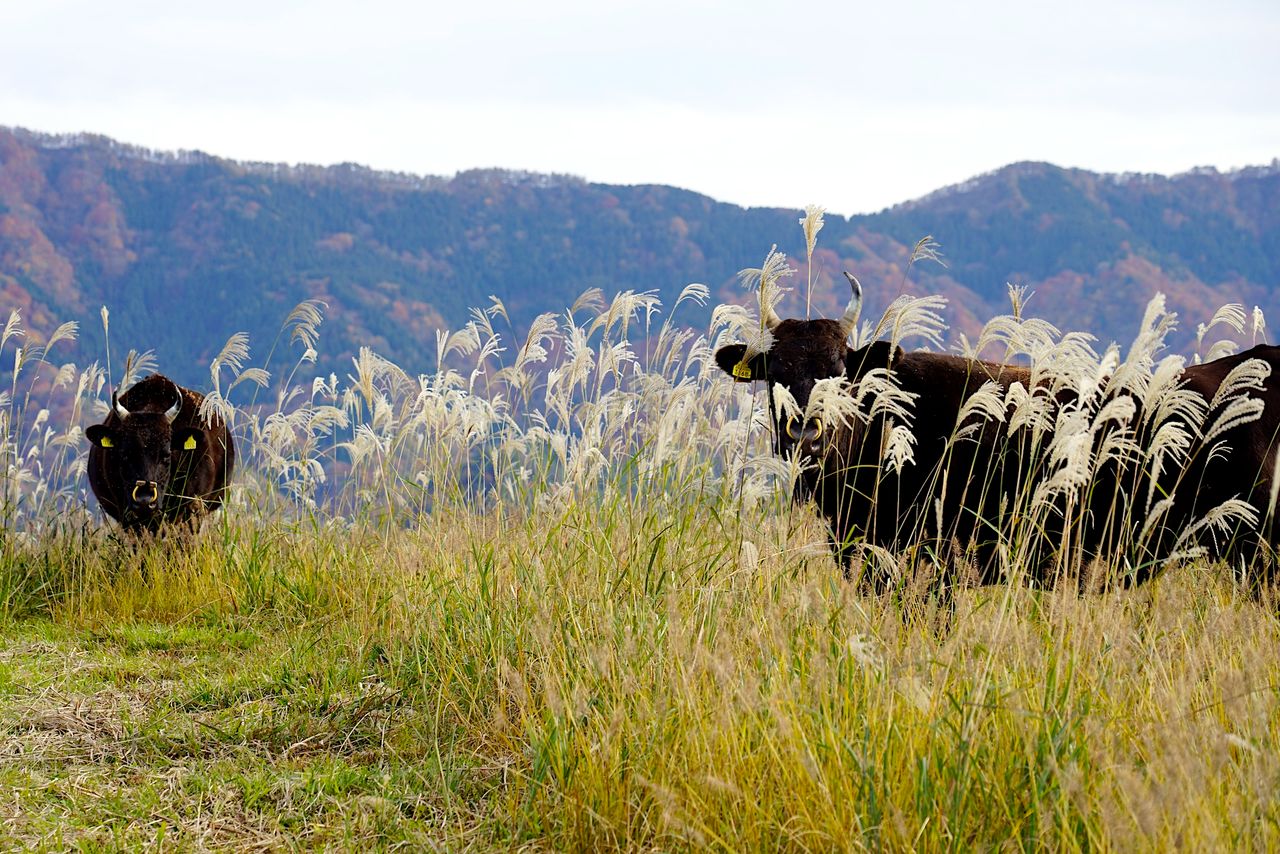
Ojiro is a well-known Tajima cattle breeding ground. (© Ukita Yasuyuki)
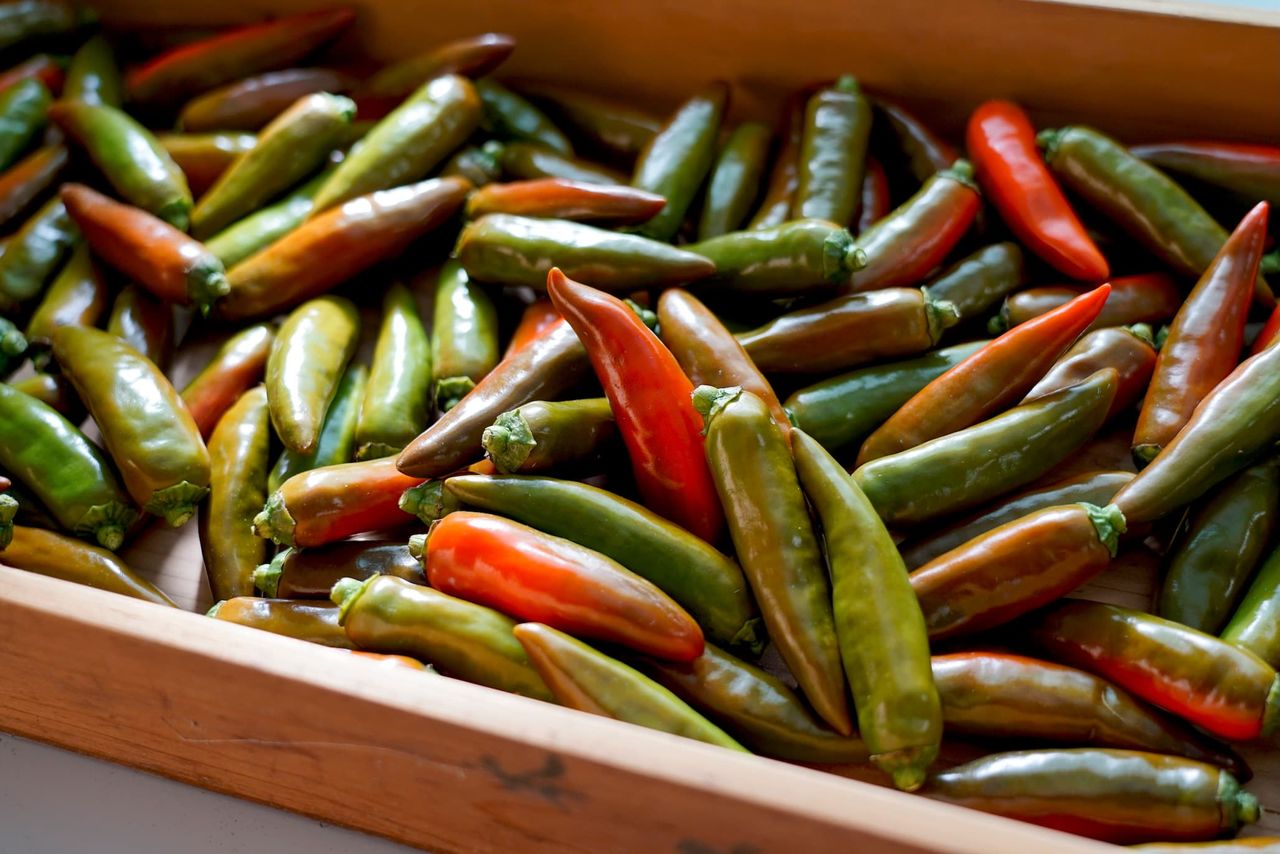
Freshly harvested chilis, a variety introduced from South Korea. (© Ukita Yasuyuki)
These pepper fields and the surrounding scenery are concrete examples of what Hirai calls the “Tajima potential.”
“The journey of chili peppers from their origins in central and South America around the world has its latest destination in Ojiro,” Hirai says with a laugh. And who can say? Perhaps these peppers will someday become so deeply rooted here they are considered indigenous to Tajima, like wine grapes carrying local names around the world.
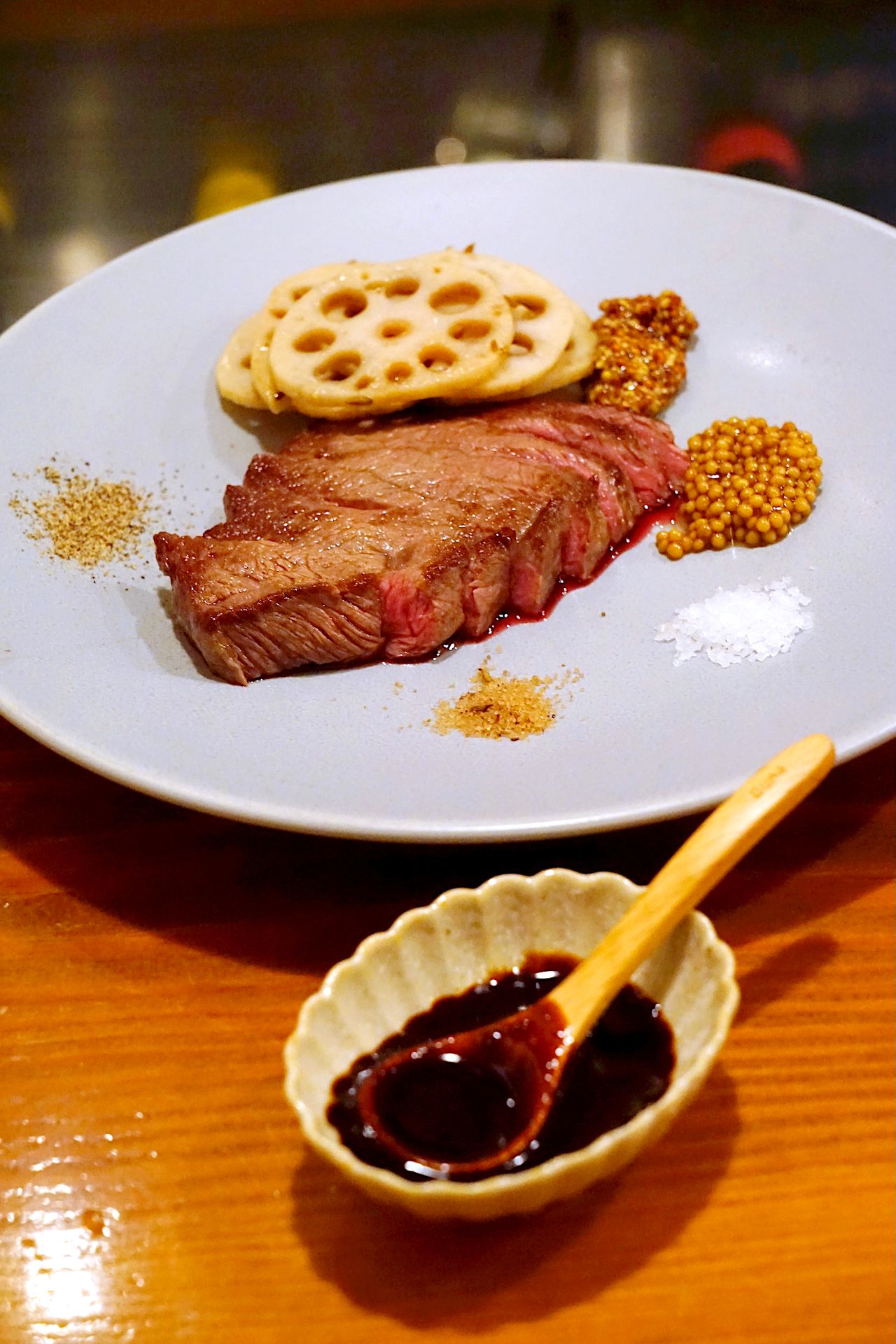
I ordered some wagyū at Himeji wine bar Vinya and tried it with Karazō Muchōsei Gen’eki. The sweetness of the beef fat melded with Karazō’s savoriness, bringing a new layer to the meat’s flavor. (© Ukita Yasuyuki)
(Originally published in Japanese. Banner photo: Fukui Seiichi, a staff member and advisor to Hirai Seiichi with a previous career as a French chef, stirs the mixture shown at right with a paddle to support the fermentation and maturation process. © Ukita Yasuyuki.)