Japan’s Snowboard Star Hirano Ayumu Battles Injury to Go for Halfpipe Gold in Milano Cortina
Sports- English
- 日本語
- 简体字
- 繁體字
- Français
- Español
- العربية
- Русский
A Last-Minute Accident
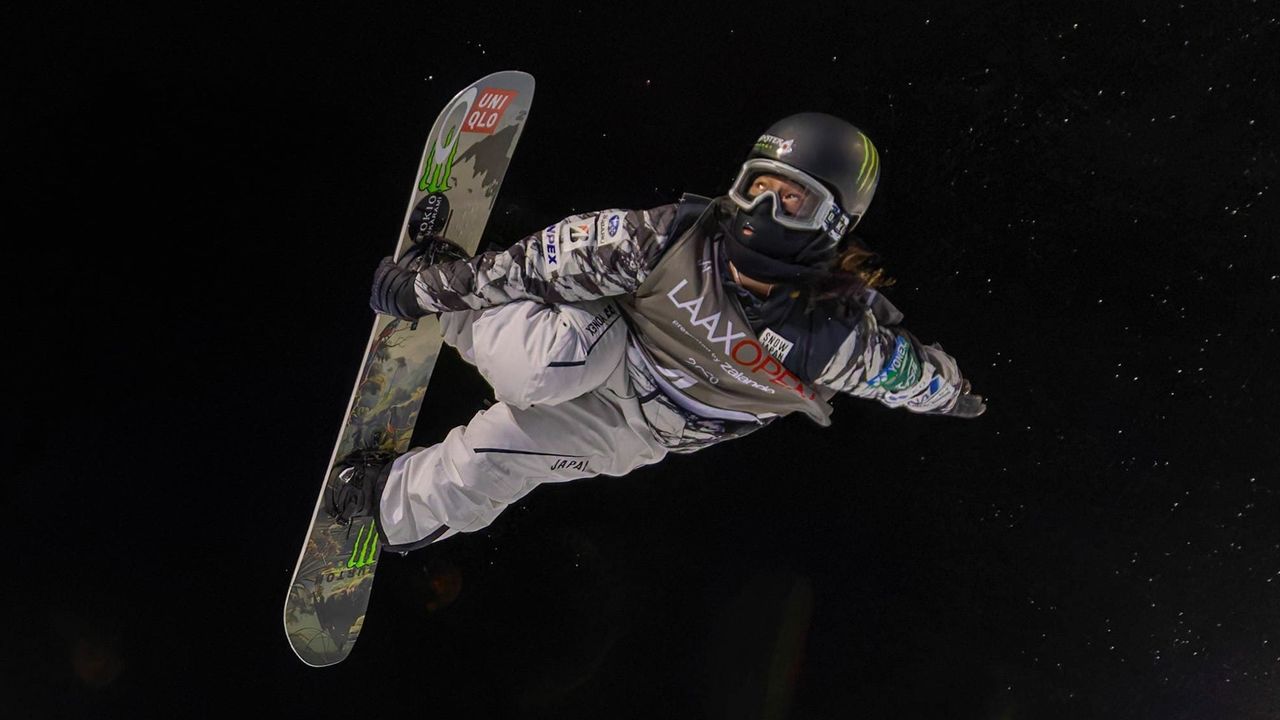
On January 17, just days before the announcement that he would represent Japan in the snowboarding halfpipe competition at the Milano Cortina 2026 Winter Olympics, Hirano Ayumu had a serious accident. Competing in his first run at the finals of a World Cup meet in Laax, Switzerland, he lost his balance while landing a high jump and fell forward into the snow.
It was a crash landing from a height of 8 meters, equivalent to falling off a three-story building. The shock of impact snapped the tip of his snowboard off, and Hirano smacked face-first into the snow, leaving him bleeding from the mouth and nose. He also injured his right knee, forcing him to forfeit the second run of the finals. His attempt at a “frontside double-cork 1260 crippler Japan grab,” a daunting trick of his own invention that combines two vertical turns and three and a half horizontal turns around a diagonal axis, had ended in disaster.
Hirano returned to Japan for more extensive testing. He was diagnosed with fractures and bruising in multiple places, but no bones were misaligned, so he announced his plans to wait until the swelling and pain subside and then push through his injuries to compete for Japan at the Winter Olympics. Preliminaries begin on February 11; the final event is on February 13. Hirano has described Milano Cortina 2026 not as the continuation of a dream but as lying beyond the dream he has long pursued. Now, however, the road ahead looks harsh.
The Danger and Fear of High-Level Tricks
The spectacular trick that made Hirano a gold medalist at Beijing 2022 was the “triple cork 1440,” combining three vertical and four horizontal spins. It wasn’t long, however, before younger colleagues in Japan started pulling off Hirano’s signature trick as well. After Hirano, aged 27, came 24-year-old Totsuka Yūto, 23-year-old Hirano Ruka, and others, winning world cup after world cup. With so many Japanese snowboarders competing at the highest level globally, there are whispers that Japan’s team could monopolize the Olympic podium in 2026.
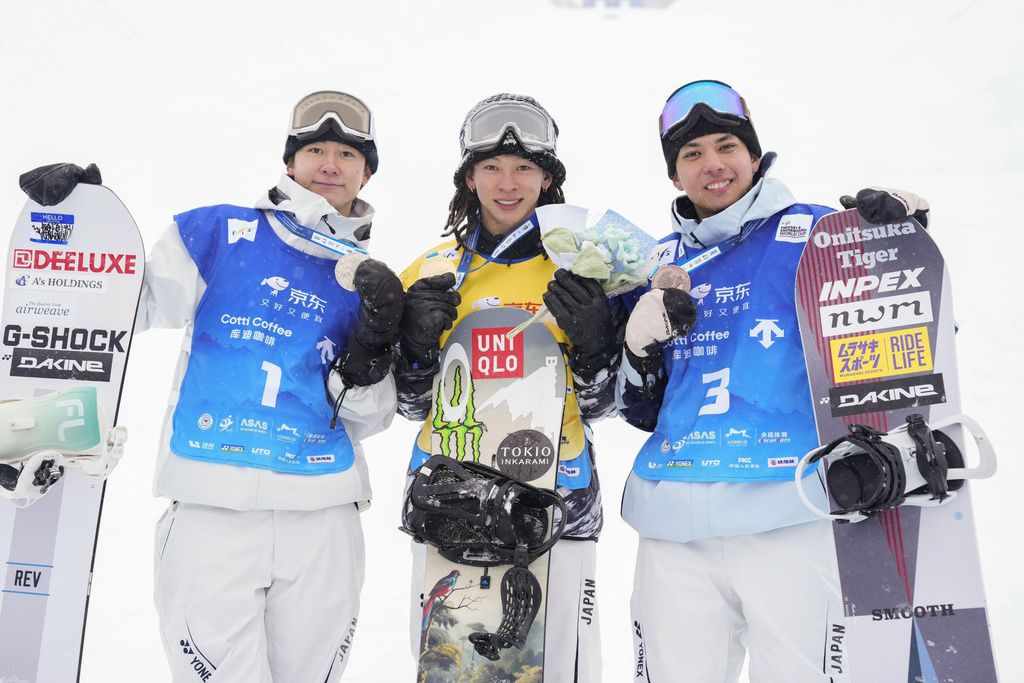
Hirano Ayumu (center) after winning the opening round in the Men’s Halfpipe competition at the FIS Snowboard World Cup round held in Zhangjiakou, China, in December 2025. Totsuka Yūto (left) and Hirano Ruka (right) placed second and third, respectively. (© Kyōdō)
“You might think there are limits to technique, but as time passes you realize how limitless it actually is,” says Hirano. “I’m sure that new tricks will continue to be invented in the future.” Hirano himself has shifted the goalposts considerably, making it clear how few limits there are to the evolution of his sport. Each competitor refines new tricks through countless rounds of trial and error.
However, the more difficult tricks get, the more dangerous they become. When competing against world champions, another opponent must be defeated: fear.
A Long-Term Rival Retires
If Hirano had a long-time rival, it was the American snowboarder Shaun White. As a gold medalist at three Winter Olympic Games—Torino 2006, Vancouver 2010, and PyeongChang 2018—White is a bona fide superstar. Hirano came close to beating him in PyeongChang, but White turned things around at the last moment in a contest still fondly discussed to this day.
After finishing fourth at Beijing 2022, White retired from competition—then went to visit Hirano in Tokyo as Milano Cortina 2026 approached. A post on White’s Instagram account shows the two side-by-side, with the caption, “Been battling this kid for years and it’s relieving to finally be able to cheer him on. Great athlete, great competitor, and great friend!”
For many years, Hirano had his sights set on White, who constantly seemed to be one step ahead in the competition. At Beijing 2022, he finally surpassed his rival and claimed his place at the center of the winner’s podium. “Seeing White take such a magnificent shot at this challenge drove my own desire to win. I was determined to come out on top in my third run today, and I was able to stay on the attack throughout,” wrote Hirano on his Instagram account, in a farewell salute to his great rival. “As long as I live, I’ll never forget seeing him give it his all from right up close.”
No such longstanding rivalries await Hirano at Milano Cortina 2026. In fact, his most formidable opponents are likely to be the rest of Japan’s team. Four have been chosen for the Men’s Halfpipe. At last season’s World Cup, Hirano Ruka (no relation to Ayumu) took the overall halfpipe title for the third season running, followed by Totsuka and Hirano Ayumu in second and third place, respectively. This season, 19-year-old newcomer Yamada Ryūsei also achieved his inaugural first place in the World Cup’s second round, closing in on his Olympic teammates.
“Results are important, too, but I try not to let that restrict me too much,” says Hirano Ayumu. “Giving the competition everything I have and delivering a performance I’m satisfied with is my ideal.” Whoever the competition might be, he plans to stay focused on beating his own expectations.
A Long-Awaited New Practice Facility at Home
After the Beijing Winter Olympics, Hirano’s practice environment also changed. In September 2024, a long-awaited new training center opened in his hometown of Murakami, Niigata: the Murakami Snow Research and Training Center, with the world’s first outdoor facility for practicing aerial halfpipe tricks even outside of the snowy season.
The center is run by Hirano’s father Hidenori, who runs an indoor skateboarding facility next door. Hirano’s corporate sponsor Uniqlo also offered special assistance with the project, giving Hirano an environment where he can focus on training all year round without heading overseas.
“This facility was the result of many discussions with my family and people on the ground about whether it was possible to create a practice environment heading into the next Olympic Games that wouldn’t be affected by the weather,” says Hirano. “Having a facility like this in my hometown is like a dream. It was a real challenge to make something with no equivalent anywhere in the world.”
Perhaps Hirano’s own participation at the design and planning stage indicates a focus on what lies beyond Olympic gold.
Giving Back to Society
Hirano invited elementary and junior high school students to the facility’s opening ceremony. This was a “Next-Generation Development Program” planned by Uniqlo, which has made Hirano a global brand ambassador.
The event was held not to cultivate competitors but to contribute to society by encouraging children to develop as people through interactions with first-class athletes at the top of the sporting field. In response to a question from one attending child about how to balance studying, surfing, and snowboarding, Hirano offered a thoughtful answer:
“The more serious you get, the more strongly you feel that you have to lose something to get something. I also struggled with taking time away from snowboarding for my skating. But I hope you’ll recognize the importance of doing what you can only do right now and keep pushing forward without giving up. Even if you make mistakes, when you look back on it as an adult, it’ll bring you strength.”
At the Tokyo Olympics held in 2021, Hirano attracted some attention for competing in the Men’s Park skateboarding category, making him a winter/summer “dual threat.” No bold endeavor is without its difficulties. But Hirano’s unrelenting emphasis on “doing what’s only possible right now” remains unchanged. After conquering the Beijing 2022 Winter Olympics and achieving his dreams, Hirano set his sights on what lay beyond as he prepared for Milano Cortina 2026. Now, as he forges ahead in a bruised and battered state, his performance promises to stir the crowd’s heart more than any mere result could.
Big Air Medal Rush Incoming?
The Men’s Halfpipe is not the only event where Japan’s chances look promising. The Women’s Halfpipe, Big Air, and Slope Style all look like possibilities for a medal rush.
The Women’s Halfpipe team includes not only Tomita Sena, who won bronze at Beijing 2022, but also young talent like Shimizu Sara and Kudō Rise. In January, Shimizu won her inaugural first place at the X Games, an invite-only competition attended by the world’s top professionals, and Kudō was close behind her in second place. In this season’s World Cup competition, Kudō and Shimizu shared the winner’s podium with Ono Mitsuki. With so much top global talent in the same team, all the members are spurring each other to greater heights.
The Big Air and Slope Style team (the same athletes compete in both events) includes Murase Kokomo, Iwabuchi Reira, and Fukada Mari, who monopolized the winner’s podium for Japan at last year’s World Championships in March. Hopes are high for a repeat performance.
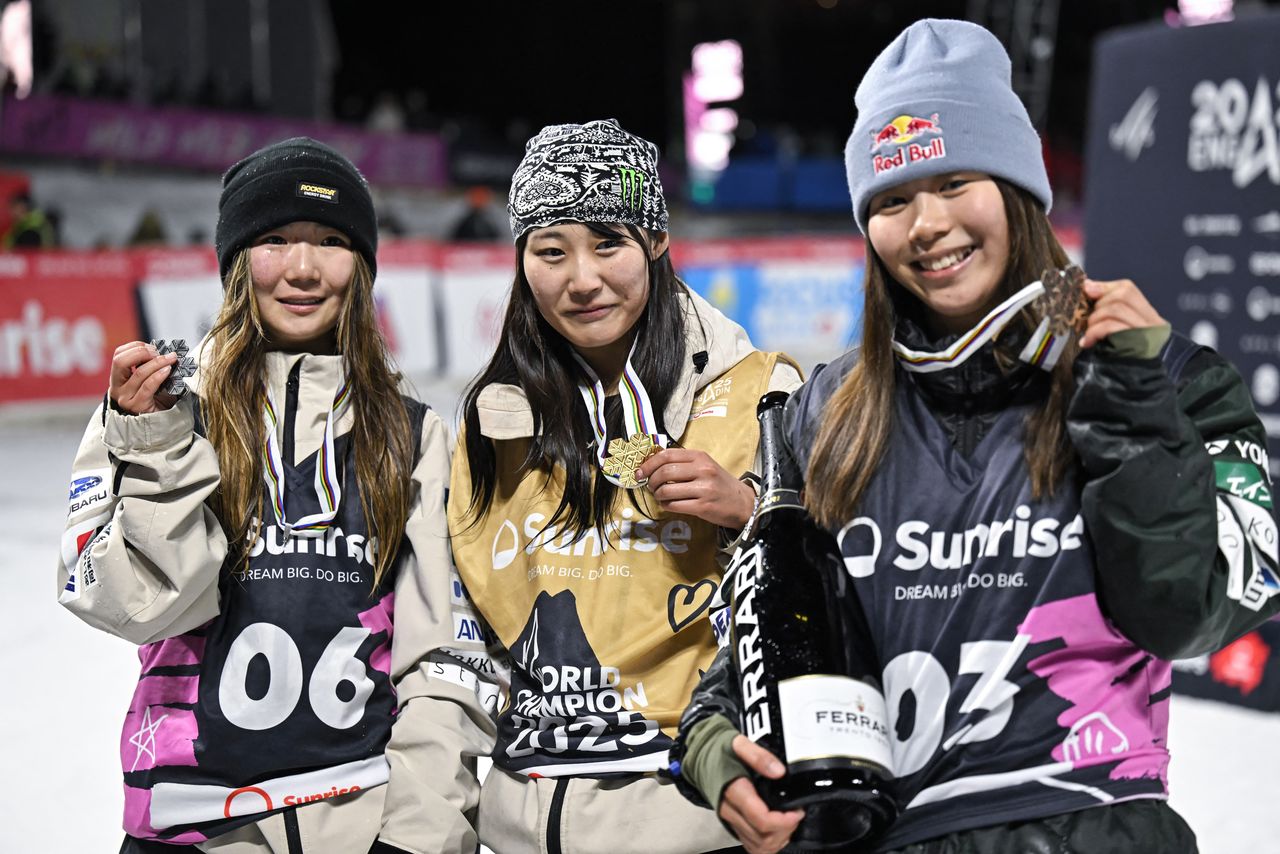
At the snowboarding World Championships in St. Moritz in March 2025, Japan’s Women’s Big Air team monopolized the winner’s podium with (from left) Iwabuchi Reira in second place, Murase Kokomo in first, and Fukada Mari in third. (© AFP/Jiji)
The men’s team, meanwhile, includes big names like Hasegawa Taiga, who won the Big Air event at last season’s World Cup, and Kimata Ryōma, who dominated last year’s Big Air World Championships, both of whom hope to medal.
(Originally published in Japanese on January 29, 2026. Banner photo: Hirano Ayumu competes in the World Cup Men’s Halfpipe final in Laax, Switzerland, on January 18, 2026. He was injured in a fall during the competition. (© Imago/JustPictures.ch, via Reuters Connect.)