Ongoing Deflation Pushing China Toward Its Own Lost Decades?
Economy- English
- 日本語
- 简体字
- 繁體字
- Français
- Español
- العربية
- Русский
A Less-Than-Rosy Picture in China
In January 2026, the Chinese government announced a real 2025 GDP growth rate of 5.0%, with a nominal rate of 4.0%. The trend of real growth surpassing nominal growth has continued for the past three years. This indicates that the GDP minus deflator value, meaning deflation, shows no signs of ending. While this 5% rate might sound like solid economic cruising speed when taken at face value, the Rhodium Group, a US think tank, estimates that true growth is only about half that figure, 2.5%–3.0%. And indeed, there are some China-watchers who believe the country is currently seeing essentially zero growth.
The Chinese government’s total revenues—including tax revenue—for 2025 dropped 1.7% year-on-year. That was the first decline in five years, since the COVID-19 pandemic hit in 2020. That drop also raises significant doubts about the announced 5% growth.
Chinese social media feeds are being flooded with images showing the sluggish economy and posts from users sharing their own struggles. Shopping streets lined with shuttered shops. Massive shopping malls empty of shoppers. Unhoused people scavenging for food and sleeping in underpasses. Economists who calculate the youth jobless rate at over 40%. A migrant worker reported, “There was no work and rent kept piling up, so I returned home before the Lunar New Year in February.” An employee at a smaller company posted, “After not paying salaries for three months, the owner disappeared in the night.” A young, female job-seeker said, “I’ve sent out over 100 resumes and didn’t get called for a single interview.”
“Xinomics” Favoring State-Owned Business
China’s dire economic state stems from President Xi Jinping’s economic mismanagement. Soon after the Xi administration took over, the term “Likonomics” took the stage. It referred to the Chinese Economic Reform movement directed by late Chinese Premier Li Keqiang, who held a doctorate in economics. However, the term quickly vanished after President Xi, who advocated for stronger, better, and bigger state-owned enterprises, stripped Li of his influence.
Perhaps the purest textbook example of the “state-first, private-second” Xinomics that replaced Liconomics is the treatment of Jack Ma, founder of Alibaba. Ma was hit with a massive antitrust fine, driving him to take up long-term residency in Japan. He effectively became an exile. How can an economy thrive when it suppresses innovators so?
In a 2023 article in the New York Times, Nobel laureate in Economics Paul Krugman wrote that, “some have been asking whether China’s future path might resemble that of Japan. My answer is that it probably won’t — that China will do worse.”
Bad Debt and Declining Births
The bursting of the bubble economy in the early 1990s is what set off Japan’s “lost decades,” some 30 years of economic stagnation. China—which is still a middle-income nation, unlike Japan, which had achieved developed status when it underwent its crisis—now faces the risk of growing old before it can afford to.
There are two major obstacles standing in the way of China’s economic future: massive amounts of bad debt born from a bursting bubble, and an inverted population pyramid from low birthrates and aging population.
After the bubble economy burst, Japan’s economic institutions had to deal with roughly ¥100 trillion worth of bad debts. China’s nonperforming loans, though, are estimated to the equivalent of about ¥1.5 quadrillion.
China’s population, meanwhile, has been falling since its peak in 2021, with 7.92 million births in 2025. That number was over 15 million up until 2018, meaning the birthrate has plunged by almost half in just seven years.
It seems China is entering its own lost decades. The question is, will it only take 30 years to recover?
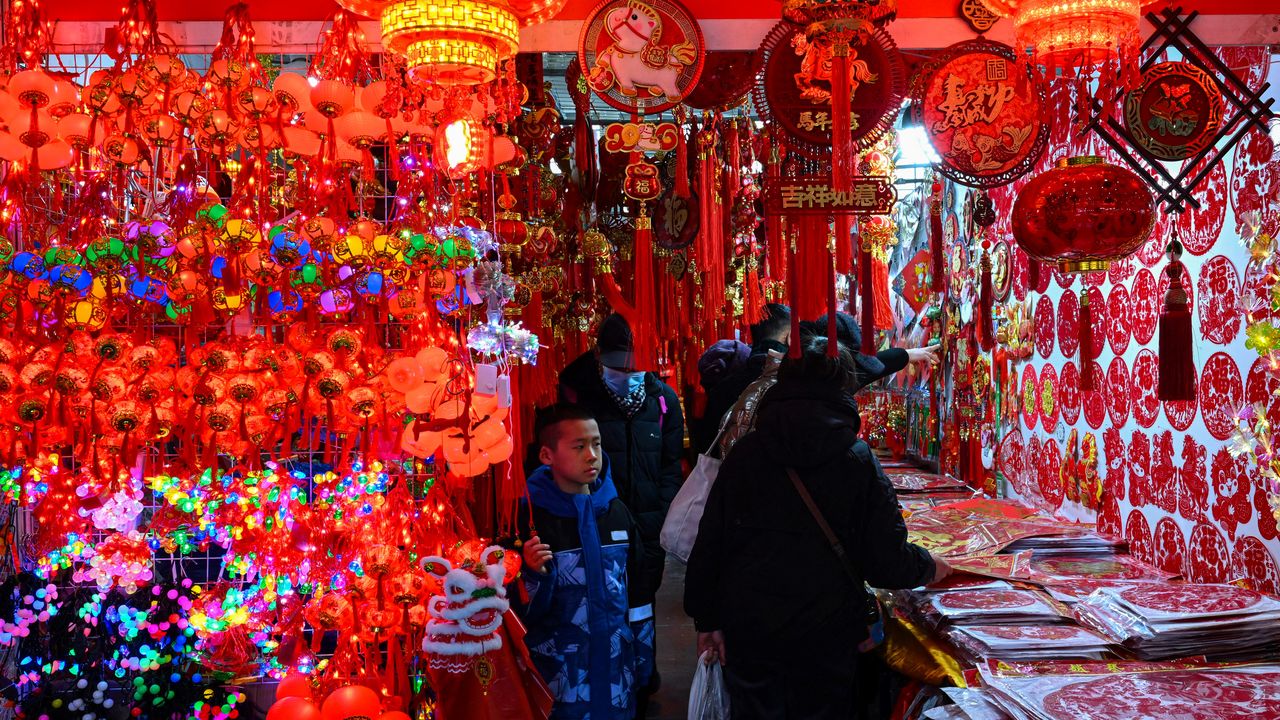
(Originally published in Japanese. Banner photo: Customers buying decorations for Lunar New Year in Beijing on February 6, 2026. © AFP/Jiji.)