
Making Olympic History in Milano Cortina: Japan’s Road to a Record Winter Medal Count
Sports- English
- 日本語
- 简体字
- 繁體字
- Français
- Español
- العربية
- Русский
Snowboarders Set the Pace
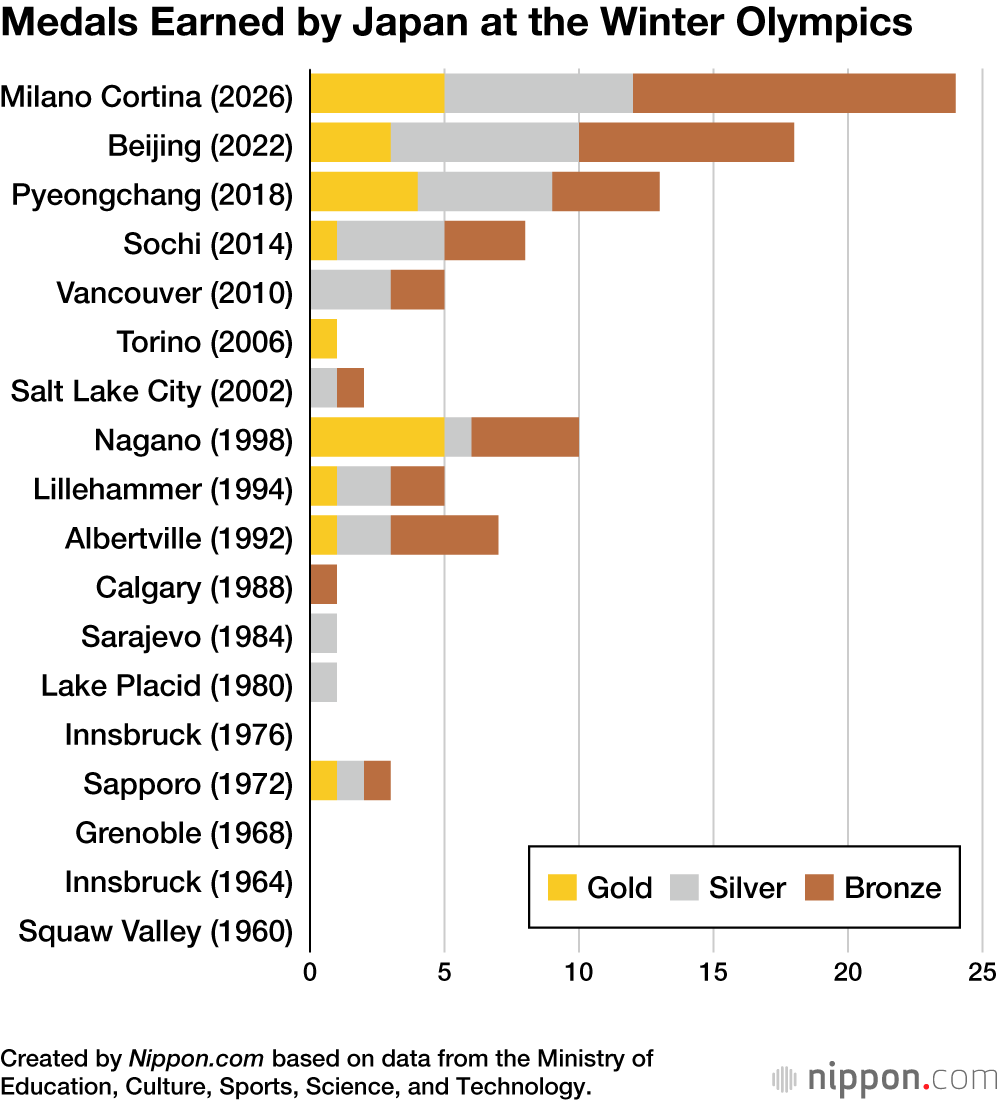
At Milano Cortina 2026, Japan took tenth place overall in the weighted medal count, with 5 gold, 7 silver, and 12 bronze podium finishes. Its 24 medals were an all-time high for the country’s Winter Games squad and placed the country fifth in the straightforward medal count.
Team Japan won the most medals among Asian countries, surpassing China in twelfth place with 15 medals (5 gold, 4 silver, and 6 bronze) and South Korea in thirteenth with 10 (3 gold, 4 silver, and 3 bronze). One factor behind Japan’s breakthrough was that it won a total of 9 medals in snowboarding alone. That was 6 more than the 3 medals (1 gold and 2 bronze) from Beijing four years ago.

Snowboarding medalists smile during a February 15 press conference in Milan. From left, men’s snowboard halfpipe bronze medalist Yamada Ryūsei, gold medalist Totsuka Yūto, and women’s bronze medalist Ono Mitsuki. (© Jiji)
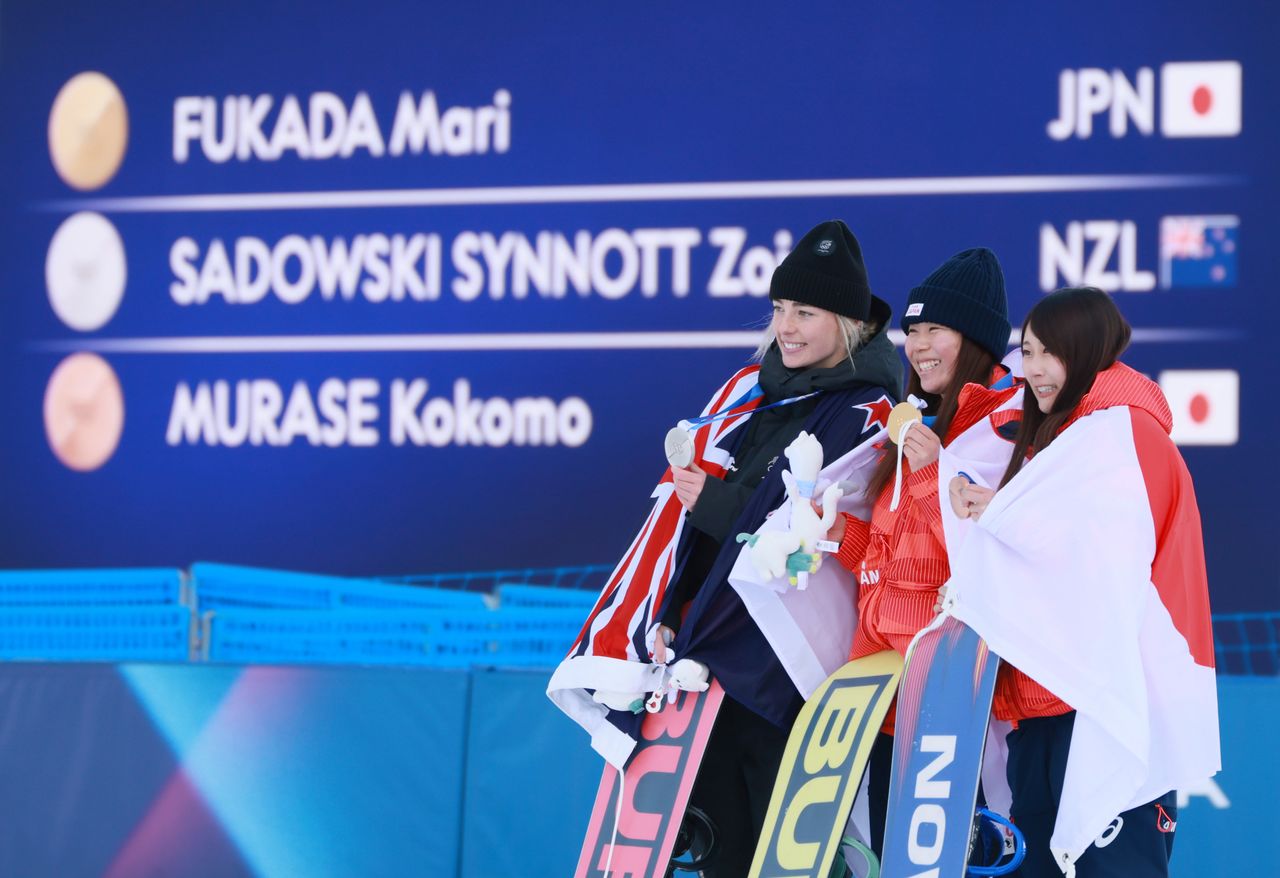
Fukada Mari (center) holds up her gold medal in the women’s snowboard slopestyle. On her right is teammate and bronze medalist Murase Kokomo, and on her left is silver medalist Zoi Sadowski-Synnott of New Zealand. Photograph taken in Livigno, Italy on February 18, 2026. (© Jiji)
In snowboarding, Japan won one gold and two bronzes in the halfpipe. In big air and slopestyle, it took three golds, two silvers, and one bronze. The momentum began on February 7, the day after the opening ceremony, when Kimura Kira and Kimata Ryōma claimed gold and silver in big air, lifting the spirits of Team Japan across the events that followed.
On February 9, Murase Kokomo, bronze medal winner in Beijing, took gold in women’s big air. Three days later, Totsuka Yūto then took gold in men’s halfpipe, giving Japan its second straight Olympic title in the event following Hirano Ayumu’s gold in Beijing. Then, on February 18, 19-year-old Fukada Mari won women’s slope style, becoming Japan’s youngest female Winter Olympic gold medalist.
Better Training Environment and Stronger Support
At medalists’ press conferences, Japan’s snowboard team members were frequently asked what propelled them to the top of their sport.
“The off-season training environment and coaching techniques have been evolving year by year,” noted Kimura Kira, gold medalist in men’s big air.
Ono Mitsuki, bronze medalist in women’s halfpipe, mentioned institutional backing as a key factor. “The new halfpipe training facility is a game-changer. As Japanese snowboarders started getting better results, support staff could travel overseas with us more frequently. We have physiotherapists and wax technicians. Support has expanded in so many ways.”
As Ono points out, improved facilities and support systems have been significant. There are now training facilities across Japan using air mats for safety during jump practice, allowing year-round practice. The athletes have developed their air work even during the summer, deepening their mastery of high-rotation tricks.
In recent years, the Ski Association of Japan has introduced biomechanics into national team training. Athletes wear sensors in their boots during practice, allowing coaches to utilize data obtained from scientific analysis instead of needing to rely only on their intuition. In the acrobatic events that demand nimble spins and flips, Japanese athletes’ relatively smaller physiques offer a physical advantage, which may also have contributed to the success.
A Legacy of Inspiration
However, infrastructure and support tell only part of the story behind the steady emergence of new heroes and heroines. Many in Japan, when reflecting on competitive snowboarding’s roots in the country, will remember Kokubo Kazuhiro, who represented Japan in the 2010 Vancouver Winter Olympics. He drew criticism for wearing his official team uniform with sagging pants; at a press conference where he was meant to apologize for this, he came in for even more flax due to a demeanor many saw as disrespectful, although some defended him for asserting his own style.
Thanks to team captain Hashimoto Seiko, he avoided being forced to withdraw. He didn’t win a medal, but he was an inspiration for Hirano, who went on to win silver at the 2014 Sochi Olympics at just 15 years of age. Kokubo has also served as Hirano’s coach.
At a press conference held in Milan on February 22, Hashimoto, now president of the Japanese Olympic Committee, spoke about watching the men’s big air final in person, where Kimura and Kimata won gold and silver, saying they reminded her of Kokubo. Kokubo’s career has remained checkered, including dark spots like a drug charge, but he continues to enjoy overwhelming support among young snowboarders.
“Kokubo is a legend, and Hirano grew up admiring him,” says Hashimoto. “These connections are producing excellent athletes. Hirano also delivered a performance that seemed unthinkable for someone who was injured. I think the sport has reached this high competitive level precisely because of the presence of such great legends.”
Having a hero to admire is an enormous source of motivation for younger generations of competitors. Moreover, as Hasegawa Taiga, who won silver in men’s slopestyle, notes, “If the athletes you aspire to are the best in the world, trying to surpass them naturally means aiming to become the best in the world yourself.”
Big Contributions from “Riku-Ryū” and Other Figure Skaters
Figure skating also played a major role in Japan’s medal surge. Led by Sakamoto Kaori, who announced her retirement this season and said this would be her last Olympics, the team won six medals across four events—men’s singles, women’s singles, team event, and pairs—missing only ice dance.
Ilia Malinin from the United States, who was widely expected to win the individual title, failed to reach the podium in the men’s singles competition coming after the team event, and the tight schedule was the subject of criticism. But for Japan, it seems that starting with the team event helped to foster a stronger sense of unity for the entire squad.
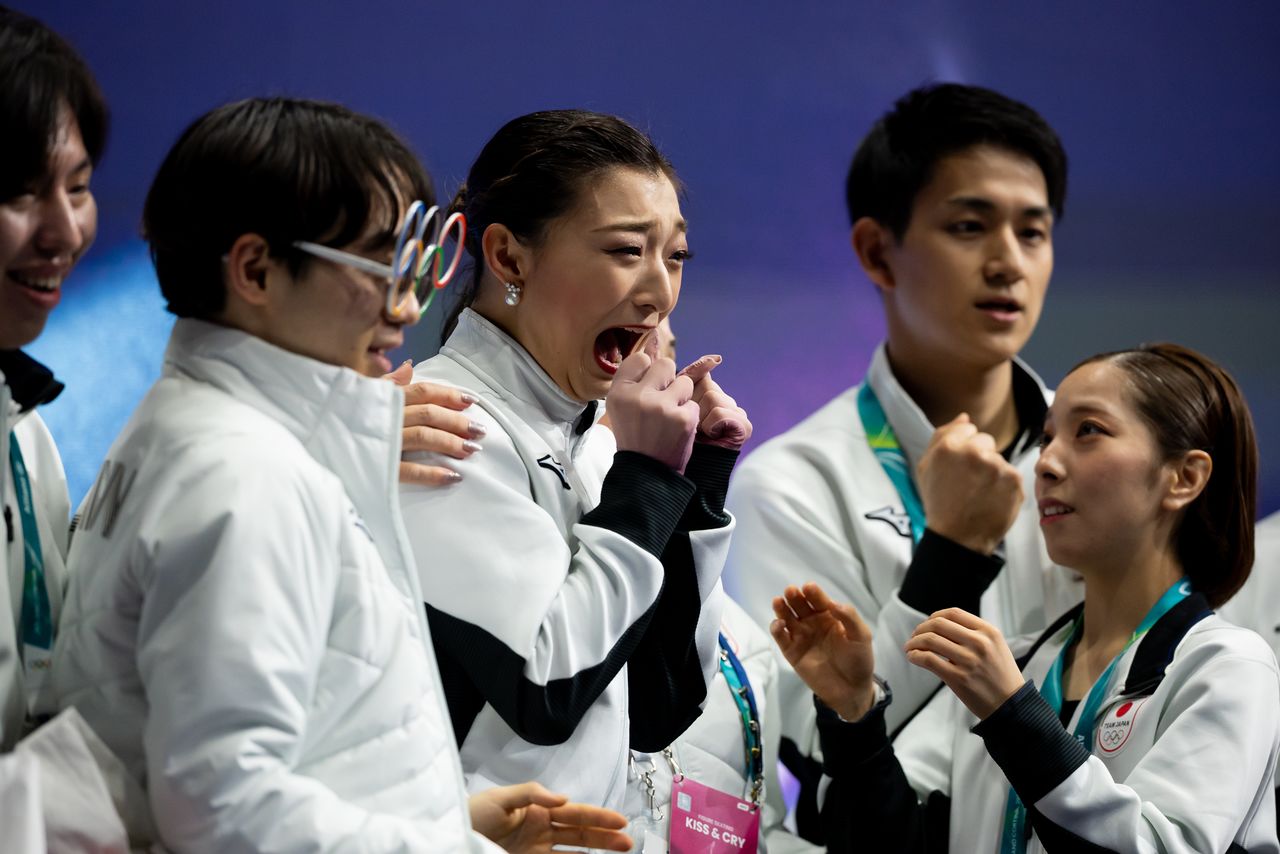
Team Japan celebrating the figure skating team event results at the Milano Cortina Winter Olympics on February 8, 2026. (© Zuma Press Wire/Reuters)
It can be said that Sakamoto’s bright personality energized the team, contributing not only to her own silver in women’s singles and Kagiyama Yūma’s silver in men’s singles, but also to podium finishes by “second-string” skaters such as Satō Shun in men’s singles and Nakai Ami in women’s singles.
And the “Riku-Ryū” pair of Kihara Ryūichi and Miura Riku delivered Japan’s first-ever Olympic gold in pairs, something that would have been unimaginable just a decade ago.
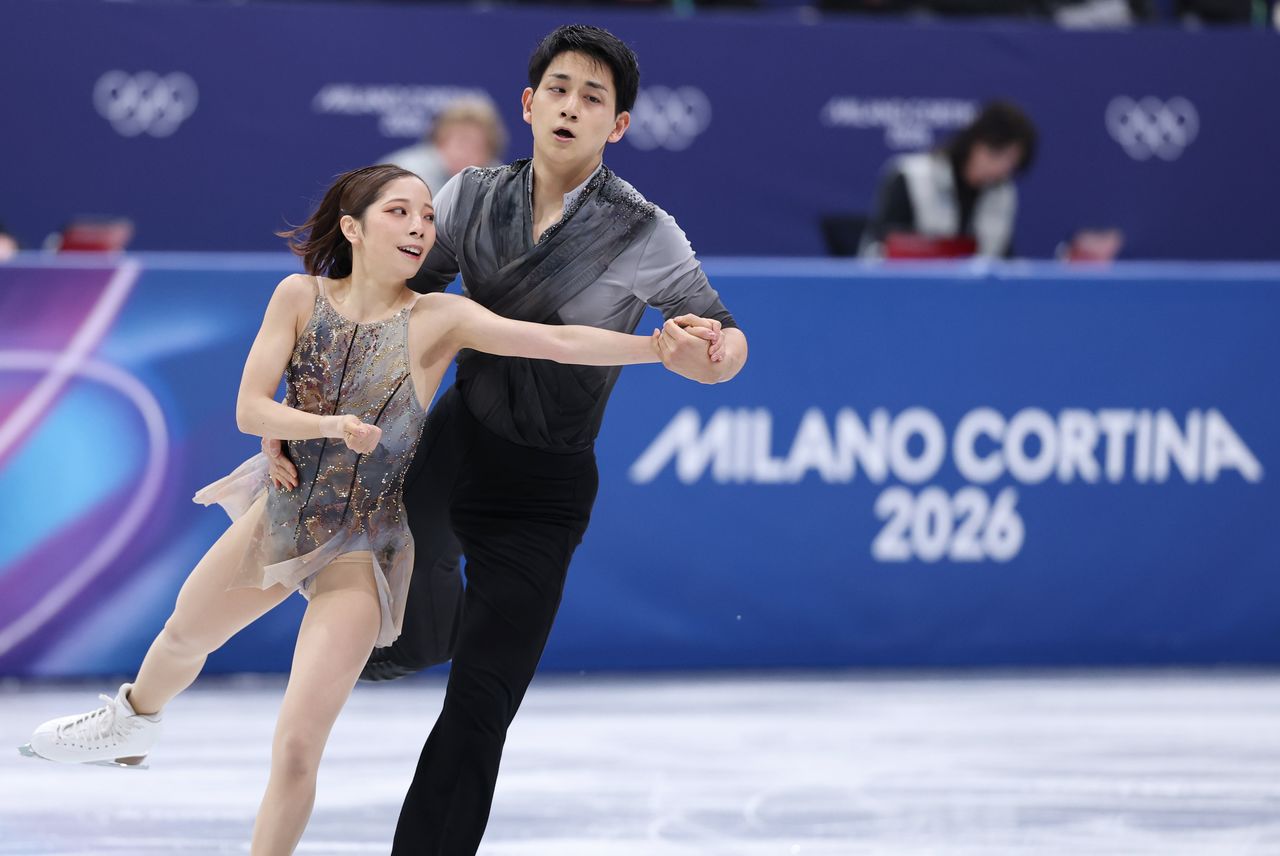
Miura Riku (left) and Kihara Ryūichi performing in the pairs free skate on February 16, 2026. (© Jiji)
JOC Training Camp Bore Fruit
On the mental side of things, the two-day training camp organized last April by the JOC for team building also proved helpful. It brought together prospective national team athletes from different sports to deepen cooperation and exchange as one Japanese team working toward shared goals.
Athletes at the training camp were given time to think about their own personal themes ahead of Milano Cortina. One athlete, the moguls skier Horishima Ikuma, stayed in the meeting room for an hour after everyone else had left. He later went on to win bronze in men’s moguls and silver in dual moguls.
His personal theme that he finally settled on was, “If I can find a goal, I’ll surely find a way to achieve it.” Horishima later revealed what that “way to achieve it” meant. “At the team-building session, I struggled to come up with the right words, and ended up staying behind. But in the process, I was eventually able to find my key phrase. For the Olympics, I focused on preparation. From arriving at the venue on February 2 until the dual moguls ended on February 15, I was able to follow my plan throughout, and I feel that was what allowed me to maintain my concentration.”
The buildup of these kinds of efforts led ultimately to Japan’s medal spree. In ski jumping, although there were no golds, the team matched its record of four medals set at the 1998 Nagano Olympics, with one silver and three bronzes. Maruyama Nozomi opened with bronze in the women’s individual normal hill. Nikaidō Ren then reached the podium in two men’s individual events, with bronze in the normal and silver in the large hill jump, and the mixed team took bronze.
Speed Skater Sets Major Record
The Milano Cortina Olympics also produced groundbreaking records for Japan. In speed skating, Takagi Miho won bronze in the women’s 500 meters, 1,000 meters, and team pursuit. Combined with her medals from Pyeongchang (one gold, one silver, and one bronze) and Beijing (one gold and three silver), her career total reached double digits, the most ever by a Japanese athlete, male or female, in Winter Olympic history. Japan won 24 medals this time, bringing its cumulative Winter Games total to 100. Fully a tenth of these have come from Takagi alone.

Takagi Miho in the women’s 1,500 meters speed skating at Milano Cortina on February 20, 2026. (© Jiji)
Japan’s public and private efforts to bolster the nation’s athletic performance accelerated after Tokyo was awarded the 2020 Olympic Games in September 2013. The success of this year’s Winter Olympic athletes can broadly be seen as part of that trend. However, considering the declining birthrate and economic conditions, even maintaining the current level—let alone achieving steady growth—will not be easy. Speed skating has historically been Japan’s most medal-generating sport, yet all of this year’s Olympic podium finishes involved Takagi, and the next generation expected to carry the team forward delivered only modest results. The factors behind success and the causes of underperformance should be analyzed one by one and put to use for shaping the future.
(Originally published in Japanese on February 27, 2026. Banner photo: Japanese athletes march into the closing ceremony of the 2026 Milan Cortina Winter Olympics in Verona, Italy, on February 22. © Jiji; pool photo.)