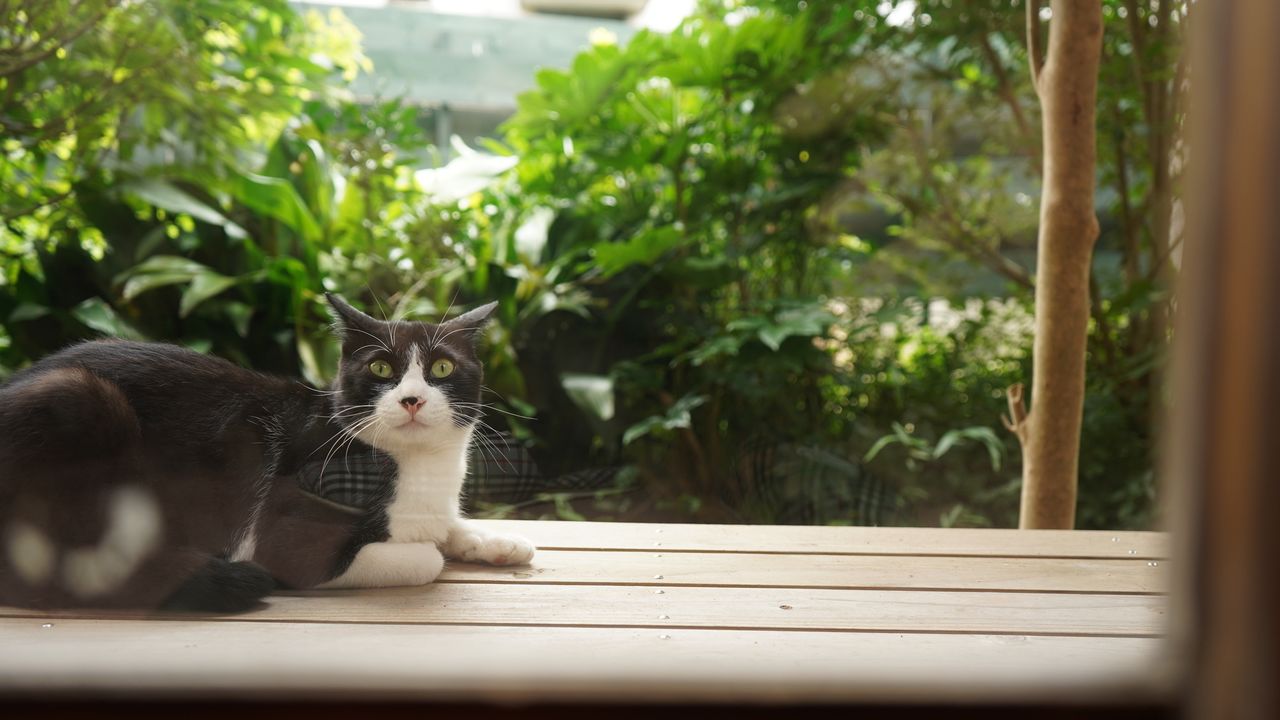
The Unnamed Cat Who Triggered Japan’s Literary Explosion
Culture Books- English
- 日本語
- 简体字
- 繁體字
- Français
- Español
- العربية
- Русский
Japan’s Original Feline Read
Japanese novels in translation related to cats currently form one of the most popular genres throughout the English-speaking world. But many people are not aware that nearly all these books have been influenced and inspired by Wagahai wa neko de aru (I Am a Cat), one of the landmark books in modern Japanese literature. Natsume Sōseki’s masterpiece can often confuse and surprise readers who come to it expecting little more than a lightly comical read. The book has many amusing moments, but also some of the most profound and fiercely satirical writings in the whole of Japanese literature.
At the time when I Am a Cat was published to wild public acclaim in serialized form in 1904–6, Sōseki seemed like the last person anyone would have expected to write such a book. He had only recently been appointed as the first Japanese lecturer in English literature—replacing the popular Anglo-Irish writer Lafcadio Hearn—at the prestigious Tokyo Imperial University. Sōseki was lauded as a distinguished intellectual, someone who had been hand-picked by the government to study abroad at public expense for two years, and whose lectures were notoriously rigorous and scientifically analytical. The lecturer himself, in his “high collar” formal Western dress, exuded a forbidding air of Westernized pretentiousness.
What the stern public image of Sōseki disguised was a man who in his private life teetered on the brink of nervous breakdown. Holding down jobs at three teaching institutions, while continuing the writing of his monumentally exhausting work The Theory of Literature, Sōseki felt intense pressure to prove himself and to support his wife and several young children. He succumbed to frequent bursts of rage and rounds of frenzied paranoia, often believing that he was being watched and having tricks played upon him.
Fearful of his precarious mental state, Takahama Kyoshi, a literary associate and mutual friend of the recently deceased haiku poet, Masaoka Shiki, came to Sōseki and suggested that as a form of therapeutic recreation he might write something for the magazine Hototogisu (“The Cuckoo”) that Kyoshi edited. Soseki had never published any form of fiction before, and hesitated about what he might write. Then, suddenly, an idea came to him, and he penned perhaps the most famous opening line in all modern Japanese literature:
I am a cat. As yet, I have no name . . .
This wasn’t just an opening line. It was also perhaps the greatest haiku of modern Japan, and the point at which the modern era of Japanese literature truly begins. Surging through the author were comedic currents from a vast hinterland of literary influences and scholarship—Sōseki was Japan’s leading expert on eighteenth-century Anglo-Irish satirists like Jonathan Swift and Laurence Sterne, but he also had a profound love of the Edo-period comic traditions of the yose theatre and humorous kokkei bungaku. Stepping out of his day job as a renowned intellectual and assuming the persona of a nameless feline, Sōseki was able to sketch merciless portraits of both himself and his coterie and the intellectual pretensions of the age.
More Than Just Comedy for This Cat
Into I Am a Cat Soseki fed all his intellectual obsessions—his contemplations on fine art, his love of Zen and German philosophy, his scientific and social theories—and lampooned them all. Sōseki displayed an extraordinary ability to interrogate and challenge as absurd his own patterns of behavior and ways of thinking. Whole sequences of I Am a Cat represent comical inversions of deadly serious rants Soseki had penned in his own notes or in the marginalia of books he had read. Hidden behind the veneer of humor, I Am a Cat represents a feat of “dialogical imagination” where, as in The Brothers Karamazov, the characters debate profound ideas about human existence. Soseki even satirized his own frequent bouts of paranoia in his depictions of nosy neighbors constantly eavesdropping, or the central character Sneeze being driven to distraction by baseballs being continually lobbed into his garden.
I Am a Cat launched the explosive outpouring of Sōseki’s pent-up literary genius. Within three years of the book’s commencement, he had resigned his position at Tokyo Imperial University and taken to full-time writing as the star novelist of the Asahi Shimbun. His complete works have astonishing range, complexity and a dazzling array of styles—covering over 20 volumes—and were written in just 12 years.
At first, Sōseki was mistakenly perceived as a “comic novelist”—one critic even wrote that Sōseki was incapable of writing a line that wasn’t funny. There was a widespread misconception that he turned increasingly dark and serious as his literary career progressed. Yet in fact all the black comedy and profound seriousness was already there in I Am a Cat, while all the later novels, too, far from being archly earnest, also teemed in ironic inversions of meaning.
I Am a Cat was first translated into English in 1972 by Itō Aiko and Graeme Wilson, who turned a tricky text into what reads like a quirky novel of Edwardian England. A retranslation seemed long-overdue, and was finally (partially) delivered in 2025 when Nick Bradley, author of The Cat and the City and Four Seasons in Japan, tried his hand at his own modern version of the first of the three volumes of I Am a Cat.
Bradley’s version strives to reproduce the reading experience of a Japanese person of the late Meiji era (1868–1912). This English translation embeds the novel firmly in its Japanese milieu—here and there kanji characters are reproduced and satirical names are left untranslated—yet (somewhat jarringly) modern English profanities are scattered across the text to give the book a visceral, contemporary feel.
It is enjoyably readable, though I found myself already dreaming of other versions that might restore the names of the scientist from “Kangetsu” to “Coldmoon,” the crass businessman from “Kaneda” to “Goldfield,” and introduce in the next volumes the Zen obsessive “Dokusen” as “Monopole” in order to luxuriate a little more in the darkness of the satire.
Opening New Paths for Modern Literature
The novel opens with a fantastic description of the cat verbally describing his master while his master sketches a portrait of the cat, a reflection of Sōseki’s deep contemplation of the competing potentialities of visual and literary art. Bradley notes that Sōseki’s persona is to be found both in the cat narrator and the master of the house, “Sneeze” (“Kushami” in Bradley’s version). Yet a defining aspect of Sōseki’s character is also discovered with the entrance of the fabulously dandyish character “Maze” (“Meitei” in Bradley’s version), the intellectual berserker of the novel, spinning absurd stories and pricking pretensions wherever he meets them.
Even in the first volume, there are episodes of some the darkest humor you will ever encounter. The scientist Coldmoon’s upcoming lecture is on the subject of “The Mechanics of Hanging Yourself,” and Meitei/Maze recounts how on an evening stroll he encounters “Hang-Neck Pine,” a tree famous as the perfect place to hang yourself, but when he heads back there to experiment, someone is already hanging from it. Sneeze meanwhile sits composing a commemorative poem to a recently deceased friend that reads, “Born into the void, / He researched the void, / But died in the void.”
Sneeze translates a story called “Great Gravity” and Coldmoon conducts research into the Earth’s magnetic field, but all the characters are constrained within the ultimate force field of Death itself, ready to draw them in at any time. When the cat narrator wanders off to see his love interest, “Miss Calico,” he discovers that she is already dead. Sneeze is assured by his wife that with his chronic dyspepsia he can’t expect a long life (Sōseki himself died at age 49 of a stomach hemorrhage). I Am a Cat is on-the-edge laughs emanating from a feline observance of the utter absurdity and fleetingness of human existence.
In his introduction, Bradley compares his translation task to that of a translator of Don Quixote, and the comparison is apt. I Am a Cat, like Don Quixote in Spanish and Tristram Shandy in English, is not just a landmark comedy, but a work helping to redefine the means in which stories can be told, weaving in and out of narratives and infusing the everyday with a deep reservoir of imaginative possibility.
A Feline Exploration Echoes Today
Sōseki has indeed become so profoundly associated with the “cat” that many researchers have attempted to uncover whether he actually had a special bond with the animal. (In fact, he was just as fond of dogs and once got into trouble with the authorities because of his dogged determination not to have a canine pet interfered with.) Yet in the stealthiness of his movements and shrewd contemplation of the human world around him, there was indeed something beguilingly catlike about Sōseki.
Whereas dogs in Japanese history are traditionally associated as symbols of authority with the shogun and the samurai class, the cat was more usually the representative of the subversive townspeople. Sōseki’s elision of his literary voice with that of a cat at the beginning of the twentieth century seems prophetic of a world where the certainties of a previous age would be questioned as people began to move and explore the world with greater freedom.
By stepping out of himself into the persona of a cat, Sōseki was casting aside all his pretensions, learning and social status and skewering the world with the thrusts of a entirely fresh vision. He did not know where that quest into the unknown would take him—he had “no name.” The world was there to be discovered anew. It is fascinating that the feline reimagination of Japan was not just the means by which modern Japanese literature explosively rose to new heights, but also a large part of the means by which new waves of modern books have ultimately transmitted an interest in Japan to readers around the world.
(Originally written in English. Banner photo © Pixta.)