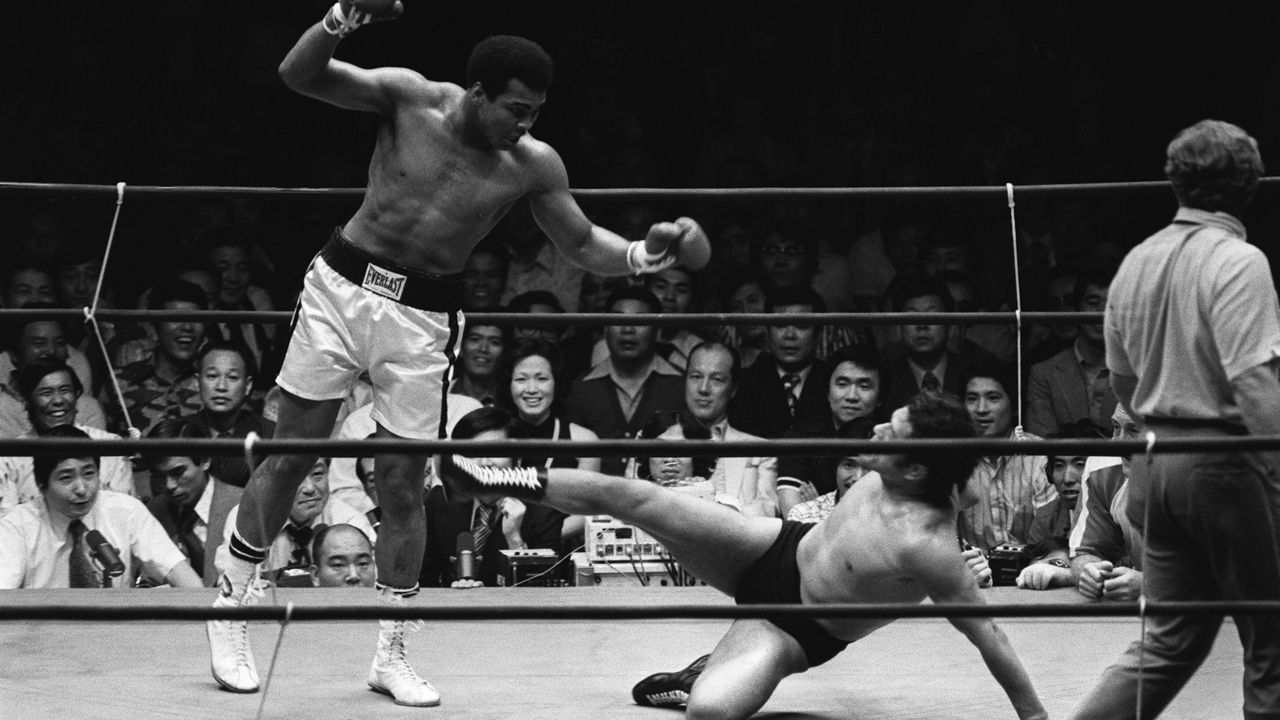
Ali vs. Inoki, 50 Years On: A Legendary Night in the Genesis of MMA
Sports Entertainment- English
- 日本語
- 简体字
- 繁體字
- Français
- Español
- العربية
- Русский
“The Greatest” Makes Boxing an Art
Half a century ago, on June 26, 1976—at what was then Japan’s largest indoor arena, the Nippon Budōkan in central Tokyo—an all-time fantasy matchup of cross-code combat sports became a reality: world heavyweight champion boxer Muhammad Ali against Japanese wrestling legend Antonio Inoki.
In keeping with his familiar maxim, “I am the greatest,” Ali was a truly historic figure––not just one of the greatest boxers of all time, but one of the greatest athletes in any sport, an assertion that surely not even such luminaries as Mike Tyson, Michael Jordan, Carl Lewis, Tom Brady, Tiger Woods, Lionel Messi, or Cristiano Ronaldo would seek to challenge.
Another famous catchphrase that became synonymous with Ali style dates back to the days when he still went by Cassius Clay: “Float like a butterfly, sting like a bee.” Circling the ring with nimble footwork, he would pepper his foes with lightning-quick jabs. And as they struggled to land a glove on him in return, he would steadily break opponents down until they were ready to be set up and sent to the canvas with a devastatingly accurate straight right hand.
While knockouts are to be expected when men of this size clash, Cassius Clay brought a natural speed that turned heavyweight boxing into an artform, captivating spectators with superlative skills as he dominated all comers while barely receiving a scratch in return.
From Triumph to Injustice, to Triumph Again
Not only would Clay predict the round in which a knock-out would come (and routinely make good on said promises), he would also taunt his opponents, playing the heel in order to build excitement. Ahead of his February 1964 bout against the unified WBA/WBC world champion Sonny Liston, Clay addressed reporters with a rhyme:
“If you like to lose your money, be a fool and bet on Sonny.
But if you wanna have a good day, then put it on Clay.”
This notorious gift of the gab has seen the future Muhammad Ali lauded not only as a pioneer of sporting trash talk, but also among the godfathers of rap music.
It was soon after claiming his first world titles, with his victory against Liston after just six rounds, that Clay converted to Islam and changed his name to Muhammad Ali. But only two years later, in March 1966, his refusal of the draft to fight in the Vietnam War saw him stripped of his belts and boxing license as he was sentenced to five years in prison and a $10,000 fine.
Unbowed by the wrath of the white ruling class, Ali took on the establishment in the Court of Appeals. In 1971, his conviction was finally overturned. It was yet another famous triumph for “the greatest,” this time over the power of the state itself.
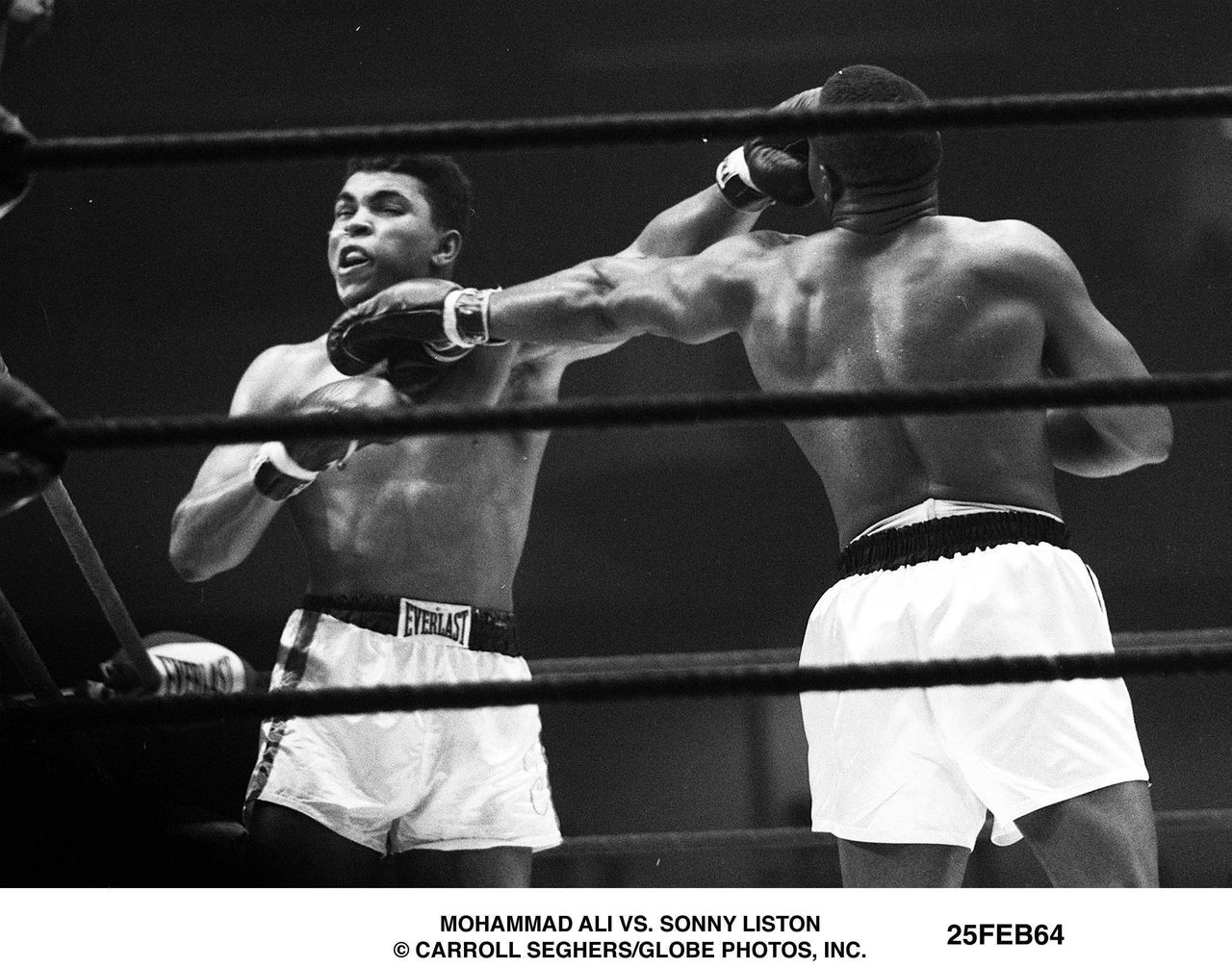
Clay (at left) takes on Liston in their first match-up, February 25, 1964. (© Zuma Press Wire via Reuters Connect)
To a professional athlete, three years of exile from competition can feel like a lifetime. By the time Ali returned to the ring in October 1970, he was already 28 years old. Past his prime and his reflexes beginning to dim, he began to take punches in a way that would once have been unthinkable.
Ironically, it was these brutal slugfests with fellow heavyweight titans, including three grueling battles against Joe Frazier, plus a loss and a broken jaw at the hands of Ken Norton, that would take Ali’s career to the next level. Then, in 1974, came the Rumble in the Jungle, when Ali’s stunning come-from-behind victory over 25-year-old power puncher George Foreman to reclaim the world title on a sweltering night in Kinshasa, Zaire, is said to have been watched by up to a billion people around the globe.
Combat Sports and Entertainment
Exhausted after years of punishment, Ali began to wonder if there wasn’t an easier way than boxing to make a living. He put out an open call to challengers from other codes of combat, and eventually the Japanese wrestling legend Antonio Inoki stepped forward, with backers offering a staggering purse for the time of $6.1 million.
In the 1970s, while boxing was unquestionably viewed as a genuine sport, professional wrestling, with its predictable pattern of heroic, dashing “faces” putting villainous “heels” in their place, was dismissed as mere entertainment––scripted and choreographed to excite the fans rather than to establish a victor.
Ali naturally assumed that his bout with Inoki would be no different, and presumably viewed the eye-watering purse as no more than was appropriate to bring a superstar such as himself into the wrestling ring.
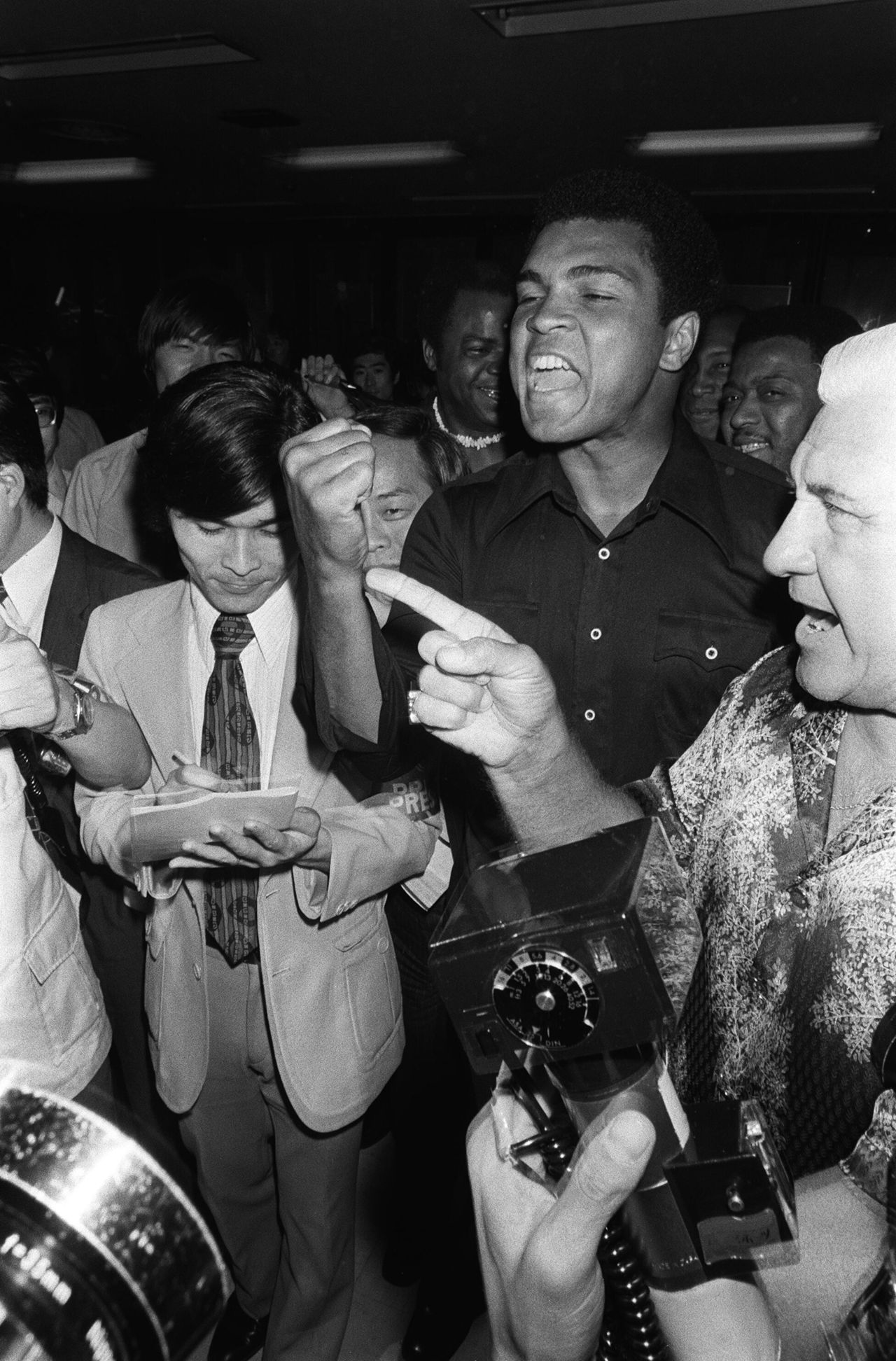
Arriving at Tokyo’s Haneda Airport on June 16, 1976, Ali promised to dispatch Inoki with only one punch. (© Jiji)
The money-making opportunity afforded by a boxing-wrestling crossover match featuring a current world champion was also seized upon by both legendary boxing promoter Bob Arum and young US pro wrestling impresario Vince McMahon, who would later come to dominate the wrestling world as the chairman of WWE. Nonetheless, their belief that closed-circuit screenings of the fight would be a guaranteed money spinner ultimately proved to be misplaced.
Inoki Has Different Ideas
To Inoki, however, what most saw as merely a cushy cash grab represented a genuine chance to prove his mettle on the global stage. “I want to overturn the embarrassing perception of pro wrestling as some kind of pantomime,” he would later insist. “I want to knock Ali out in the ring and prove to the whole world how strong pro wrestlers really are.”
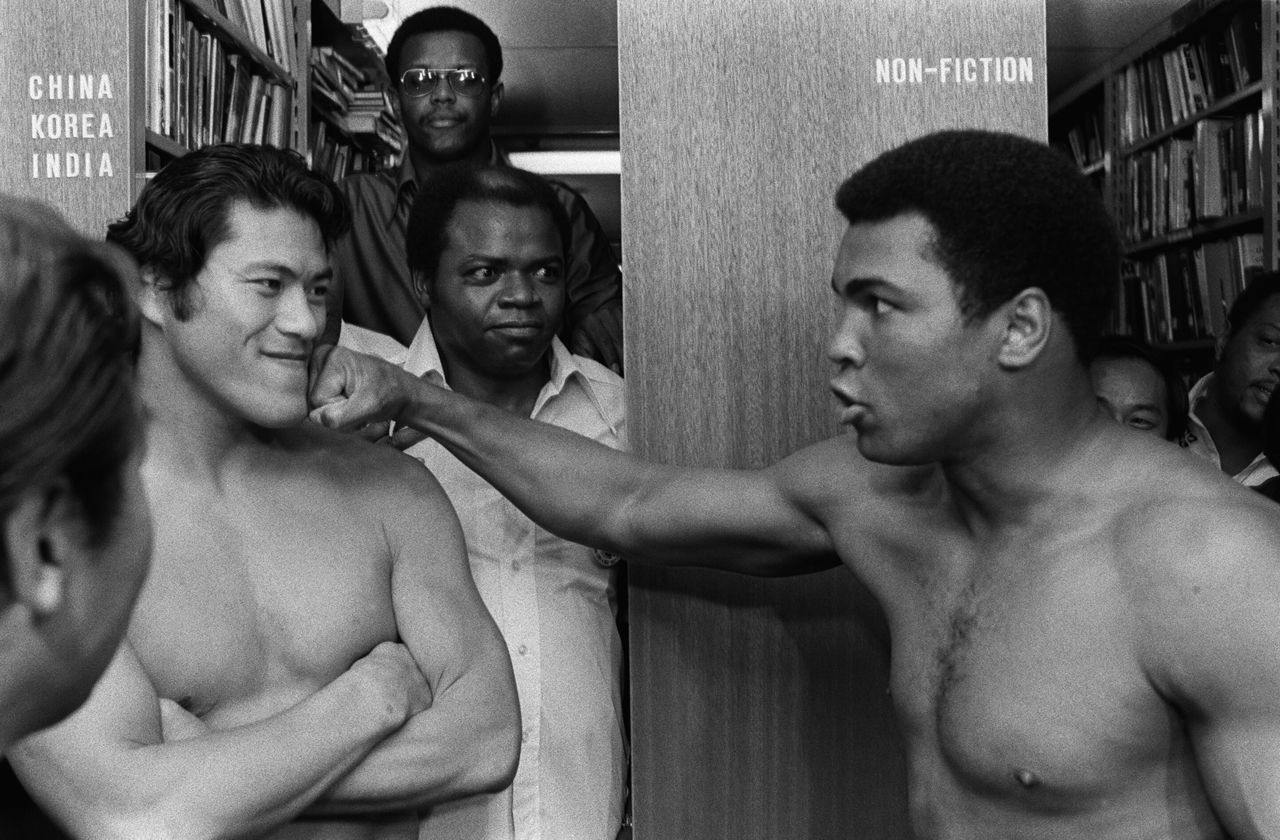
Sparks fly at the June 18, 1976, press conference at the Foreign Correspondents’ Club of Japan in Chiyoda, Tokyo. (© Jiji)
Having come to Japan geared up for an exhibition match, Ali was alarmed to learn of Inoki’s intentions, but ultimately agreed to take part in a real fight, with lengthy deliberations conducted to decide on a special set of rules for the occasion.
To modern readers acquainted with the world of mixed martial arts, these stipulations may seem straightforward enough: Ali would wear gloves and fight standing up, under broadly defined boxing rules, attempting to put his opponent down with punches, while Inoki could use his grappling skills to take his opponent down and incapacitate him with locks and holds.
The Worst Match in History?
What actually unfolded on fight night, however, would leave audience, announcers, and cornermen alike dumbfounded––because it in no way resembled a proper contest.
Despite his mastery of wrestling techniques, Inoki was unable to get inside Ali’s punches to attempt a takedown, and instead chose to simply shuffle around the ring on his back and target the boxer’s legs with vicious kicks.
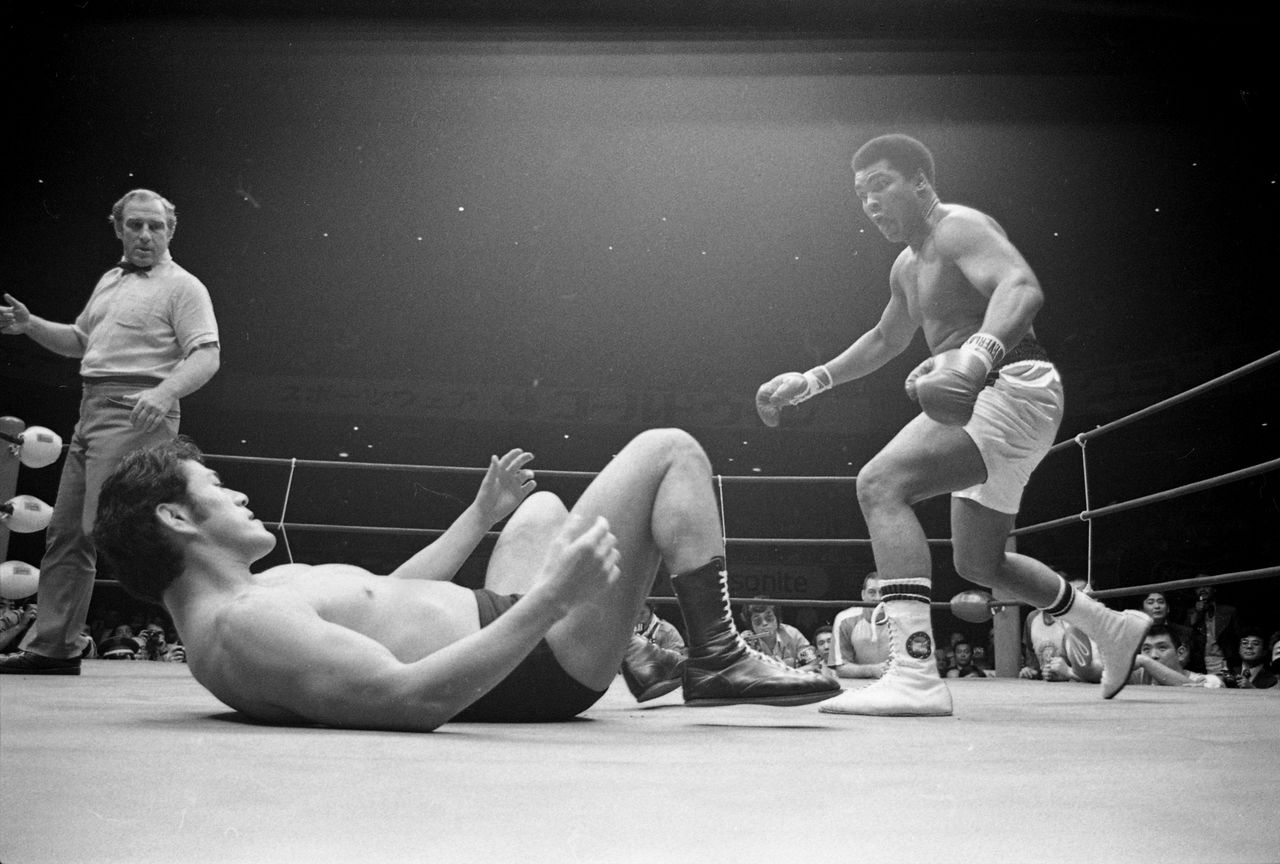
Inoki stays on the mat as he delivers kick after kick to the approaching Ali’s legs. (© Jiji)
Meanwhile, without the necessary “ground and pound” experience to punish a prone opponent, the world’s greatest boxer was reduced to hurling insults, calling Inoki a coward and yelling at him to stop fighting on the floor like a “sissy” and stand up “like a man.”
After 15 three-minute rounds, the match ended in a stalemate, and the scorecards were read out to a chorus of boos and abuse from the crowd: “What a rip off! We want our money back!” Newspapers in Japan and overseas decried the lack of action, and even called Inoki an “embarrassment.” One NHK newscaster reported that, “Just as planned, the match ended in a draw.”
The Seeds of Later Success?
But in reality, there was nothing “planned” about it. Ali and Inoki had each done their utmost to win within the stipulated rules, but the limitations placed on them meant that the result was a lackluster spectacle, and it would be many years before the true value of this historic crossover match was accepted.
Indeed, it would be decades later, in 1993, that the UFC took form—a cross-code promotion that popularized the idea of mixed martial arts in which almost anything goes, from punches and kicks to knockdowns, joint locks, and chokeholds. In 2005 the MMA training camp reality TV show The Ultimate Fighter brought a further explosion in popularity for the sport around the globe.
Then, in April 2014, at the age of 71, Muhammad Ali himself posted a photo from his match against Inoki to his social media, addressing it to UFC CEO Dana White with the caption: “What you think @DanaWhite? Muhammad Ali—the original #MMA fighter?” To this White replied that this was the “greatest tweet” he had ever received, hailing Ali as “the original everything” and “the reason combat sports is where it is today.”
Today, 50 years after Ali and Inoki took to the ring together, their historic matchup is rightly seen as a crucial step in the genesis of modern mixed martial arts.
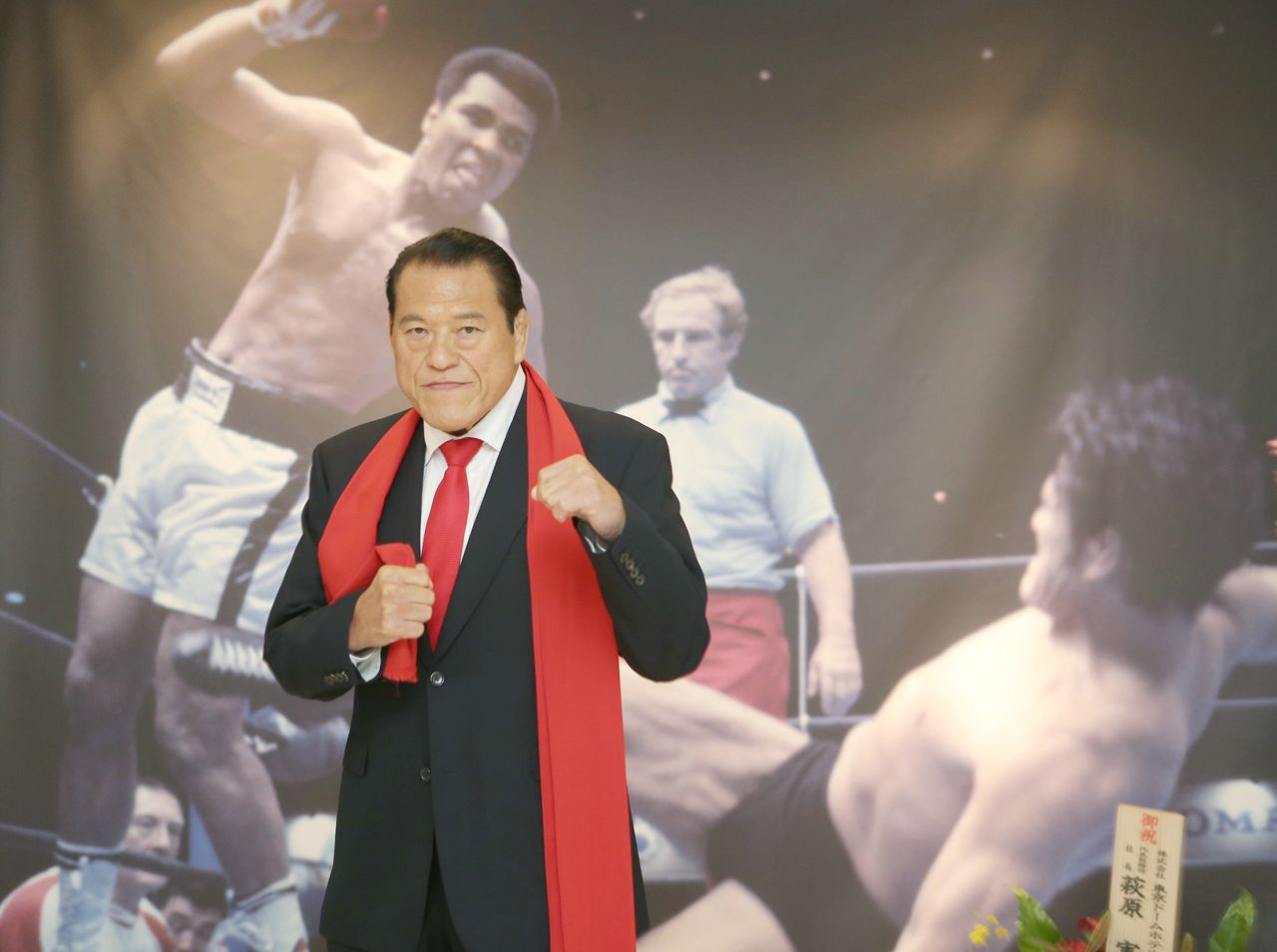
Antonio Inoki at a May 2016 press conference held by the Japan Anniversary Association to declare June 26 “World Combat Sports Day.” (© Jiji)
(Originally written in Japanese. Banner photo: A scene from the bout between Muhammad Ali and Antonio Inoki on June 26, 1976, at Tokyo’s Nippon Budōkan. © Jiji.)