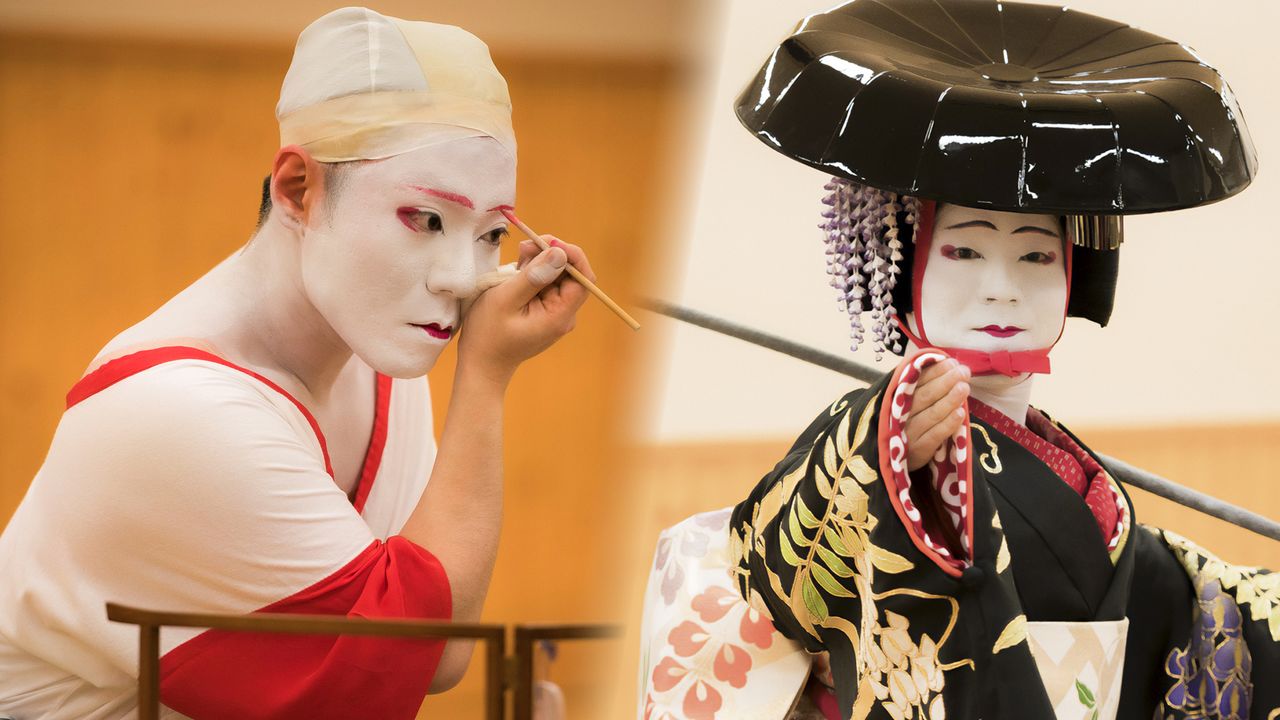
Becoming an Onnagata: Takanosuke Brings the Art of Transformation to Europe
Entertainment People Japan in Video Culture
Nakamura Takanosuke
Kabuki actor. Born Watanabe Dai in Tokyo in 1999. Eldest son of Nakamura Tomijūrō V, a kabuki actor and living national treasure. In 2001, at age two, was given the name Nakamura Dai and took the stage for the first time. In 2005 made his debut performance as Takanosuke in the drama Kuramayama homare no wakataka (The Famed Hawk of Mount Kurama). Earned a degree in economics from Gakushūin University.
- English
- 日本語
- 简体字
- 繁體字
- Français
- Español
- العربية
- Русский
The Centrality of Onnagata to Kabuki
Nakamura Takanosuke toured Paris, Rome, and Cologne from April 9 to 23 under the banner “Meet Kabuki: The Art of Onnagata Europe Tour.” Although generally known for his tachiyaku (male) roles, Takanosuke hoped to famliarize international audiences with a broader range of kabuki characters by presenting an onnagata dance.
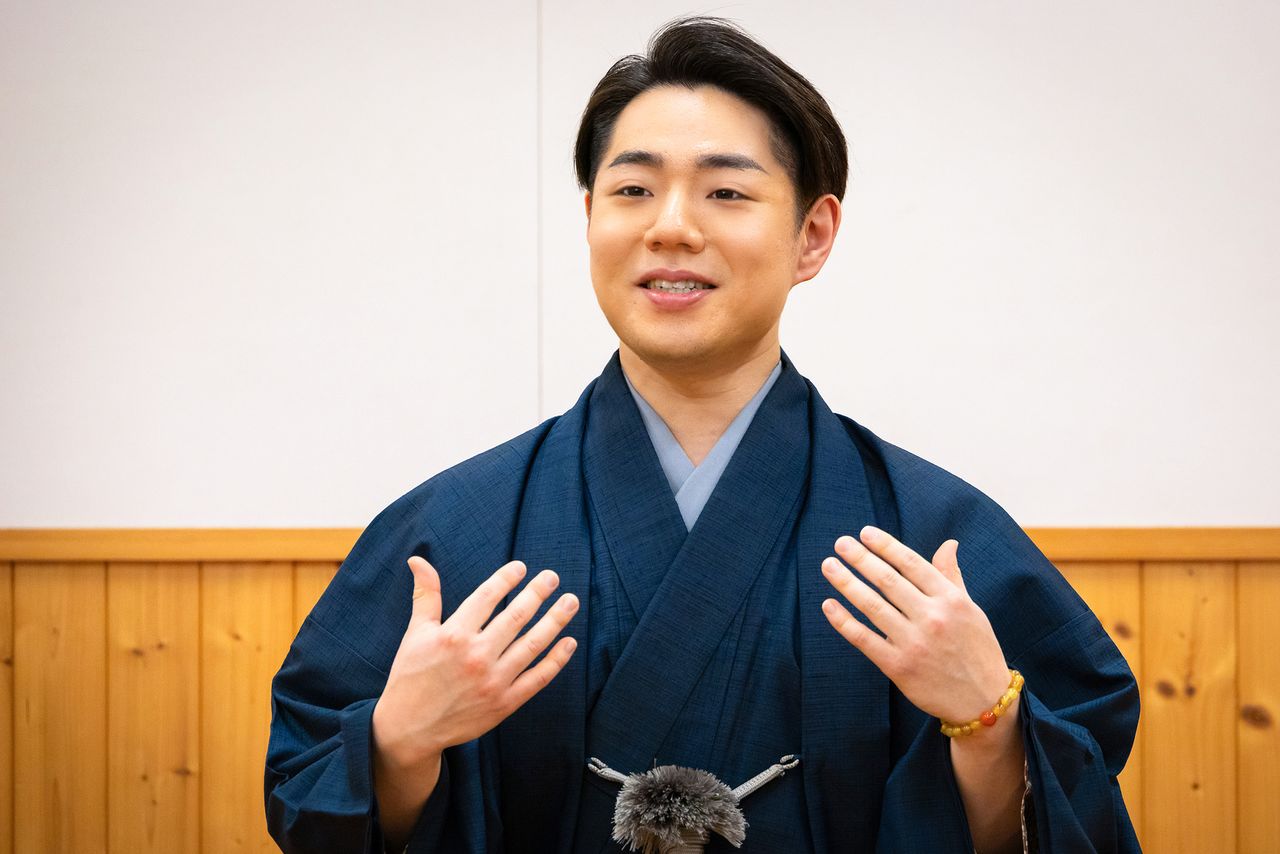
In February 2026, Takanosuke spoke in Ginza, Tokyo, about his hopes for the European tour. (© Nippon.com)
Speaking to the media in Tokyo before the tour, he emphasized the centrality of onnagata to kabuki: “The onnagata is a fundamental element of the genre. I usually appear as a tachiyaku in acting roles, but in dance I also perform as an onnagata. Even when playing male parts, you need to understand the inner sensibility of the onnagata. All kabuki actors, without exception, study onnagata dance from childhood.”
For the tour he performed Fujimusume (Wisteria Maiden), a dance portraying the innocent stirrings of a young woman in love. Considered essential training for any kabuki dancer, the piece features a rich array of core onnagata techniques and the essence of traditional Japanese dance. Takanosuke first performed it at age 15 at his privately organized recital series, Shōnokai.
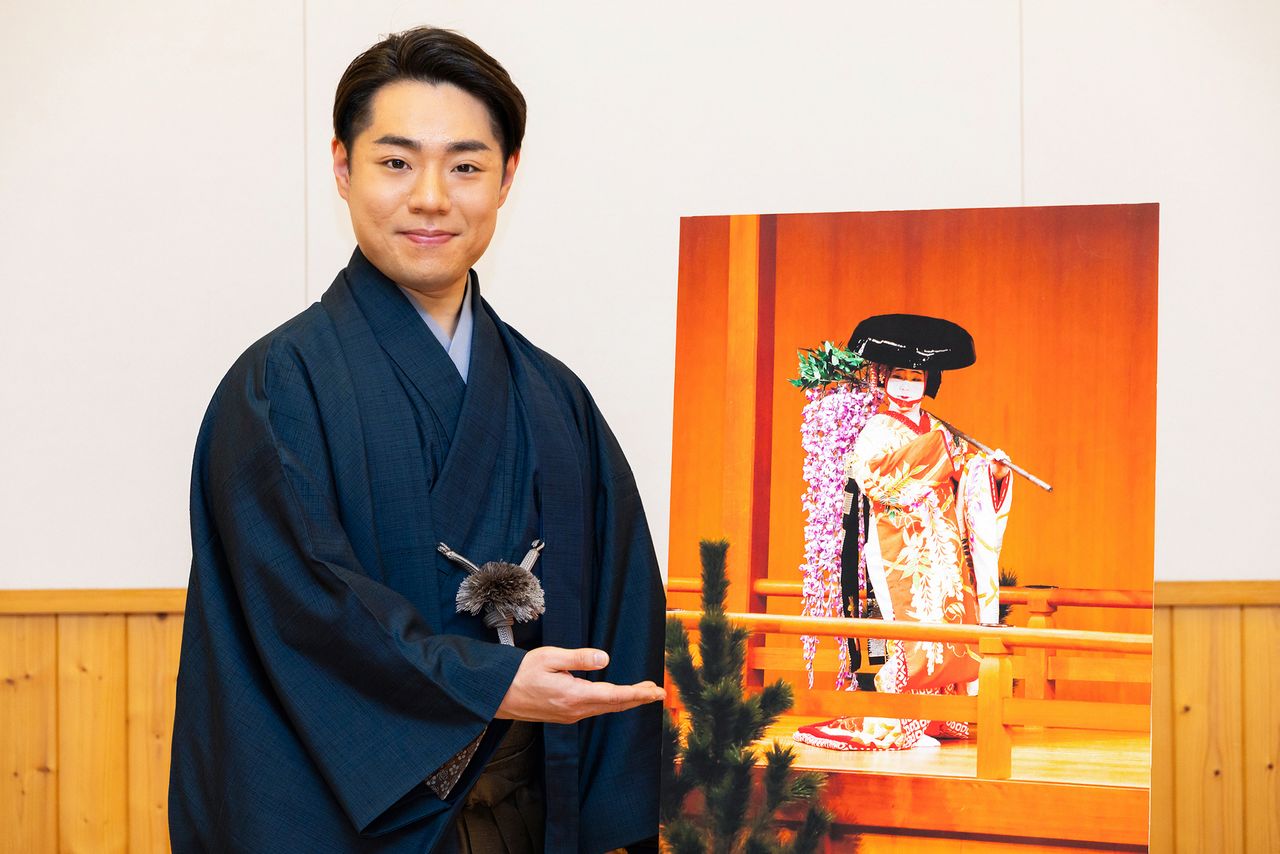
“Meet Kabuki: The Art of Onnagata Europe Tour” took place at Japan Foundation facilities in three European capitals in April 2026. The tour poster featured the actor in his Shōnokai performance of Fujimusume. (© Nippon.com)
A Tradition Refined Over 400 Years
Kabuki traces its roots to the kabuki odori created by Izumo no Okuni in 1603. As its popularity surged, the shogunate banned women from performing, citing concerns over public morals. Men stepped into the female roles, and across four centuries the artistry of the onnagata evolved into a highly refined aesthetic.
Takanosuke initially made a name for himself with his aragoto (dynamic acting style), but is equally respected for his elegant dance. His late father, Nakamura Tomijūrō V (1929–2011), was a living national treasure who excelled in both tachiyaku and onnagata roles.
The first-generation Tomijūrō, active in the mid-Edo period, was a leading onnagata celebrated especially for dance (shosagoto). He performed the lead role in the premiere of Kyōganoko Musume Dōjōji, which remains one of the quintessential onnagata dances today.
The inaugural Tomijūrō’s father was the legendary onnagata Yoshizawa Ayame (1673–1729), whose treatise Ayamegusa laid down the principles of the art—including the famous dictum that an onnagata must “live as a woman even offstage.” His ideas shaped the careers of generations of performers.
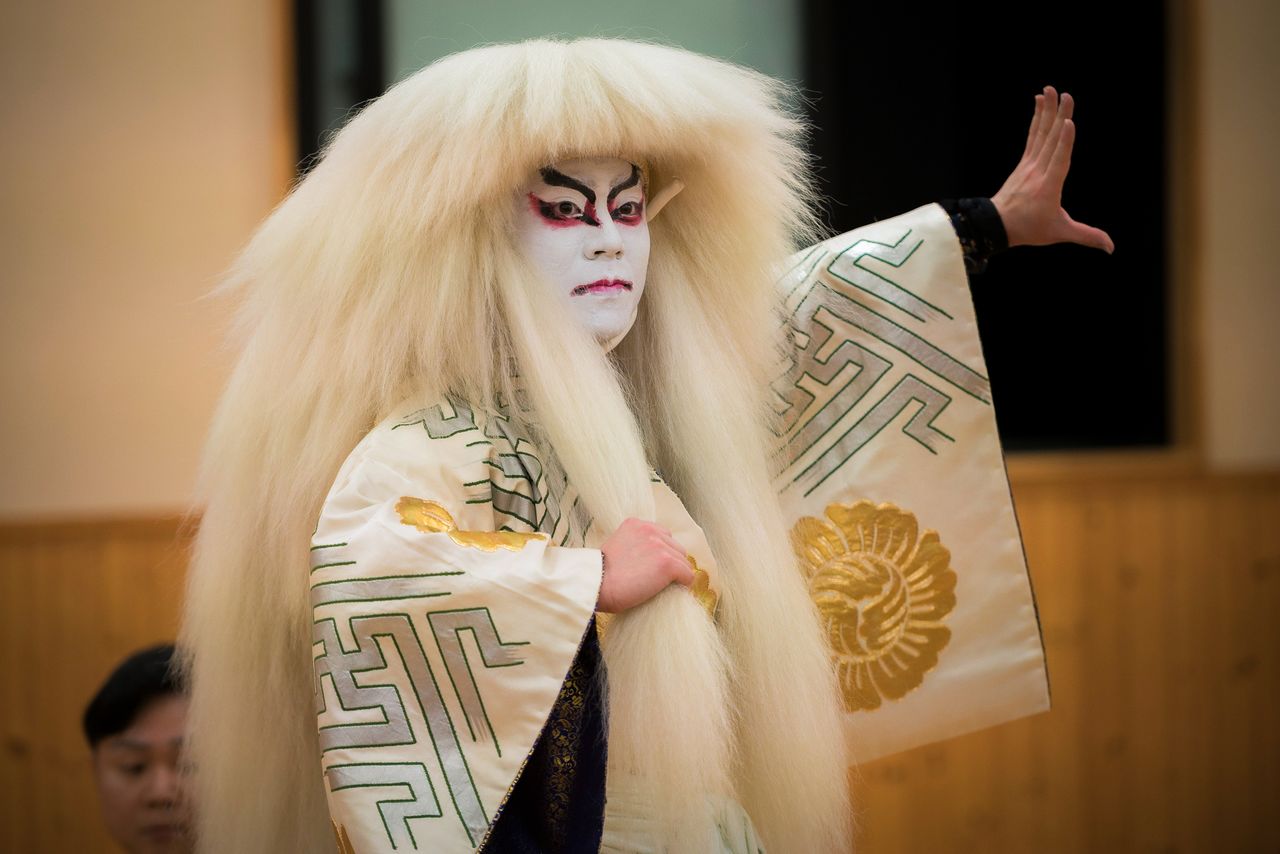
Takanosuke performs a complete run-through of his tachiyaku role in the play Shakkyō at Tokyo’s Kabukiza theater as part of preparations for performing it in Paris in April 2026. (© Matsuda Tadao)
Makeup as a Window into Character
For the European tour, Takanosuke performed the makeup and costume dressing—normally done backstage—in front of the audience. Accompanied by the sharp, dramatic wooden clacks of the tsuke, he entered the stage and struck a powerful mie pose before sitting at a dressing table to apply white makeup, don a wig, and layer on the ornate costume of the Wisteria Maiden. It was an inventive presentation that revealed, step by step, how he transforms into an onnagata.
Kabuki actors do their own makeup—an essential part of “becoming” their role. The process begins with bintsuke oil to help the makeup adhere, followed by dōran (oil-based foundation) to blank out the eyebrows and lips. Over this, white powder is applied, and new eyebrows are drawn with practiced precision.
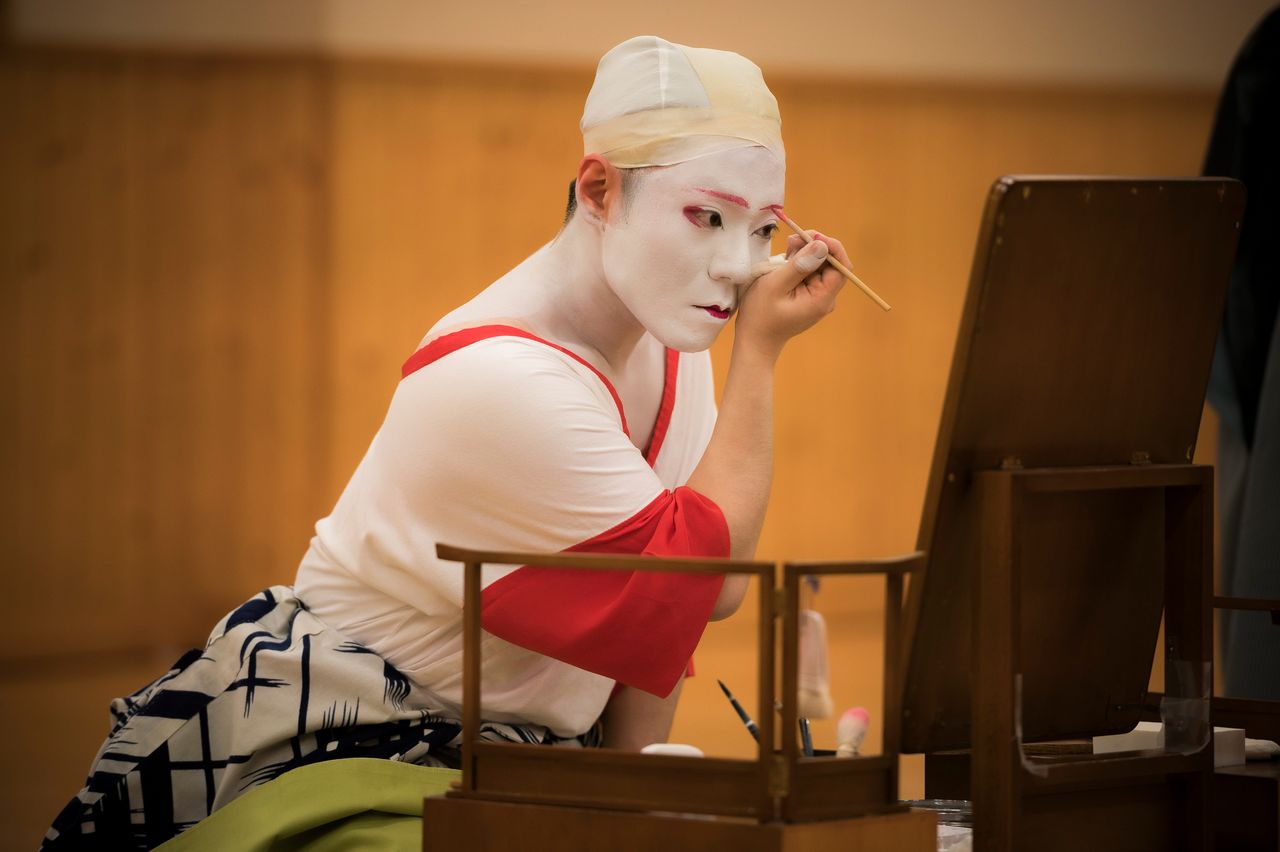
Kabuki actors handle their own makeup duties. (© Matsuda Tadao)
Kabuki makeup is a visual code. For tachiyaku roles, white is used for young men, virtuous characters, and nobility; reddish tones for bold or heroic roles; and natural skin tones for commoners. Kumadori, which exaggerates the lines of the face to suggest bulging veins and taut muscles, is one of kabuki’s most iconic visual signatures. Red is commonly used to signal righteousness, courage, and youthful vigor, but there are also blue and brown variants, each hue and arrangement encoding a different facet of a character.
Onnagata makeup layers soft pink around the eyes and cheeks over white powder, with lips painted smaller and rounder than the actor’s natural shape. Costume and wig complete the onstage appearance. Onnagata kimonos are long with trailing hems to enhance elegance, and the collar is pulled back slightly to create a slender shoulder line.
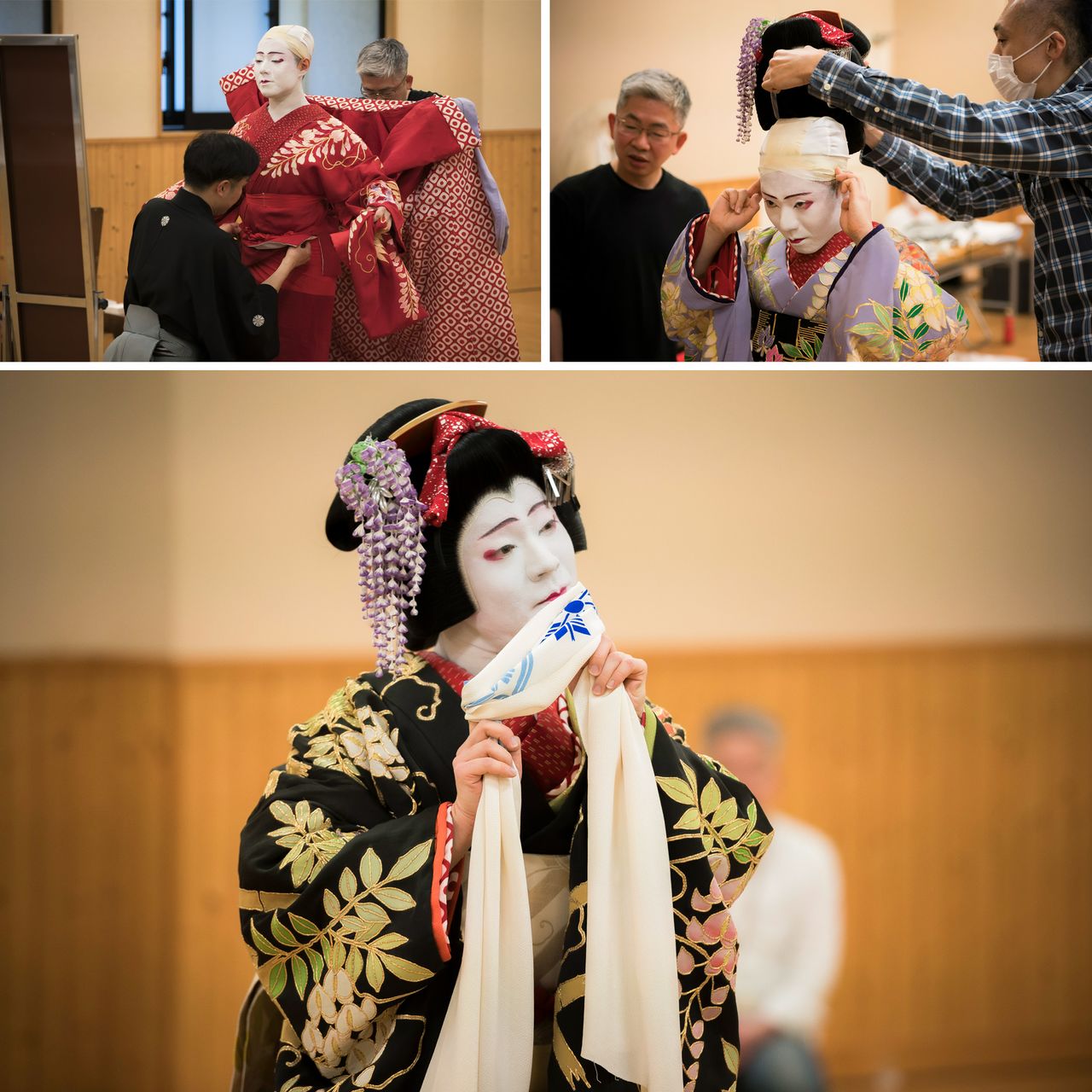
After makeup application, wig fitting, and dressing is done, it’s time to perform. (© Matsuda Tadao)
One highlight of Fujimusume is the rapid onstage costume change called hikinuki. Multiple layers are temporarily stitched together; when a stage assistant pulls on the thread to remove the black-hued top layer, a new costume of brighter colors is revealed in a flash.
Kabuki wigs are individually tailored to each actor, painstakingly assembled over several hours by a master wigmaker, who finishes them with delicate ornaments. The Fujimusume wig, trimmed with wisteria hairpins, has a sweet, delicate charm, yet it weighs around 2 kilograms. Takanosuke dances, though, as if it were weightless.
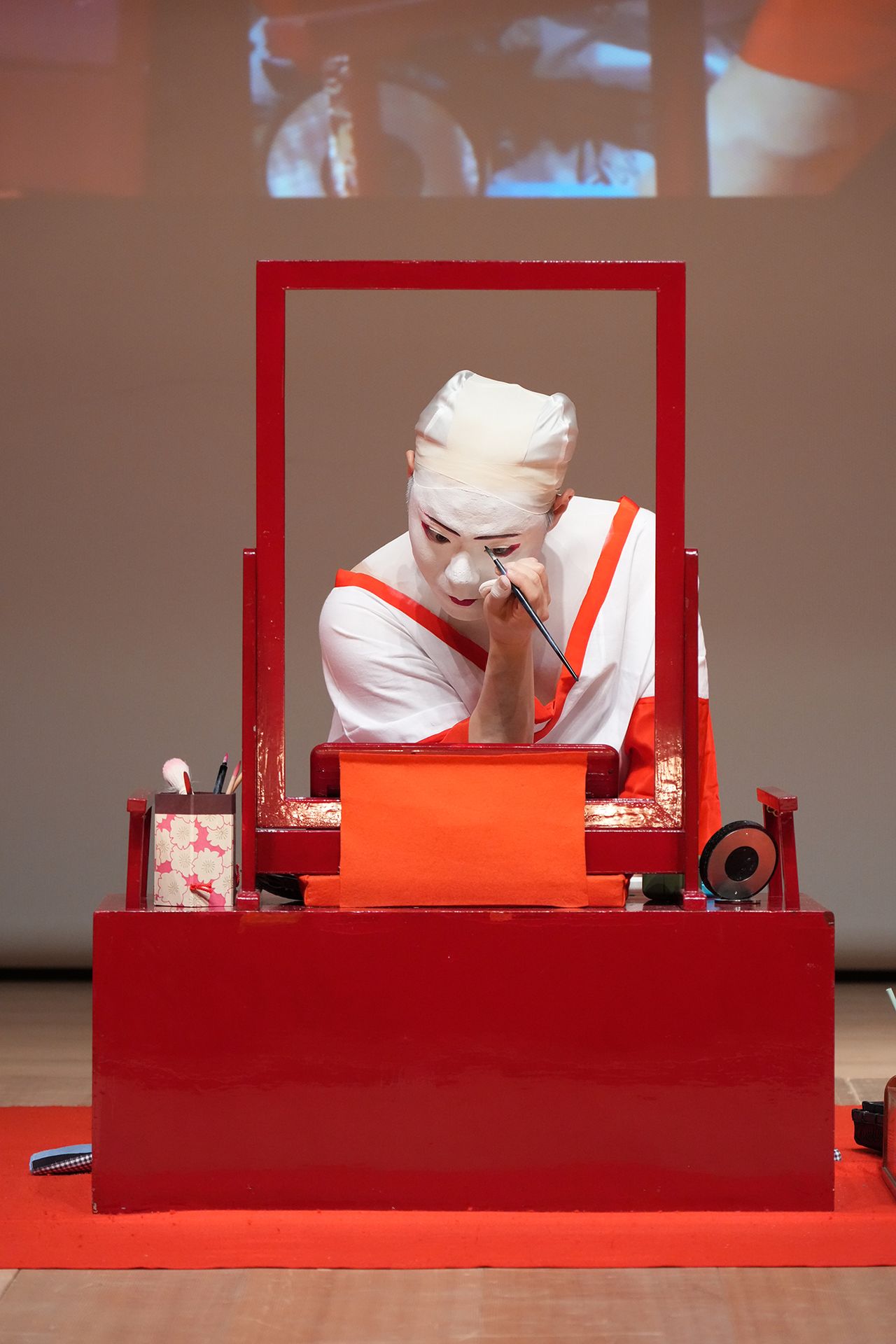
The mirror is replaced with an empty frame to show the audience the painstaking preparations that go into every performance. (© Shōchiku)
Giving Feminine Grace to a Masculine Frame
“I hope audiences will feel both the splendor of the performance and the onnagata’s unique graceful and refined beauty,” Takanosuke said of his European tour.
“Because we’re male actors playing women, we have to constantly be mindful of how the body appears. A man’s body, by nature, tends to be heavy or rigid. The challenge is to make it supple and feminine. Traditional onnagata training emphasized posture: drawing the shoulder blades down and walking pigeon‑toed with a sheet of paper held between the knees so it won’t fall. More so than tachiyaku, onnagata must cultivate an acute awareness of how each gesture looks on stage.”
Another essential quality of the onnagata is sensibility. In dramatic scenes, they perform with an unbroken awareness of the tachiyaku, adjusting their movements in response. This layering of small, almost invisible gestures creates the impression of feminine grace.
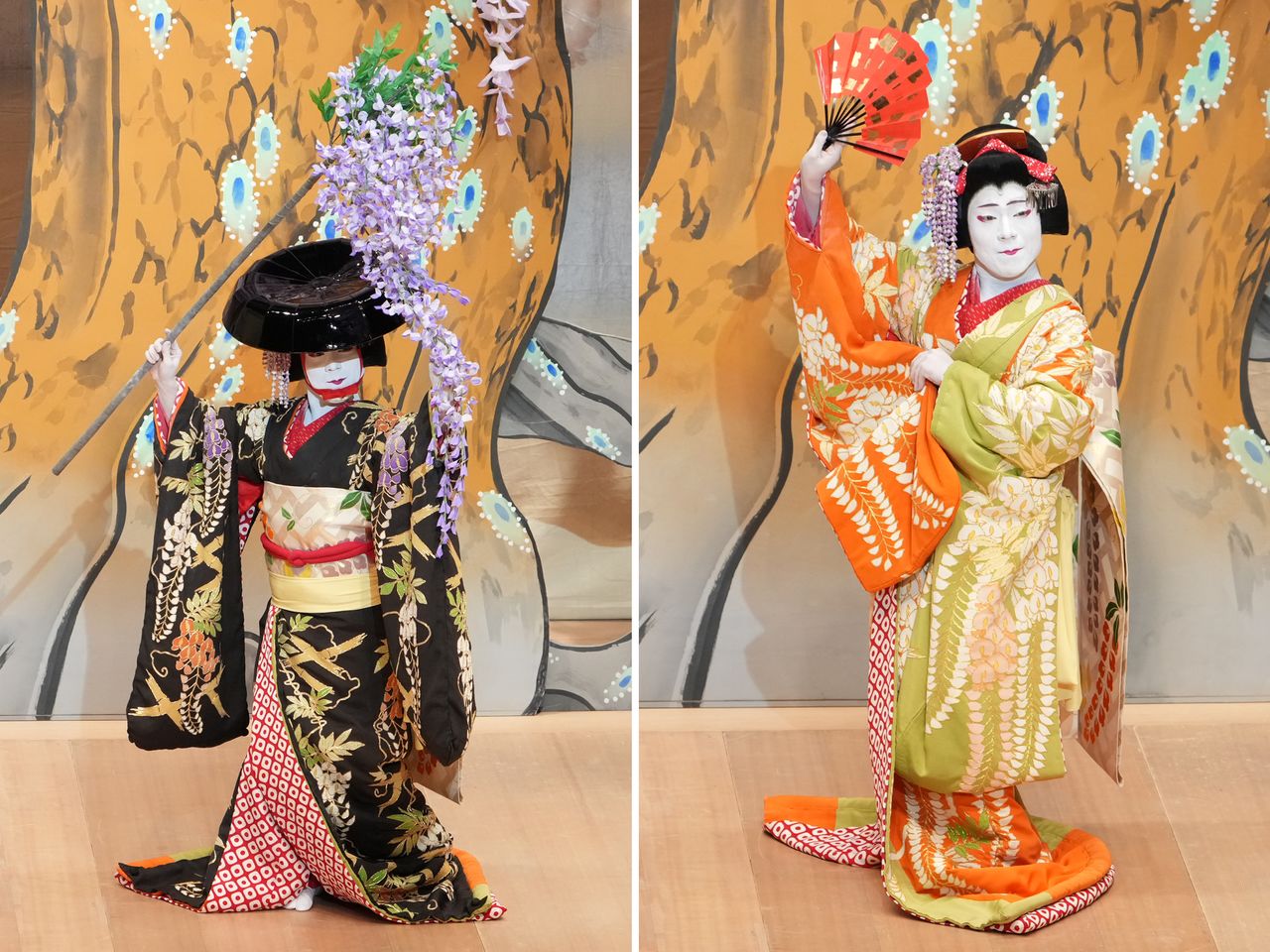
The dramatic costume changes are a key part of Fujimusume. (© Shōchiku)
In Paris, Takanosuke followed his performance of Fujimusume with Shakkyō, taking on the role of a powerful, mythical lion. With vivid kumadori makeup and sweeping shakes of the lion’s flowing white mane, he moved effortlessly from the softness of an onnagata to the dynamic physicality of a tachiyaku.
On Instagram, he later noted the enthusiasm of audiences in each city. Looking ahead, he hopes to bring kabuki to the world’s leading venues—among them the Théâtre du Châtelet in Paris, where his father Tomijūrō once danced Ninin Wankyū alongside Nakamura Jakuemon IV.
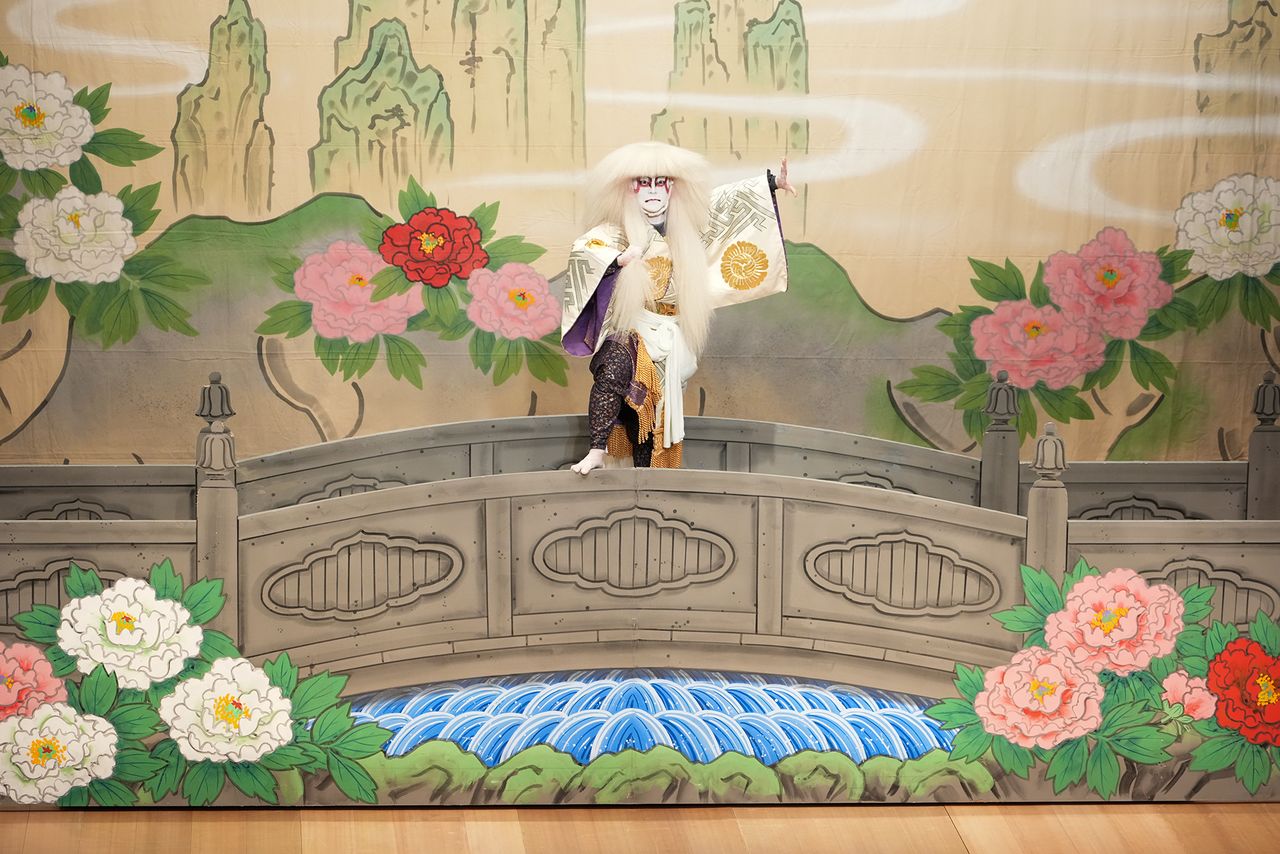
Takanosuke brought down the house in Paris with his performance of Shakkyō. (© Shōchiku)
(Originally published in Japanese on May 28, 2026. Reporting and video editing by Hashino Yukinori and Itakura Kimie of Nippon.com. Banner photo: Nakamura Takanosuke transforming into a Wisteria Maiden through the art of kabuki makeup. © Matsuda Tadao.)