A Strange Twist of Fate: Translating Uketsu’s Eerie Worldview into English
Books Culture Language- English
- 日本語
- 简体字
- 繁體字
- Français
- Español
- العربية
- Русский
The Secret of My Success? Listening to My Wife
My first encounter with Uketsu was in 2022. My wife had become a fan of his YouTube channel and, knowing how I enjoy the macabre and weird, thought I would enjoy it. She was right on the money, and I was particularly taken with the long-form stories the masked man was putting out.
But I am more oriented toward text than to video, so when I found out Uketsu had published two books, I headed to the bookstore.
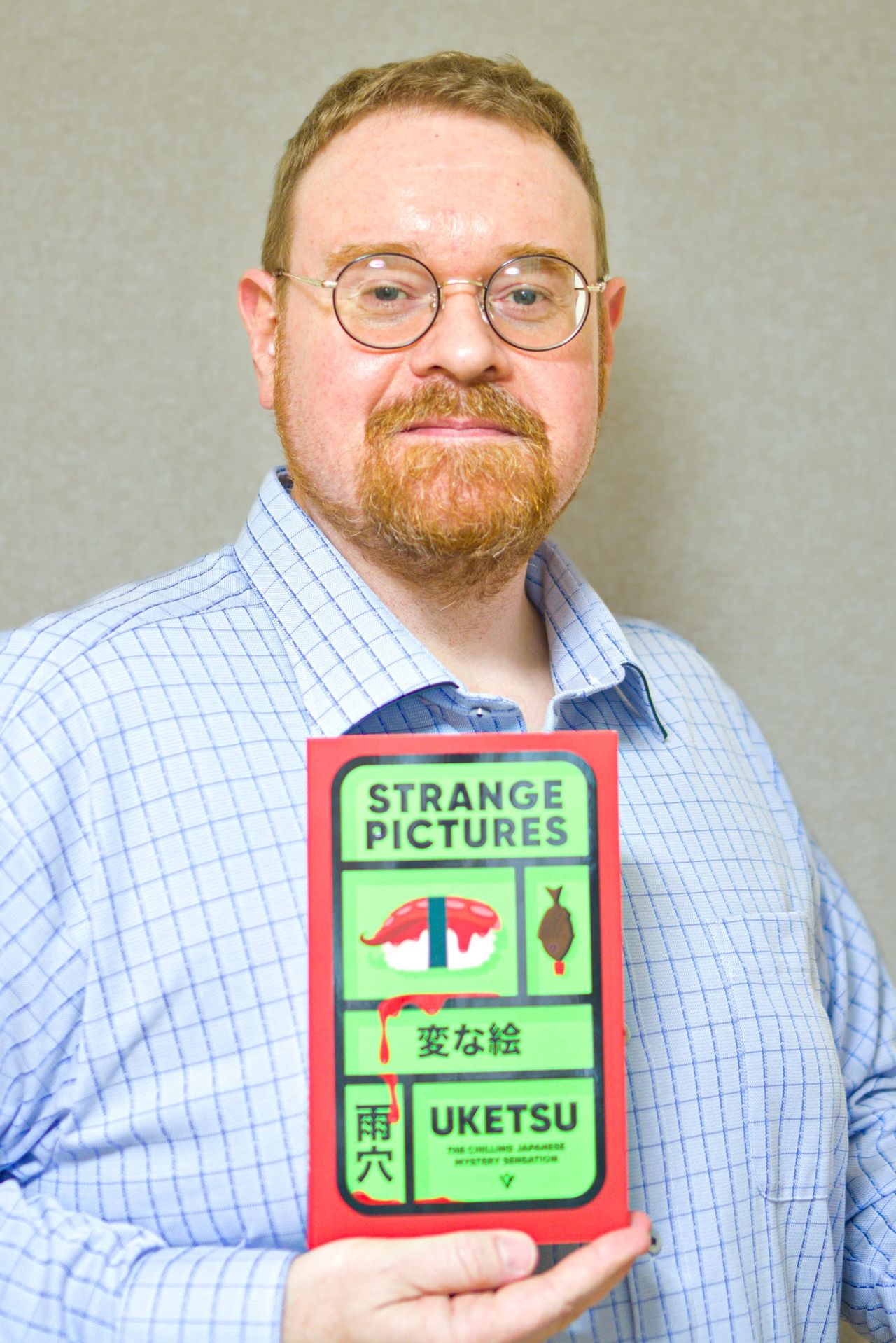
Translator Jim Rion with his nominated work. (Courtesy Jim Rion)
I had just finished my translation of Akuma ga kitarite, fue o fuku (The Devil’s Flute Murders) first serialized in 1951–53 by Yokomizo Seishi, and on reading Uketsu’s 2021 Hen na ie (Strange Houses) sensed immediate ties to Japan’s earlier works of the macabre. Without getting into spoilers, Uketsu’s debut novel has clear echoes of the decadent wealth, rural isolation, and grotesque family secrets that Yokomizo so often wrote about.
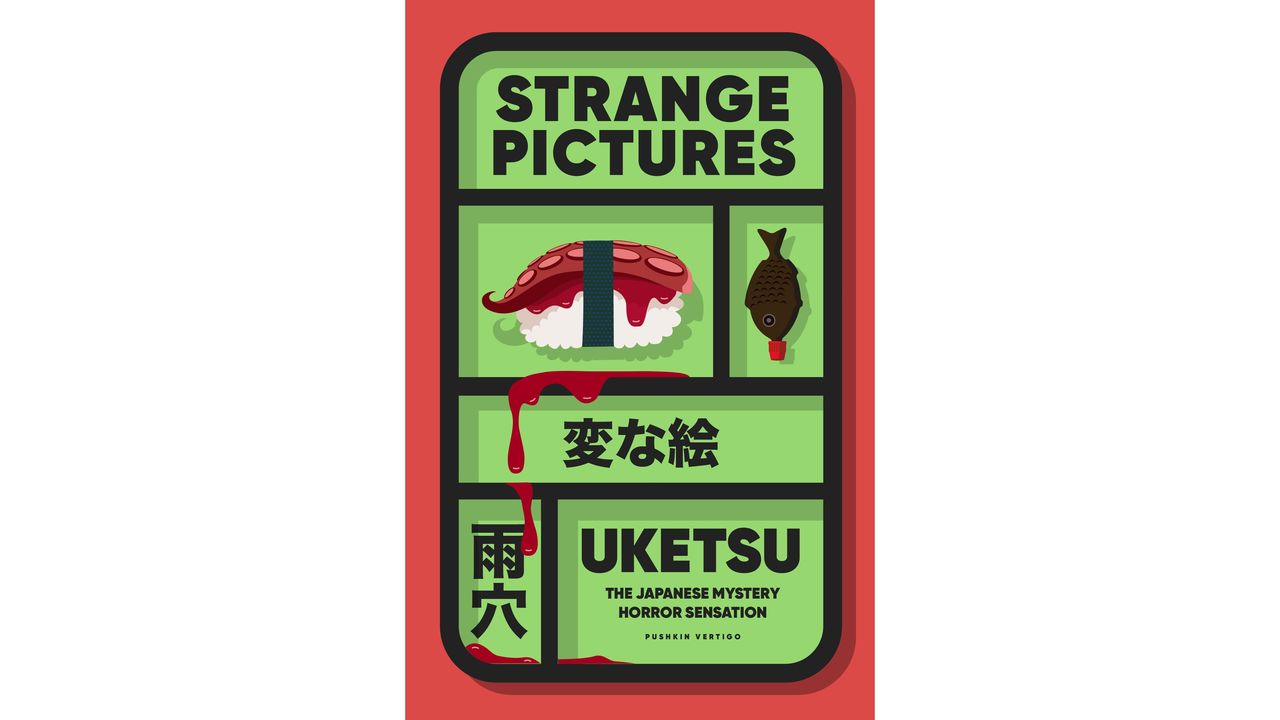
But it was the 2022 Hen na e (Strange Pictures) that really struck me. The simple writing and use of pictures both as guides and as clues were unusual, sure, but it was the deceptively intricate structure behind them that was the thing for me. I also found it interesting how Uketsu shifted from the obvious Japanese-genre roots evident in Strange Houses toward a more Western-influenced psychological thriller, placing modern social mores front and center.
My wife told me I should try translating them, and I immediately agreed. I recommended the books to the editor I’d been working with at Pushkin Vertigo, and work finally began on English translation at the end of 2023. Strange Pictures came out in English just over a year later.
I’d say that everyone involved made the right decision.
From the Internet to Your Bookshelf
My wife was not the only one to discover Uketsu through YouTube. Among millions of followers was an editor at Asuka Shinsha, who saw the video “Real Estate Mystery: A Strange House” and reached out to Uketsu about turning it into a book. The result, Hen na ie, was a hit, and so was the next, and the next, and . . . Here we are.
That path from the internet to publishing success is increasingly common. There is a current boom in Japan of horror authors who kicked off successful careers after posting on free websites like Kadokawa’s Kakuyomu, which awards the most popular stories each year with publishing contracts. Sesuji, the author of Kinki chihō no aru basho ni tsuite (About a Certain Place in the Kinki Region), started out there, and ubiquitous horror event planner and author Nashi wrote for both Kakuyomu and the Japanese-language version of the SCP Foundation website, kind of a cross between The X-Files and Wikipedia, before his novel career began.
Of course, they only came after a long line of light novels that started as web posts, not to mention the even longer history of cellphone novels in the days before the arrival of the smartphone. So, the internet is not a new way to kick off publishing success, but there does seem to be a change in inflection now. What was once limited to niche genres now feels mainstream, and Uketsu’s incredible success has been influential in that shifting attitude.
Becoming a Global Phenomenon
Even after watching it happen, it is difficult for me to fully grasp just how popular Uketsu and his books have become.
Uketsu’s YouTube channel has 2 million subscribers, and most of his videos have over 5 million views. His masked face has appeared on magazine covers, in purikura photo booths, and even in the children’s cartoon Crayon Shinchan. Each of the four Hen na books has been a bestseller, and in 2024, Uketsu had 3 of the top 10 bestselling fiction books in Japan.
Outside Japan, the story is similar. The two English language publishers Pushkin Vertigo and HarperVia recently celebrated 1 million English-language Uketsu books sold. The books have been translated into 36 languages and have sold nearly 8 million copies worldwide.
Why? How?
I am no expert, but I have some ideas.
I think his internet-based beginning—especially the synergy between the YouTube videos and simultaneous written content—and its timing were absolutely key to building a solid base for stardom.
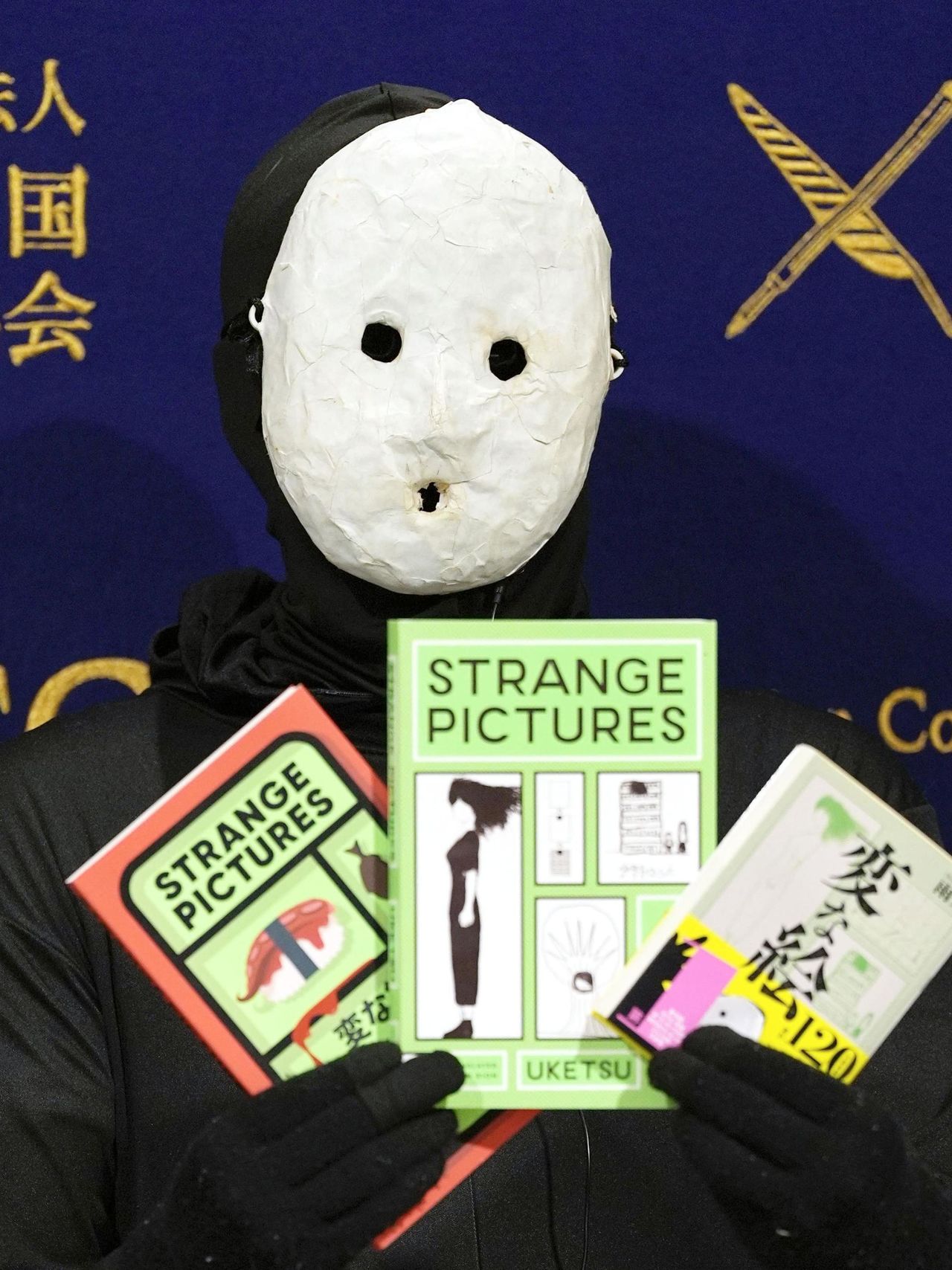
Masked author Uketsu appears with English translations of his works at a January 2025 press conference at the Foreign Correspondents’ Club of Japan in Tokyo. (© Kyōdō)
Uketsu started out writing for the Japanese entertainment site Omocoro. Internet stories tend to require images, so according to Uketsu himself, the main thing he has become known for—the visual aspect of his works—just happens to be the way he learned to write. Posting video versions of his Omocoro articles was originally suggested by an editor there and was aimed at capturing a wider audience, but now the strategy has grown a bit deeper. In one interview, he explained that he wants his YouTube channel to appeal to those who aren’t interested in reading or worry about buying the wrong book. This explains why he has recently posted a newly rewritten version of Hen na ie, in its entirety, both to Omocoro and to YouTube.
I am convinced that the COVID-19 pandemic also played a role. The video that really kicked his career into high gear and went on to become Hen na ie was posted in October 2020—when millions of people around the world were trapped at home, consuming online content. The frequent and uniquely odd videos pulled in that captive audience and eventually led them right to the books, which sold well right off the bat.
His popularity overseas was initially built on that domestic success. International publishers seem very interested in big domestic sales and easy marketability, and Uketsu certainly has those. The author himself is a marketer’s dream, with his black body suit and white mask making for easy social media virality and merchandising visuals.
Those elements also made it easy to get attention from traditional media. In the run-up to Uketsu’s English debut, major London newspapers ran stories calling him “Japan’s biggest crime writer” and “Japan’s answer to Richard Osman.” A full-press campaign with bookstore displays, merchandise, public transit posters, and video trailers helped get readers’ attention, too.
But of course, all of that press and marketing would have been a waste if no one actually liked the books, and people do seem to. Uketsu’s English releases have worked their way up the bestseller lists everywhere from Singapore to Canada, and the most recent, Strange Buildings, was an immediate New York Times and Times of London best seller. Strange Pictures was shortlisted for the Waterstones Book of the Year in 2025 and for the British Crime Writers Association Dagger award for Crime Fiction in Translation in 2026.
I can only assume that what first attracted me—the deceptive simplicity, the creepy worldview, and the creative use of images—has proven just as interesting to others.
The Strange Days Continue
The global success of Uketsu is rubbing off on me, as well. My name is appearing alongside Uketsu’s, on the covers of books being read around the world and listed in awards nomination announcements. It feels strange indeed for someone used to the anonymity that translation usually affords. But make no mistake, more than anything, I feel lucky. Lucky that my wife clued me in, lucky that I trusted her and my instincts, and lucky that we got there before anyone else.
Given the success of Strange Buildings and the anticipation for Strange Maps—the fourth Uketsu book scheduled for English release in April 2027—I can’t see any end in sight for this long, strange trip.
(Originally written in English. Banner photo © Pushkin Vertigo.)