The Fab Four in the Far East: The Beatles’ 1966 Tokyo Tour
Culture- English
- 日本語
- 简体字
- 繁體字
- Français
- Español
- العربية
- Русский
“It Was Sixty Years Ago Today . . .”
More than half a century after their breakup, the Beatles continue to enjoy an extraordinary level of popularity around the world, and few countries have embraced them more enthusiastically than Japan. The relationship between the Fab Four and their Japanese fans reached a defining moment in the summer of 1966, when the group performed a series of five concerts in Tokyo during what would prove to be the final tour of their career.
Beatlemania arrived in Japan relatively late. The band’s records first appeared on the Japanese market in 1964, and within a year their fame had spread nationwide. Initially, many Japanese observers viewed John, Paul, George, and Ringo less as musicians than as youth idols. Their appeal seemed to lie as much in their personalities and appearance as in their songs. This perception is reflected in the Japanese title of their film and album Help! which was released as Yonin wa aidoru (“The Four Are Idols”). Not everyone was impressed. Conservative commentators frequently linked the group’s long hair, energetic performances, and youthful fan base to what they perceived as growing social disorder among Japanese teenagers.
By 1966, the Beatles themselves had become increasingly disillusioned with touring. Nevertheless, Japan remained an intriguing destination. Both John Lennon and George Harrison had developed a strong interest in Asian religions and cultures, while the country’s unique blend of modern industry and traditional heritage fascinated the band. Their manager, Brian Epstein, had more practical reasons for wanting to visit. Japan was already one of the group’s most important overseas markets and showed every sign of becoming even more profitable.
Even the Japanese booking agency believed devoted fans would willingly pay as much as ¥10,000 for the best seats. However, the organizers opted for much lower prices. Premium tickets were set at ¥2,100—roughly the cost of a record album—while less expensive seats sold for ¥1,800 and ¥1,500.
A Not Always Warm Welcome
As preparations advanced, opposition to the tour intensified. With the notable exception of the Yomiuri Shimbun, the major newspaper that was one of the event’s sponsors, much of the Japanese media reacted with open hostility. Headlines urged the Beatles to leave the country, insulted the band, and in some cases called for violence against them. Television commentators dismissed their music and denounced the phenomenon surrounding them. The Yomiuri, however, defended the group, emphasizing both their artistic achievements and the fact that they had recently been named Members of the Order of the British Empire by Queen Elizabeth II in recognition of their contribution to British culture.
Despite such criticism, enthusiasm among fans reached extraordinary levels. In Japan, Beatlemania became known as Bītoruzu-kyō jidai, literally “the age of the Beatles craze.” Demand for tickets was enormous, but social conventions limited who could attend. Many high-school students, especially girls, were permitted to go only if accompanied by an adult. Some schools went further, explicitly forbidding students from attending popular music concerts.
The concerts were scheduled for June 30 to July 2, but before a single ticket could be sold, organizers faced a major challenge: finding a suitable venue. Epstein insisted on an arena capable of holding at least 10,000 spectators. Outdoor stadiums were ruled out because the tour would take place during Japan’s rainy season, leaving relatively few options.
Eventually, attention turned to the Nippon Budōkan. Built for the 1964 Tokyo Olympics, the arena could accommodate around 14,000 people and appeared to satisfy all practical requirements. Yet its selection immediately sparked controversy. The Budōkan was primarily associated with martial arts and occupied a special symbolic place in the minds of many conservatives and nationalist groups. To them, allowing a Western rock band to perform there bordered on sacrilege. Economic considerations ultimately prevailed, though, and on May 26 the Budōkan’s administrators approved the concerts.
When the Beatles landed at Haneda Airport, police easily managed the crowds of excited fans. More troublesome were several nationalist organizations that had vowed to oppose the visit. Members of one right-wing society attempted to travel to the airport to obstruct the Beatles’ route into the city, but were stopped by police before they could do so. Elsewhere, activists from another right-wing organization, the Great Japan Patriotic Party, staged demonstrations outside the Tokyo Hilton Hotel, distributing leaflets and displaying banners demanding that the Beatles leave Japan.
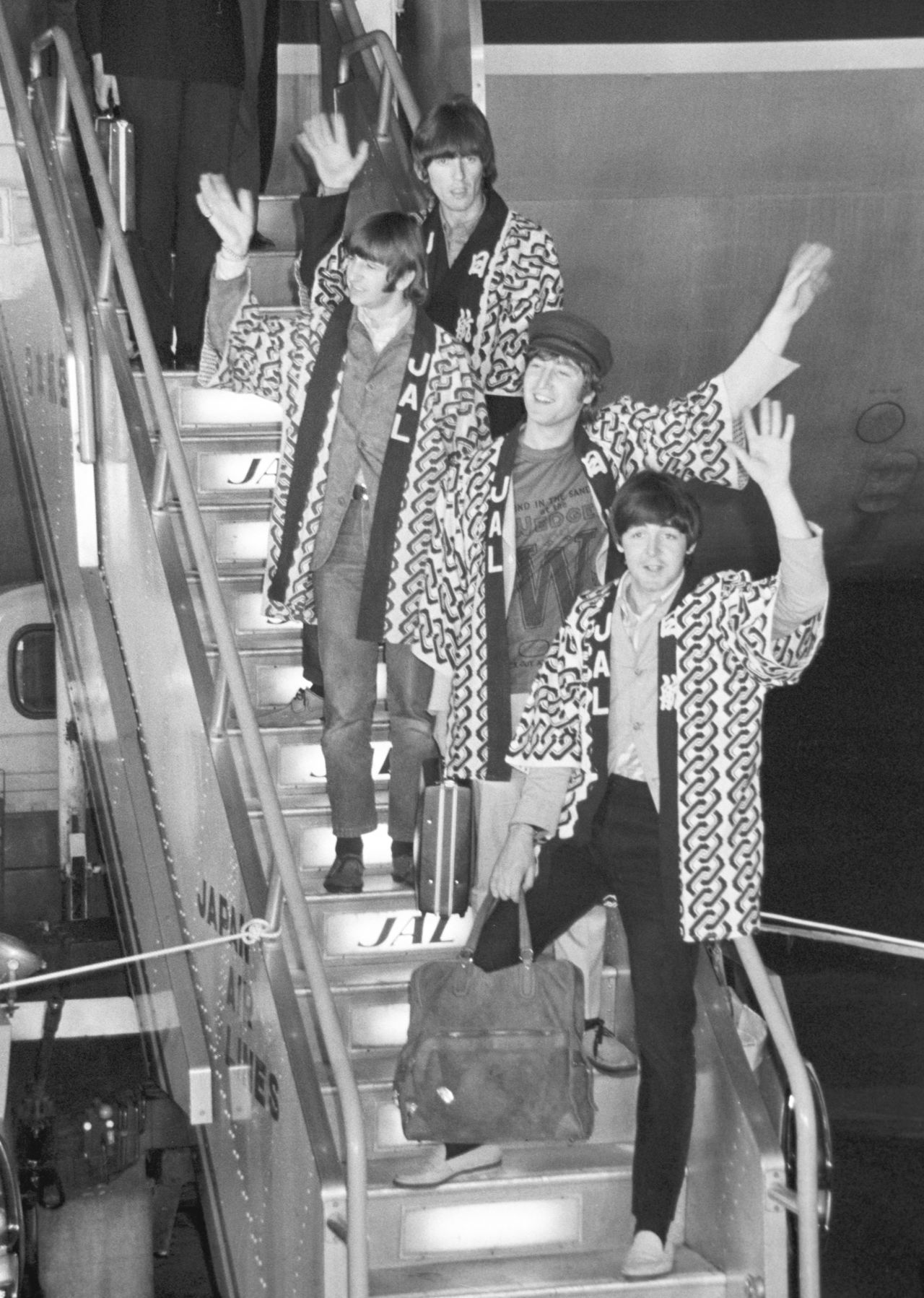
The Beatles arrived at Haneda Airport on June 29, 1966. (© Kyōdō)
The Fab Four Hit the Stage
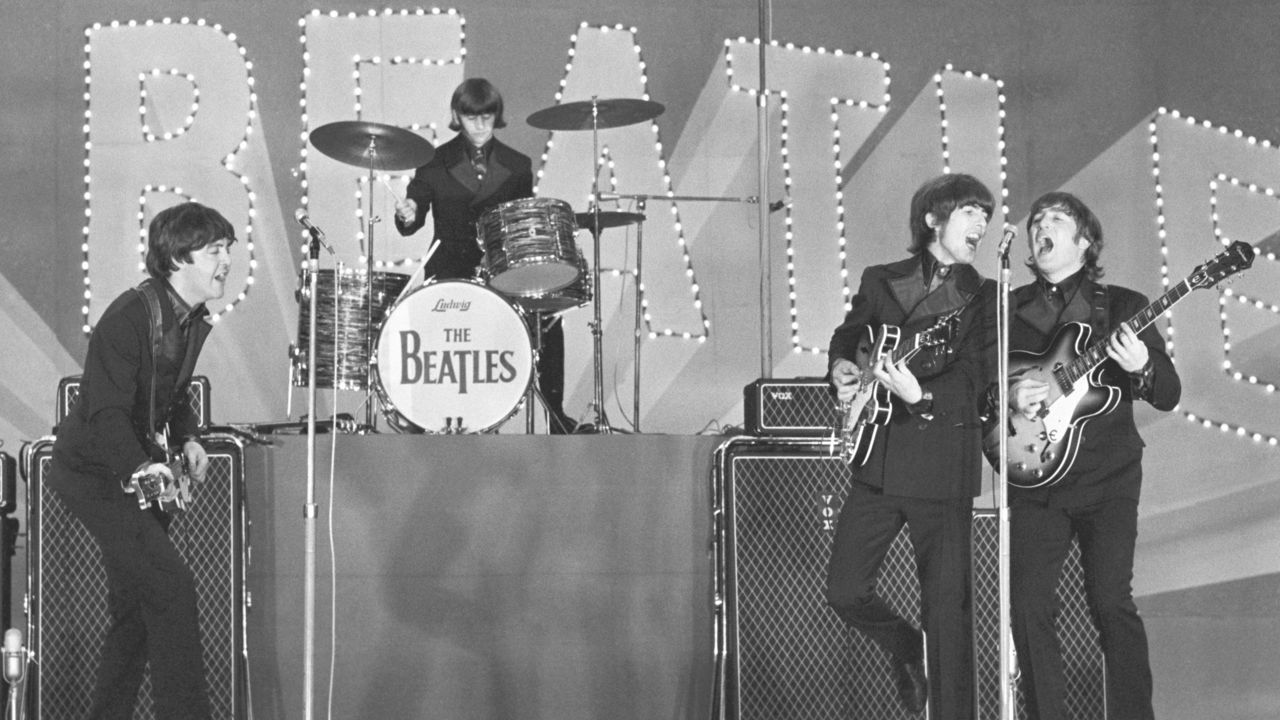
On June 30, the group performed its first concert at the Nippon Budōkan. Despite the short distance between the Hilton and the venue, the journey required a major security operation. Around 1,700 police officers, including both regular and riot units, were deployed, and roads along the route were temporarily closed to ensure safe passage.
The evening began at 6:35 pm with a lineup of supporting acts that reflected the eclectic nature of Japanese entertainment in the mid-1960s. The bill included several pop singers, the popular “group sounds” domestic bands Blue Jeans and Blue Comets, and even the comedy troupe the Drifters. Their performances were met with polite but limited enthusiasm. The audience had come for one reason only.
At 7:35 pm, the Beatles finally took the stage.
Fans immediately noticed their new concert attire. Gone were the flamboyant fashions associated with many contemporary rock groups. Instead, the Beatles appeared in elegant, restrained outfits whose formal appearance may have been intended to emphasize sophistication over rebellion.
The opening performance itself has often received mixed reviews. Some contemporary observers criticized it as uninspired, though such judgments overlook the difficult circumstances. Technical problems plagued the concert from the start. The Budōkan’s sound system had been designed primarily for announcements during sporting events, not amplified rock music, and the resulting audio quality was poor. Under such conditions, even experienced performers would have struggled.
After approximately 30 minutes, the Beatles completed their set, bowed briefly, and left the stage without an encore.
The much-feared outbreaks of mass hysteria never materialized. Strict security measures ensured that spectators remained seated throughout the performance, with anyone attempting to rush forward facing immediate removal. Instead, thousands of young fans expressed their excitement in a more restrained manner, waving handkerchiefs, screaming, and cheering from their seats. Medical staff treated only four attendees for minor complaints, including headaches. Considering the dire predictions that had preceded the concerts, the evening was remarkably uneventful.
Concluding a Successful Run
The remaining performances proved more successful. On both July 1 and 2, the Beatles played twice daily, giving afternoon and evening shows. By then, the musicians seemed more comfortable, the technical issues were less distracting, and audiences responded enthusiastically. Across all five concerts, attendance figures are generally estimated at somewhere between 43,000 and 50,000 people.
On the morning of July 3, the Beatles’ brief Japanese adventure came to an end. Leaving the Tokyo Hilton at 9:40 am, they headed for Haneda Airport and boarded Japan Airlines Flight 731 bound for Manila, the next leg of their tour.
Despite the unprecedented security arrangements, hostile demonstrations, and technical frustrations that accompanied the visit, the experience appears to have left a positive impression on the band. George Harrison, in particular, retained fond memories of the trip. Writing years later, he described Japan as “a wonderful place” populated by “wonderful people,” and devoted considerable space in his autobiography to recalling the visit.
The affection proved mutual. Sixty years later, Japan remains one of the Beatles’ most devoted overseas markets. Former members of the group have continued to attract enthusiastic audiences whenever they perform in the country. If the band’s entourage learned one lesson during those extraordinary days in Tokyo, it was that Japanese fans were not only passionate but also exceptionally knowledgeable, among the most dedicated Beatles followers anywhere in the world.
(Originally written in English. Banner photo: The Beatles appear in their first-ever Japan concert at Tokyo’s Nippon Budōkan on June 30, 1966. © Kyōdō.)