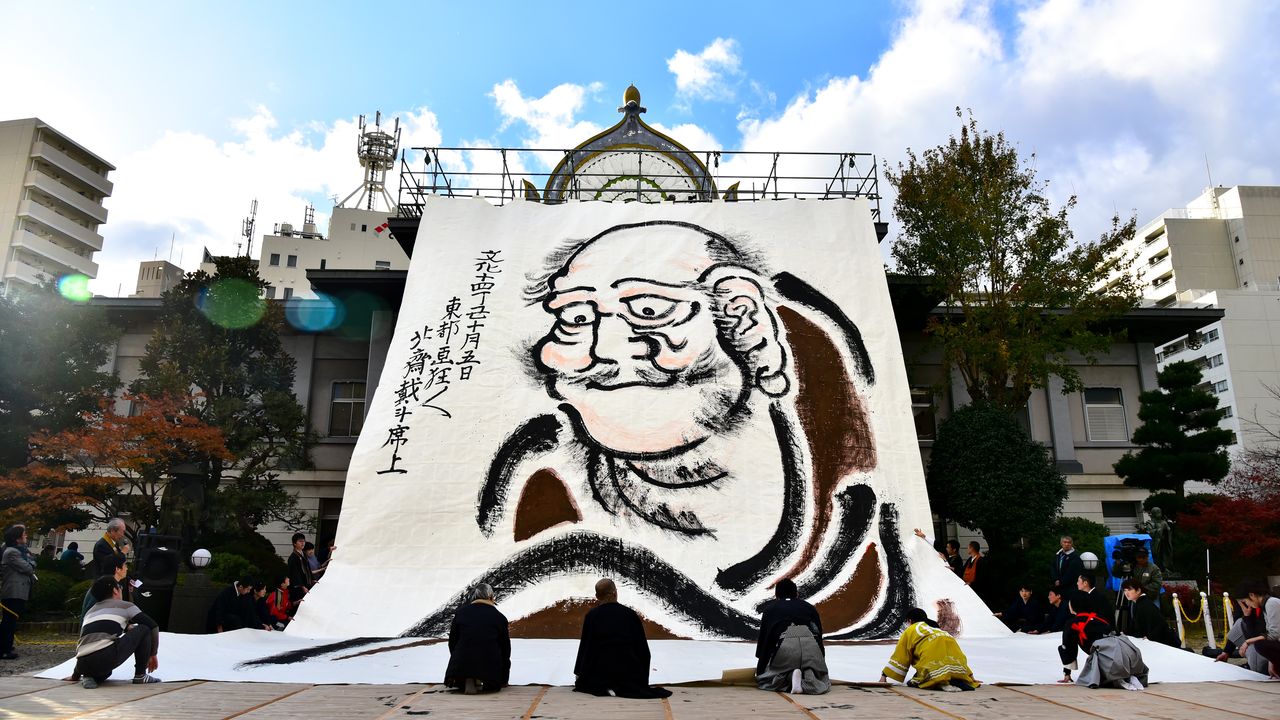
Hokusai’s Giant Daruma: The Street Performance Sensibilities of a Master Painter
Culture Art- English
- 日本語
- 简体字
- 繁體字
- Français
- Español
- العربية
- Русский
A Huge Canvas and a Showman’s Flair
Katsushika Hokusai was born in 1760 in Ryōgoku, then the center of popular entertainment in Edo (now Tokyo), and died in 1849 in nearby Asakusa, another hub of street performance.
He is said to have moved house nearly a hundred times, but his wanderings rarely took him far from these lively neighborhoods. Wherever he lived, the clamor of shamisen music and taiko drums from nearby show tents and the shouts of street performers must have filled the air. If he disliked such noise, he would never have stayed.
And indeed, Hokusai was no stranger to showmanship, reveling in dazzling audiences with his artistic skill.
On October 5, 1817, crowds began gathering from early morning at the grounds of what is now Hongwanji Nagoya Betsuin temple near Ōsu in Nagoya. They came to see Hokusai paint a giant Daruma (Bodhidharma) figure before their eyes. The handbills they carried, the equivalent of modern flyers, were illustrated by Hokusai himself. Food stalls lined the temple gate, giving the event a festive atmosphere.
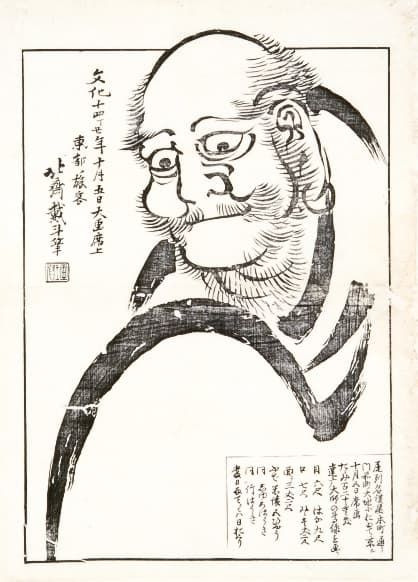
Event flyer drawn by Hokusai. (Courtesy Nagoya City Museum)
Inside the temple grounds, a massive sheet of paper—18 meters long and 10.8 meters across—had been laid out. By midday, the grounds were packed. Hokusai climbed atop the paper with apprentices in tow, ready to perform.
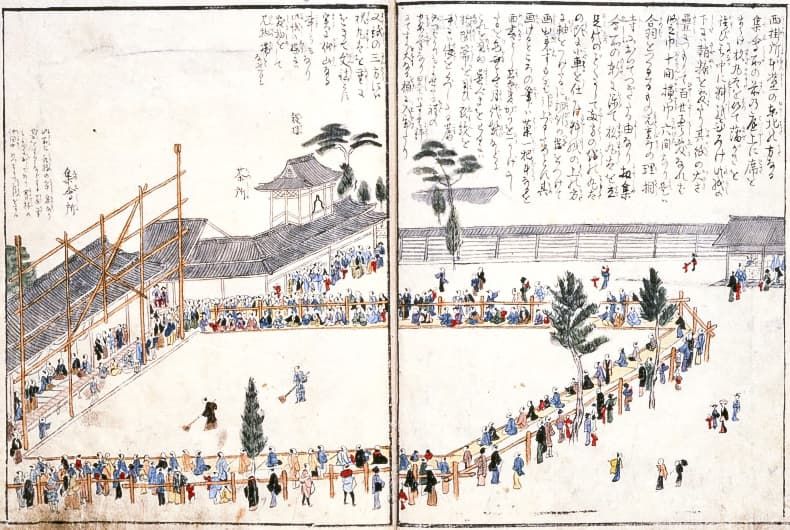
A crowd gathers for a painting performance by Hokusai, illustrated and recorded by Enkōan in Hokusai taiga sokusho saizu (Illustrated Report of Hokusai’s Live Large-Scale Painting). (Courtesy Nagoya City Museum)
A Brush Made from Five Rice Bales
Hokusai dipped a special brush made of bundled straw into a bucket of ink and swept a thick, bold line across the paper. He curved the stroke sharply at the end, then added rounded lines to either side. When he drew a horizontal stroke beneath the first, the crowd suddenly realized they were looking at a face: nose, eyes, and mouth. Each new stroke revealed another feature—ears, head, and torso—and the spectators chattered excitedly as Daruma’s image took shape.
Hokusai switched between brushes made from five rice bales, palm fibers, and bamboo brooms. His apprentices worked frantically around him, adding color to the robe and blotting excess water. The giant figure emerged with astonishing speed.
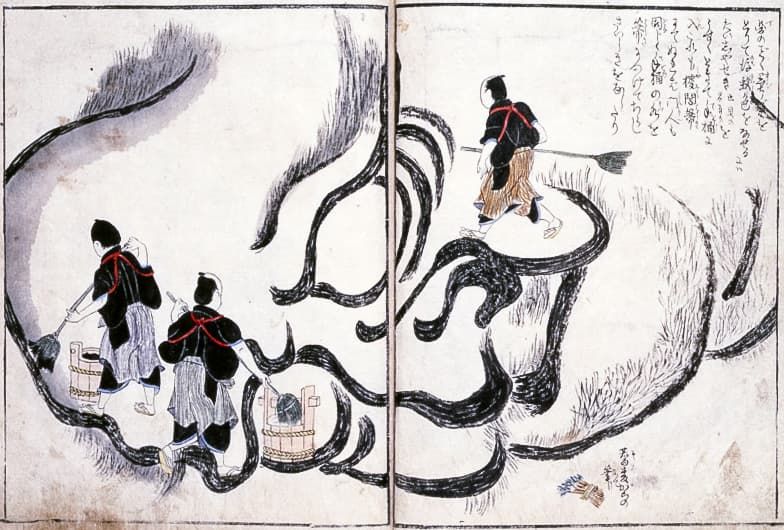
Adding details to Daruma’s face. From Enkōan’s Hokusai taiga sokusho saizu (Illustrated Report of Hokusai’s Live Large-Scale Painting). (Courtesy Nagoya City Museum)
By evening, the painting was complete and hoisted onto a 13-meter-tall scaffold. The next day, Hokusai added his inscription to the work, and once again a large crowd gathered to admire the enormous painting billowing in the wind like the sail of a great ship.
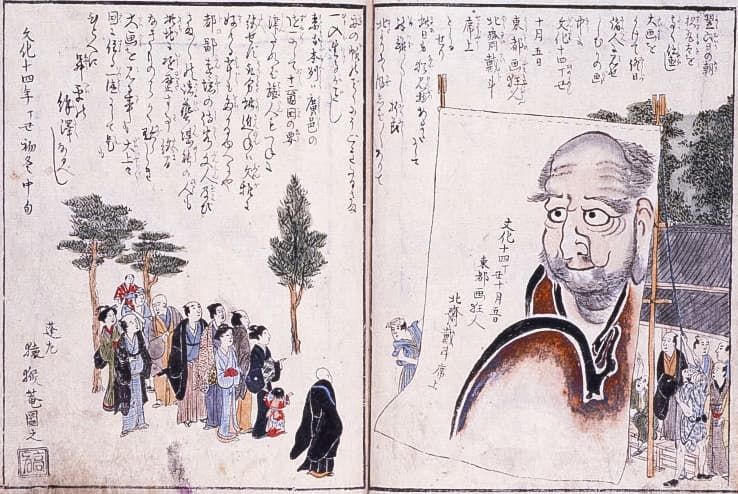
Visitors admiring Hokusai’s giant painting. From Enkōan’s Hokusai taiga sokusho saizu (Illustrated Report of Hokusai’s Live Large-Scale Painting). (Courtesy Nagoya City Museum)
This account of the Nagoya event is based on Illustrated Report of Hokusai’s Live Large-Scale Painting, a detailed chronicle produced by Kōriki Tanenobu, a local ukiyo-e artist better known as Enkōan, who was six years Hokusai’s junior.
Painting is often imagined as a solitary pursuit, undertaken free from noise and distraction. But Hokusai turned it into a public event, using applause and cheers to fuel his creative energy much like a masterful street performer.
A Humbling Lesson During His Youth
While the Nagoya performance may have been a day of triumph for Hokusai, there are also stories about embarrassing moments in his life, including an episode while moonlighting as a spice vendor.
Hokusai became a student of Katsukawa Shunshō in his late teens, a rather late start for that era. He had earlier worked at a lending library and as a block carver’s assistant, so he no doubt looked forward to his apprenticeship with great anticipation.
But apprentices had no guaranteed income. To make ends meet, Hokusai took up a side job selling spices, a new and fashionable trade in keeping with his penchant for novelty. Vendors wore flamboyant costumes and sang catchy sales chants to attract buyers—a practice that survived as late as around the 1964 Tokyo Olympic Games.
One day, while chanting his sales pitch, Hokusai heard a voice wondering out loud what he was doing. He turned around and found his master Shunshō. Mortified, Hokusai fled, later vowing to commit all his time to painting—his chosen path—no matter how poor he became.
Groundbreaking Use of Perspective
Apart from the fact that Hokusai himself was a born performer, his paintings also appear to bear the imprint of Edo’s street entertainments and show tents.
In his youth, Hokusai produced many prints inspired by Western linear perspective. These works—depicting theaters, grand shops, temple interiors, and bustling avenues—draw viewers into an uncanny, three-dimensional world.
Such prints were often used in peep show boxes fitted with lenses. Originally, these boxes displayed mechanical dolls, but perspective prints soon became the main attraction. Viewed through a lens, the sense of depth intensified, creating the illusion of infinite space inside the box.
This sensation echoes the composition of Hokusai’s later masterpiece, The Great Wave off Kanagawa: the towering wave in the foreground and distant Mount Fuji glimpsed through its curling trough.
Experimenting with Light and Shade
Peep show operators also devised ways to present night scenes. After showing a daytime view, they blocked the front light and illuminated the back, suddenly shifting from day to night and revealing windows, lanterns, stars, and flames using cutouts.
Enkōan, who authored the report on Hokusai’s Daruma performance, wrote upon seeing the peep show for the first time that it startled the rich and poor alike and was so wondrous that people suspected it was magic.
In an age before electric lighting, nighttime illumination was rare outside pleasure quarters and restaurants catering to the elite. The chance to experience such a nightscape was a novelty for most commoners.
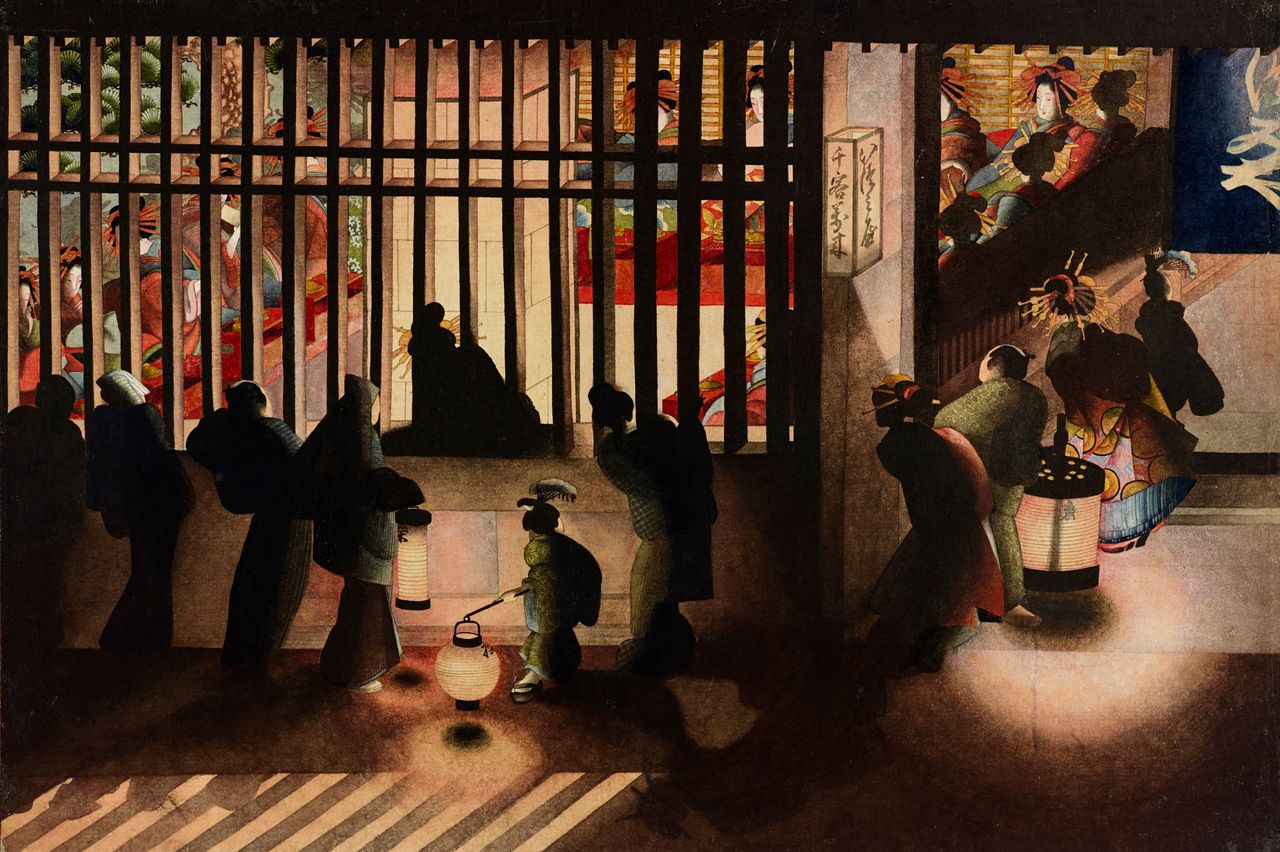
Katsushika Ōi makes effective use of light and shade in Yoshiwara kōshi saki no zu (Night Scene in the Yoshiwara). (Courtesy the Ōta Memorial Museum of Art)
One remarkable example survives in the Edo Tokyo Museum: a 10-meter kage karakuri (shadow illusion) scroll. It depicts a boat journey, first moving downstream from near Nihonbashi and then traveling upstream along the Sumida River to the temple Mokuboji. It is one of many panoramas of the Sumida—a theme also depicted by Hokusai.
The scroll was not merely a landscape but enabled viewers to virtually experience a pleasure boat ride.
Windows, fireworks, lanterns, and shoji screens were cut out so that light from behind created the illusion of an evening cruise. A sharebon (popular fiction) book published around the same period records the sales pitch used by kage karakuri operators, alongside the cries of other street vendors and sideshow barkers. Spectators, seated inside a cramped little booth, could enjoy drifting along a river at night without ever leaving the room.
Such nighttime scenes closely resemble the dramatic use of light and shade in the works of Hokusai’s daughter, Katsushika Ōi, such as Night Scene in the Yoshiwara. Viewers continue to be drawn by the refined artistry of both father and daughter, but it is worth noting that the techniques they employed were inspired by the amusements of ordinary people in Edo.
Note: A special performance by Asakusa Zatsugeidan—a troupe led by the author—celebrating the popular spectacles loved by Hokusai will be held on Thursday, September 3, 2026, from 6:30 p.m. at Theater X (Japanese site) in Ryōgoku, Tokyo. The show will include peep-show boxes, street performances, and a recreation of Hokusai’s giant Daruma painting. Advance tickets are ¥3,000.
(Originally published in Japanese. Banner photo: A huge Daruma painting recreated in 2017 at Hongwanji Nagoya Betsuin, 200 years after Hokusai’s original performance. Courtesy Hongwanji Nagoya Betsuin.)