Gut Bacteria behind Many Colorectal Cancer Cases in Japan
Newsfrom Japan
- English
- 日本語
- 简体字
- 繁體字
- Français
- Español
- العربية
- Русский
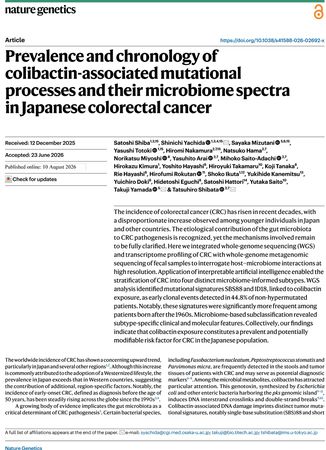
Tokyo, Aug. 11 (Jiji Press)--A Japanese research team has said it found traces of genetic mutations caused by a toxin produced by certain E. coli strains in the intestines in nearly half of colorectal cancer cases in Japan.
Announcing the findings Monday, the team said that the toxin called colibactin is considered to be involved in carcinogenesis, or the process by which normal cells turn into cancer cells, adding that it aims to develop a method to prevent colorectal cancer through bacterial elimination.
The team includes professor Shinichi Yachida of the University of Osaka's Graduate School of Medicine and professor Tatsuhiro Shibata of the University of Tokyo's Institute of Medical Science.
Various factors contribute to colorectal cancer, including genetics, diet and lifestyle. In addition, there have been reports that other bacteria are involved.
"We want to elucidate why there are many cases of colorectal cancer involving colibactin in Japanese people and identify the infection route of E. coli strains that produce colibactin," Yachida said.
[Copyright The Jiji Press, Ltd.]