Experiencing Chernobyl, and the Lessons to be Learned
Politics World- English
- 日本語
- 简体字
- 繁體字
- Français
- Español
- العربية
- Русский
The Delayed Official Announcement
Around 1:23 AM on April 26, 1986, a sudden explosion took place at the Unit 4 reactor inside the Chernobyl Nuclear Power Station. The first public admission that anything was wrong came more than 60 hours later, on the evening of April 28, during the nine o’clock news program Vremya. Even then, although the story ran as the main headline news of the evening, the brief 10-second report merely stated that there had been a major “accident” (avarya in Russian) at the Chernobyl station and that a committee of ministers of state was on its way to the scene. I was working as counsellor at the Japanese Embassy in Moscow at the time. Along with everyone else at the embassy, I did all I could to gather information about what was happening by contacting every Soviet authority I could think of. But it made no difference who we called—we were given the brush-off at every turn and informed that it was impossible to get through to the relevant department so late at night.
Rumors Start to Fly
For the next month and a half, the entire Japanese Embassy worked day and night, squeezing what information we could out of the Soviet authorities and providing assistance and protection to the 750 or so Japanese nationals who happened to be in Moscow at the time. The response of the Soviet side was brusque and dismissive. Beyond insisting stubbornly that “Moscow is at no risk,” they told us practically nothing. The international diplomatic corps came together as a group to demand the facts, but the Soviets refused to provide any concrete information about radioactivity levels or other data.
In the interests of self-protection, several embassies took the step of calling in experts from home to carry out independent measurements of radioactivity levels. At the Japanese Embassy, we summoned experts from Tōkaimura in Ibaraki Prefecture, who carried out measurements to ascertain the radioactivity levels in things like water and vegetables that concerned our citizens most. The wind happened to be blowing in an anticlockwise direction in the days following the accident, so that although radioactivity levels rose significantly in Finland to the immediate north, as well as across wide areas of the Netherlands, Switzerland, Germany, and Romania, in Moscow itself, some 750 kilometers northeast of Chernobyl, levels remained close to normal.
A bigger problem was people’s state of mind. Groundless rumors began to circulate about the risk of thyroid cancer in children or the impact the accident might one day have on the pregnancies of girls who were infants at the time. As we worked to explain the situation to Japanese citizens in Moscow at the time, the biggest difficulty we had was to strike the right balance between making sure we warned people about the precautions they could take while avoiding alarming them unnecessarily at the same time.
Too Much Faith in Nuclear Power
It is clear from any comparison between what happened at Chernobyl and the events now unfolding at Fukushima Daiichi that the situations differ fundamentally in several ways. At Chernobyl, a nuclear reactor exploded suddenly while it was in operation, spewing a vast radioactive cloud over an area that eventually covered more than 1,000 square kilometers. At Fukushima, although a partial meltdown is believed to have occurred, the radiation damage caused so far has reached nothing like the same scale, either in degree or geographical extent.
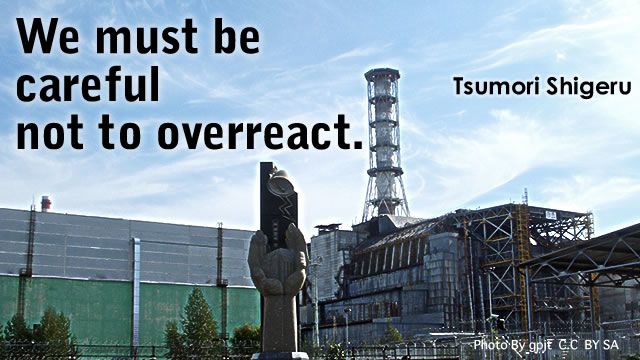
However, there is an important lesson to be drawn from at least one thing the two events do have in common: We must be careful not to overreact. Although most people in Japan have remained relatively calm so far, some parts of the foreign media have been guilty of publishing unsubstantiated reporting and biased, one-sided polemics. Conduct of this kind is not only disrespectful of the valiant efforts of victims doing their utmost to recover and rebuild and hurtful to the Japanese people as a whole. It also has a negative impact on the global economy.
The accident that took place at Chernobyl was caused entirely by operational error. At Fukushima too, since the people involved in building the power station failed to plan for a tsunami on this scale, the situation currently unfolding there can also be described as the result of human error in the broad sense of the term. Both disasters reveal fundamental problems with the way we treat nuclear power, as well as evidence of overconfidence and complacency.
(Originally written in Japanese on March 25, 2011.)
disaster Fukushima Daiichi Nuclear Power Station Great East Japan Earthquake Chernobyl Soviet Union