

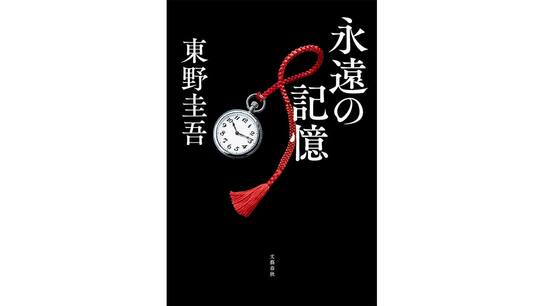
Eternal Memory, the final novel in Higashino Keigo’s Galileo mystery series, was published after the popular author’s death. For longtime fans, the book reads like a poignant farewell.
The Birth of Galileo
When he died this summer, Higashino Keigo was mourned by millions of readers around the world. Over the past few decades, his novels of tightly wrought mystery and ingenious deduction had made him one of Japan’s best-loved writers. His biggest hit was the Galileo series. The final installment Eternal Memory was published in Japanese in August, reaching his fans shortly after his death in July, almost like a farewell message. Although Higashino never wrote that this was his intention, as a reader who knows the series well, I felt that sentiment clearly at various points in the book.
Let me begin with a brief history of the Galileo series. It will take a little time, but I hope you will bear with me. Understanding this series is essential for getting to the heart of what made Higashino such a formidable writer.
It all started with the short story “Burning,” which was published in the magazine Ōru Yomimono in November 1996. The protagonist is a brilliant physicist nicknamed Galileo at the fictional Teito University. A former university classmate called Kusanagi, now working as a detective with the First Criminal Investigation Division of the Tokyo Metropolitan Police, visits him one day with a difficult case that has proved too much for him and his colleagues. Galileo uses his powers of scientific deduction to shed new light on the mystery. This first story was followed by four more, and the series was then published together in book form as Detective Galileo in 1998.
The exchanges between the contrasting characters that became one of the great pleasures of the series were there right from the start: Yukawa, the physicist, appears to have no interest in anything but science, while Kusanagi, the police officer, is driven by a devotion to his job and a high sense of duty. The two friends make an excellent double act. But perhaps the biggest attraction of the stories is the ingenuity of the deductions that expose the tricks behind the crimes, and the experiments they run to test their conclusions. This was followed by a second series dealing with difficult cases involving the occult.
I was working in the editorial department of the magazine at the time. I understood that Higashino, unusually for a novelist, had studied science at university, and that he was drawing on this background in the series. At the same time, though, I felt that the emphasis on tricks and riddles and their ingenious elucidation left the stories somewhat lacking in human drama.
Looking back, I can only feel ashamed of my lack of insight. The books went on to win a devoted following among discerning mystery fans. In addition, Higashino was already attracting attention from major publishers as a bestselling author, and the publisher Bungeishunjū asked him to write a full-length novel featuring the same characters.
The result was The Devotion of Suspect X, published in 2005. No doubt many people will remember the sensation the novel made when it won the Naoki Prize in January 2006. This brings us to the end of the first stage of the Galileo saga.
Among those who saw the potential of the characters was the drama team at Fuji TV. In 2006, they planned a series based on the two collections and approached Higashino to ask whether he would give his approval to the addition of a female detective who did not appear in the original stories. Higashino agreed, and in September that year he introduced the female detective Utsumi Kaoru in a new series of short stories. She would later play a central role in the final novel.
The TV series Galileo was a huge hit, starring Fukuyama Masaharu, then at the height of his popularity, as Yukawa. Building on this success, The Devotion of Suspect X was made into a movie in 2008. The film enjoyed extraordinary success at the box office and turned Galileo into a national icon. The books have continued to sell in large numbers in the two decades since. The series eventually grew to comprise 11 volumes in all: 4 collections of short stories and 7 full-length novels. Cumulative sales have now reached over 17 million copies.
The Human Heart Is Also a Science
And now we come to the final installment: Eternal Memory.
The story opens with Utsumi Kaoru, now married and raising a child while continuing to work as a detective. She is stabbed in a supermarket by someone she does not recognize and seriously wounded. Her attacker immediately jumps from the supermarket in an apparent suicide attempt. Although he survives, he is seriously injured and refuses to speak. The investigation reaches an impasse, with nothing known of the attacker’s motive or any possible connection he might have had with Utsumi.
Professor Galileo makes an appearance as usual, but this time something is different. Kusanagi has left frontline investigative work for a management position and talks about bringing his career as a police officer to a close. Yukawa responds by looking back on the numerous cases in which he has helped the police over the years.
At this point, readers become keenly aware that time has passed, and that the story has begun its march toward the final curtain. Of course, since the book was published after the author’s death, readers already know that this must be the last installment. But even apart from that reality, the opening exchanges between the two main characters make it impossible not to sense something quite different from what has come before. A quiet sense of desolation is creeping in.
As the story unfolds, Yukawa’s incisive reasoning brings a particular figure into view. Gradually, the relationship between this person and Utsumi, as well as the connection to the attacker, becomes clear.
The devastating truth about the person’s cruel past is revealed, along with an anger and grief with no outlet. These passages make compelling reading, but at the same time they bring into sharp focus Utsumi Kaoru’s dedication to her life as a detective and her resolve in the line of duty. Here again, the series looks back on its own history, and readers who have followed it over the years will surely sense a clear message from the author.
This brings us to the end of part one. But the story does not end simply by unveiling the truth of the crime. In part two, the perpetrator breaks his silence. We learn why he came to commit a violent act on someone else’s behalf and trace the life that led him there, as the author guides the reader toward deeper truths that lie hidden within the labyrinth of the human heart. Even for those coming to the book without having read the rest of the series, this is an expertly constructed mystery that probes the truth about human nature.
And then—
Right at the very end, another twist awaits. The attacker had in his possession a bankbook in someone else’s name. When Yukawa discovers whose name it is, the shock and emotion he feels will surely leave readers of the series feeling astonished. As the impact of the revelation approached, I felt a pounding in my heart that refused to stop. A mystery that had remained unresolved throughout the whole series, the final piece that even Yukawa’s flawless skills of deduction had failed to put in place, is finally revealed.
In the final scene of the novel, Yukawa says to his old friend and ally Kusanagi:
“We’ve revealed all kinds of secrets together, you and I. And to do so, we ignored people’s feelings. I don’t know about you, but personally I was never much interested in such things in the first place. It was that case that taught me that the human heart is a science too.”
“The human heart is a science too.” Higashino Keigo was a man who loved science and dedicated his life to the art of the novel—and to me, at least, those words felt like his final message to the world.
It is hard to believe we will never see Galileo again.
- Higashino Keigo’s Yōgisha X no kenshin is translated as The Devotion of Suspect X by Alexander O. Smith.
- Eien no kioku (Eternal Memory) is yet to be translated into English. Tantei Garireo (Detective Galileo) and “Moeru” (Burning) are also untranslated.
Eternal Memory
By Higashino Keigo
Published by Bungeishunjū in 2026
ISBN:978-4163921327
(Originally published in Japanese.)