


Japan will begin scaling back gasoline subsidies in December 2026 to ease fiscal strain, raising pump prices even as upcoming local elections complicate the equation for Prime Minister Takaichi Sanae.
Subsidy Reduction
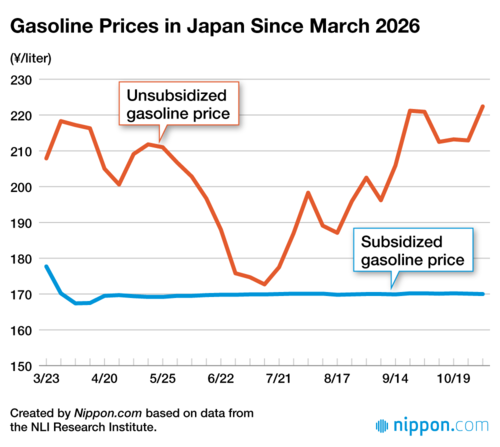
The Japanese government’s gasoline subsidy program ended in 2025, but it was reinstated in March 2026 after US and Israeli strikes on Iran in late February sent crude oil and gasoline prices skyrocketing. Under the program, whenever the market price exceeded ¥170 per liter, the government used state funds to pay the excess to wholesalers, keeping the retail price at that level.
According to the Agency for Natural Resources and Energy, as of November 2, the subsidy-free market price for gasoline had reached ¥222 per liter, meaning consumers were benefiting from a subsidy of as much as ¥52 per liter. However, as the total amount of subsidies paid out since March totals ¥1.4 trillion, there is a danger that the funding source will be exhausted within the fiscal year if the trend continues.

At the end of October, Prime Minister Takaichi Sanae announced a phased reduction in the gasoline subsidy. Under the policy, the subsidized target price, previously set at ¥170 per liter, will be raised by ¥5 each month, starting in December and continuing into early spring.
Prioritizing Price Controls or Fiscal Responsibility?
If the increases continue through March 2027, the benchmark price will reach ¥190 per liter. However, all that has been confirmed so far is that it will be raised three times in December 2026, for a total increase of ¥5, bringing the price to ¥175. Beyond December, it remains unclear when Takaichi will introduce further increases or how high the price will rise.
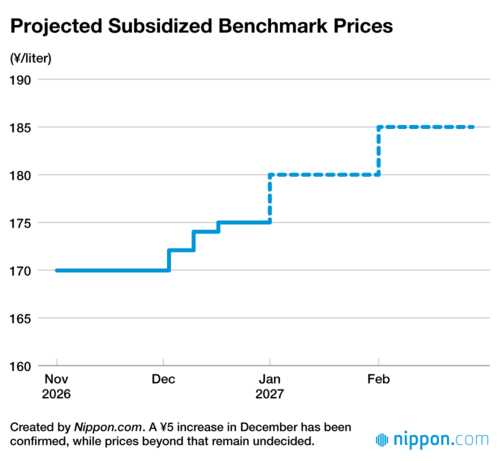
Ueno Tsuyoshi, chief economist at the NLI Research Institute, points out: “Looking back at the Kishida and Ishiba administrations, the highest subsidized price was around ¥185. With the unified local elections scheduled for April 2027, which will also serve as a prelude to the LDP presidential election that same year, the government will likely want to curb rising dissatisfaction among voters.” Given this, he expressed the view that the benchmark price will be “no higher than ¥185.”
However, as of early November, the gap between the market price and the benchmark price stood at approximately ¥50 per liter. Unless the gap is narrowed, the fiscal burden will continue. Although crude oil and gasoline prices are currently falling, the outlook is still unclear. Following the Republicans’ crushing defeat in the US midterm elections, President Donald Trump may find it difficult to implement domestic policies, and the possibility cannot be ruled out that he will seek an outlet in foreign affairs by adopting a hard-line stance toward Iran.
The subsidy program for gasoline and other types of fuel began in 2022, and budgetary measures totaling ¥10.7 trillion have been implemented to date. As Ueno notes, “If there is no clear path to phasing out these subsidies, speculation about fiscal expansion could contribute to weakening the yen and raising long-term interest rates.”
- Information on emergency measures to mitigate the impact after the outbreak of hostilities in the Middle East (Japanese) from the Agency for Natural Resources and Energy
- Information from press conference concerning gasoline subsidies (Japanese) from the Prime Minister’s Office
(Translated from Japanese. Banner photo © Photo AC.)