Year of the Horse: Five Shrines to Visit in 2026
Guideto Japan
Travel Culture History- English
- 日本語
- 简体字
- 繁體字
- Français
- Español
- العربية
- Русский
The Horse as Sacred Messenger
Horses first featured in Japanese history around the fifth century, when they appeared in Kyushu, having come from the Asian continent via Korea. They were initially for military use, but since there were so few, it is unlikely that they actually saw the battlefield. Horses in fact symbolized power and wealth, as evidenced by burial goods such as harnesses and haniwa horse figures included in kofun tumulus tombs, and they later became incorporated into religious devotions.
The Shoku Nihongi (Chronicles of Japan), compiled in 797, notes that horses were sacred animals presented to the deities. Ceremonies with elaborately decorated horses, dating back to the Heian period (794–1185), gradually developed into national rituals to pray for rain, good weather, or peace in the land.
Horses were also presented to shrines as divine messengers or mounts for the deities. Over time, illustrations or wooden figures came to substitute for live horses, and the custom of writing a request onto wooden plaques called ema, decorated with the figure of a horse, developed. Sacred horses still exist today: One appears during the festival of Kamigamo Shrine in Kyoto, and a horse donated by the imperial household serves the deities at Ise Shrine. Many shrines associated with the creatures have also horse statues in their precincts.
Shrines connected with horses are found all over Japan. Used in martial arts and in war, horses were also essential for farming and transport. They have long been venerated for ensuring victory, career fortune, or financial success, and nowadays are also associated with traffic safety and figurately “opening the way” to some desired new phase in the life of the person offering the prayer. When visiting a horse-themed shrine, write a message on an ema to ask for divine favor.
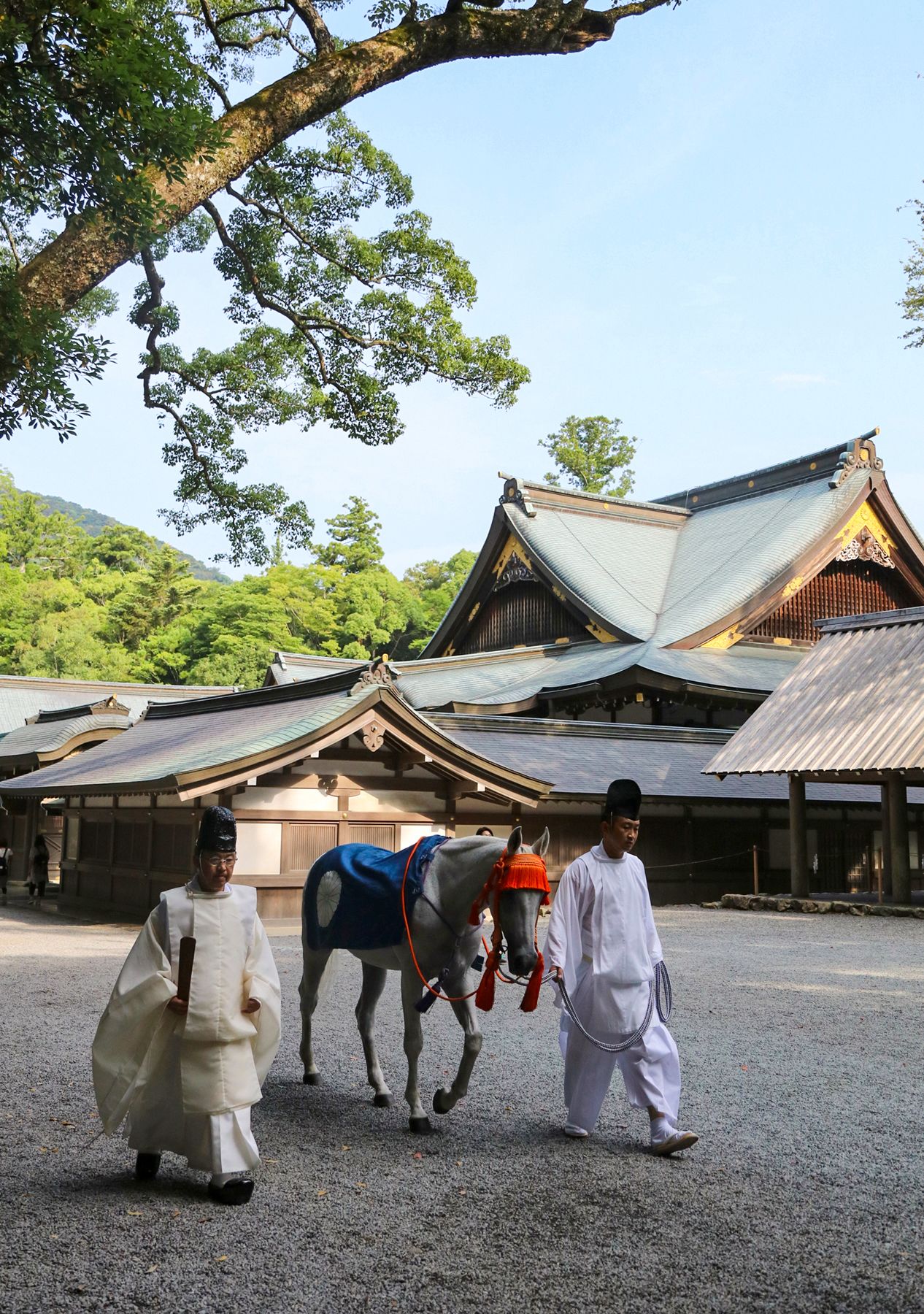
A sacred horse being led to the main sanctuary of the naikū inner shrine of Ise Shrine. (© Jingūshichō)
Fujinomori Shrine, Kyoto
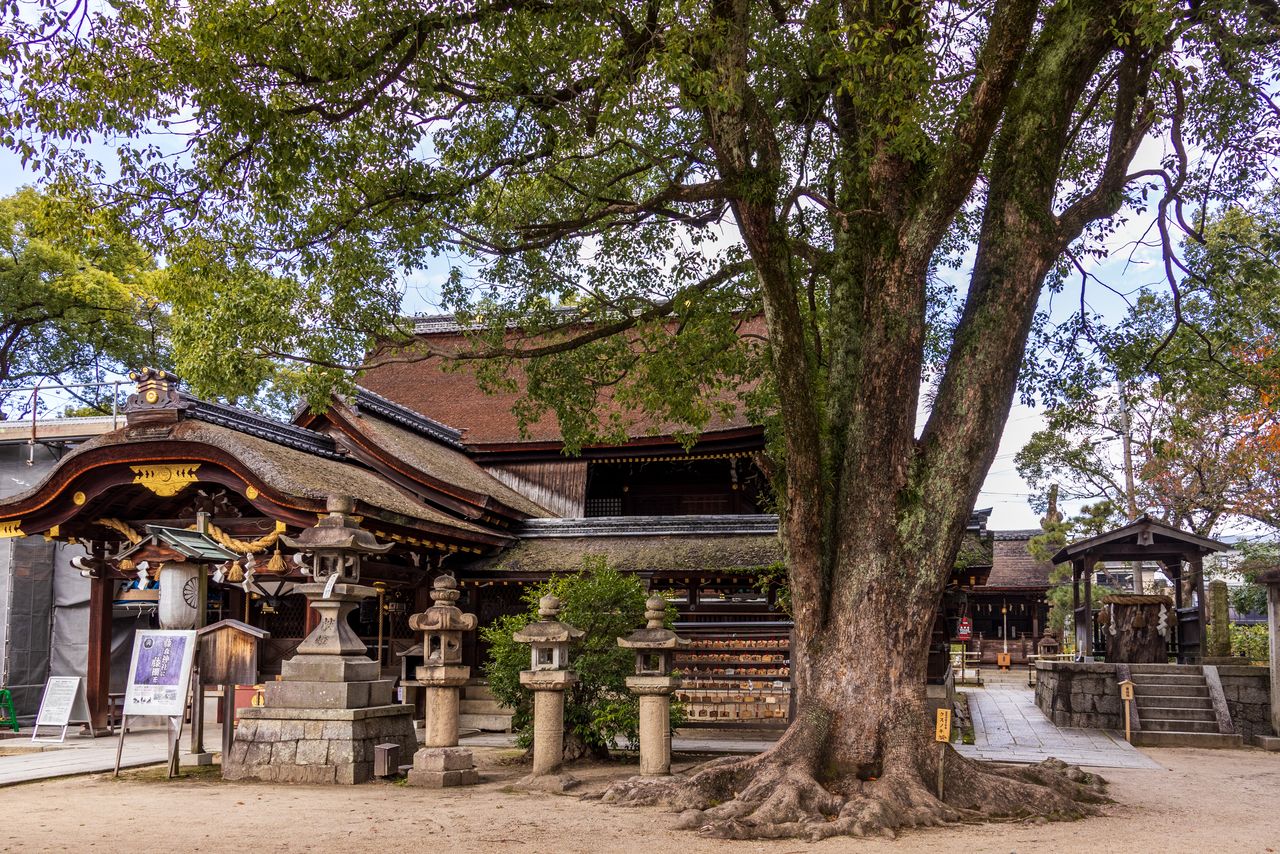
The shrine’s main sanctuary was donated by an Edo period (1603–1868) emperor. To the right is the hatazuka, a mound where empress Jingū erected a banner and conducted a rite. (© Nippon.com)
Fujinomori Shrine, in Fushimi, Kyoto, has deep connections with Japan’s rulers. Supposedly founded in 203 by empress Jingū, known for her military exploits, it was designated by Emperor Kanmu (r. 781–806) as the protector shrine of the city’s southern approaches when the capital was relocated to Heiankyō (modern-day Kyoto).
The shrine festival’s musha gyōretsu samurai procession on May 5 supposedly gave rise to the popular gogatsu ningyō boy dolls outfitted in medieval armor or samurai helmets. These are displayed in homes to celebrate the growth of male children on shōbu no sekku, now the May 5 Children’s Day public holiday. On that day, families run baths into which they place leaves of 菖蒲 (shōbu, iris), to ward off evil. Because 菖蒲 is associated with the homonyms 尚武 (shōbu, martial spirit) and 勝負 (shōbu, competition), prayers have been said at this shrine for victory in war.
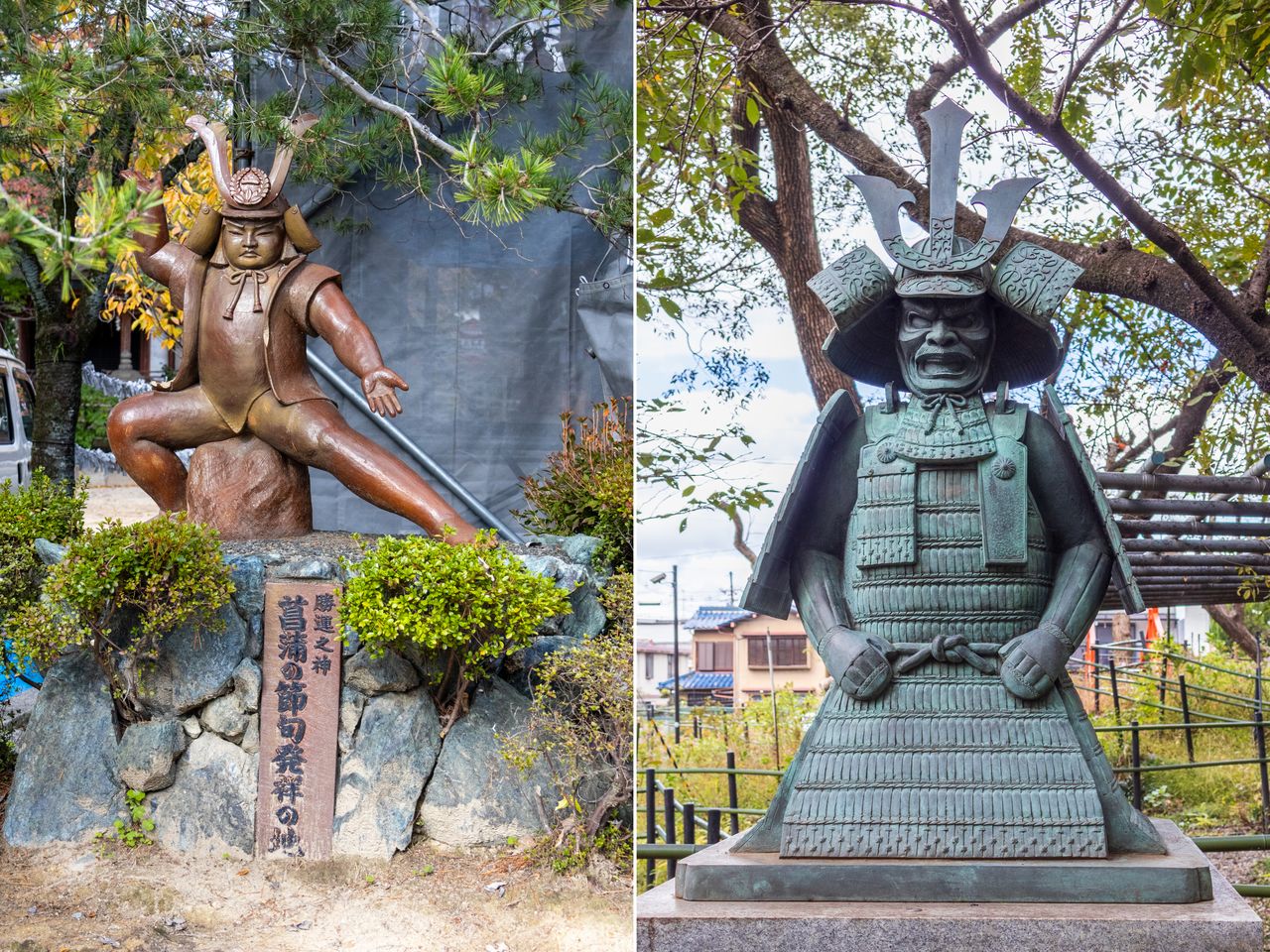
These statues tell the shrine’s story as the originator of the May 5 shōbu no sekku observance. (© Nippon.com)
Shrine priest Tsuji Ken’ichi explains that “The shrine’s origin as the deity of victory goes back to the Nara period [710–94], when the prayers of emperor Kanmu’s brother for victory in battle were answered. Beginning in the Heian period, the shrine has conducted the kakeuma rite, which replicates the going-into-battle ceremony of that time, during its annual festival.” Kakeuma gradually evolved from a demonstration of riders’ acrobatic moves to a ceremony asking for blessings to improve equestrian skills.
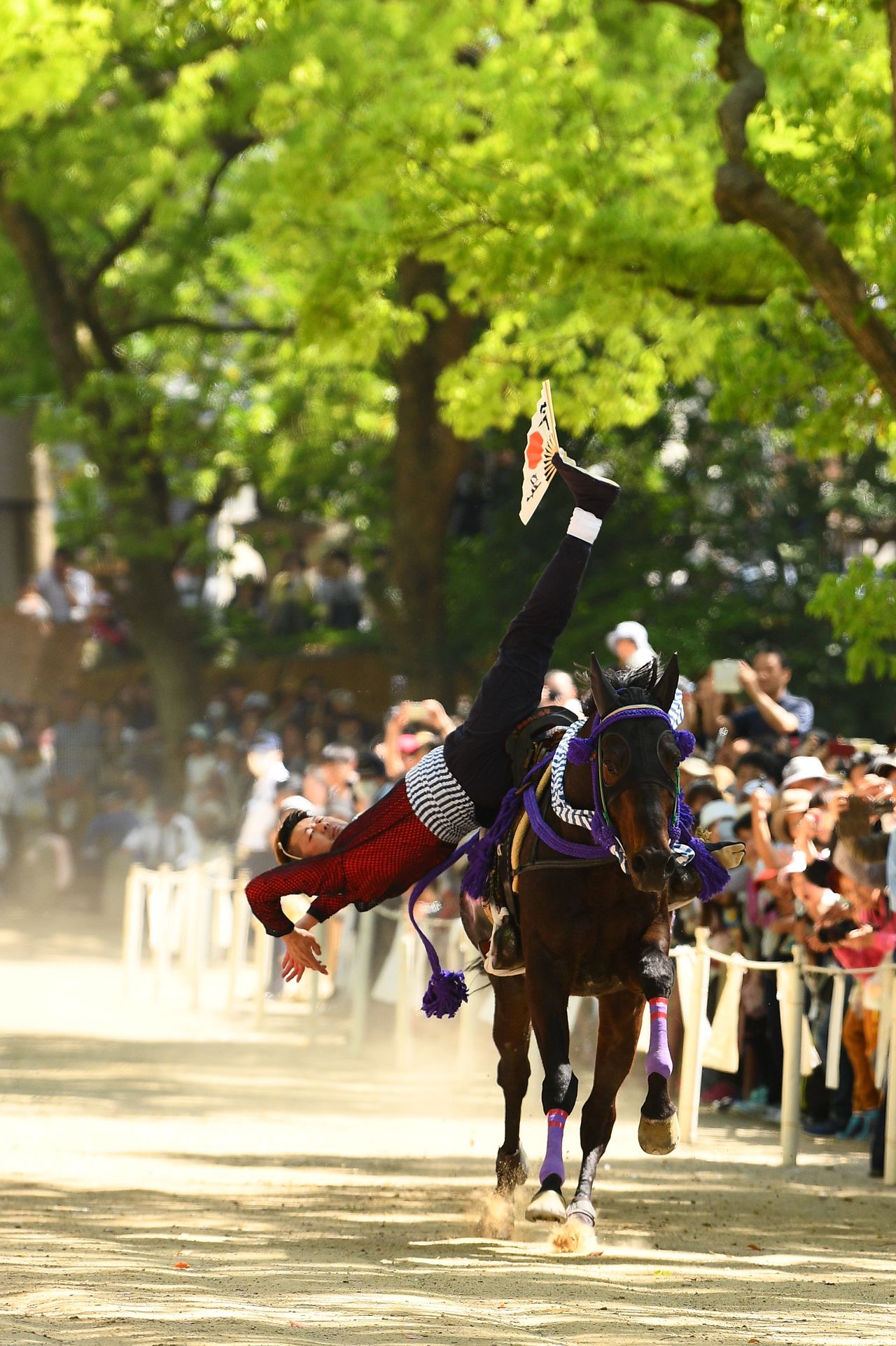
A rider performs a daredevil maneuver atop a galloping horse in the kakeuma rite. (Courtesy Kyoto Design)
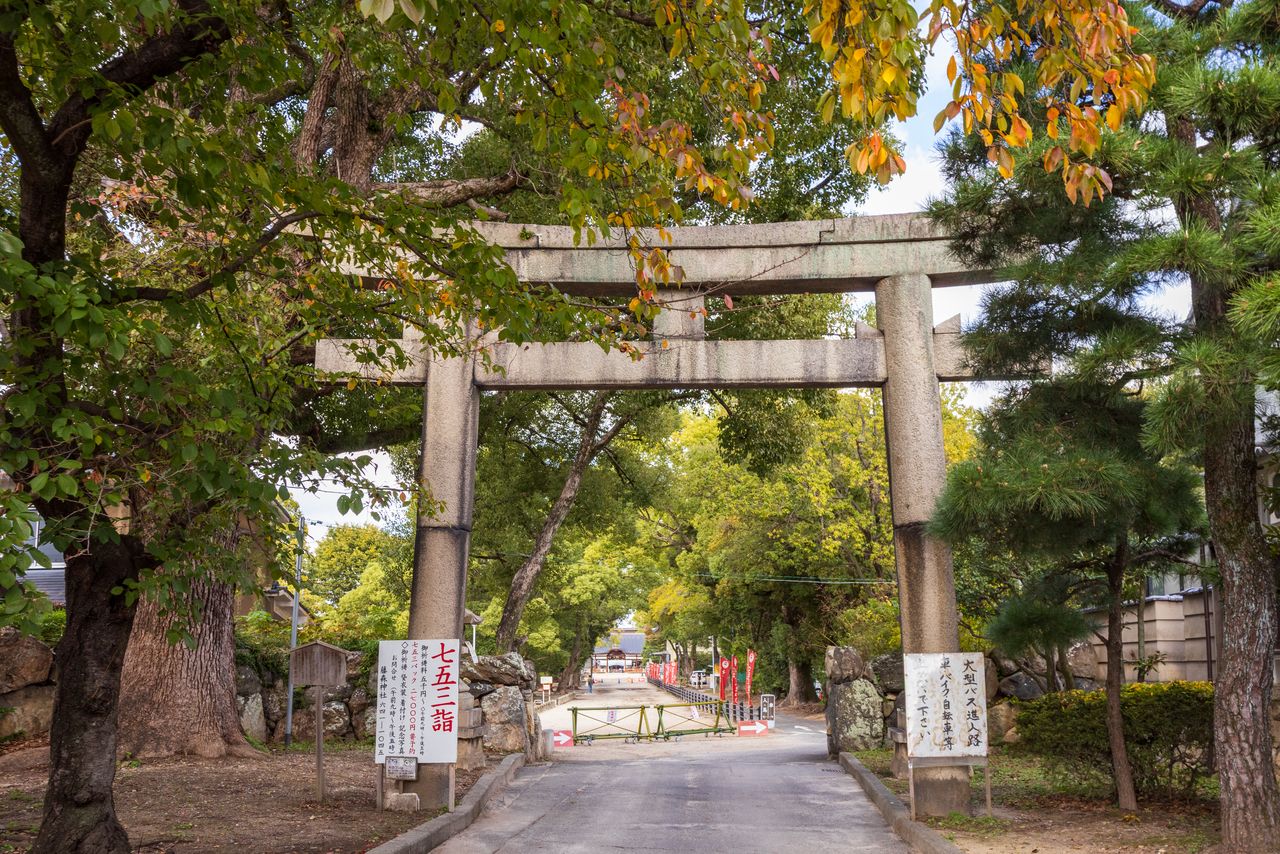
Horses are ridden along the long approach to the shrine. (© Nippon.com)
Fujinomori Shrine is famous in horseracing circles; the Fujinomori Stakes race, begun in 1982, takes place at the Kyoto Racetrack in the same Fushimi district of Kyoto. After the owner of Tamamo Cross had gone to the shrine to offer thanks for the horse’s victory in the 1987 Fujinomori Stakes, the horse went on to win both the spring and autumn editions of the 1988 Tennōshō Emperor’s Cup, cementing the shrine’s reputation for backing a winner. Its Shinshinsai festival for people connected with the equine world also attracts horseracing fans eager to get a glimpse of the horses and jockeys participating in festival events.
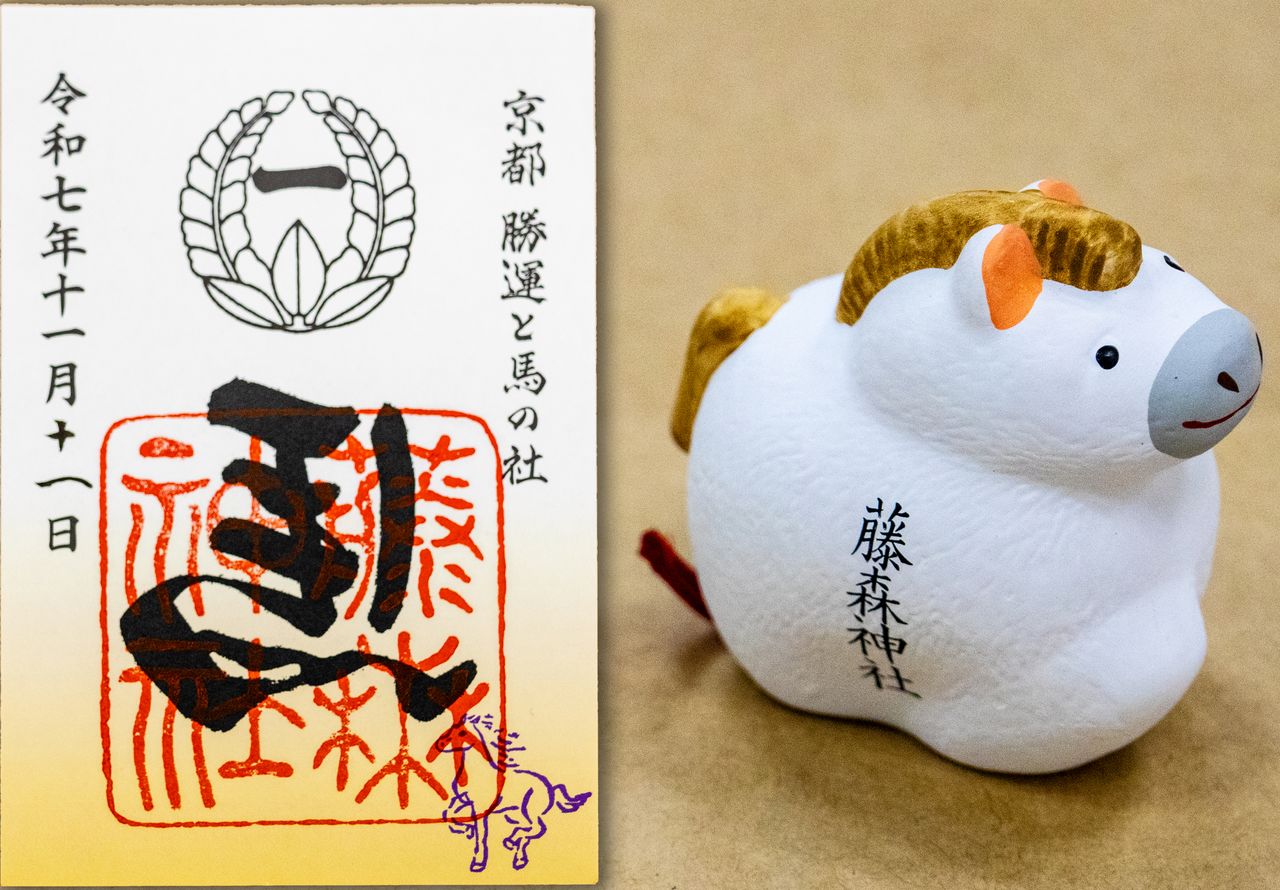
The special goshuin stamp used only during the Shinshinsai festival, which takes place yearly in November. Horse figures containing mikuji fortunes are also available. (© Nippon.com)
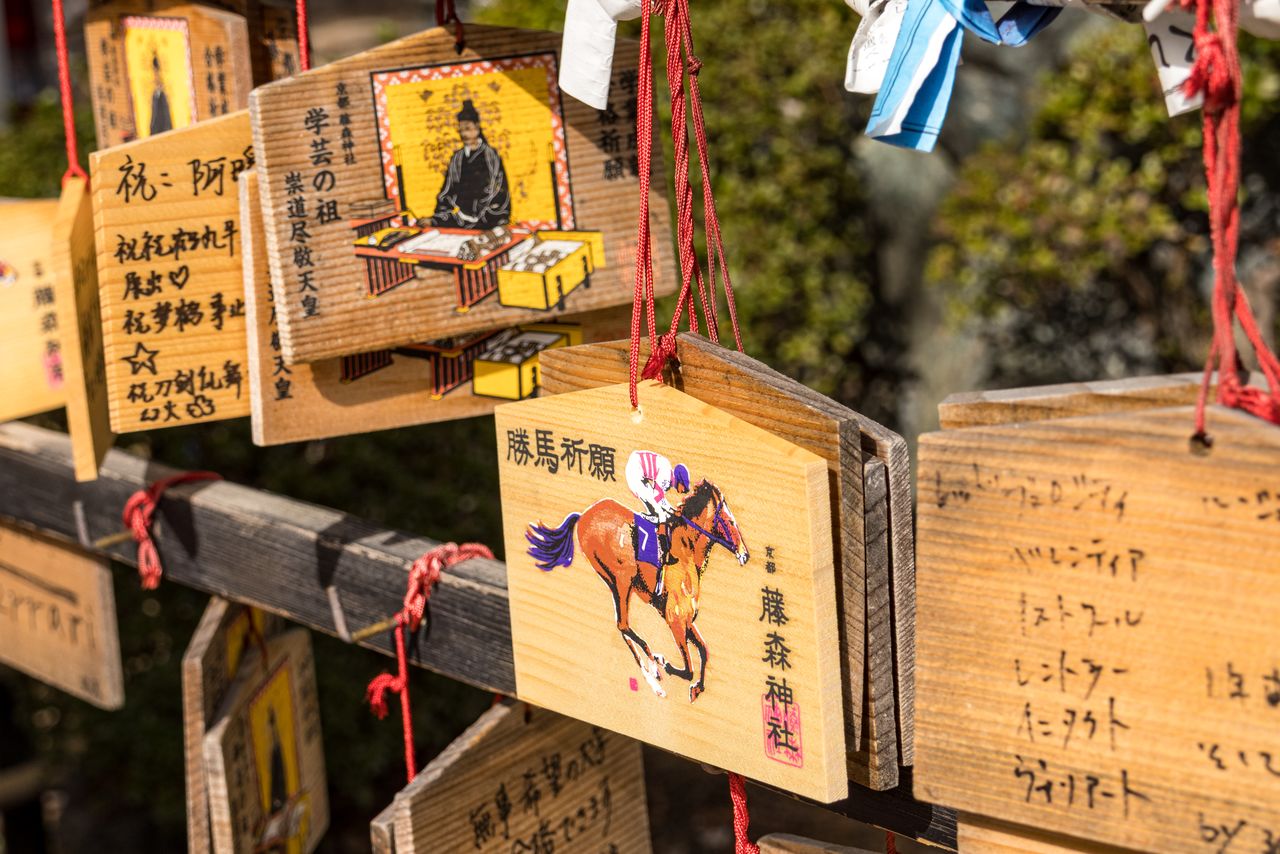
Ema depicting racehorses are popular among bettors hoping for a win. (© Nippon.com)
The ema offered at the shrine include prayers for horses’ health and also reflect the desire to back a winner, such as placing a winning bet, passing an entrance exam or doing well in contests or elections.
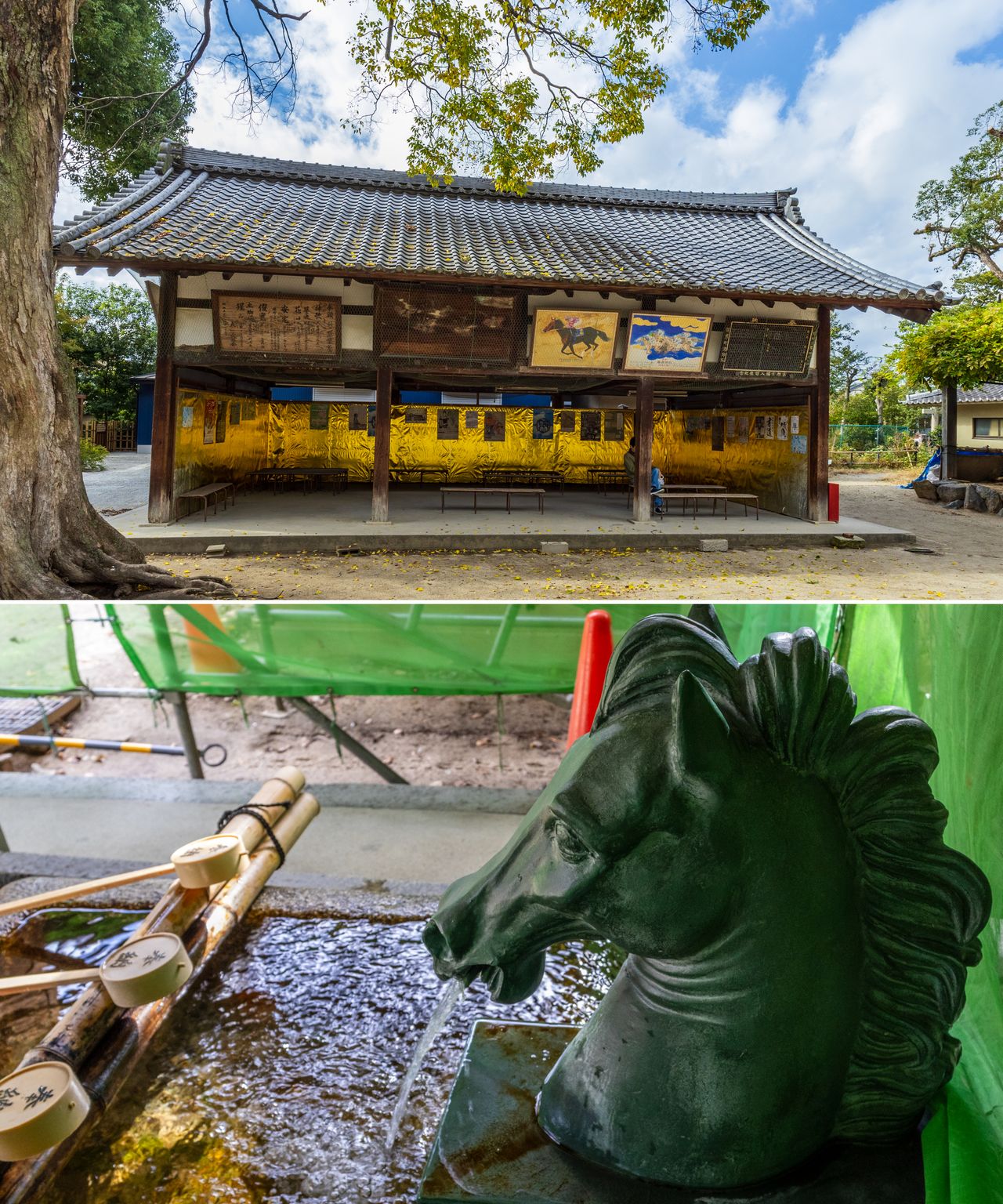
Top: This structure displays ema from the Edo period (1603–1868). Bottom: Water flows from a horse’s head at the shrine’s temizuya ritual purification basin. (© Nippon.com)
Kamo Shrine, Ōmi Hachiman, Shiga Prefecture
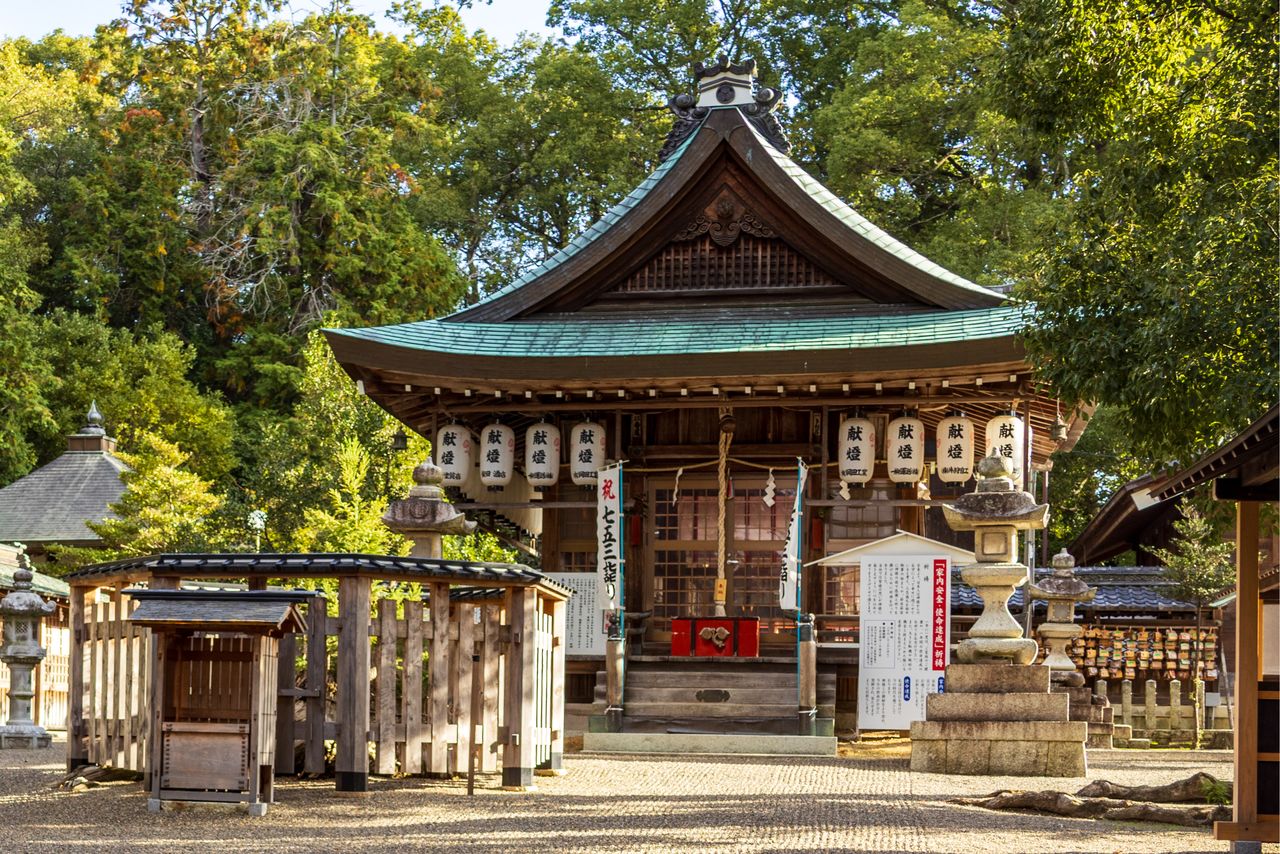
The stump of the shrine’s sacred tree, ringed by a wooden fence, fronts the shrine’s worship hall. (© Nippon.com)
Kamo Shrine, in the central region of Shiga Prefecture, was founded in 736 to protect the capital from epidemics and natural disasters. Because of its central location, emperor Tenji established the nation’s first pasture for raising warhorses there in the seventh century, inspiring profound reverence for the shrine as the protector of horses.
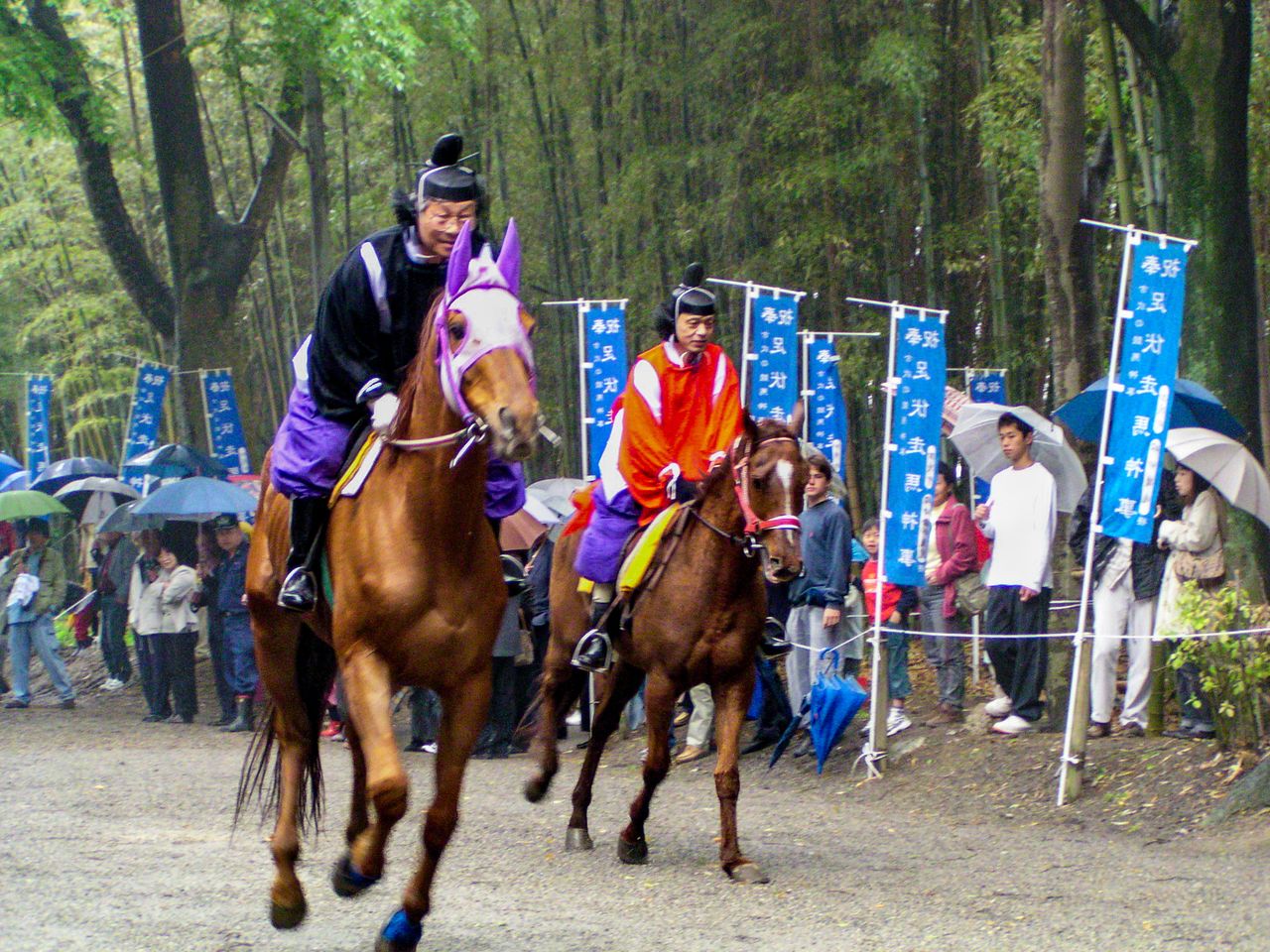
Horses race along a 400-meter-long stretch at the shrine. (© Biwa Visitors Bureau)
Many rites and rituals relating to horses take place at Kamo Shrine, and people who work with horses visit the shrine year-round. At an annual festival held here on May 6, seven horses compete in a race. This race, which has taken place for over 1,350 years, has its origins in horse races held at the imperial court.
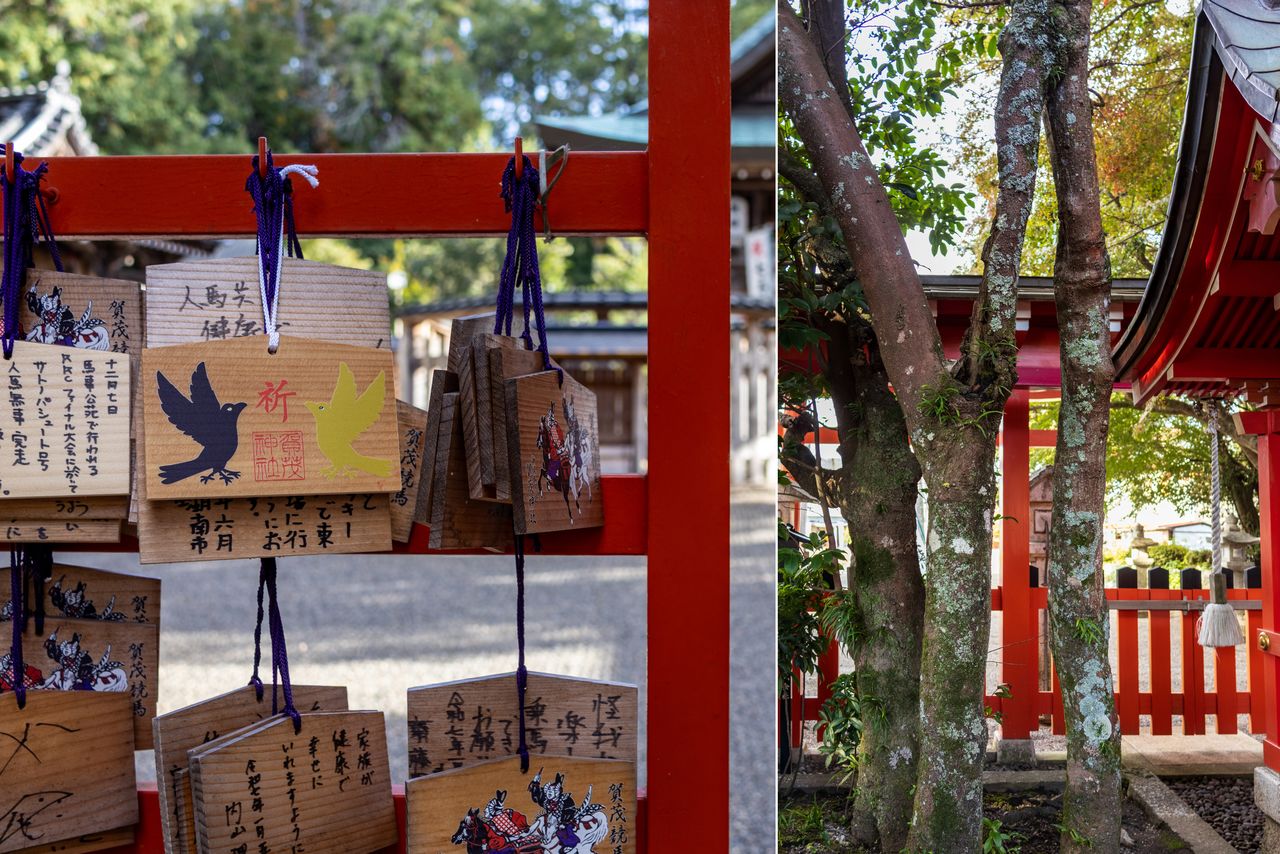
Left: Many ema show horse-related wishes. Right: A sacred sakaki tree with a forked trunk. (© Nippon.com)
The remains of a Jōmon period (ca. 10,000–300 BC) ritual site have been found in the shrine precincts, and the presence of a sacred tree promoting harmonious existence also makes it a popular “power spot.” One of the shrine’s trees, a thousand-year-old specimen, was toppled in a typhoon in 2018. It also took down one of the country’s largest statues of a sacred horse at a shrine when it fell, and restoration work has not yet begun. A herd of rare Kiso horses, an endemic species, are kept at the nearby Mikarino no Mori, where horse-lovers may pet and ride them.
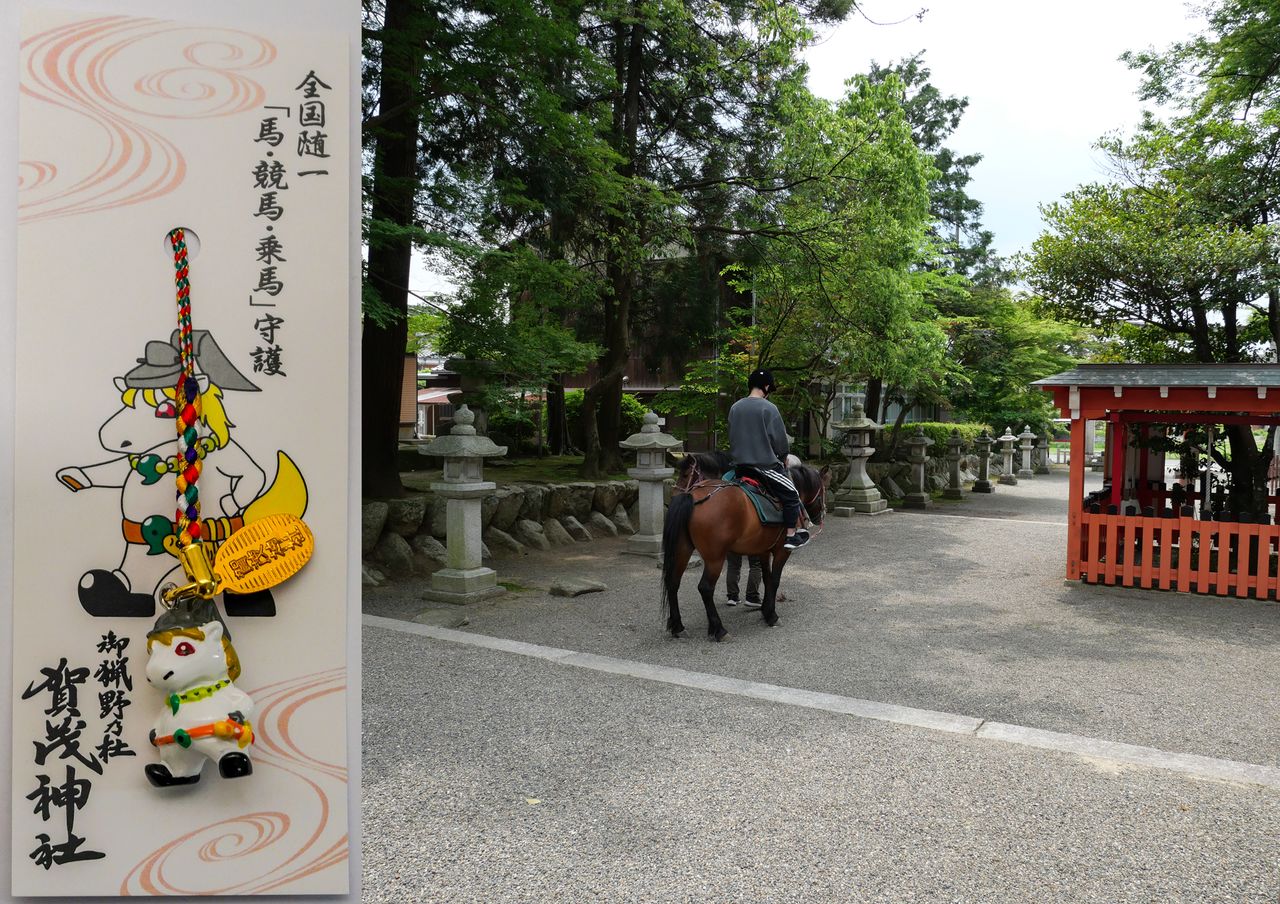
Left: A horse-shaped amulet. Right: A horse from Mikarino no Mori is led to the shrine. (© Shibuya Nobuhiro)
Kachiuma Shrine, Ibaraki Prefecture
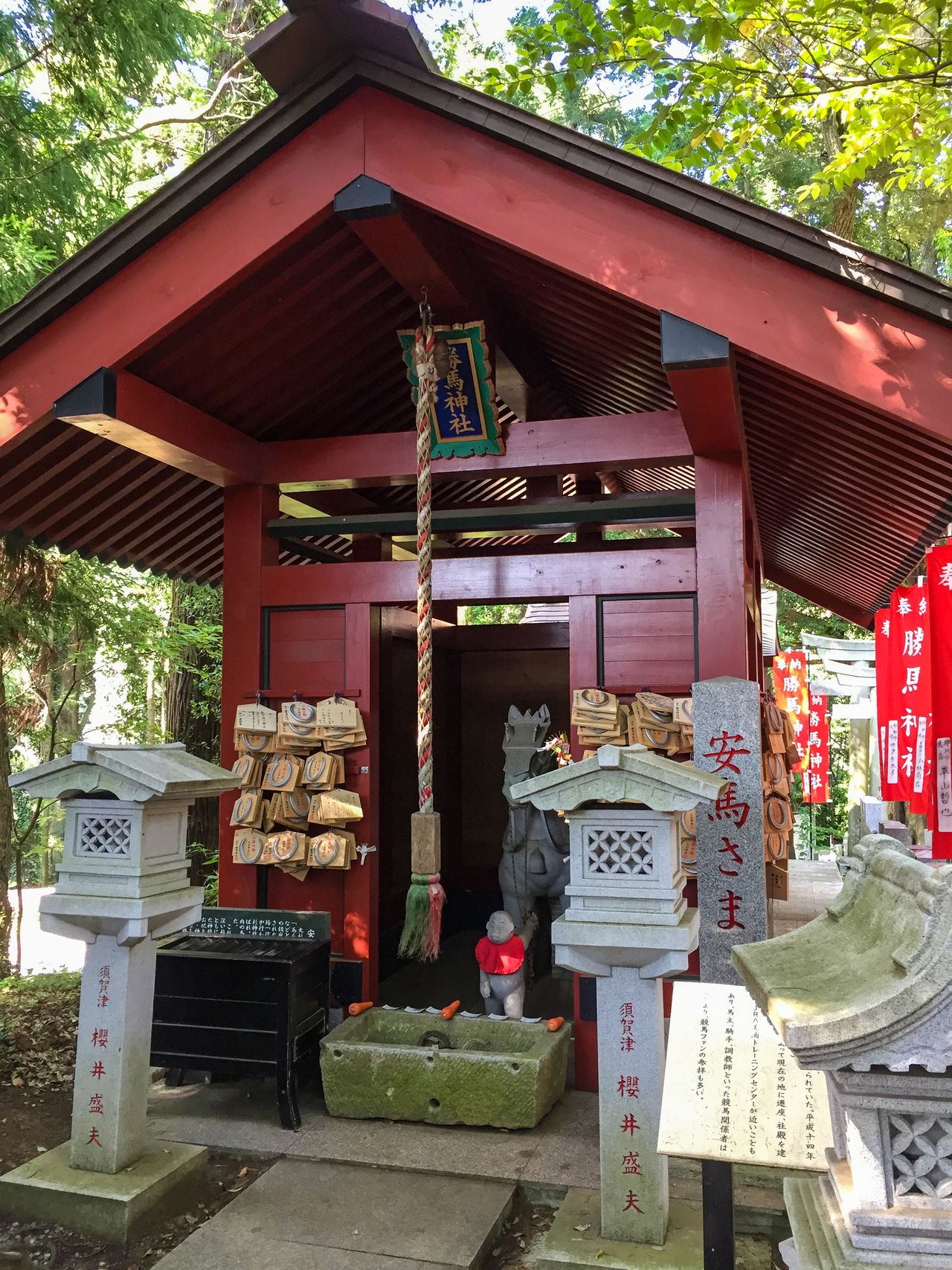
Kachiuma Shrine, an auxiliary to the nearby Ōsugi Shrine. (© Pixta)
Kachiuma Shrine in Ibaraki Prefecture dates back to the Heian period, when the imperial court established a shrine to protect the horses of the imperial farm in present-day Miho, a village in the prefecture. That shrine, Bareki Shrine, was later moved into the precincts of nearby Ōsugi Shrine. The Miho Training Center for training racehorses opened in 1978 on the grounds of the former shrine, a fortuitous coincidence that has brought endless streams of owners to the shrine to pray for the health of their horses ever since.
The gnarled branch of a sacred tree standing beside the shrine’s main sanctuary resembles a horse’s head, and the shrine’s ema carries an illustration of a horseshoe. Visit the main Ōsugi Shrine too, famous in the area for warding off evil and making wishes come true.
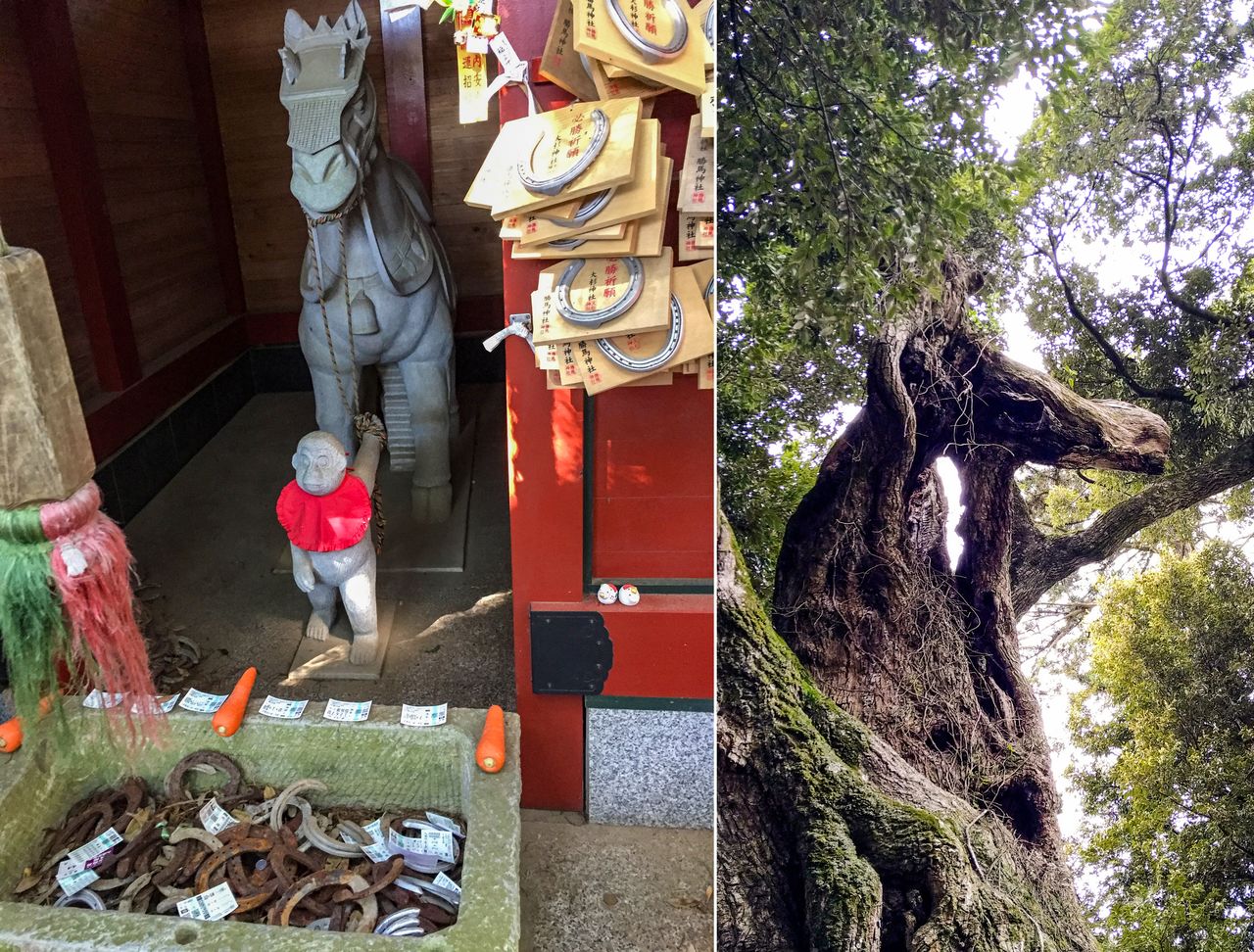
The sacred monkey Anba, leading a sacred horse (left). The tree’s branch resembles a horse head (right). (© Pixta)
Komatsunagi Shrine, Setagaya, Tokyo
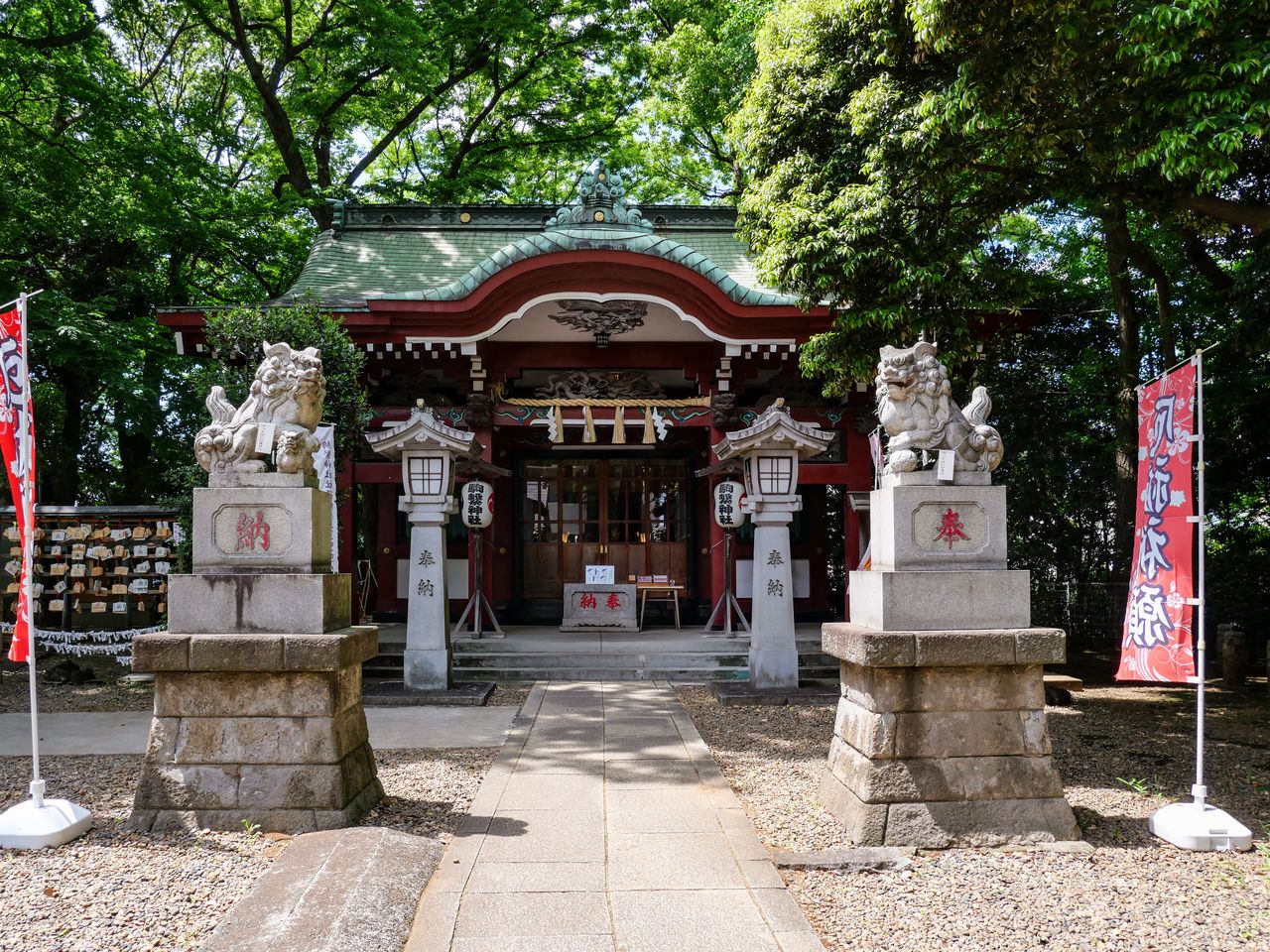
Komatsunagi Shrine in Shimouma, Setagaya. (© Shibuya Nobuhiro)
Komatsunagi Shrine in Shimouma, Setagaya, derives its name from a story related to Minamoto no Yoritomo (1147–99), founder of the Kamakura shogunate. On his way to a campaign to subdue the northern provinces, Yoritomo stopped by the shrine to pray for victory, tethering his horse to a pine tree on the grounds. His prayer was granted, and this act of tethering (tsunagu) lives on the shrine’s name.
The place name Shimouma also comes from an incident connected with Yoritomo. When crossing the stream in front of the shrine while mounted on his horse, the horse fell into a deep spot and drowned. Thereafter, it was decreed that riders should dismount and lead their horses when crossing, at the spot which became the village of Shimouma Hikizawa. The ancient pines and other trees growing on the grounds and the shrine’s ema depicting a horse bring to mind this legend.
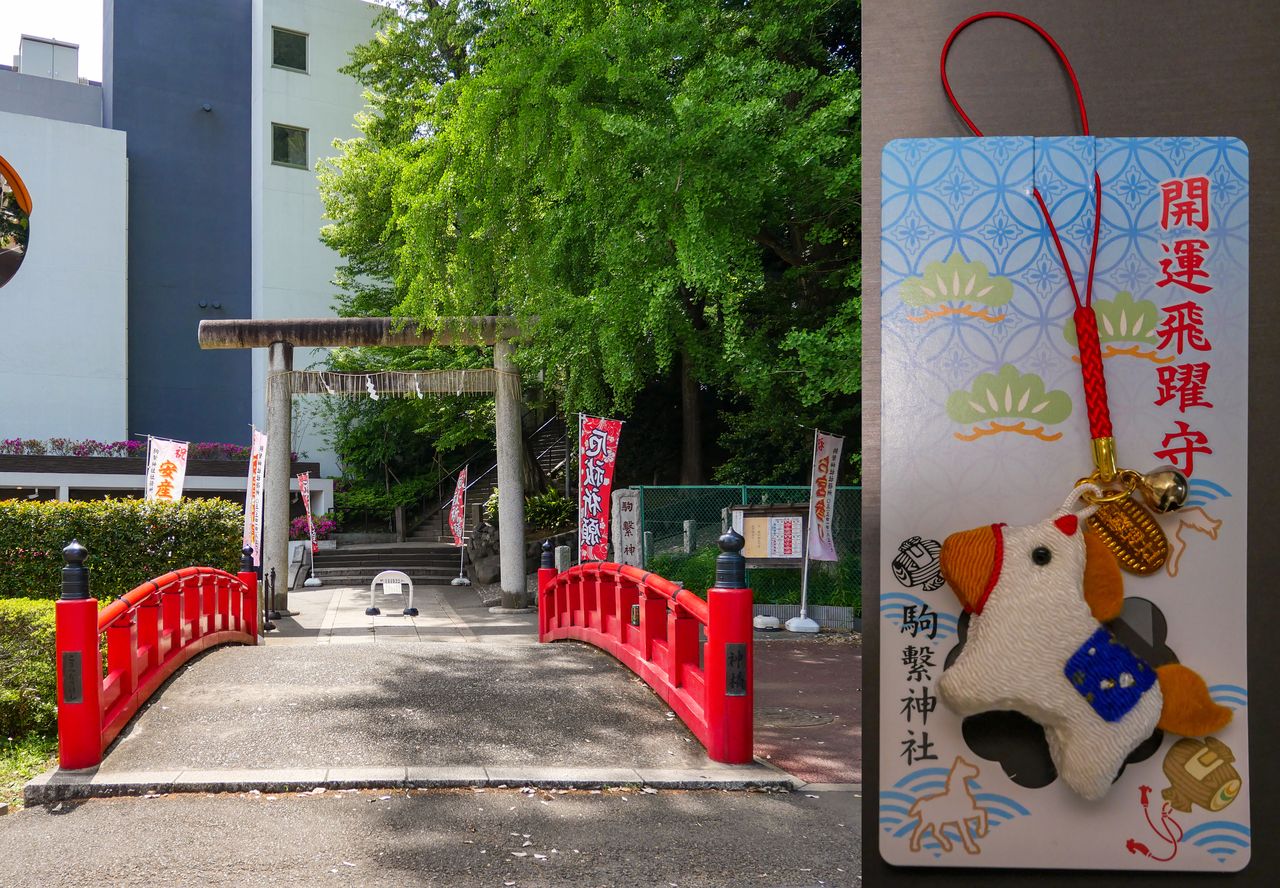
A vermillion bridge crosses the stream, which now runs underground (left). A horse-shaped amulet (right). (© Shibuya Nobuhiro)
Arakawa Komagata Shrine, Tōno, Iwate Prefecture
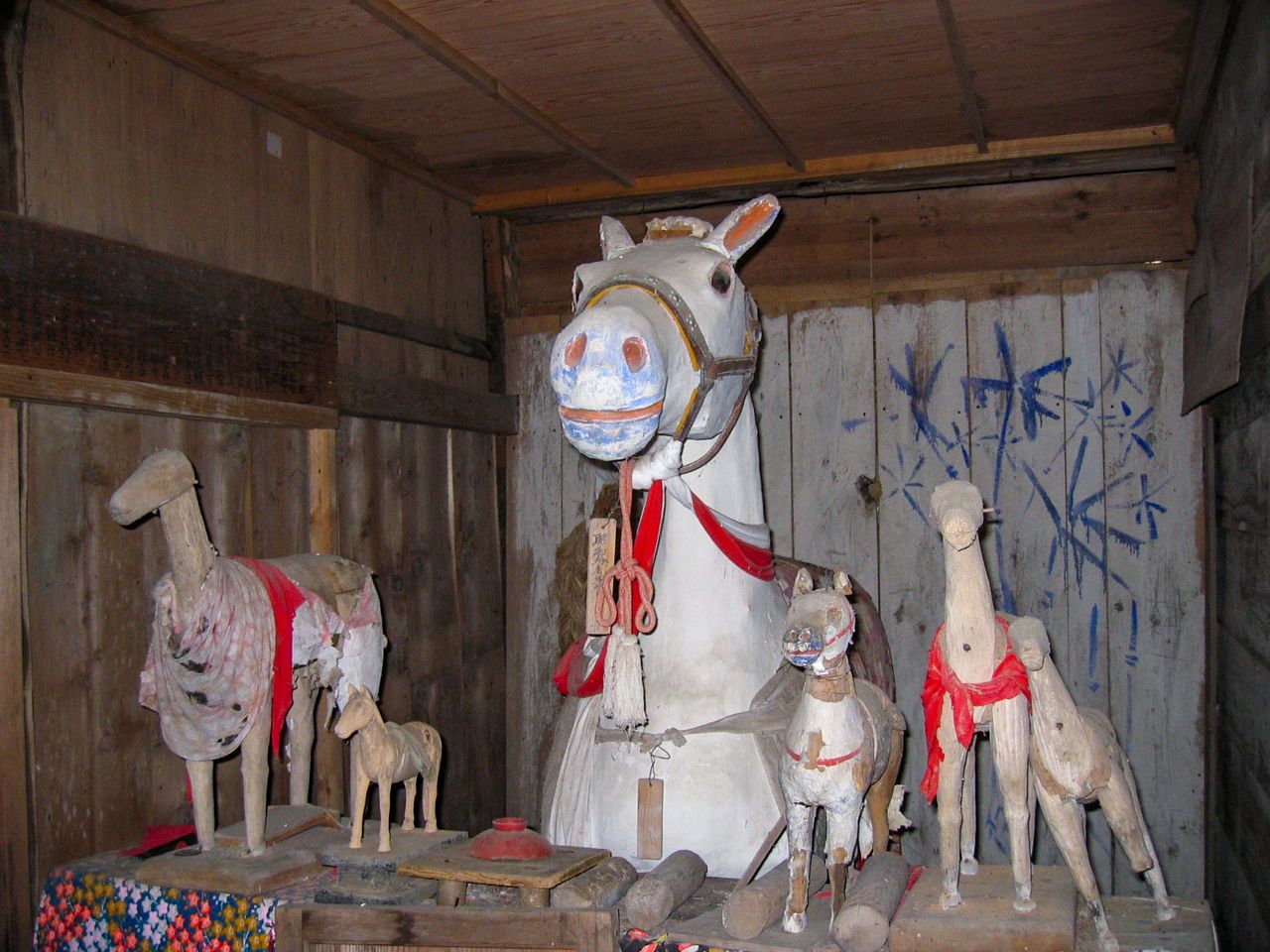
Horse figures presented as offerings to Arakawa Komagata Shrine. (© Tōno Tourism Association)
The Tōhoku region, known as horse country, is rich in folk beliefs pertaining to these animals. One especially well-known folk belief is that of oshirasama, revered as the protector of home and hearth. This belief is based on the legend of a maiden who fell in love with a horse, as recounted in the The Legends of Tōno, collected by folklorist Yanagita Kunio.
Arakawa Komagata Shrine, protector of horse breeding, lies in Tōno’s Arakawa highlands, known as prime grazing land. The shrine’s annual May festival, featuring a procession by a sacred horse, attracts people working in the livestock industry. According to legend, a Buddhist priest saw the mountain deity riding a white horse. He drew a picture of the sight, which became the shrine’s sacred image. The shrine, lying in a deep forest, is approached through time-worn torii gates, immersing visitors in an atmosphere of mystery appropriate to the region’s folklore.
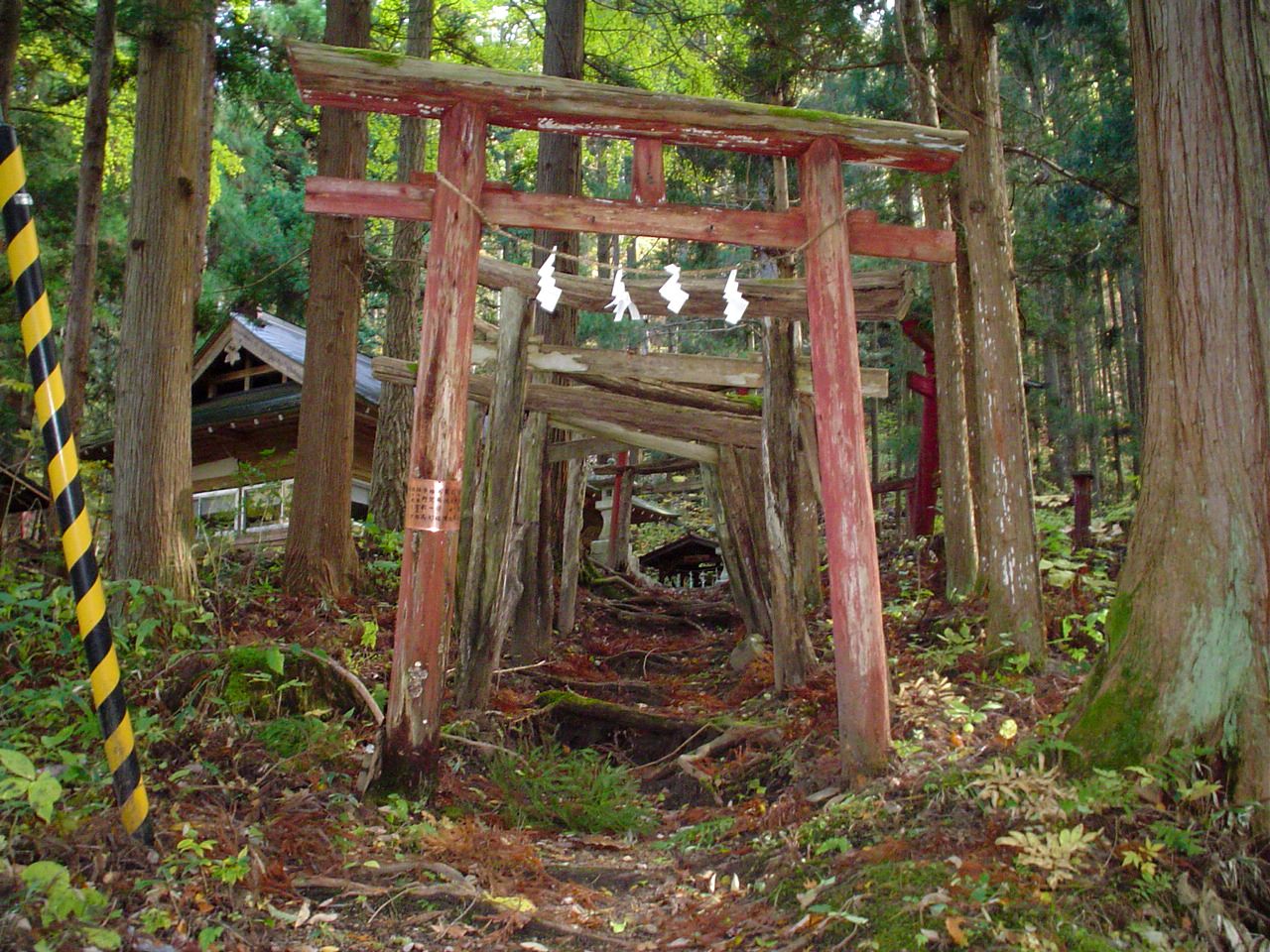
The shrine’s weathered torii gates. (© Tōno Tourism Association)
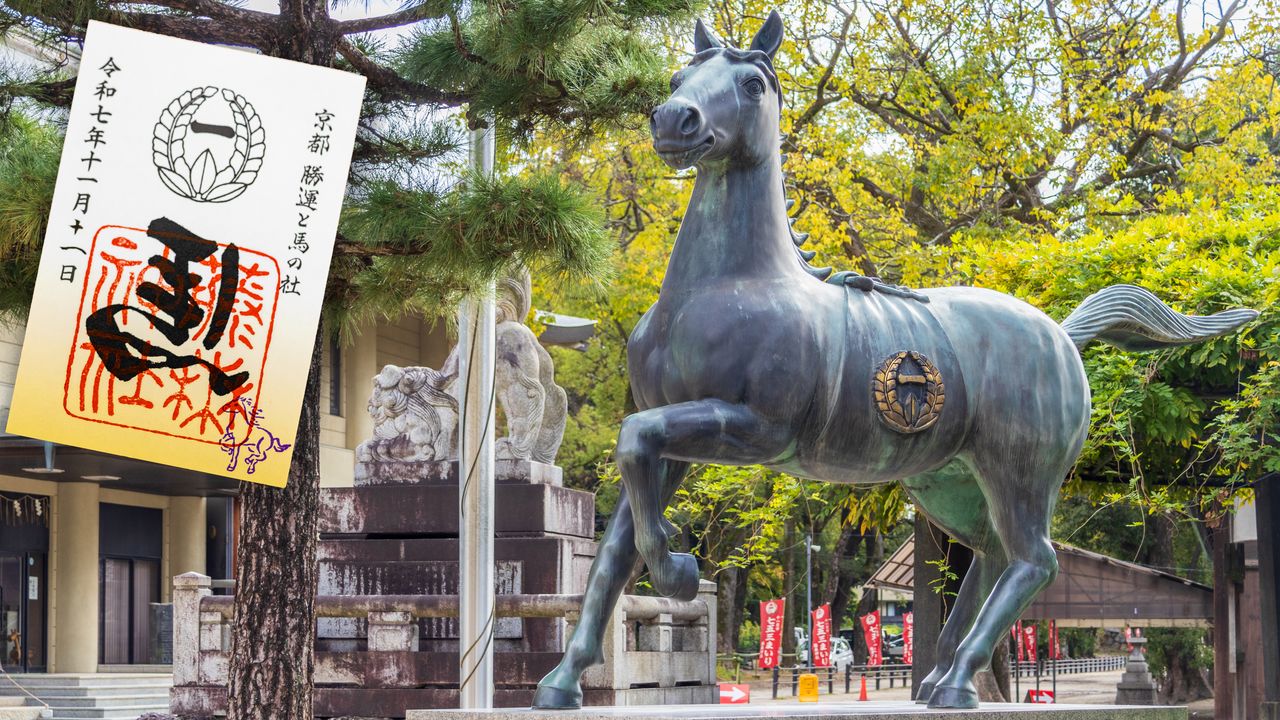
(Originally published in Japanese with editorial supervision by Shibuya Nobuhiro. Banner photo: The goshuin and horse statue at Fujinomori Shrine. © Shibuya Nobuhiro.)