
The Shifting Japanese Labor Scene
Sweetening the Pot: Personnel Shortages Driving Hikes in Beginning Wages in Japan
Work Economy Society- English
- 日本語
- 简体字
- 繁體字
- Français
- Español
- العربية
- Русский
Japan’s Once-Uniform Starting Salaries
Starting salaries in Japan used to be largely uniform. This could be confirmed by calculating the degree of variation in monthly scheduled cash earnings (the amount paid for standard working hours) for newly hired male university graduates employed by companies of the same size and in the same industry. A value of zero on the vertical axis in the figure below, which charts salaries in the banking industry, would indicate that all starting salaries are exactly the same. For comparison, the figure also displays the variation in scheduled cash earnings in 2023 for male university graduates aged 30, 40, and 50 who have been continuously employed by the same company since graduation.
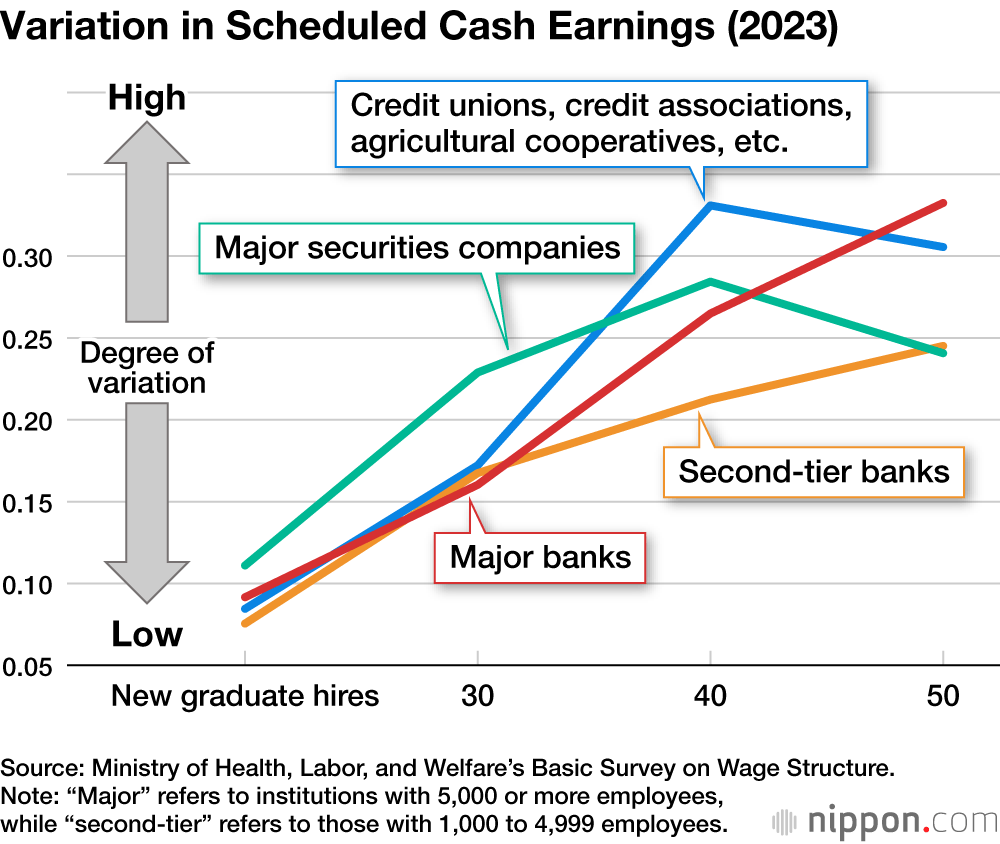
For fresh hires among all types of banking institutions, the degree of variation is around 0.1. While this doesn’t indicate total uniformity, the disparity is very small. As the chart demonstrates, salary variation increases considerably with age in some parts of the industry, showing that uniformity dissolves with continued employment.
The increasing variation in salaries over time may stem from employers gradually recognizing workers’ abilities, as well as differences between individuals in their pace of improving skills and gaining experience. The low variation in starting salaries, which we have been calling “uniformity,” might instead reflect a lack in difference of ability, or indicate that such differences are not yet apparent to employers at the early training stage.
Corporate Coordination to Suppress Starting Salaries
In Japan’s long-term employment model, worker salaries have been determined through companies’ “internal labor markets” determined by HR management. However, starting salaries have been an exception, set instead by the “external labor market,” based on supply and demand between companies and job seekers. It has been noted that the “one price for one good” principle of market economics of the external labor market readily applies to starting salaries, since they are set for inexperienced graduates, tend to involve roles with low importance and responsibility, and because hiring takes place simultaneously across the country for fresh college graduates.
Some believe that companies have been aligning their salary levels with competitors, while also using single people’s living expense levels as a reference point. Indeed, in the market for hiring new graduates, inexperienced applicants have limited bargaining power, and in addition to time constraints during the job-hunting period and asymmetry of information, the number of companies competing to hire new graduates is relatively small.
In Japan, HR personnel have reportedly met regularly with those from other companies, exchanging information on salary systems and market wages. Therefore, interfirm coordination as an explanation of salary uniformity cannot be easily dismissed. By coordinating to, for example, set starting salaries below productivity levels, companies may have been able to maintain seniority-based wages and long-term employment by setting a wage curve that rises from the initial salary.
The Japanese employment system (where all new graduates are hired at once) has meant that job searching was less difficult for new graduates since specific job experiences or skills are not required at hiring. Even if initial wages are low, they knew that they could expect their salaries to increase over time.
Since long-term employment is presumed in the Japanese-style labor environment, companies were able to stably secure the necessary workforce, and there may have been no need to raise starting salaries above the uniform level. Companies may also have been cautious about raising starting salaries, as doing so under a seniority-based wage system would require corresponding increases for short-tenure employees, which would raise personnel costs considerably.
Uniformity Breaking Down
If it is true that companies of the same size and industry are maintaining uniformity of starting salaries, then groups with smaller variation would point to a more conscious effort for uniformity. The figure below illustrates the distribution of starting salaries by company size and industry category.
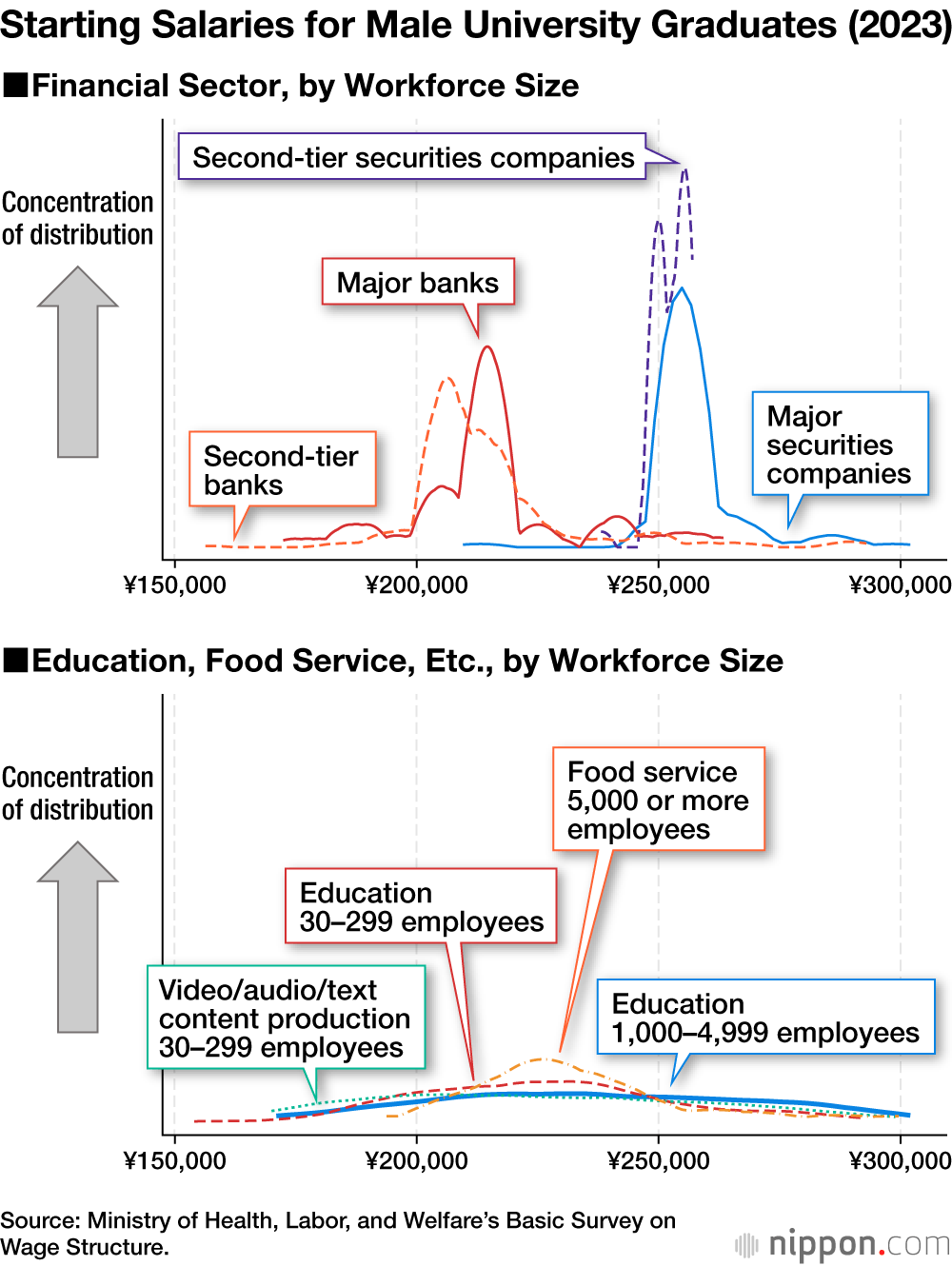
The higher on the distribution axis, the more concentrated starting salaries are in that range. Across all industries and workforce sizes, starting monthly base salaries are distributed in a bell curve, peaking between roughly ¥200,000 and 250,000. For example, starting salaries at large banks and securities firms are concentrated within a narrow range of ¥20,000 or ¥30,000. Meanwhile, in the education and food service sectors, the range of distribution is much wider, exceeding ¥100,000.
Looking at the structure of uniform starting salaries over time, signs of change emerged around the mid-2010s. As the minimum wage increased, baseline starting salaries were pushed up. Also, some companies began offering higher-than-average starting salaries to certain employees, leading to more variation in initial pay levels.
Major Companies Hiking Starting Salaries to ¥300,000 or Higher
| Sumitomo Mitsui Banking Corp. | ¥300,000 (¥254,000) |
| Tokio Marine & Nichidō Fire Insurance | Up to ¥410,000 (¥280,000) |
| Fast Retailing | ¥330,000 (¥300,000)* |
| Meiji Yasuda Life Insurance Co. | ¥332,000 (¥295,000)** |
| Shimizu Corp. | ¥300,000 (¥280,000)** |
Notes: Figures are for April 2026 hires, except for Fast Retailing (March 2025 hires) and Meiji Yasuda and Shimizu (April 2025 hires). Numbers are starting salaries for university graduates. Figures in parentheses are the previous amounts.
Source: Compiled by Nippon.com based on media reports.
The figure below shows the distribution of starting salaries at regional banks. As seen earlier, the variation in new graduates’ starting salaries is smaller than that of other age groups. However, a comparison of fiscal 2006 and fiscal 2022 reveals an upward shift of the base salary. Also, by 2022, some banks had begun offering higher starting salaries. Furthermore, as of fiscal 2024, the variation of starting salaries has significantly increased.
Even in 2019, prior to the pandemic, when the job offer ratio for graduates was high, some wholesale, software, and real estate companies were already offering starting salaries close to or above ¥300,000. Now, a growing number of companies, even those in sectors where starting salaries were just slightly above ¥200,000 before the pandemic, are making substantial increases to their first-year pay packages.
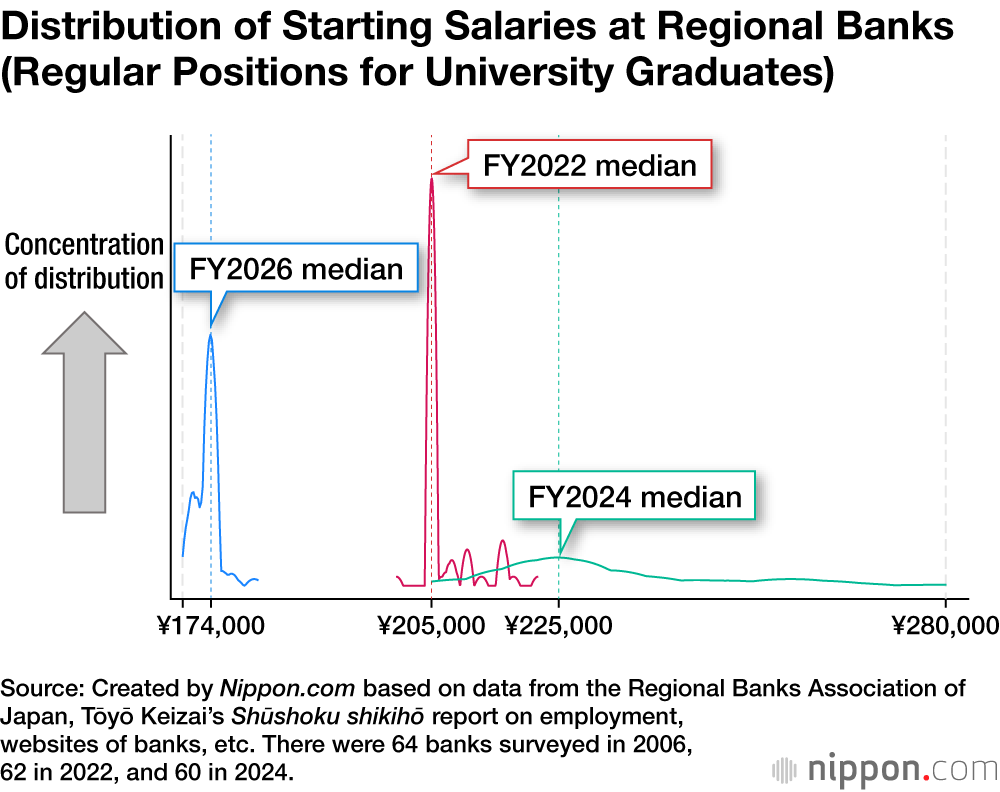
In the context of a historic labor shortage (particularly for full-time employees), the decrease in the proportion of younger workers in the working population, and a rising turnover rate among younger workers, some companies are making significant increases in starting salaries in an effort to secure top talent early on. At the same time, other companies have not raised wages to the same extent as similarly sized competitors in their industries, suggesting that rapid change may await the market for new graduates, which has traditionally had nearly uniform wages.
It is likely that this trend will continue, given worsening labor shortages and the ongoing aging of the workforce. The breakdown of uniformity in starting salaries may also indicate a shift for Japan’s traditional employment practices, which have been based on long-term employment and seniority-based wages.
In addition, with the acceleration of technological innovation—most notably with the rise of AI—the demand for high-skill labor that can keep pace with new technologies is growing, and there may be younger workers with strengths in these fields seeking wages that better match their potentials.
Changing values within the younger generation, including lower expectations toward Japanese-style employment practices, are also seen as contributing to the rise in starting salaries. It will be interesting to see how the variation in these salaries will evolve from here.
(Originally published in Japanese. Banner photo: Young office workers walk through the streets of the Marunouchi business district in Chiyoda, Tokyo, on April 1, 2024. © Jiji.)