JFL Today: Considering Japanese-Language Education for Foreign Residents
Learning Japanese Anywhere: Remote Teaching Tech Enables Language Instruction at Multiple Sites
Society Education- English
- 日本語
- 简体字
- 繁體字
- Français
- Español
- العربية
- Русский
Learning Through a Screen
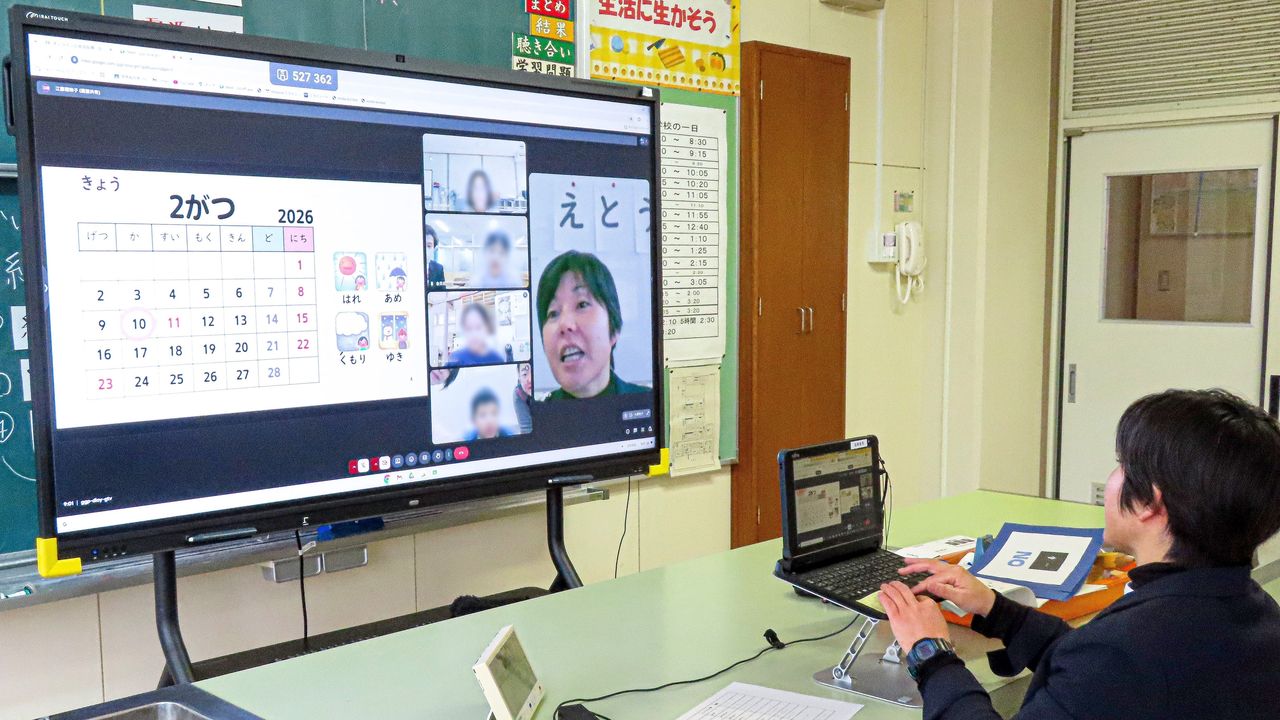
In early 2026, the city of Fukuoka began testing a new approach to Japanese language education. Online classes linking four elementary schools were conducted from Fukuoka Municipal Haruyoshi Elementary School. The classes were attended by four students from China, Korea, and Indonesia, in grades one to four.
On the day we visited, teacher Etō Rieko could be seen instructing the children on vocabulary relating to everyday school objects and the appropriate words to count them. She was facing a large screen displaying the lesson content and the four students, nodding as they listened.
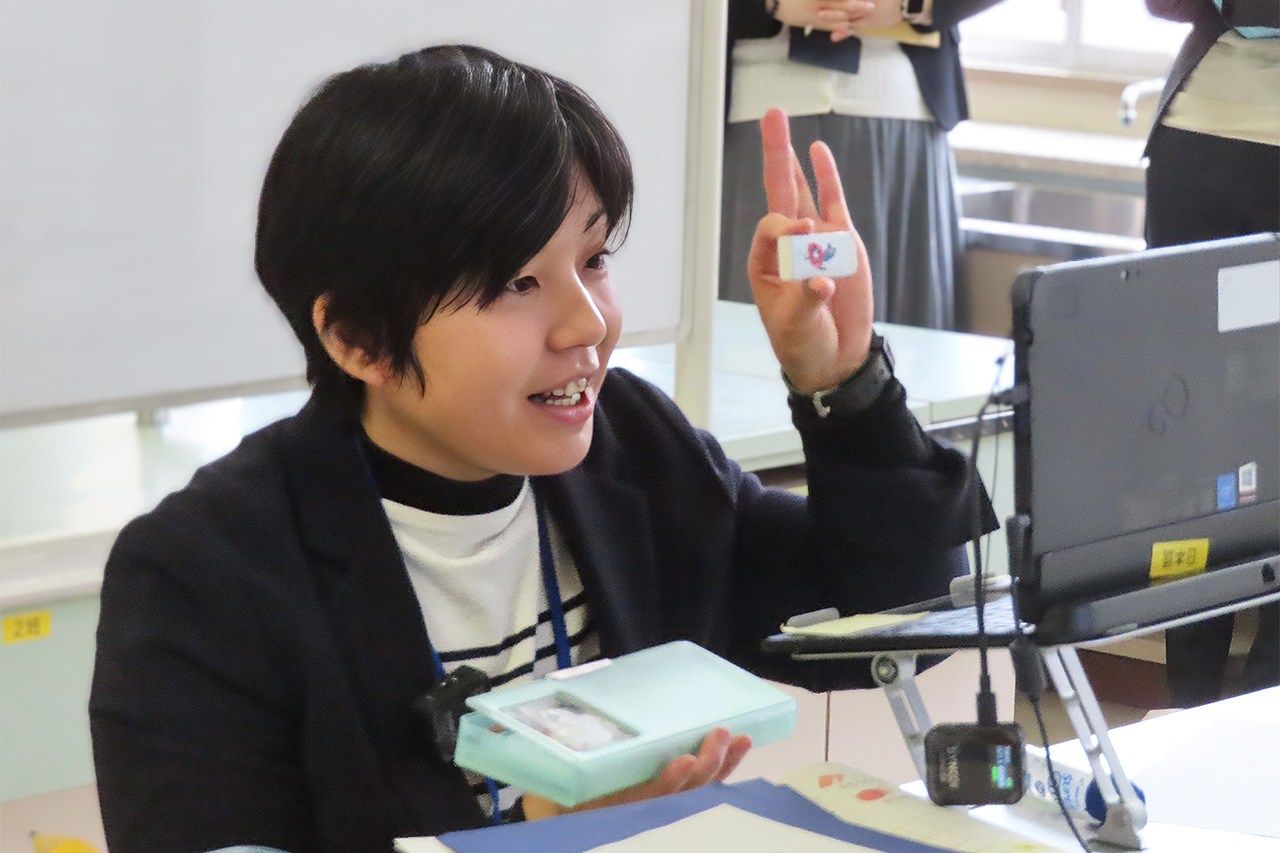
Etō Rieko conducts a remote Japanese language class through connected computers. (© Tanaka Keitarō)
These classes were part of a trial program conducted by the Fukuoka Municipal Board of Education from January to March. The Board sought to evaluate the benefits and challenges of providing Japanese language instruction to children with foreign roots using computers at their schools and homes.
Children participating on computers were able to stay focused thanks to monitoring by parents or teachers at their sides. When the students used paper and pencils, the adults adjusted the cameras so the teacher could see their work, enabling two-way interaction.
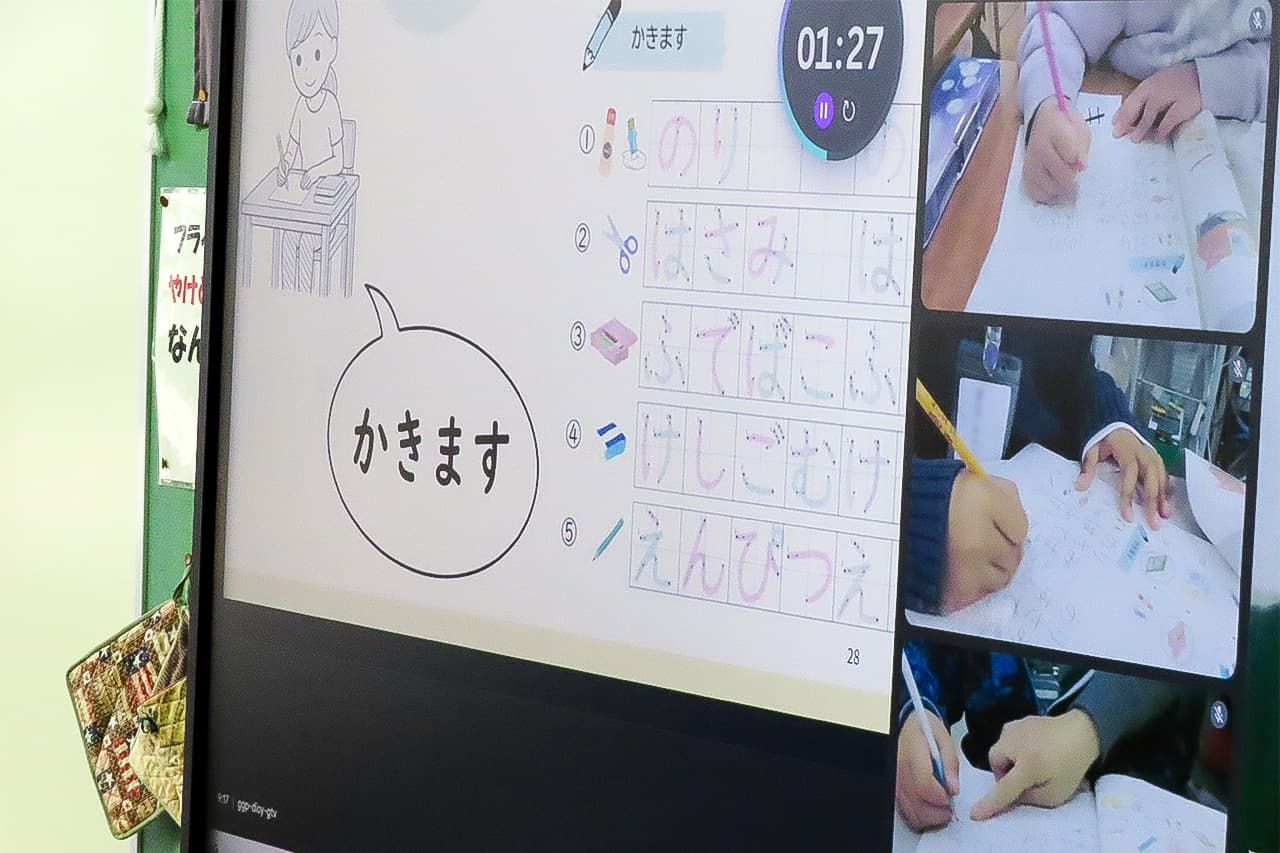
In online classes, cameras also show the children’s hands so the teacher can monitor their progress. (© Tanaka Keitarō)
Reducing the Burden at Schools and Homes
The purpose of online classes is to reduce the burden on schools and families of children learning Japanese while ensuring that they have access to educational opportunities.
The Board of Education had been strengthening its support system in line with the Ministry of Education, Culture, Sports, Science, and Technology (MEXT) guideline of providing one teacher for every 18 students who require Japanese language instruction. In the 2025 school year, it assigned Japanese language teachers in 12 of the city’s 146 elementary schools and 6 out of 72 junior high schools. Under this system, students were to go to the schools with the language teachers and attend Japanese classes there.
However, Abe Mayuko, the chief supervising instructor in the School Planning Division of the Guidance Department, explained that this arrangement was inconvenient for some students. “Getting to other schools could take more than an hour. It’s a burden on the parents who transport them there. Online classes could help ease this.”
According to Abe, another reason for introducing online classes was the sharp increase expected in the number of foreign students during the school year.
MEXT decides the number of Japanese language teachers to be assigned based on the number of students as of May 1, a month into the academic year beginning in April. However, in Fukuoka, the number of foreign students increases notably in May and September, which are transitional periods in the school calendars of many of their home countries. In the 2025 school year, there were 527 students requiring Japanese instruction as of May 1, but that number jumped to 744 by the end of December. Although part-time teachers are recruited whenever the number of students increases, securing enough staff has not been easy, and the situation puts additional pressure on schools. Online teaching is seen as an effective way to reduce regional disparities even while schools wait to secure additional teachers.
In the trial program, students were divided into two groups—first through fourth grade students, and fifth through ninth graders—and each group received ten 45-minute lessons. In-person Japanese instruction is mainly conducted one-on-one, but with online classes, multiple students are taught at once. Learning with other students, even online, gives students a sense of connection because they can see each other’s faces, and the Board believes that this may boost their motivation to learn.
Seeking Insight into the Effectiveness of ICT
In its Comprehensive Measures for Acceptance and Orderly Coexistence of Foreign Nationals set forth in January 2026, the Japanese government included multilingual translation systems and information and communication technology as solutions to be used in children’s Japanese language education. Many schools in areas where foreign residents are concentrated are able to secure the number of teachers needed under the “18 students to one teacher” standard. But in areas with sparser foreign populations, it can be difficult to secure the teaching resources to handle the smaller numbers of children in each area. This also increases the burden on schools, but the use of ICT could help ease these challenges to an extent.
However, as Etō Rieko notes, teaching online classes is no simple undertaking. “They’re totally different from in-person classroom lessons,” she says. Online lessons are generally seen as more difficult for keeping students focused, and the challenge is even greater for younger learners and children with foreign roots who are still developing their Japanese skills.
In the trial program, Etō made efforts to communicate effectively through the screen by using large gestures and movements. The Board designed the lesson slides using Canva, a free design tool, referring to worksheets created by educators elsewhere in Japan. Animations and timers were also added to keep a hold on students’ attention.
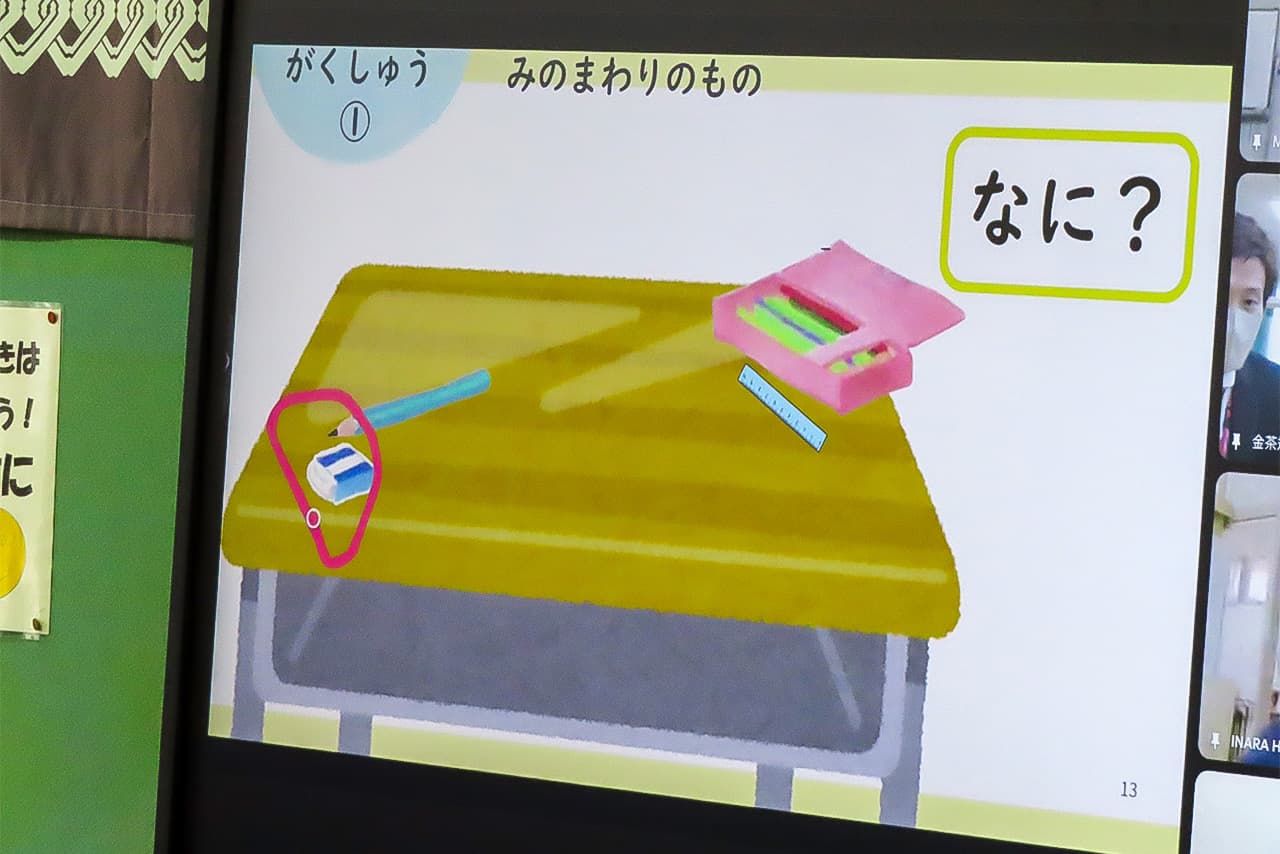
The teacher’s pen marks—here a red circle indicating the eraser on the desk’s corner—are made visible in real time on the children’s screens. (© Tanaka Keitarō)
One thing Etō struggles with is eye contact. If she looks at the children on the screen while speaking, she is no longer looking at the camera. “If I don’t speak straight to the camera, the children won’t feel like I’m looking at them. I normally don’t teach while looking at the camera, so it’s a challenge,” she says.
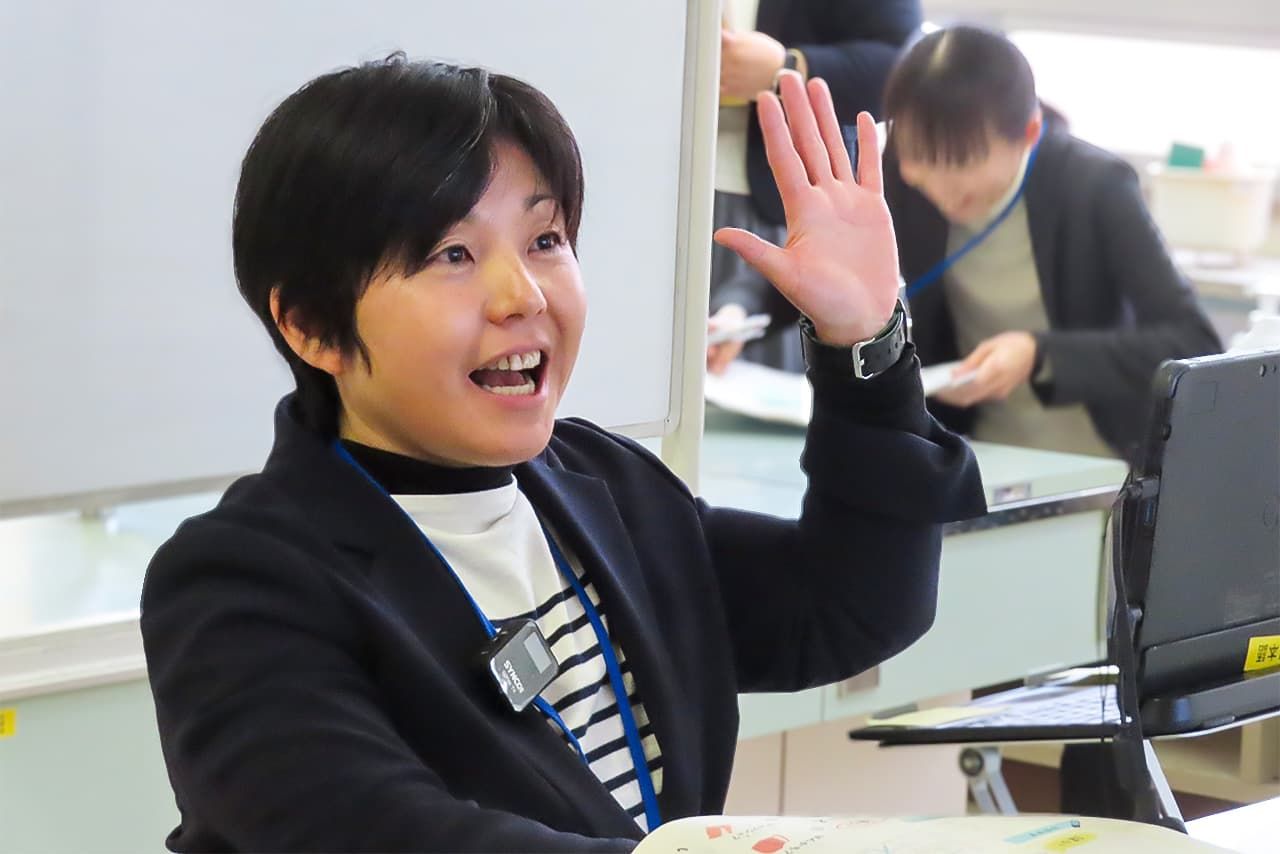
Etō consciously looks into the camera and uses gestures to connect with the children. (© Tanaka Keitarō)
The trial also served as a study of online classes. The lessons were observed by chief supervising instructor Abe Mayuko, Japanese language teachers, and coordinators who meet with students and parents. After the class, they shared their impressions and discussed areas for improvement.
On this day, Associate Professor Sawada Hiroko of Tsukuba University, who researches Japanese language instruction, joined the observation.
The observers praised Etō’s lesson, saying that the children were able to engage in the learning process without losing interest. However, one observer pointed out that the children rarely smiled during the first 15 minutes and suggested a specific improvement: “When explaining the difference between aru (there is) and nai (there is not), the children became more engaged when actual objects were shown. The teacher should use this type of approach from the start.”
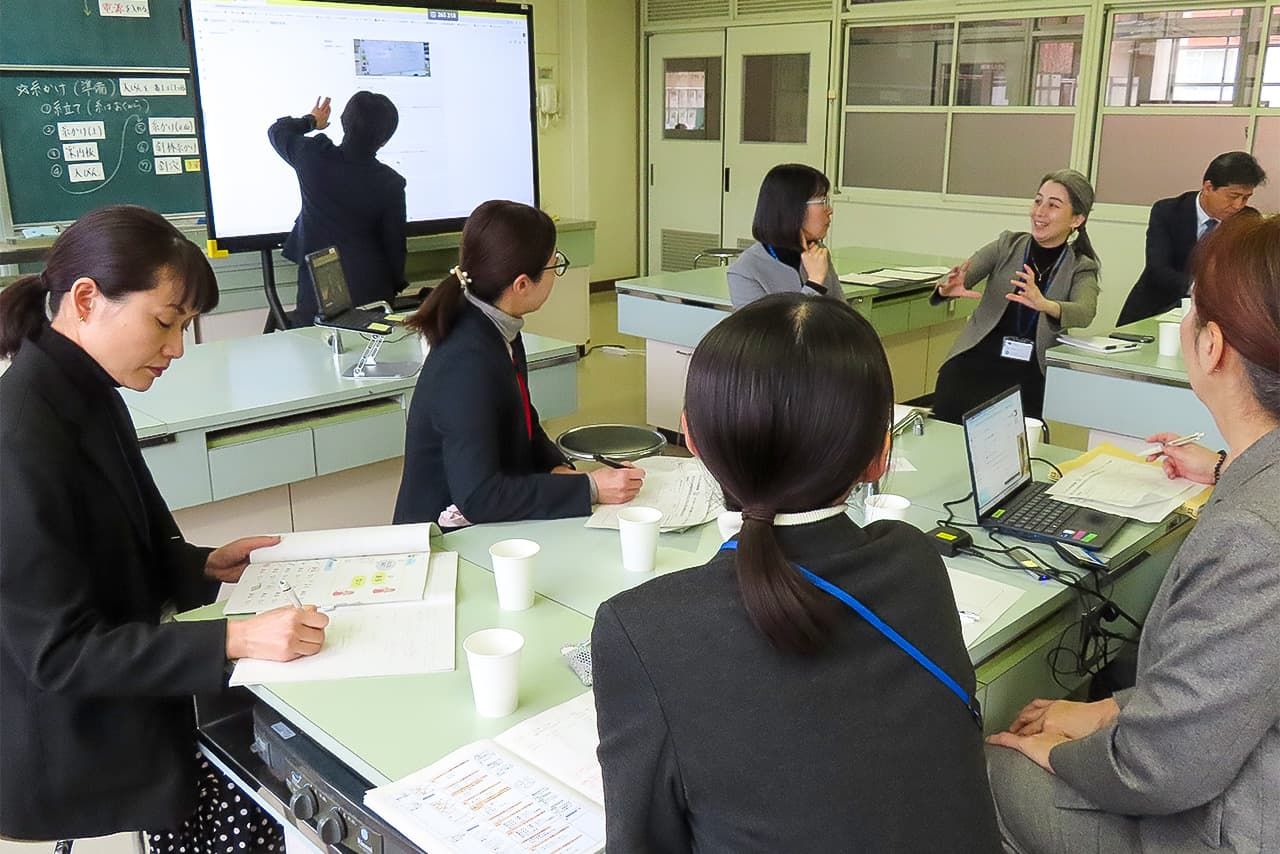
Participants review the online class conducted by the Fukuoka Municipal Board of Education. (© Tanaka Keitarō)
Rolling Out New Ideas Based on Lessons Learned
The Fukuoka Municipal Board of Education will decide which schools will serve as hubs for remote classes before launching full implementation in the 2026 school year. The classes will focus on teaching “survival Japanese” for use in daily life. The Board intends to use its own materials for instruction, drawing from the results and challenges of the trial program carried out over the previous year.
In the current school year, the Board has been visiting trial schools and holding discussions with school administrators in preparation for full implementation. The program will be offered in eight periods during the year; students will be able to join the classes at the start of one of these periods, depending on when they transfer.
In an effort to increase the number of hub schools for remote classes, Abe is working to gain the understanding of different schools. In addition to teaching “survival Japanese,” she hopes to begin developing a curriculum of teaching the Japanese needed to study school subjects.
In April 2025, MEXT introduced a new benchmark for language development and mastery. This guidance policy recommends using students’ native languages to help them gradually acquire Japanese. The Fukuoka Municipal Board of Education has distributed AI voice translation devices to teachers and is exploring ways to incorporate students’ native languages into the teaching process. By making use of cutting-edge technologies, including ICT, the Board hopes to provide children with what they need at the moment, taking it one step at a time.
(Originally published in Japanese. Banner photo: Etō Rieko teaches an online Japanese lesson to foreign students in the city of Fukuoka. © Tanaka Keitarō.)