JFL Today: Considering Japanese-Language Education for Foreign Residents
Japanese at the Touch of a Finger: Tablet-Based Language Learning in Japan’s Classrooms
Society Education- English
- 日本語
- 简体字
- 繁體字
- Français
- Español
- العربية
- Русский
Starting from Zero with Anime and Subtitles
Information and communication technology has had a massive impact on all industries, and the language-teaching profession is no different. Surala Nihongo, a Japanese language-teaching platform launched by the developer Surala Net in April 2023, is a prime example. This tablet app and associated teaching materials were developed under the supervision of language education experts. By combining Japanese narration with subtitles in users’ native languages, and adding animation to the mix, Surala Nihongo enables users to learn Japanese on tablets from scratch, even with no previous experience with the tongue.
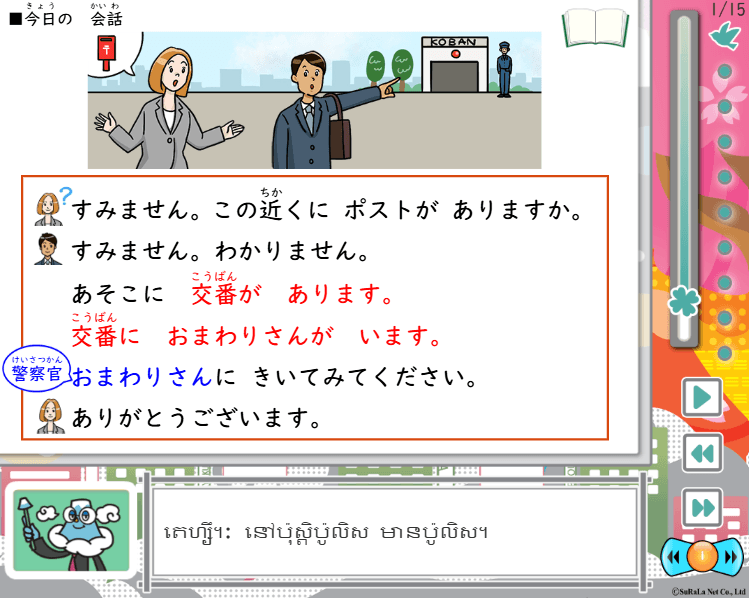
A screenshot from Surala Nihongo. Users can practice conversation with the characters who appear. Subtitles in the learners’ languages (Khmer in the image shown) are displayed at the bottom to aid comprehension. (Courtesy Surala Net)
The “Lectures” section covers Japanese script, words, and grammar, with digital characters speaking to students in Japanese as the lessons progress. After completing the lessons, users move on to the “Drills” section, where they solve multiple-choice problems and practice conversation reordering exercises. In the “Test” section, AI tools analyze the users’ progress, presenting more difficult questions as their skills advance. If they are struggling, review questions covering the same areas are repeated.
Through animated lectures, feedback, and repeated learning in small steps, users can study at their own pace. The system also aims to reinforce learning through repeated cycles of input and output. It contains about 500 learning units and 10,000 questions.
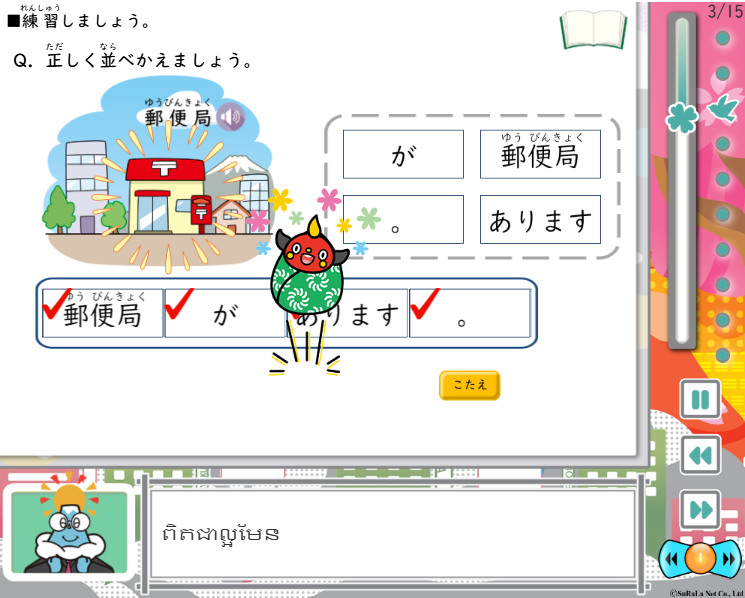
Studying in the “Drills” section. (Courtesy Surala Net)
The challenge is keeping students focused and ensuring that they continue learning. When the app is used in classrooms, the key is not to leave learning entirely to the tablets. Instead, instructors are provided with manuals and teaching materials so that they can supplement the lessons with their own input.
The platform also contains features that make learning more fun, such as gamelike elements that give users a ranking based on study time among learners working on the same learning unit. By completing units, users can obtain items and titles, and the characters “grow” according to the user’s level of advancement.
Currently, subtitles are available in English, Khmer, and Indonesian. Students can listen to the Japanese audio while following subtitles to aid understanding. By autumn 2026, Surala Nihongo is slated to support 12 additional languages, including Nepali and Chinese. About 8,000 people in total in Japan and abroad are using the system, and its adoption is spreading among Japanese language schools, public elementary and junior high schools, and a range of other education facilities.
From Public Schools to Night Schools
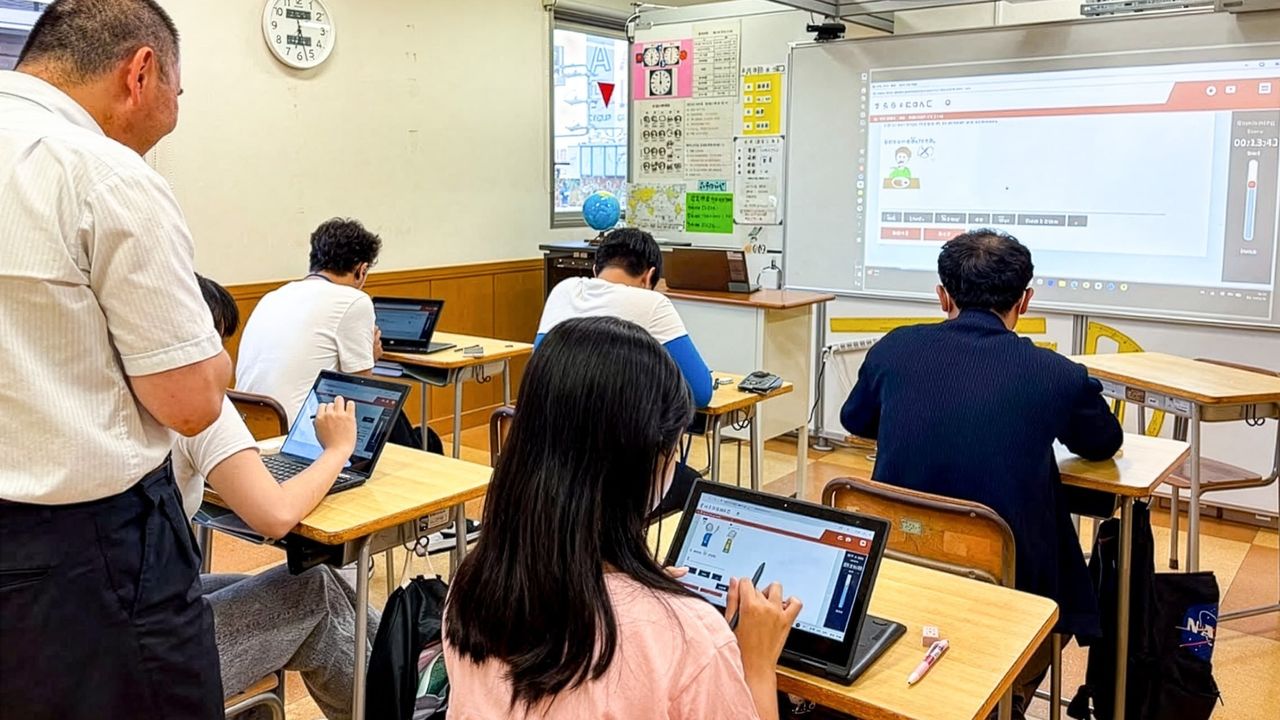
Fujinokuni Junior High School, a prefectural night junior high program in Shizuoka with many foreign students, rolled out Surala Nihongo in April 2025. In the first year, about 20 students requiring Japanese language instruction used it. This new approach enabled students at the school to learn at their own pace during free periods and at home, complementing regular group lessons.
Fujinokuni teacher Aoki Masafumi points out that students’ Japanese levels vary widely, with some still at the stage of learning hiragana and others able to speak Japanese decently, but needing to develop their reading and writing skills. “We had been searching for ways to help these students acquire Japanese even when specialized teachers are not available. Since Surala Nihongo allows students to study individually as long as they have a device, some have started using it not just during our lessons, but also as they study and review at home. We’re starting to see positive outcomes.” Backing this up are the results of a questionnaire the school conducted two months after introducing the platform, with nearly 90% of students saying that learning had become more enjoyable and that their understanding had improved.
Other schools have similar stories to tell. Some educators have reported that students who previously only spoke with others in their native language began speaking in Japanese after using the app’s Conversation section. And the municipal board of education in Kurume, Fukuoka Prefecture, which adopted Surala Nihongo in September 2025, describes a main benefit of the platform as the way it gives students a chance to study independently, both at school and at home, while previously their learning had largely been limited to the hours of Japanese language instruction.
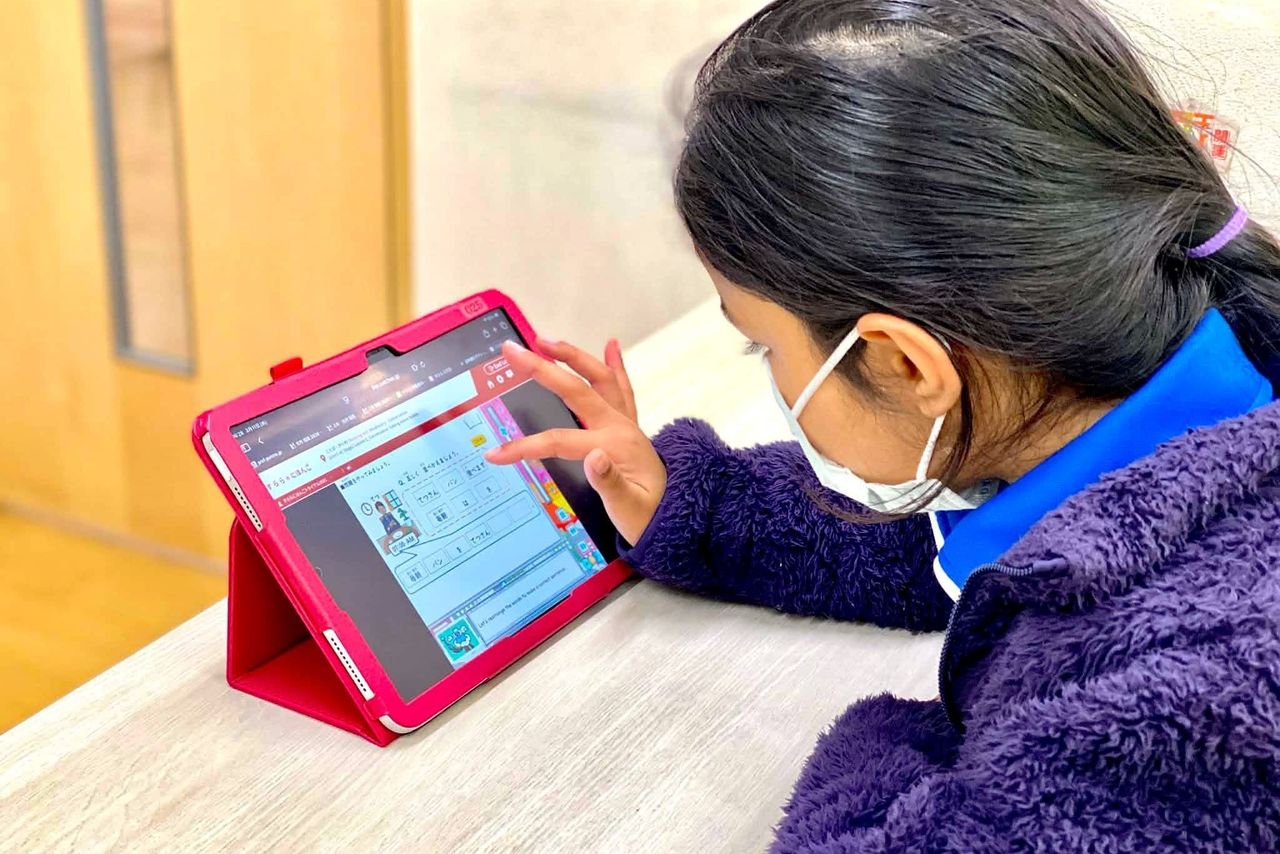
Surala Nihongo is also used at a growing number of cram schools that accept foreign students. At Shingaku Juku Quest in Tatebayashi, Gunma, Surala Nihongo was introduced for students with Burmese backgrounds. (Courtesy Shingaku Juku Quest)
“It seems that people appreciate the strength of tech tools like ours in providing an environment where more children can study whenever they want,” says Surala Net’s Masunaga Rina, who provides implementation support as part of the marketing department.
Turning Problem-Solving into a Business
It was in 2007 that Surala Net launched its first tablet-based educational software for Japanese students, including those who had stopped attending school. The company started developing Surala Nihongo after learning about a growing challenge in Japan: As the number of foreign residents increased, many local governments and schools were finding it difficult to secure enough personnel to teach them the language skills they needed to survive and thrive.
It is not uncommon for students to fall behind in class, stop attending school each day, or drop out entirely because they lack Japanese ability. “We wanted to use the strength of the original Surara, which is designed to help anyone learn from the very beginning, to support the frontlines of Japanese language education,” recalls Tsubota Miho, a manager responsible for planning and development.
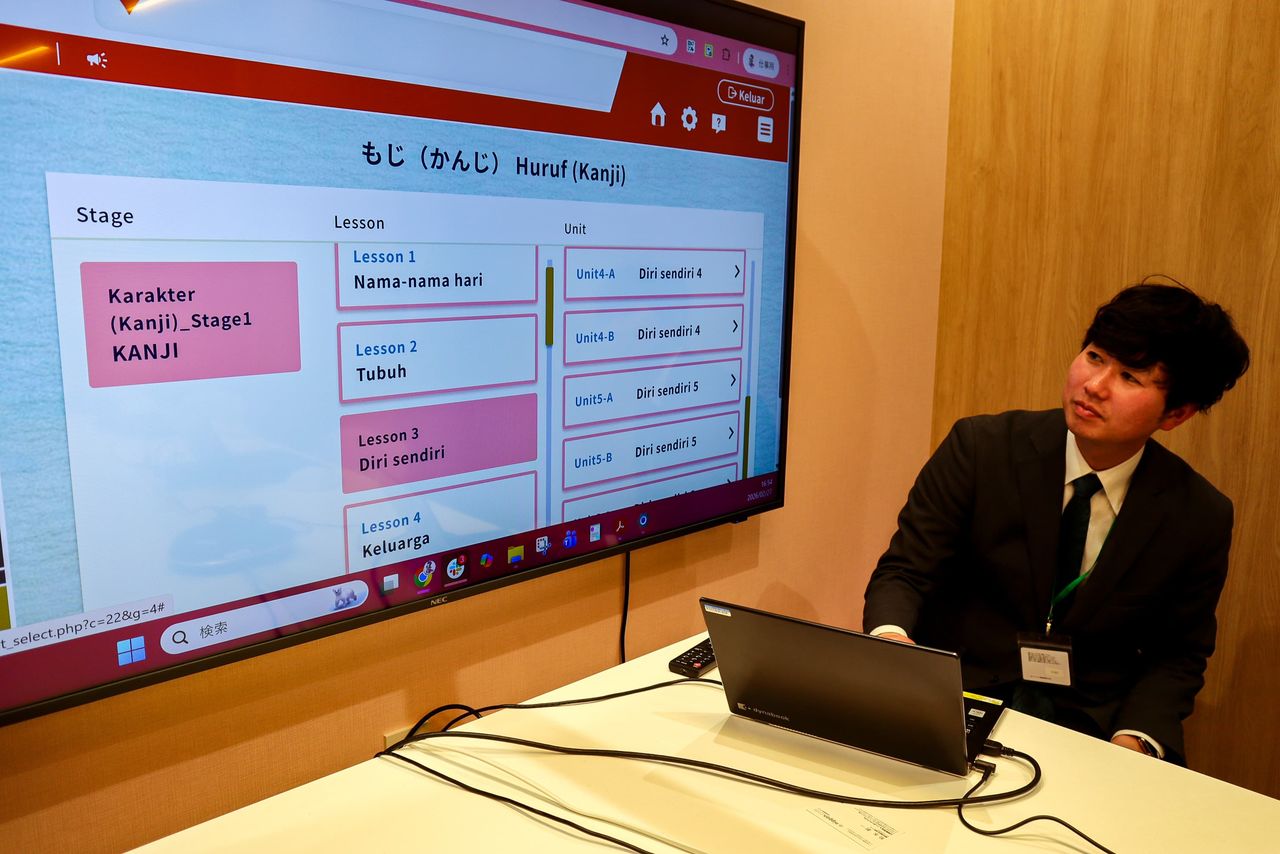
A Surala Net employee testing the Surala Nihongo interface. (© Matsumoto Sōichi)
Digging into the Details: Intonation, Nonverbal Cues, and More
Surala Nihongo goes beyond grammar and vocabulary to instruct in the correct intonations of Japanese, too. Some online or app-based teaching materials use automated voices, but the intonation sometimes sounds unnatural. To provide a better learning experience, Surala Nihongo uses recordings of standard Japanese by professional voice actors. Learners can improve their proficiency by repeatedly listening to and becoming familiar with natively spoken Japanese.
Another feature is the app’s approach to conveying the nuances of Japanese. For example, it’s difficult to explain only through words the difference between taberu tokoro desu (about to eat), tabete iru tokoro desu (in the middle of eating), and tabeta tokoro desu (have just eaten). Surala Nihongo uses animations and pictograms to help students get a grasp of these subtle nuances.
Tsubota explains that those from other countries who are learning Japanese essentially have no base for understanding things that native Japanese speakers can grasp intuitively. “If Japanese is taught in the same way that it’s taught to Japanese natives, it’s difficult to get learners to fully understand the nuances. We struggled a lot with how to communicate those nuances in nonverbal ways.”
Supporting JLPT Test Preparations
Surala Nihongo supports the first two levels of the Japanese-Language Proficiency Test, N5 and N4, covering up to everyday conversation ability. In November 2025, a JLPT preparation course was added that allows learners to practice questions in a format similar to the actual test. Surala Net plans to continue developing the service to support higher JLPT levels in the future. Starting in April 2026 the company also began offering Surala-i, a digital teaching tool that allows students to practice subject-specific drills. By combining it with Surala Nihongo, the company aims to make it easier for students to progress from learning Japanese to studying other school subjects in the language.
Surala Net plans to continue developing educational materials together with local governments and schools. And it is not alone—other tech-based learning resources are on the rise. The online course Irodori, for example, helps foreigners living and working in Japan acquire basic Japanese communication skills and provides them with digital learning materials and audio resources on its website. The NHK program Erin’s Challenge! I Can Speak Japanese, which began broadcasting in 2006, is still available for free as a karaoke-like video learning platform that lets viewers learn Japanese by reading subtitles aloud along with the videos. The range of engaging digital learning options is growing.
(Originally published in Japanese. Banner photo: Surala Nihongo in use at Shizuoka Prefecture’s Fujinokuni Junior High School. © Tanaka Keitarō.)