Ōnosato on Top: The Meteoric Rise of a Talented New Sumō Champ
Sports Culture- English
- 日本語
- 简体字
- 繁體字
- Français
- Español
- العربية
- Русский
A Record-Breaking Advance
When Ōnosato debuted at the makushita level of pro sumō in May 2023—a feat he accomplished in a surprisingly short time, due to his prowess in amateur competition—sumō elders, fellow rikishi, and members of the media all agreed that “he might become a yokozuna in about three years’ time.” As a matter of fact, he has climbed to the pinnacle of the sport after just two years as a professional. His original position in the rankings bore the note tsukedashi, which at the time of his entry (it is no longer used today) referred to a system of preferential promotion to the sport’s upper divisions based on the individual’s prior record in amateur sumō.
Such was the speed of Ōnosato’s ascent in the tournaments that followed that his hair did not grow long enough to be fashioned into the ōichō topknot permitted for rikishi in the jūryō division and above until he was finally able to wear the style in January 2025. It would be less than half a year from that point until he reached the highest rank in the sport.
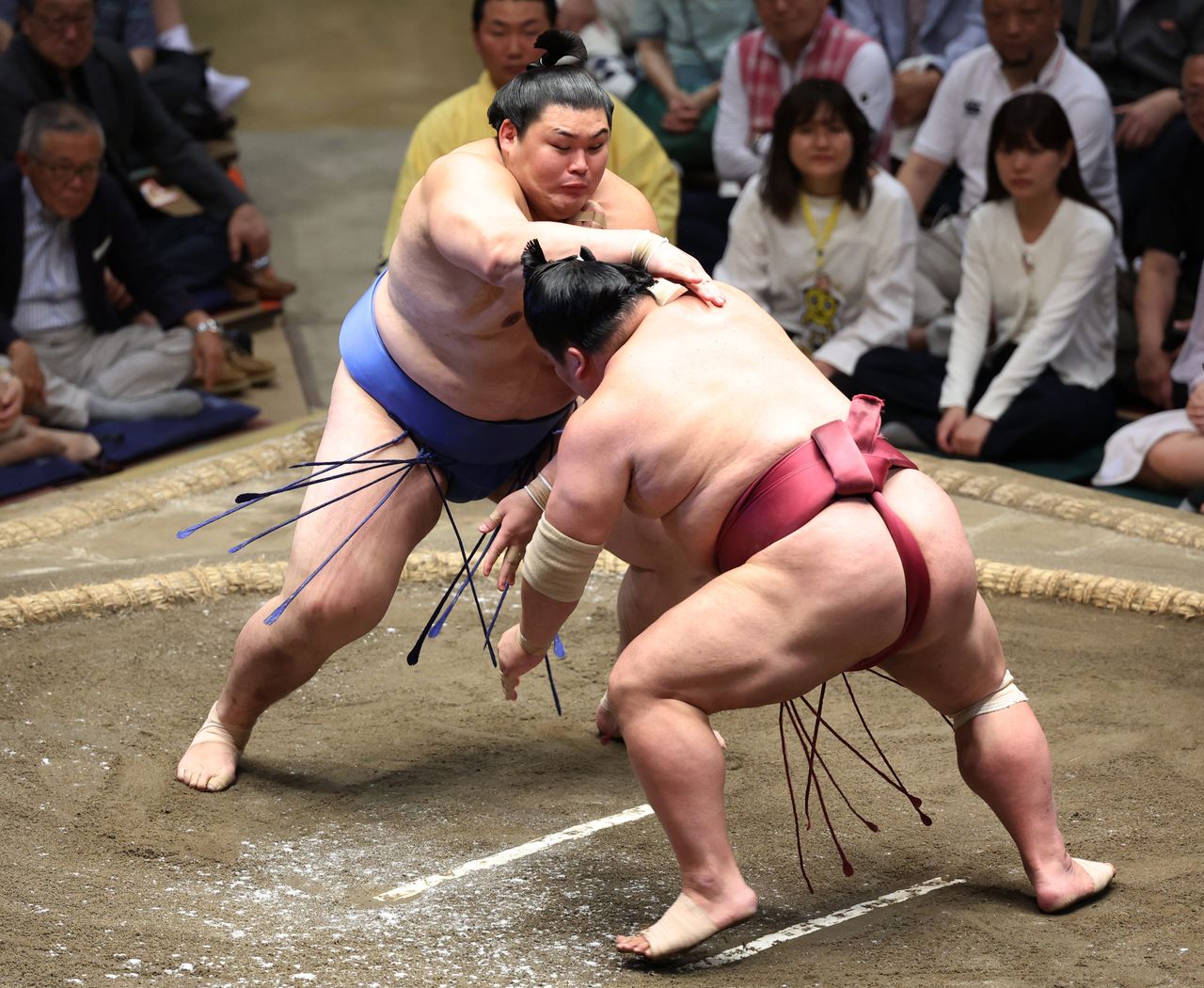
Ōnosato, on the attack against Daieishō (right) at Ryōgoku Kokugikan, on May 24, 2025. (© Jiji)
Everyone agrees that compared to the stratospheric heights reached by the “Waka-Taka” pair of the 1990s—the Hanada brothers, who both reached the rank of yokozuna as Wakanohana II and Takanohana II—the ranks of potential sumō stars are much thinner today. The number of new recruits is steadily dropping, but now a supernova has appeared. That is Ōnosato, who by his first year in university had won the student yokozuna title and had become a yokozuna in amateur sumō by his junior year at Nippon Sport Science University. Given his innate talent and outstanding performances, rapid ascent to the rank of yokozuna in professional sumō was broadly predicted, and many were confident that he would reach that rank whichever stable he belonged to.
A Fateful Encounter
But the hand of fate played a role in his rapid progress. In his senior year at university, Ōnosato (birth name Nakamura Daiki) was being scouted by several heya (stables), including the Miyagino stable led by the former yokozuna Hakuhō. Near crunch time in the autumn of that year, he was also interviewed by Nishonoseki oyakata, a title given to sumō elders and stablemasters, none other than the former yokozuna Kisenosato.
Nishonoseki recounts his impressions on meeting Ōnosato for the first time. “Plenty of university sumō wrestlers are full of themselves; many of them give the impression that they’re listening to you, but in fact they’re not paying attention. Ōnosato was different, though. He acted exactly like a 15-year-old new recruit, propelled by the desire to get stronger, hungry to learn, and ready to absorb instruction. He did not seem like other student sumō wrestlers I had encountered.”
Out of the many options available to him, Ōnosato unhesitatingly chose to train at the Nishonoseki stable. Entering the stable for tryouts, he was treated like other new recruits, regardless of his amateur accomplishments, something he found hugely appealing.
The remotely located Nishonoseki stable is in Ami, Ibaraki Prefecture, some distance away from the distractions of Tokyo; the wide-open spaces and spacious training facility appealed to Ōnosato. The location also reminded him of Ishikawa Prefecture’s Tsubata, where he was born and lived until the age of 12, and Itoigawa, the Niigata Prefecture city where he attended junior and senior high school. He simply wanted to live in an environment that would enable him to concentrate on sumō, and he wanted to train under stablemaster Nishonoseki, a Japan-born yokozuna—a relative rarity in an era when rikishi from Mongolia have tended to dominate the top ranks.
Once he was formally accepted into the stable, Ōnosato and his stablemaster had to decide on goal-setting. Not bothered by expectations or attention, Ōnosato was not especially focused on immediate results. His approach was to build a solid foundation and take things one step at a time. Nishonoseki remarked that “while Ōnosato has the requisite large build, he still lacks the strength to generate power from within. I’m looking forward to training him from the ground up.”
Nishonoseki drilled Ōnosato thoroughly in the fundamental exercises meant to ensure flexibility and cultivate lower-body strength: shiko, the high-legged stomps that are part of the opening ritual to a match; suriashi, shuffling the feet to advance while in squatting position; teppō, pushing the hands and first the right and then the left leg and hip against a vertical surface to learn to topple an opponent; and koshiwari, a surprisingly challenging squat performed with the feet placed outside shoulder width. He also did not see the value of having Ōnosato engage in multiple practice bouts with stablemates. Instead, he concentrated on building his endurance. Unlike amateur meets, where wrestlers compete just for one day, the grueling 15-day professional tournaments require sustained stamina.
As they faithfully performed these conditioning exercises, the new recruits gradually developed broader shoulders, thicker chests, and solid thighs and buttocks. The exercises are tedious, and the slow koshiwari squats are the most arduous. But Nishonoseki notes that Ōnosato faithfully practiced them all, and the hard work paid off handsomely.
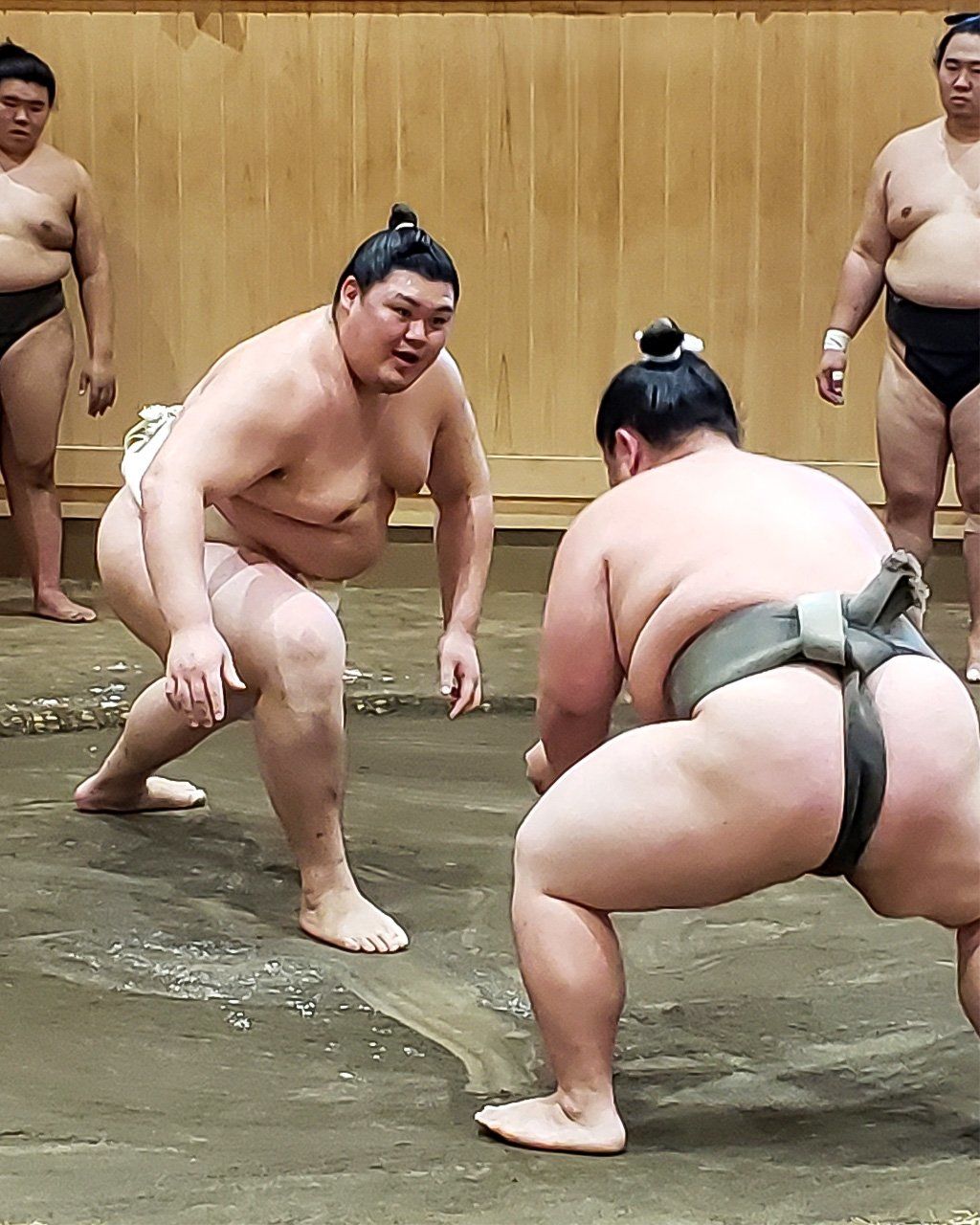
Ōnosato (at left) during a practice session at the Nishonoseki stable, Ibaraki Prefecture, on June 5, 2025. (© Tai Hiroyuki)
Passing the Torch
With his promotion to yokozuna, Ōnosato became the first Japanese-born wrestler in eight years, since his stablemaster, competing as Kisenosato, to reach the highest rank in sumō. This development has been especially meaningful in the sumō world, which sets great store by tradition.
Carrying the names of three yokozuna—Wakanohana I (1928–2010), Takanosato (1952–2011), and Kisenosato (b. 1986)—the headline on the Nishonoseki stable website reads “From yokozuna to yokozuna.” Known as a stern taskmaster, Wakanohana I instilled in Takanosato, who reached the top rank despite battling diabetes throughout his career, the yokozuna ethos, which he in turn bequeathed to Kisenosato, a lineage that flows in turn through to Ōnosato.
It is unusual for wrestlers who have trained under yokozuna to attain the top ranking themselves—and Ōnosato is the fourth in this line. His stablemaster Nishonoseki had been very keen to nurture a yokozuna from August 2021, when he founded what would be the predecessor to the Nishonoseki stable.
Ōnosato feels pride in having continued the line and become a yokozuna himself, and at a comparatively young age to boot. Whereas Wakanohana I was 29, and Takanosato and Kisenosato were both 30 when they became yokozuna, Ōnosato rose to the rank at the age of 24.
The Power of an Insightful Approach
One of Ōnosato’s great qualities is his capacity for course correction. Originally favoring a right-handed grip on his opponent’s mawashi belt, he learned how to approach from the left, greatly expanding his attack repertoire. And whereas he had tended to retreat quickly when he found he could not push forward, he was now doing so less often. At each successive tournament he bent his knees down farther, giving him greater lower-body stability. Much of this rare ability to absorb and learn came from the six years he spent as a boarder in junior and senior high school.
In elementary school, Ōnosato had been frustrated at his inability to win matches. It was he who decided that he would benefit from a change of environment, which prompted him to leave his hometown for a school in Niigata Prefecture. The school dorm prohibited mobile phones, and outside of class he had to spend all his time in the practice ring. “Living in that dorm environment helped me to polish my skill for observing people,” he recalls. “We had to learn quickly what would get us yelled at, and what actions might get our bits of free time taken away.” Longing for a bit of freedom motivated him to polish his skills, and indeed has served him in good stead since then: As he notes, “Nowadays it’s easy for me to get to the heart of what my oyakata is trying to teach us as soon as he begins a lesson. I can look at his eyes and see what he’s teaching us right away.”
Ōnosato was an avid reader of sumō magazines from childhood, a habit that built the foundation for his love of the sport. He enjoyed watching films of past sumō greats to study their moves, and he has always been curious, never hesitating to ask others around him to clear things up for him. All of these qualities have contributed to his development as a rikishi.
Maintaining His Own Style
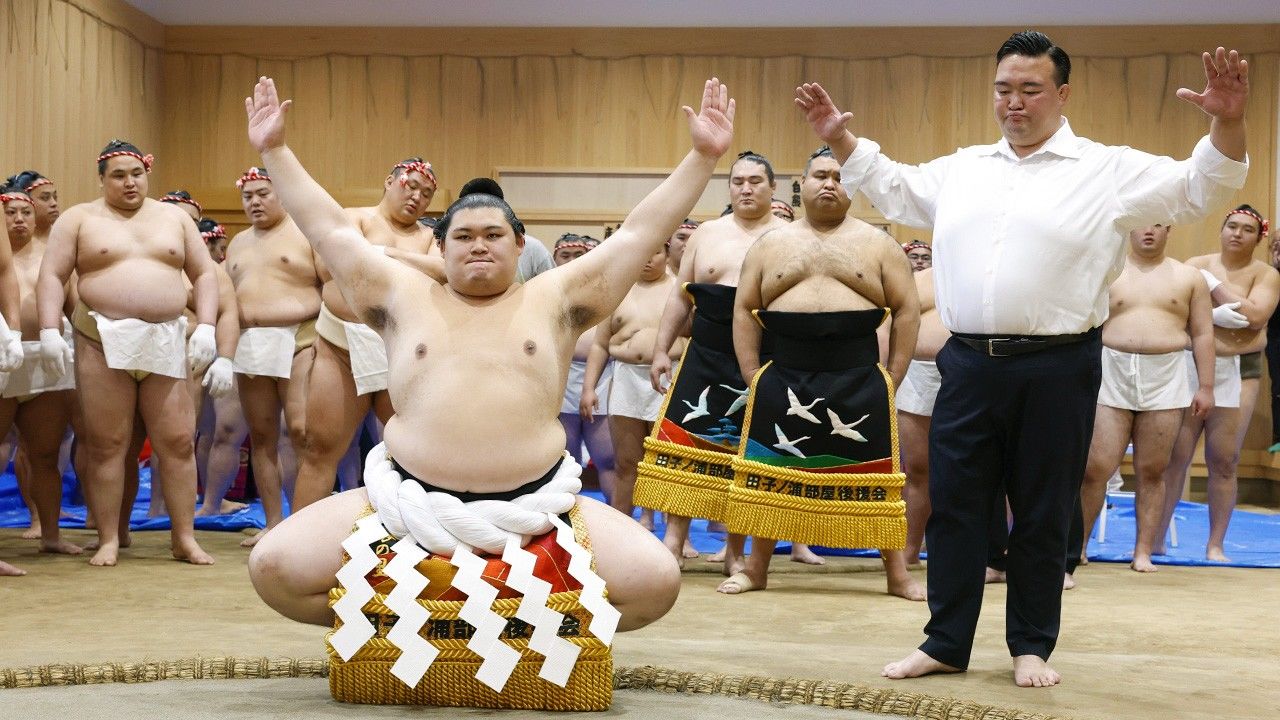
On May 29, 2025, the newly minted yokozuna Ōnosato, wearing the pure white rope signifying his rank, practiced his ceremonial dohyōiri ring entrance in the Unryū style under Nishonoseki’s watchful eye. The first yokozuna to hail from Ishikawa Prefecture in 52 years, Ōnosato pledged to “devote myself to studying the way of the yokozuna. Achieving this rank is a great honor, but without letting it become a burden, I will continue to develop without compromising my style. I want to continue being myself: to wrestle my way, stay focused, and become a unique and unparalleled yokozuna.” Full of enterprising spirit, he remains thoroughly grounded.
Throughout the year, except for February and June, regional jungyō tours take place in the even-numbered months. Ōnosato is a major draw for local fans during these events, but it is clear that he is constantly thinking about getting back to his all-important training back at Nishonoseki. With dedication of that kind, Ōnosato’s power will certainly continue evolving.
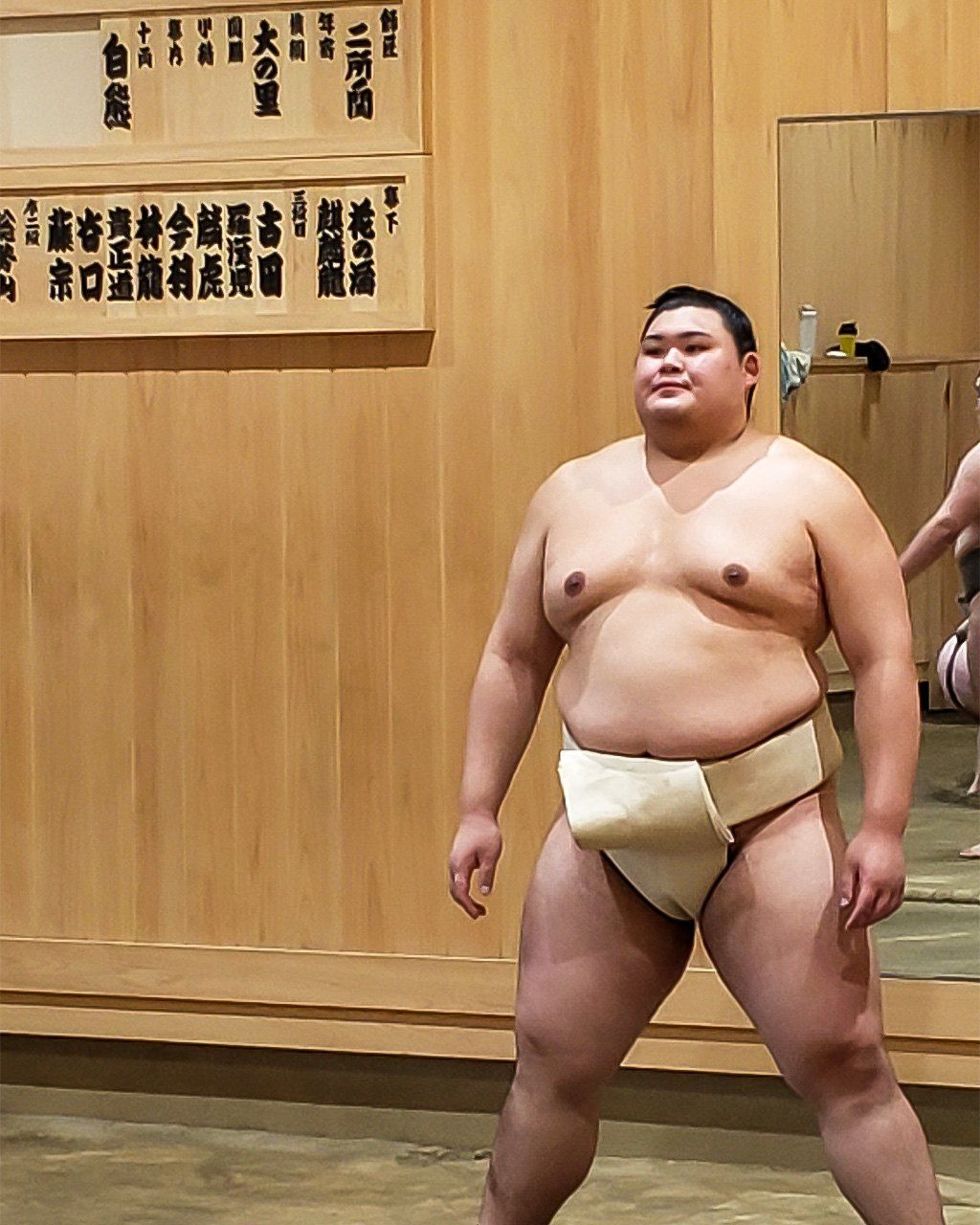
Ōnosato in the practice ring at the Nishonoseki stable, Ibaraki Prefecture, on June 5, 2025. His name as yokozuna is displayed on the board at top left. (© Tai Hiroyuki)
The July Nagoya grand sumō tournament, starting on July 13, will inaugurate the city’s new Aichi International Arena. I am looking forward to seeing what kind of yokozuna Ōnosato will become. His outstanding talent makes him a towering figure for this new era for sumō.
(Originally published in Japanese. Banner photo: Yokozuna Ōnosato, at front left, receives instruction in the Unryū-style ring-entering ceremony from his stablemaster at the Nishonoseki stable in Ibaraki Prefecture on May 29, 2024. © Jiji.)