Behind Sanseitō’s Electoral Explosion: Bottom-Up Strategy Propels “Japanese First” Party
Politics Society- English
- 日本語
- 简体字
- 繁體字
- Français
- Español
- العربية
- Русский
Targeting Local Assemblies
As upstart political parties continue to fragment Japan’s opposition forces, Sanseitō stands not only for its far-right anti-immigrant rhetoric but also for its unusual organizational and electoral strategy.
Since the party’s establishment in April 2020, it has consistently focused its resources on securing seats in local assemblies around Japan. As of the end of July 2025, Sanseitō politicians held a total of 155 municipal and prefectural assembly seats. By contrast, Reiwa Shinsengumi, a rapidly growing leftwing party formed in 2019, controls only 60 seats in local assemblies nationwide, and the Conservative Party of Japan, formed in 2023, occupies only 9.
As a general rule, Japan’s emerging political parties, keen to post quick gains in the two chambers of the National Diet, have tended to neglect local assembly elections. This behavior reflects the widespread perception that local assemblies (with a few exceptions) are more or less irrelevant to the political process in Japan.
The postwar Constitution of Japan pays lip service to the principle of local self-government, which had gained little traction before World War II. In practice, however, most local governments have little policy-making discretion, largely because their budgets depend so heavily on the Local Allocation Tax and other transfers from the central government’s coffers. Indeed, local governing entities have been derisively described as “20% autonomous” or “30% autonomous,” reflecting the role local taxes play in financing their budgets. In the unified local elections held in the spring of 2023, average voter turnout was 44% for municipal assemblies and 42% for prefectural assemblies, as compared with 54% for the 2024 House of Representatives election.
Under the circumstances, one can understand why emerging political parties, all but eclipsed by the big names and organizations, would choose to channel their resources into Diet elections. But this approach ignores the important role local assembly members play in those contests.
Boots on the Ground
On average, Japan’s local assemblies convene only 90–120 days out of the year. This means that for about two-thirds of the year, assembly members are free to do things other than attending assembly sessions. Of course, a portion of this period is typically spent meeting with voters and supporters or touring neighborhoods and facilities. But in reality, the core job of local assembly members involves using this long period of “paid leave” to further the national ambitions of their respective parties with the next Diet election in mind.
Such elections occur quite frequently in Japan. The term of a member of the House of Councillors (upper house) is six years, but elections for half of the members are held every three years. The term for members of the House of Representatives (lower house) is four years, but because the prime minister can dissolve the lower house anytime prior to the expiry of that term, the average interval between general elections is roughly 2.5 years. The upshot is that elections for the Diet take place about every other year on average.
In this electorally charged environment, local assembly members are expected to function as “ground forces” in their parties’ official and unofficial national election campaigns. The connections they have nurtured and the knowledge of local affairs they have acquired during their time in office can contribute materially to the planning and implementation of a party’s national election strategy. In this sense, the more representation a political party has in local assemblies, the better positioned it is to launch an effective national election campaign. Indeed, some have argued that local assembly members are the backbone of each national party.
From the foregoing, it can be concluded that Sanseitō has focused on capturing local assembly seats and building regional networks for the purpose of posting major gains in national elections.
Low-Hanging Fruit
But how has Sanseitō managed to capture so many local assembly seats? The secret to its success at this level is a clear-cut strategy of fielding candidates where they have the best chance of winning owing to a lack of competition. This means systematically targeting local jurisdictions where the fewest candidates are competing for the available assembly seats. And the fact is that many rural jurisdictions nowadays suffer from a shortage of candidates. Population decline and demographic aging have contributed to the trend, along with a general lack of interest in positions that offer limited power and meager compensation.
In the 2023 unified local elections, almost 14% (2,057) of all assembly members elected ran uncontested, and a full 40% of successful mayoral candidates were walkovers (Asahi Shimbun, June 5, 2023). Sanseitō secured 100 seats in that year’s local assembly elections.
By targeting jurisdictions with candidate shortages and collecting pertinent electoral data about them (population, demographic structure, partisan leanings, and so forth), a party can grab assembly seats fairly easily, even fielding candidates unfamiliar with the communities where they are running. Indeed, this is precisely the approach Sanseitō has used to snap up local assembly seats in the five years since its formation.
It is true that Japan has a system of election deposits designed to deter people from running for office purely for publicity or other frivolous purposes. In fact, overall, Japan’s election-deposit requirements are among the world’s stiffest. But the bar to candidacy in municipal assembly elections is relatively low: just ¥150,000 in towns and villages and ¥300,000 in cities. And that deposit is returned to election winners and those who receive a significant portion of the total vote.
Exploiting these weak links in the system, Sanseitō has seized on a strategy of fielding candidates in low-cost, easily-won local elections with the purpose of putting “boots on the ground” in preparation for the national polls.
Gaming the Lower-House System
In addition to securing footholds in local assemblies around Japan, Sanseitō has established party chapters in almost all of Japan’s single-member House of Representatives constituencies, even though its base of support is heavily concentrated in the major metropolitan areas. As of August 2025, the party boasted chapters in 287 of the 289 single-seat districts for the lower house. Other emerging parties have been hard-pressed to establish chapters in each of Japan’s 47 prefectures, let alone every electoral district. Sanseitō’s numerous local chapters, each corresponding to a lower-house constituency, constitute a network of front-line bases geared to fighting Diet elections nationwide.
To better understand this strategy, we need to take a closer look at the development of Japan’s lower-house electoral system over the past few decades.
For a half-century following World War II, members of Japan’s powerful House of Representatives were elected from districts with multiple seats (generally between three and five). Under this system, it was common for the dominant Liberal Democratic Party to field two or more candidates in an electoral district. This had the effect of intensifying interfactional competition for funding and members, while policy debate took a backseat.
The evils of factionalism notwithstanding, the conservative LDP retained a strong grip on power for decades, sustained by a loyal and well-organized rural base. Labor and other leftwing forces, concentrated in the country’s major urban areas, gravitated to the Japan Socialist Party, the perennial opposition force. This was the “one-and-a-half party system” that persisted from 1955 to 1993.
In the 1980s, amid a spate of political scandals, momentum gathered for electoral reform. Contending that the lower house’s multi-seat districts fostered factionalism and money politics while hindering the development of a two-party system, reformers called for the establishment of winner-take-all single-member constituencies similar to those in Britain and the United States.
The opportunity for change finally came after the LDP was toppled by a reformist coalition in 1993. Under the short-lived cabinet of Prime Minister Hosokawa Morihiro, the Diet passed a sweeping reform of the lower-house electoral system through the 1994 amendment of the Public Offices Election Act. First applied to the 1996 general election, the new system (still in effect) combines single-seat districts with large multi-member “proportional-representation blocs” in which voters cast a ballot for the party of their choice.
For some time thereafter, the LDP, which remained the largest party in the Diet, was able to retain its electoral advantage thanks to districting that disproportionately favored the rural areas of Japan. But the issue was repeatedly brought before the Supreme Court, which ruled that the large “disparity in the value of a vote” violated the Constitution, and eventually the electoral map was redrawn to better reflect population distribution.
Meanwhile, the economic slump that began in the 1990s, following the collapse of the “bubble economy,” accelerated the exodus of young people from the countryside to the Tokyo area, with the result that many urban and suburban electoral districts were subdivided to reflect population growth.
Second-Chance Victors
Although Sanseitō currently has only three seats in the House of Representatives, it can expect to benefit henceforth from the proliferation of urban electoral districts, since its supporters belong overwhelmingly to the urban and suburban middle class. This makes it all the more interesting that the party would bother setting up headquarters in single-seat constituencies, rather than focus on the prefectures, as other emerging parties have done.
The rationale for this strategy lies in a particular mechanism of the current lower-house electoral system. In addition to single-member districts, a portion of the chamber’s seats are filled by proportional representation from 11 multi-member regional blocs. Using a separate ballot, voters indicate their party preference, and seats are allocated to each party based on the percentage of votes it receives. The party then assigns individual politicians to those seats in accordance with a ranked list published in advance. Since a politician running in a single-seat district can also be on its party’s proportional-representation list, a loser in the winner-take-all single-seat districts can be “resurrected” via proportional representation.
The prospect of such second-chance victories is doubtless what motivates Sanseitō’s drive to establish party chapters in single-seat districts nationwide, including many where its chances of a win are slim. This approach promises to give Sanseitō another big boost in the next general election (to be held no later than October 2028 but probably much sooner).
As of 2022, Sanseitō claimed about 45,000 members and supporters, and its rolls are currently estimated at around 68,000. But Sanseitō’s future depends less on the number of card-carrying party members it can claim at this time than on the efficacy of the electoral strategies it is pursuing in its effort to establish itself as a major player on Japan’s political stage.
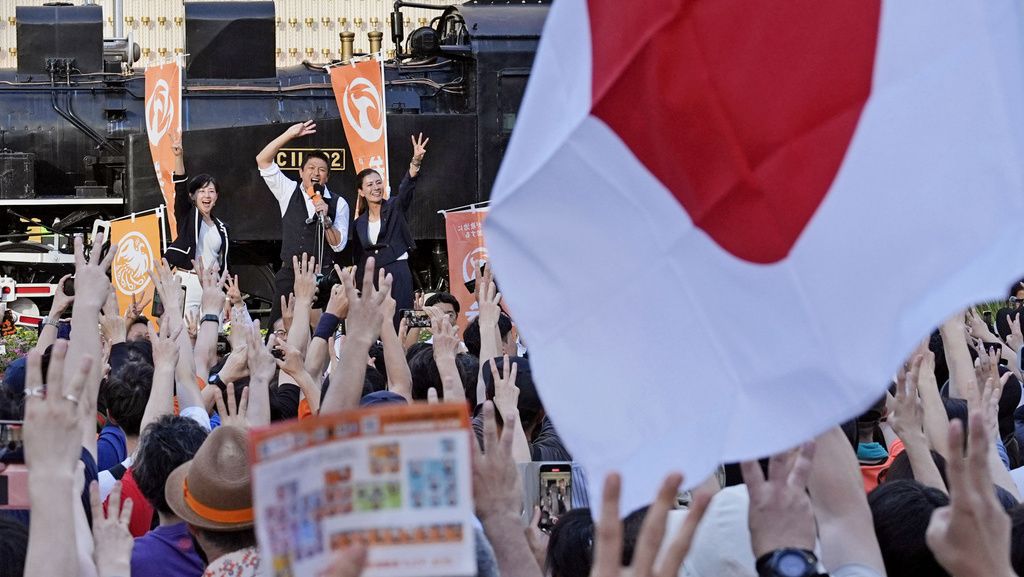
(Originally published in Japanese. Banner photo: Supporters gather at a Sanseitō rally outside Shinbashi Station in Tokyo on July 21, 2025, after the party’s strong showing in upper house elections held the previous day. © Kyōdō.)