Takaichi Sanae’s Smiling Start: Will Long-Term Progress Follow Early Diplomatic Success?
Politics- English
- 日本語
- 简体字
- 繁體字
- Français
- Español
- العربية
- Русский
An Early Start on the Diplomacy Job
Takaichi Sanae became Japan’s first-ever woman prime minister on October 21 following her election as the Liberal Democratic Party’s president earlier in the month. Just five days later, on October 26, she was making her diplomatic debut at an Association of Southeast Asian Nations leaders’ summit in Kuala Lumpur. This was an abrupt appearance on the world stage for the new leader—even more so since she was slated to meet with US President Donald Trump, who would arrive in Tokyo on October 27—and there was discussion of whether she should make the trip to Malaysia at all. But Japan is an expected presence at this annual gathering, and Takaichi evidently felt that her absence would send an unwanted message to China and the ASEAN members that Japan was less interested in the region than before. This led to her decision to make the trip.
In Kuala Lumpur, Takaichi declared Japan’s intention to carry forward the ideals of the Free and Open Indo-Pacific, first espoused by Prime Minister Abe Shinzō during his 2012–20 term in office, and to cooperate with the Southeast Asian group in the area of maritime security and support the group’s own ASEAN Outlook on the Indo-Pacific, a framework proposed in 2019 to advance openness, inclusivity, respect for international law and dialogue, noninterference in domestic politics, maritime cooperation, and more. Here she hoped to entice Southeast Asian nations back to the fold of open systems led by Japan and the countries of the West, given their drift away from the United States in the face of Donald Trump’s arbitrary and punishingly high tariffs.
Perhaps because of her high-profile position as Japan’s first female leader, there was strong interest among the gathered leaders in meeting with her, and she quickly filled a busy schedule with summits with heads of key ASEAN nations, along with Australia. Officials accompanying Takaichi from Japan hailed her performance as a “rocketlike start” to her diplomatic career, driving home a powerful message about Japan’s deep interest in regional ties.
Sanae Deals with Donald
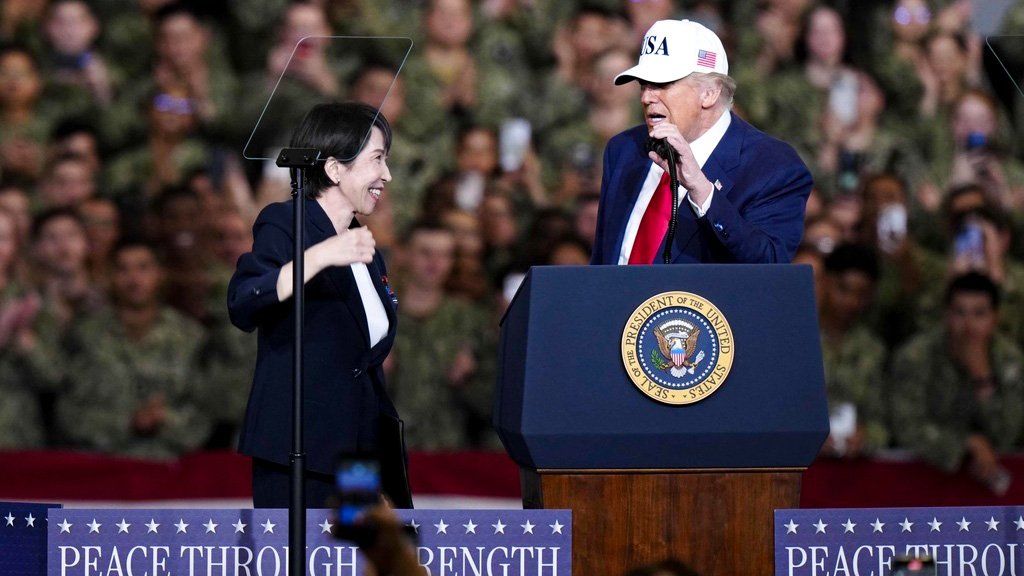
On October 28, soon after her return from Malaysia, Takaichi met with President Trump at the State Guest House in Moto-Akasaka, Tokyo, calling for the forging of a “new golden age” in Japan-US bilateral ties. She also boarded the presidential helicopter to accompany Trump to the US Naval base in Yokosuka, Kanagawa, where she appeared alongside him aboard the aircraft carrier USS George Washington, raising her fist and leaping energetically in a gesture calculated to appeal to American watchers of her performance.
This led to some criticism that she was “overly excited” during her time with the president, but she certainly made the case for herself as the successor to Abe Shinzō’s close personal relationship with the American leader, with “Sanae and Donald” on a friendly first-name basis right away. It may be said that this performance also laid the path to her swiftly realized summit with Chinese President Xi Jinping as well.
All that said, the current state of global affairs impacting the Japan-US relationship can hardly be described as conducive to a “new golden age.” Donald Trump has sought to punish China with high tariffs on its exports, but been pressed to compromise in the face of China’s retaliation in the form of export restrictions on badly needed rare earth metals. Other serious issues are rising to the fore, including the lagging status of both Japan and the United States in military and economic security terms due to China’s hold on more than half of the global shipbuilding market.
It is no surprise, therefore, that one of Takaichi’s earliest moves in her dealings with Trump was driven by a sense of urgency as she secured agreement on a cooperative framework including expanding stable supply chains for rare earths and enhancing the two countries’ shipbuilding capacity.
Dialogue with Wary Counterparts: China and South Korea
Just days after her time with Trump, Takaichi was off again on October 30, this time to Gyeongju, South Korea, for the Asia Pacific Economic Cooperation leaders’ gathering. On the APEC sidelines she met with South Korean President Lee Jae-myung, smiling her way through what appeared to be a successful attempt to do away with her image as a hardliner on Korea. Together with Lee, viewed by some as a left-leaning hardliner against Japan, she reached an agreement on “aiming for a stable, future-oriented relationship” and pledged to continue shuttle diplomacy between the two nations.
On October 31 she met with Xi Jinping. The two agreed to pursue ongoing dialogue to create a strategic, mutually beneficial relationship, with Takaichi stating: “I am a firm believer in conviction and the power of action. My hope is to continue frank dialogue with President Xi to improve the ties between our countries.”
Takaichi Sanae has long been counted among the more hawkish wing of the LDP on things like Takeshima (the islands controlled by South Korea, which calls them Dokdo), the “comfort women” historical issue, the question of Yasukuni Shrine, the status of Taiwan, and human rights issues in China. There has likely been little change in Beijing’s and Seoul’s strong concerns about her in this regard, but as she noted at the press conference following her talks with Xi, in the early days of her administration, “it is precisely because there are these concerns that we need to talk things through.” In this way she marked her course as one aimed at creating mutual benefits for Japan and its neighbors in the region.
The US media generally struck positive notes in its coverage of Takaichi’s early days on the foreign policy circuit. The New York Times headlined its coverage of the Japan-US summit with “Trump Bonds with Japan’s Leader,” reporting that she had succeeded somewhat in securing Trump’s pledges on stronger engagement with the Indo-Pacific region and robust alliance ties. Other coverage went so far as to call Takaichi “Trump’s new bestie.”
Indeed, praise for Takaichi’s diplomatic debut has been well earned. She has refrained from pushing ahead vigorously with the views she has been known to espouse previously, crafting an image as a flexible, realistic diplomat with a smile on her face. Compared with a decade ago, when her mentor Abe Shinzō represented Japan on the world stage, conditions facing Japan have become much tougher: the disturbing cooperative ties among China, Russia, and North Korea, Trump’s tariffs, and the dire global security situation as seen in Ukraine and the Middle East, to name a few factors she must deal with. To protect its national interests, Japan cannot go it alone with little more than a tough stance in the face of challenges like these.
Japan can no longer rely only on deterrence in its dealings with China; a more nuanced ability to handle ties with the country must come into play now. This means both strengthening the bilateral alliance with the United States and advancing a pragmatic China policy with a focus on dialogue and actual benefits. The truly difficult tests for Takaichi Sanae—finding the funds needed to boost Japanese defense spending to 2% of GDP, effectively rolling out the promised $550 billion in investment in America, stabilizing ties with China and South Korea—have yet to be faced.
(Originally published in Japanese. Banner photo: Japanese Prime Minister Takaichi Sanae and US President Donald Trump appear before sailors aboard the USS George Washington in port in Yokosuka on October 28, 2025. © Kyōdō.)
China foreign policy South Korea Donald Trump Takaichi Sanae