Japan’s Energy Plan: New Policy Shifts Nuclear Power Stance from Reduction to Maximization
Politics Science Society- English
- 日本語
- 简体字
- 繁體字
- Français
- Español
- العربية
- Русский
Japan’s Energy Mix
The cabinet in February 2025 approved Japan’s seventh basic energy plan that sets targets to meet growing demand for electricity while keeping the country on track to achieve carbon neutrality by 2050. The latest iteration of the plan positions renewable energy as the main power source by increasing its current 20% ratio in the nation’s energy mix to between 40% and 50%. It also looks to “maximize” nuclear power by boosting its share from the 2023 mark of 8.5% to around 20% by 2040. Conversely, reliance on fossil fuel–based thermal power generation will decrease from the current mark of around 70% to 30% to 40%, bringing with it a sizable reduction in greenhouse gas emissions.
Japan’s Current and Future Energy Mix
| FY 2023 (preliminary) | FY 2040 target | |
|---|---|---|
| Solar | 9.8% | 23%–29% |
| Wind | 1.1% | 4%–8% |
| Hydro | 7.6% | 8%–10% |
| Geothermal | 0.3% | 1%–2% |
| Biomass | 4.1% | 5%–6% |
| Nuclear | 8.5% | 20% |
| Thermal | 68.6% | 30%–40% |
Created by Nippon.com based on the Agency for Natural Resources and Energy’s Seventh Strategic Energy Plan.
The latest plan’s emphasis on maximizing nuclear power represents a clear turning point for the government, which looks to achieve this goal by extending the operation of existing reactors beyond the “in principle” limit of 40 years and promoting the development and deployment of next-generation advanced reactors.
Assumption of Growing Demand
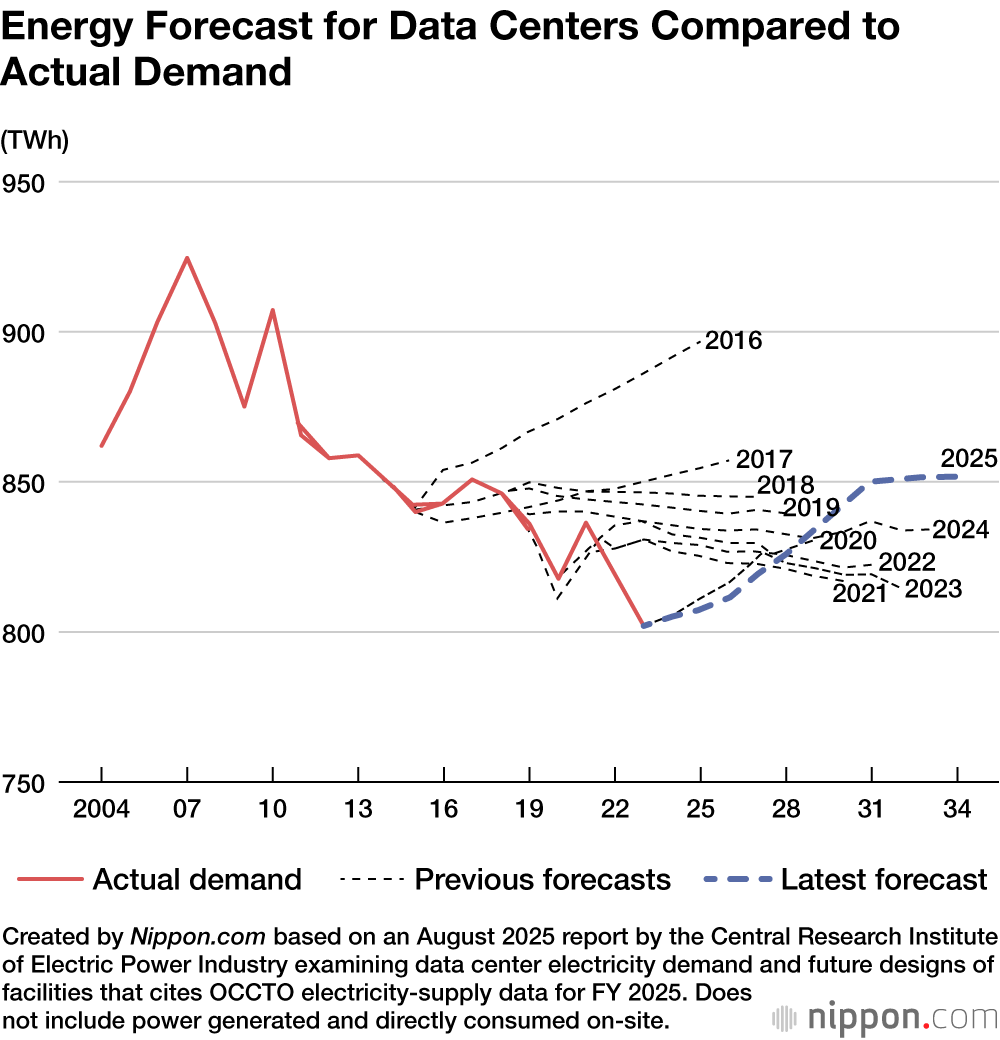
Japan draws up its energy plan based on long-term forecasts of supply and demand. The shift toward maximizing nuclear power rests on the assumption that the expansion of digital technologies like AI and the Internet of things (IoT) will significantly drive demand for electricity upward. While on the surface this appears to be logical, the reliability of the future demand predictions that it is based on is questionable. For instance, a report by the Organization for Cross-Regional Coordination of Transmission Operators, a private organization established in 2015 to help manage Japan’s power grid, shows that demand forecasts have consistently overestimated consumption since 2016.
The extremely high uncertainty of forecasting raises doubts about the assumption that Japan’s growing army of data centers will push energy demand into the stratosphere. There is no shortage of experts who contend that, rather than simply driving up demand, digitalization will in fact reduce power consumption overall through new technologies that greatly improve energy efficiency.
Issues in the Decision-Making Process
Over the last several decades, Japan has worked to liberalize its electricity market with the aim of shifting from a system dominated by state-regulated regional utilities to a market-driven model. However, the government’s centrally planned energy strategy is ill-suited to a market that has become less predictable as a growing variety of players, including major gas companies and telecommunication firms, throw their hats into the ring. If market principles are to rule the day, Japan needs to follow the lead of Europe and the United States, which were early movers in liberalizing energy markets, and abandon its centrally determined supply-and-demand model.
Another shortcoming of the energy plan is its lack of alternative approaches. The document gives little indication that drafters considered all available options to come up with choices that best suit Japan’s needs. In other words, there is no “Plan B,” the lack of which deprives Japan’s energy policy of the necessary flexibility to adjust to future uncertainties.
Adding to these concerns is Japan’s long adherence to the committee model of decision-making. The government appoints experts to the Advisory Committee for Natural Resources and Energy, who then develop the strategic energy plan. However, the body is comprised largely of members whose interests are directly tied to the policies being discussed. This stifles the range of opinions that are shared, a failing that is compounded by a glaring lack of participation by members of civil society.
Unsurprisingly, the public response to the push to restart nuclear reactors has been lukewarm at best, with the decision coming to be viewed as being driven by a handful of stakeholders rather than as the outcome of a national debate.
Questions of Economic Viability
The government has failed to make a compelling economic argument for its decision to maximize nuclear power. The Ministry of Economy, Trade, and Industry already acknowledged in 2021 that atomic energy was not the most economically efficient power source. This is supported by the latest power generation cost assessments, which show nuclear as being the more costly option compared to solar power.
Nevertheless, the target of replacing some existing facilities has prompted Kansai Electric Power Company to begin surveying land at its plant in Mihama, Fukui Prefecture, for a next-generation reactor. While this marks the first nuclear project by a utility since the Fukushima nuclear accident, KEPCO President Mori Nozomu has expressed concerns over the profitability of the venture. Speaking to national broadcaster NHK, Mori said that the success of the project hinges on the government enacting policies to support the long-term economic viability of nuclear power.
Toward this end, authorities are mulling a system for supporting the construction of new nuclear power plants that would recoup costs by adding a charge to electricity rates. This has garnered criticism, with opponents contending that there is no better argument against nuclear power’s economic viability than the need to stick the public with the bill for new reactors. There is also the risk of problems arising from the government having yet to clarify how the policy aligns with its goal of extending the operational lifespan of existing reactors.
Limited Benefits
Japan’s energy plan justifies the stance of maximizing nuclear power with the lofty goals of ensuring a stable supply of electricity and contributing to mitigating climate change. However, the actual impact in these areas is likely to be limited.
Nuclear power is a baseload energy source, but in Japan the extended shutdown of plants following the Fukushima disaster and growing uncertainty around reactors clearing stiff new regulatory requirements and other hurdles have prevented it from fulfilling this role. In 2024, the average output of nuclear power was just 30.6% of capacity, casting serious doubt on its reliability as stable source of power.
In terms of advancing Japan’s climate goals, making full use of existing nuclear potential will certainly contribute to the country reducing its reliance on fossil fuels. However, the focus on nuclear power could also have a negative impact if it hinders the shift to renewables and other forms of clean energy. It is important to also keep in mind that it takes upward of 20 years to construct a nuclear power plant. The reduction in emissions from any new facility would not appear until after 2045 at the earliest, making the impact on Japan’s aim of becoming carbon neutral by 2050 negligible at best.
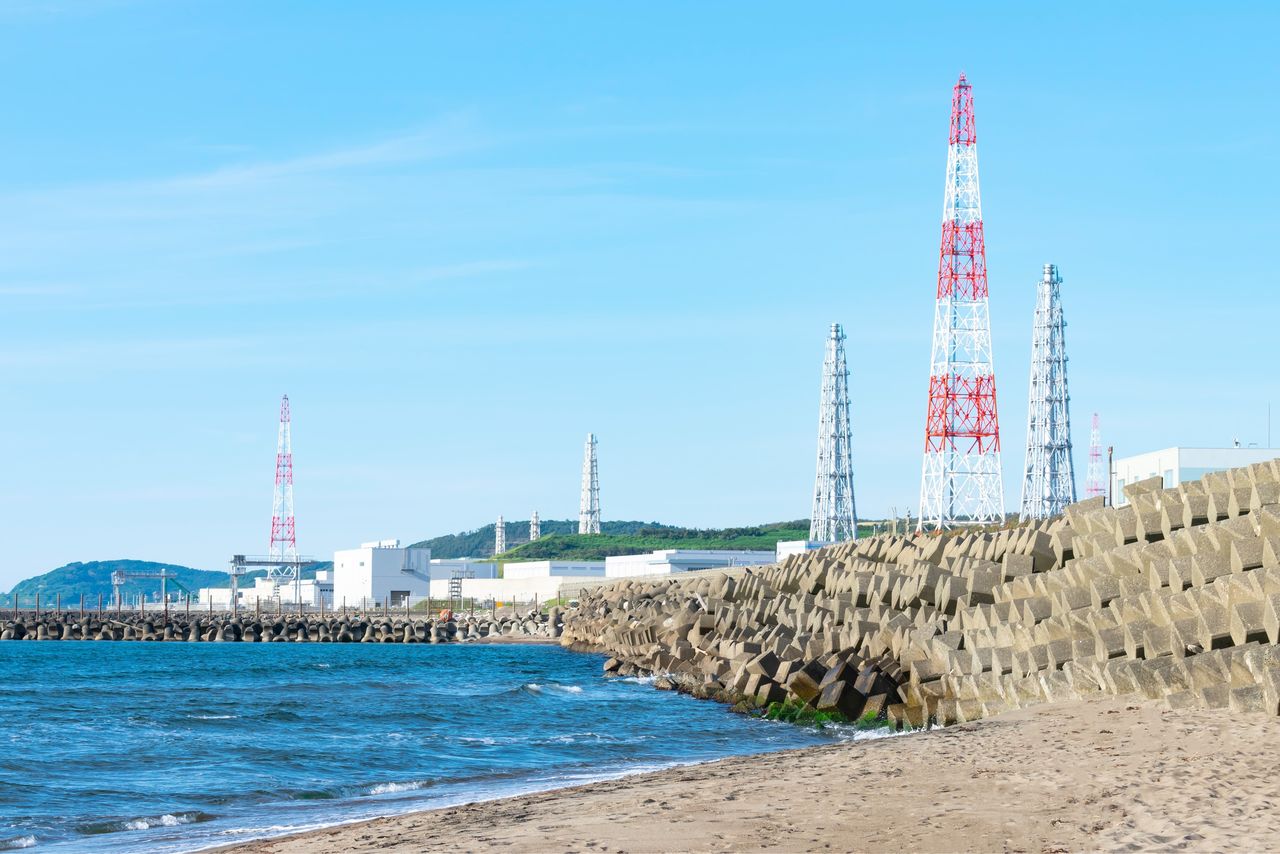
Tokyo Electric Power Company’s Kashiwazaki-Kariwa Nuclear Power Station. The number 6 reactor at the plant is set to resume operation after Niigata Governor Hanazumi Hideyo approved the restart on November 21, 2025. (© Pixta)
Building Public Trust
Finally, the two most pressing challenges facing Japan’s nuclear energy policy are deciding on the final disposal site for spent fuel and other high-level radioactive waste and the decommissioning of Fukushima Daiichi. There is little prospect of nuclear power winning broad public backing as long as these issues are unresolved.
Surveys are currently underway at three potential storage locations—the towns of Suttsu and Kamoenai in Hokkaidō and Genkai in Saga—but the final decision on a permanent site remains far off. From a practical standpoint, the need to resolve the issue of where to store nuclear waste is a nonpartisan matter. This should be reflected in any legislation along with the necessary institutional frameworks and the establishment of an independent third-party body to objectively evaluate the disposal process.
The decommissioning of Fukushima Daiichi and ongoing recovery work in areas affected by the meltdown are also critical, nonpartisan issues. However, the roadmap for decommissioning the stricken plant not only lacks a solid legal underpinning, the 30–40-year timeframe it assumes for completing the process is based on dubious scientific reasoning. The host of other issues that remain unresolved 14 years after the accident include determining the overall goals of the decommissioning project, establishing frameworks for implementation and evaluation of the process and the independent oversight of these, reassessing costs and burden-sharing, disposing of contaminated soil, handling of treated water, and building consensus at the local and international levels. The current situation demands that the government fundamentally reassess its approach.
Transparency and Fair Evaluation
To smoothly implement nuclear policy, the government needs to earn the trust of the Japanese public as well as the international community. To do this, it must disclose the information underpinning its policy decisions and seriously consider alternative options that reflect the views of a wide range of stakeholders. The review process cannot be limited to internal assessments, but must include insights provided by independent, third-party evaluations.
Finally, the policy-making process must be completely transparent and authorities must as a matter of course engage the public and the international community in an earnest dialogue. Only by fundamentally overhauling its rigid decision-making process will Japan stand a chance of garnering support for its basic energy plan at home and on the international stage.
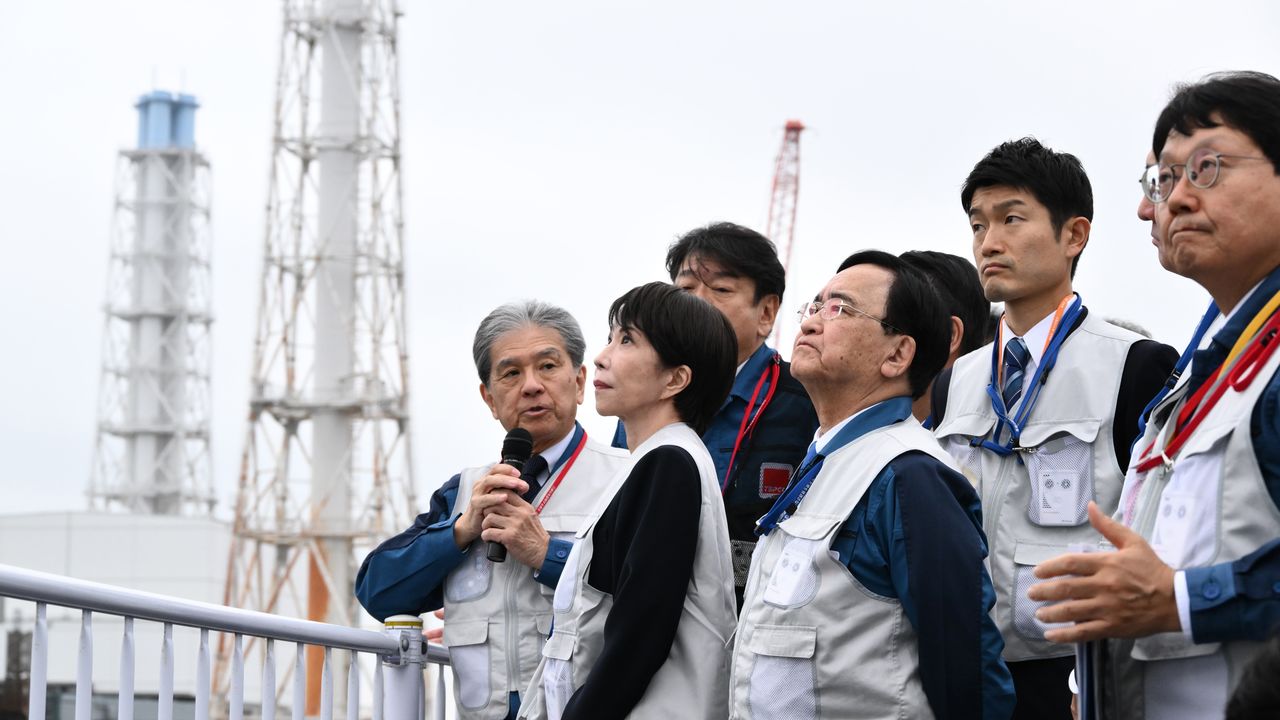
(Originally published in Japanese on January 14, 2026. Banner photo: Prime Minister Takaichi Sanae [second from left] listens to Ono Akira [left], president of the TEPCO Fukushima Daiichi Decontamination and Decommissioning Engineering Company, during an inspection of the Fukushima Daiichi Nuclear Power Station on December 2, 2025. © Jiji; pool photo.)