Disengaged Youth Threaten China’s Great Rejuvenation: Jobless College Grads Embrace “Lying Flat”
Economy Society- English
- 日本語
- 简体字
- 繁體字
- Français
- Español
- العربية
- Русский
No End to Youth Joblessness
China’s youth unemployment rate stood at a sobering 16.5% in December 2025, according to the latest figures released by the National Bureau of Statistics. To be sure, joblessness among non-students aged 16 to 24 has declined somewhat since August 2025, when it peaked at 18.9% (using the new methodology; see below). But a drop of several points is expected after the cyclical summer spike triggered by the graduation of university students each June. The December 2025 report shows a slight increase over the year-before figure, indicating that youth unemployment has plateaued at an alarmingly high level.
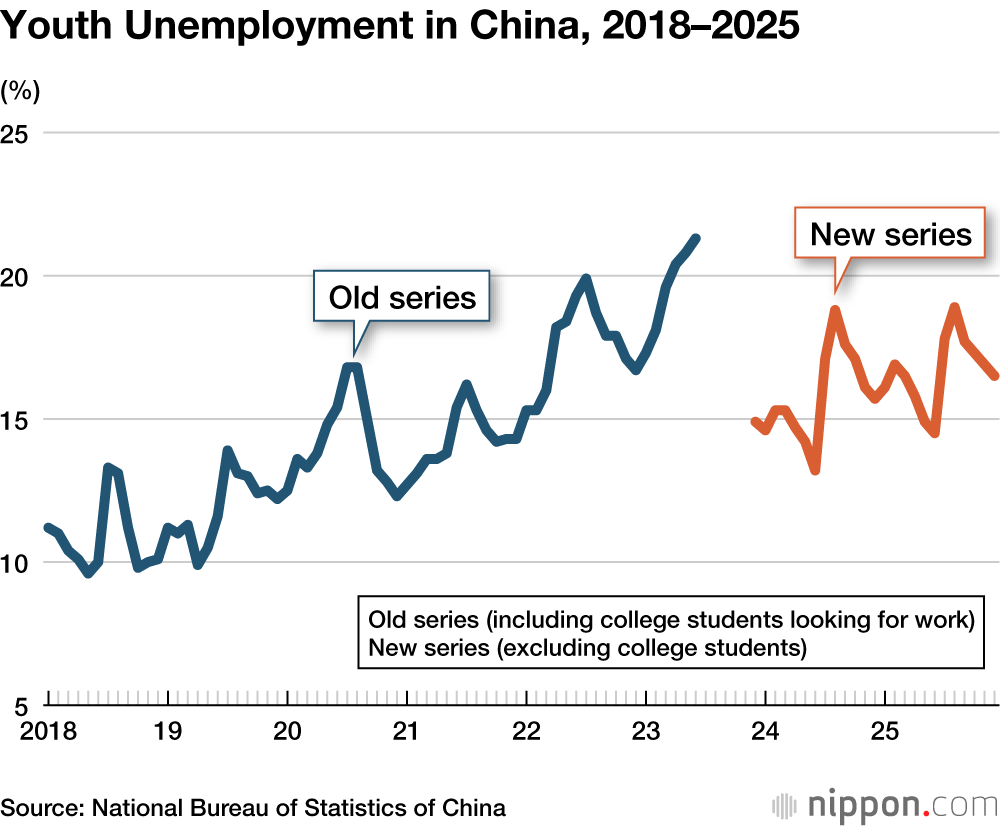
Youth joblessness stood at around 10% in 2018, the year the government began publishing unemployment data disaggregated by age group. The rate climbed subsequently, as the COVID-19 pandemic and the real estate crash took their toll, hitting 21.3% in June 2023. For the next five months, the NBS suspended the release of youth unemployment data, ostensibly in order to revamp its methodology. The new series excludes college students searching for part-time or temporary jobs.
Largely as a result of the methodology change, when the Statistics Bureau resumed its tracking of youth unemployment in December 2023, the reported rate was down sharply, to 14.9%. In the two years since, it has hovered between 14% and 18%. Given that overall unemployment has held steady at around 5%, it seems clear that youth joblessness remains a major problem for China, even leaving aside questions as to the aptness of the new methodology.
Mismatch Between Jobs and Skills
An important factor to consider when analyzing China’s high youth unemployment rate is the proliferation of college graduates over the past quarter century. In 2003, only 17% of high school graduates went on to institutions of higher education. By 2023, just two decades later, the college enrollment rate had risen to 60%. In the five years between 2018 and 2023, the number of graduating college students swelled from 7.53 million to 11.58 million.
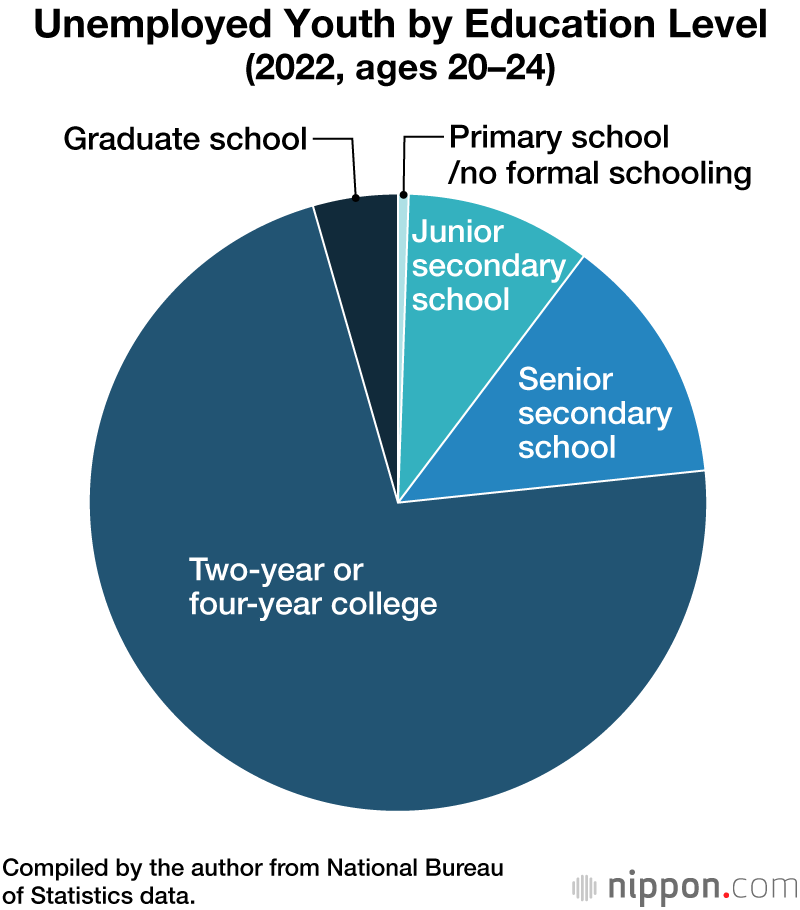
Drawing on the Chinese government’s labor statistics, we can break down the population of unemployed youth by educational level. In 2022, about 70% of unemployed Chinese aged 20–24 were graduates of two-year or four-year colleges. Among young people entering the labor force in 2022, recent college graduates accounted for 8.57 million, more than twice the number hired out of junior secondary school and senior secondary school combined.
The economic slowdown of the past few years is one factor behind college graduates’ job-hunting struggles. But another reason is the gulf between the type of work they seek and the labor needs of Chinese industry. For the most part, college grads have their sights set on office jobs in the relatively high-paying technology, automotive, and financial sectors. But these jobs have become more and more difficult to land. Businesses in areas like logistics, wholesale and retail sales, and services have need of frontline workers. China’s manufacturing industries, meanwhile, are suffering from a severe shortage of skilled “purple collar” workers; they are on the lookout for graduates with a technical background to work in today’s modernized factories. There are also opportunities for elite science and engineering majors equipped to hit the ground running in research and development. But relatively few college grads are so equipped.
Pronounced income disparities based on academic background have long been a fact of life in China. For many years, graduates of the country’s elite universities could count on a prestigious white-collar job with the promise of steady advancement. Accordingly, Chinese parents prioritized their children’s education with a view toward upward mobility. The old one-child policy contributed to the increase in college graduates, as blue-collar parents channeled their limited resources into the education of their only child, determined to get them into college and secure them a better life. These forces fostered a strong white-collar orientation among Chinese college students. But the office jobs they seek are becoming harder to find.
Rise of the Rat People
Typically, a college student who fails to find an acceptable permanent position upon graduation will settle for gig work while continuing the search. A few kick the can down the road by enrolling in graduate school. But a growing number are simply rejecting mainstream society’s expectations of regular employment leading to independence and material affluence.
These are the adherents of the tang ping (“lying flat”) lifestyle, a phenomenon that has elicited much comment in China. Indifferent to professional success and passive toward love and marriage, these “layabouts” have embraced a low-energy, low-consumption way of life. Some continue to live off their parents, while others work just enough to sustain a minimalist lifestyle, foregoing cars, home ownership, and so forth.
In a 2021 online questionnaire conducted over the Chinese social media site Weibo, participants were asked their opinion of the tang ping movement. Of those who responded (more than 240,000 altogether), the majority expressed either sympathy or admiration, while less than 10% disapproved entirely. The “layabouts” themselves have become a growing presence on social media, presenting their reclusive lifestyles and even identifying themselves derisively as “rat people.” After decades of rapid growth fueled by fierce competition for material advancement, China’s economy and society may be at a turning point.
No Quick Fix for Youth Unemployment
The Chinese government is by no means guilty of inaction when it comes to the problem of youth unemployment. In September 2024, the State Council and the Chinese Communist Party Central Committee jointly unveiled a 24-point strategy to “promote high-quality and sufficient employment.” To address the structural mismatch between labor supply and demand, the policy calls for (1) aligning curricula more closely to the needs of industry, as by expanding programs in science, engineering, agriculture, and medicine; (2) requiring companies to budget more for employee education, with at least 60% of that budget allocated to the training of frontline workers; (3) building a National Qualifications Framework that would establish integrated outcomes for professional certification and academic degree completion; and (4) raising wages and improving job conditions for skilled workers.
In addition, the government has rolled out measures to improve public employment services, including the use of advanced digital tools. It is also considering new social-insurance policies aimed at long-term unemployed youth.
But China’s policy makers have been drawing up initiatives to address youth unemployment almost nonstop since 2021. The latest plans to reorient college curricula toward sci-tech and beef up employee training are geared to the evolution of China’s industrial structure and are aligned with the nation’s fifteenth Five-Year Plan (2026–30), which promotes the development of new growth industries (including artificial intelligence, new energy, new materials, and aerospace). But no one expects them to have an immediate impact.
The Chinese Dream at Risk
Xi has built his regime around the goal of turning China into a ”great modern socialist country”—equaling or surpassing the United States in economic, military, and technological might—with a target year of 2049. By then, today’s twenty-somethings will be the backbone of Chinese society and industry.
Moreover, in the coming age of demographic aging and population decline, China will need to optimize its available human resources to boost productivity. Mounting disillusionment and apathy do not bode well for Xi Jinping’s vision of Chinese greatness. The proliferation of labor-force dropouts could also strain the social safety net. China’s leaders cannot but regard the tang ping phenomenon with growing alarm.
In September 2025, the Cyberspace Administration of China, the state agency responsible for regulating and censoring the internet, launched a campaign to rein in content that incites “excessively pessimistic sentiment.” Since then, the CAC has targeted bloggers and influencers who argue that “hard work is pointless” and extol a low-energy, laid-back lifestyle. With this crackdown, the government has shown itself anxious to repress not just political dissent but also evolving attitudes toward life and material affluence. These are signs that Chinese society has entered a new phase.
As of early 2026, the real estate slump continues to sap China’s economic vitality, and a return to the high-paced growth of the pre-pandemic era seems unlikely. But the country’s competitive potential in cutting-edge technologies and their commercial application is not to be underestimated, as evidenced by last year’s stunning global debut of the AI chatbot DeepSeek. Thus far, the Xi regime has shown a strong preference for placing state-owned enterprises at the core of the economy while keeping private business closely aligned to state goals. Can the government foster innovation even while tightening its control over the private sector? Can it rekindle the younger generation’s drive and ambition? These are the key challenges facing China’s policy makers as they tackle the problem of youth unemployment.
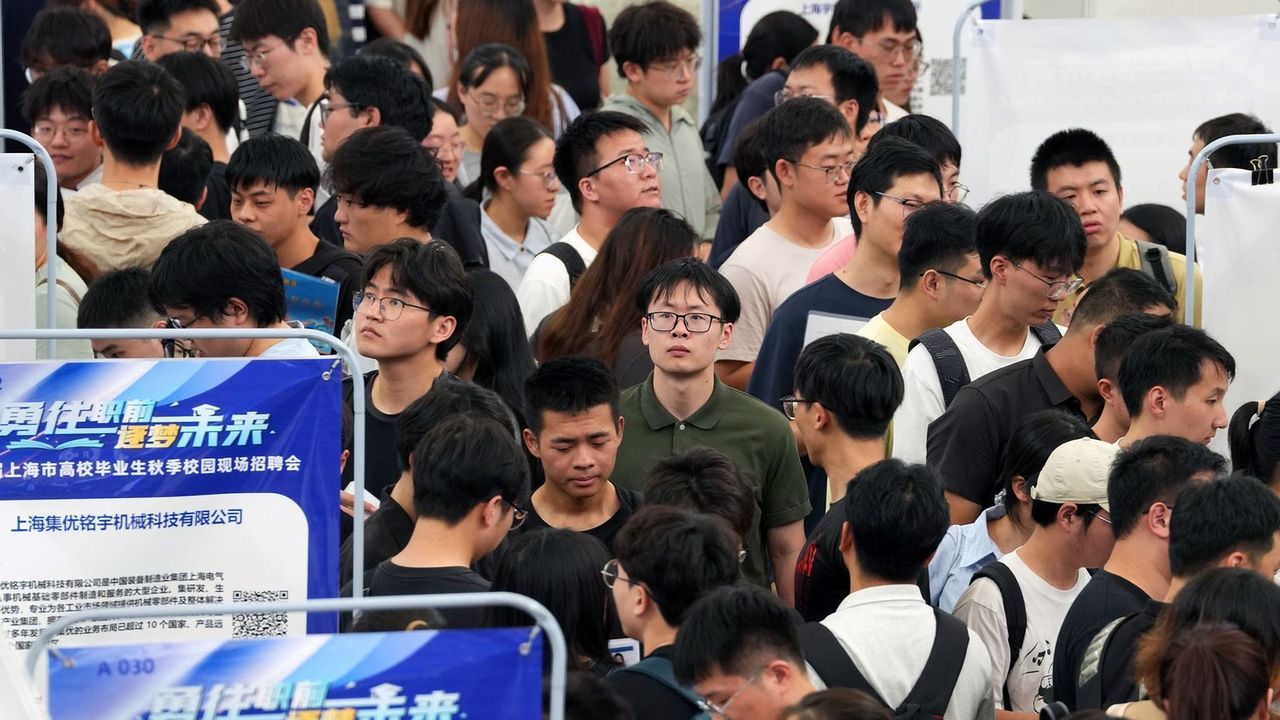
(Originally published in Japanese. Banner photo: A job fair held at Shanghai Jiao Tong University, September 26, 2025. © Xinhua/Kyōdō.)