Japan’s “Foreigner Policy” Skirts Key Issues: No Orderly Coexistence Without Plan for Immigration
Politics Society- English
- 日本語
- 简体字
- 繁體字
- Français
- Español
- العربية
- Русский
Targeting the “Foreigner Problem”
In January 2026, the government of Prime Minister Takaichi Sanae unveiled a policy framework titled Comprehensive Measures for Accepting Foreign Nationals and Orderly Coexistence. It replaces guidelines first adopted in December 2018, when a major revision of the Immigration Control and Refugee Recognition Act officially opened Japan’s doors to lower-skilled foreign labor under the Specified Skills program. How does the latest framework differ from the guidelines it replaced?
One of the biggest differences is the scope of the new document, which addresses not just foreign workers and residents but also such unrelated issues as overtourism and the purchase of real estate by overseas foreigners.
Tourists, overseas foreign investors, and foreign residents all interact with Japanese society in different ways. There is something fundamentally wrong-headed about trying to lump all of them under one comprehensive “policy toward foreigners.” Doing so has the effect of obscuring the distinct and complex factors surrounding the individual issues, including their background and their impact on various stakeholders. It gives rise to a simplistic, polarized debate between the proponents of tighter restrictions and the advocates of tolerance.
Skirting the Core Issue
With regard to foreign nationals currently residing in Japan, the government has termed its approach a policy of “orderly coexistence.” On the one hand, this involves a continuation of integration policies adopted in 2018, such as Japanese language training for foreign workers and educational and vocational assistance for their children. On the other hand, it calls for “optimized” (i.e., stricter) management of the resident foreign population—primarily by making completion of a Japanese language program mandatory for permanent residency and by lengthening the period of continuous residence required to obtain Japanese citizenship.
At the same time, the Takaichi administration has had very little to say about the real policy issues—that is, the government’s basic approach to the use of foreign workers to meet Japanese industry’s labor needs amid an aging population. Does the administration favor admitting such workers strictly as temporary labor? Admitting them with a view to granting permanent residency? Or cracking down on the number of foreign workers entering Japan? The “comprehensive measures” offer no clear indication.
Permanent Residency Is Stable
Takaichi administration’s comprehensive measures aim to tighten the requirements for obtaining legal recognition as a permanent resident of Japan or naturalized Japanese citizen. In fact, though, there has been no significant or long-term increase in the granting of citizenship or permanent residency. The increase in Japan’s foreign population is owing to the growing number of workers admitted and living here as temporary residents.
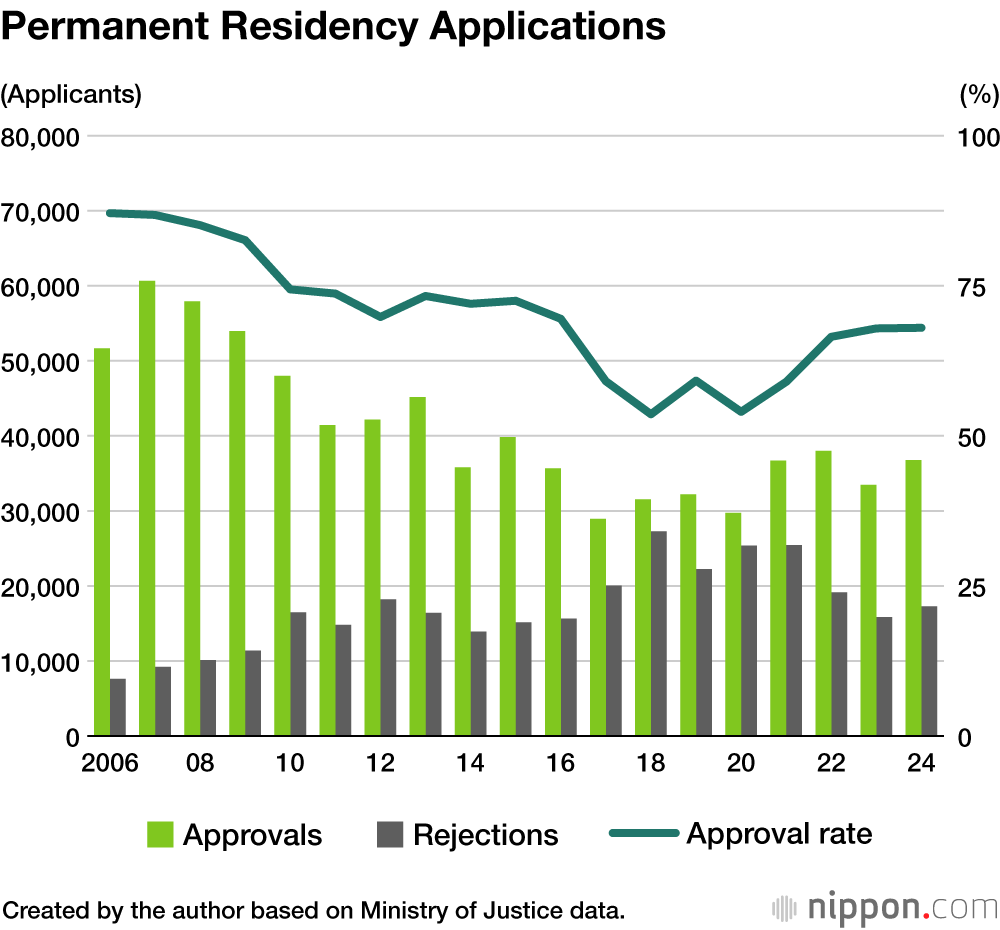
Japanese government statistics on applications for permanent residency go back only as far as 2006, but these figures indicate that the number of permits granted annually has declined since 2007. The pace picked up somewhat between 2018 and 2022, but it never returned to its pre-2010 high, and for the past few years, it has hovered in the vicinity of 35,000. The percentage of successful applications has mirrored this trend.
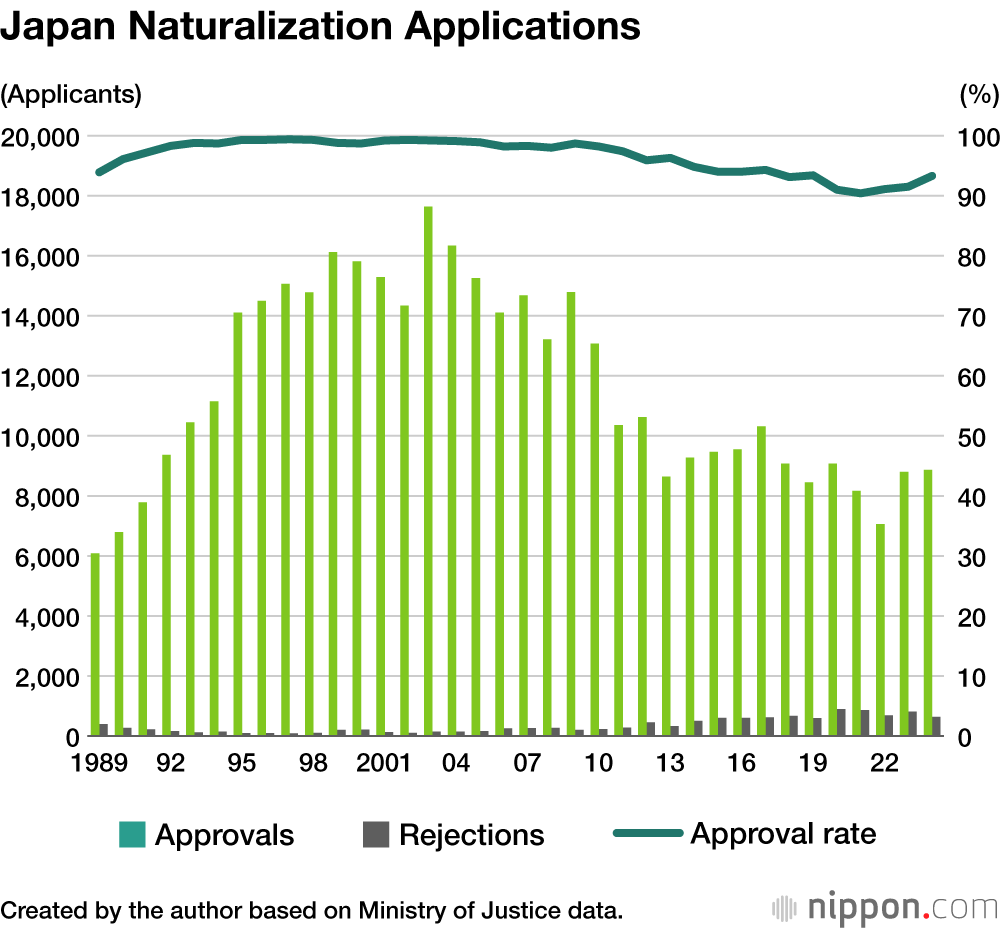
Naturalization statistics go back to 1989. According to these figures, the number of foreign-born residents granted Japanese citizenship each year has been declining since 2003, when it peaked at about 18,000. Since 2010, it has hardly crept above 10,000. The success rate for applicants is high, consistently surpassing 90%, but it has declined somewhat in recent years, trending below 95% since 2013.
Of course, the decline in the percentage of successful applicants does not necessarily equate to stricter standards for approval; it could also be the result of changes in the background of the “typical applicant.” But the foregoing figures do demonstrate that, while the population of foreign nationals in Japan has risen sharply over the past few decades, the number of those securing permanent residency or Japanese citizenship has not.
In 2018, my research team conducted a survey of foreign nationals living in Japan. Of the respondents we surveyed, only 38.5% indicated a desire to reside in Japan permanently. Even among those who entered Japan as spouses of permanent residents or Japanese citizens—a group generally inclined to settle permanently—the figure was less than 50%. Since the self-selection of subjects willing to respond to such surveys tends to favor those with an interest in or attachment to Japan, it seems likely that the percentage of all resident foreigners who plan to make Japan their permanent home is even lower.
Japan’s “No Immigration” Policy
Statistics published by the Organization for Economic Cooperation and Development allow us to compare Japan’s selection of visa applicants with that of other countries. Apart from tourism, the overwhelming majority of visas issued by the Japanese government are either for study or for work, whether short- or long-term. Foreigners other than students or workers are very rarely admitted for extended stays.
This contrasts with European countries like Germany, the Netherlands, and France, which accept a substantial number of migrants each year for purposes other than work or study. These include citizens of European Union countries, who have freedom of movement within the EU; refugees and other humanitarian cases (see graph); and relatives of resident foreign nationals. Since leaving the EU, Britain has clamped down on free movement, with the result that students now account for a large percentage of nontourists entering the country. But a good number are also relatives or other newcomers sponsored by current residents. In South Korea, meanwhile, the overwhelming emphasis has been on short-term migrant workers.
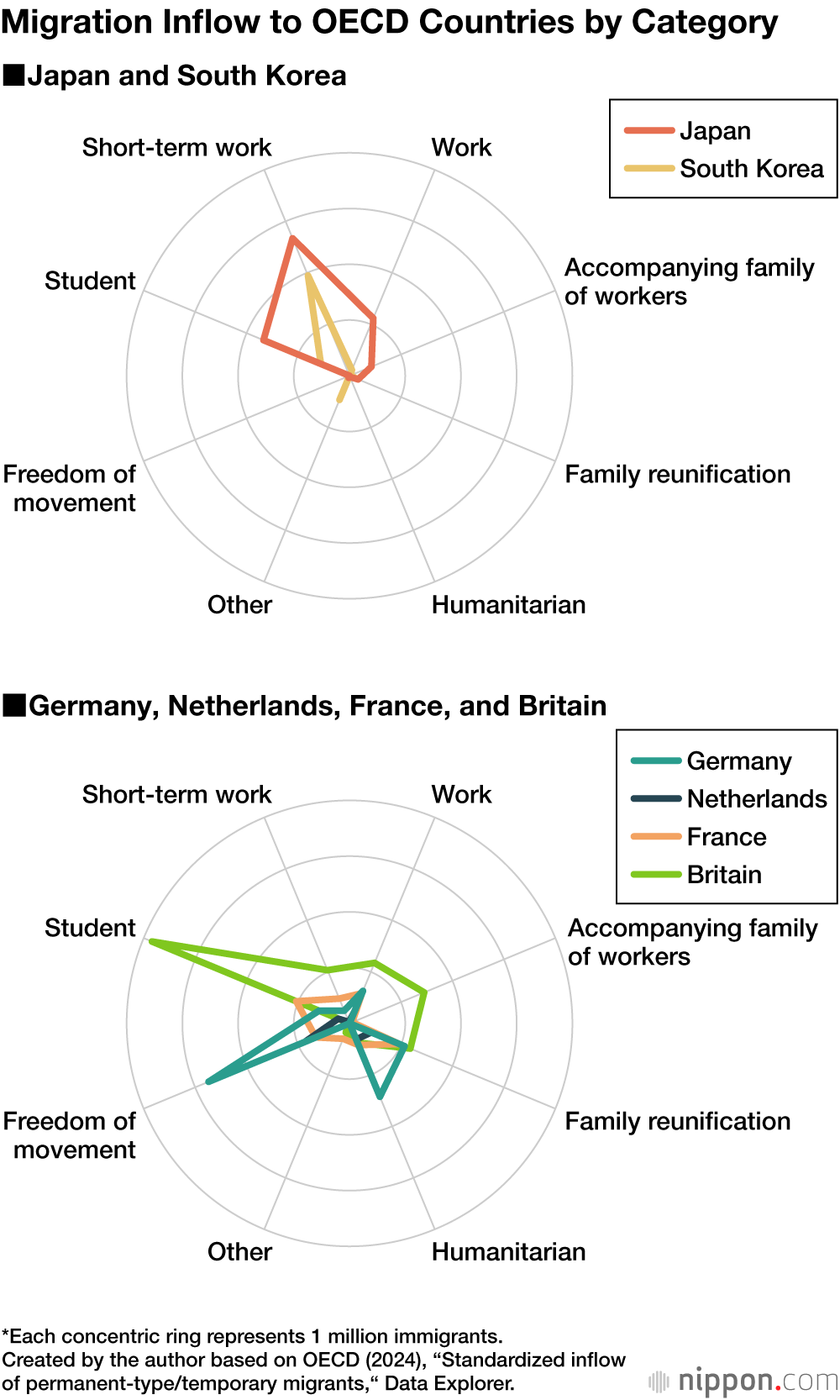
The Japanese government has instituted policies that actively encourage the influx of foreign nationals as laborers, and it has also provided pathways by which they can legally extend their stay. But it has never issued visas predicated on permanent settlement. This is why the Japanese government asserts that it has no “immigration policy” (imin seisaku) per se. The data presented above confirm that the increase in foreign residents stems from an influx of foreign workers admitted on a temporary basis (in keeping with the Japanese government’s official “no immigration” policy).
There were reports last year that the panel tasked with drawing up the latest comprehensive measures was considering setting a cap on the number of foreign residents. But the framework issued in January gives no indication of such a policy shift, and there is no suggestion of a slowdown in the latest figures on admissions under the Specified Skills program and the newer training and employment system. It seems fair to conclude that the current government intends to maintain a proactive policy on the acceptance of foreign labor.
At the same time, the new measures are designed to make it harder for such workers to obtain permanent residency. The government is opening the door wider to temporary residents without addressing the issues raised by “continued temporary residency”—the main path by which migrant workers end up settling in Japan as de facto immigrants.
Unequal Opportunity
In an era of growing labor shortages, the acceptance of lower-skilled foreign workers has been embraced as a means of securing human resources for the kinds of low-paying, labor-intensive work shunned by the Japanese. It is not surprising, therefore, that a relatively high proportion of foreign workers are employed in nonregular positions, which are generally characterized by limited benefits, fewer opportunities for advancement, and less job stability.
According to the latest census data (2020), the percentage of nonregular workers is significantly higher among foreign nationals than among Japanese citizens. The difference is particularly marked among male employees. While only 14% of Japanese males are employed in nonregular jobs, the ratio is 53% for Brazilians, 45% for Indonesians, and around 40% for Vietnamese, Nepalese, and Peruvian workers. The gap is less striking among women, but even so, the percentage of nonregulars is conspicuously high among female workers from Southeast Asia, South America, and Nepal (see figures).
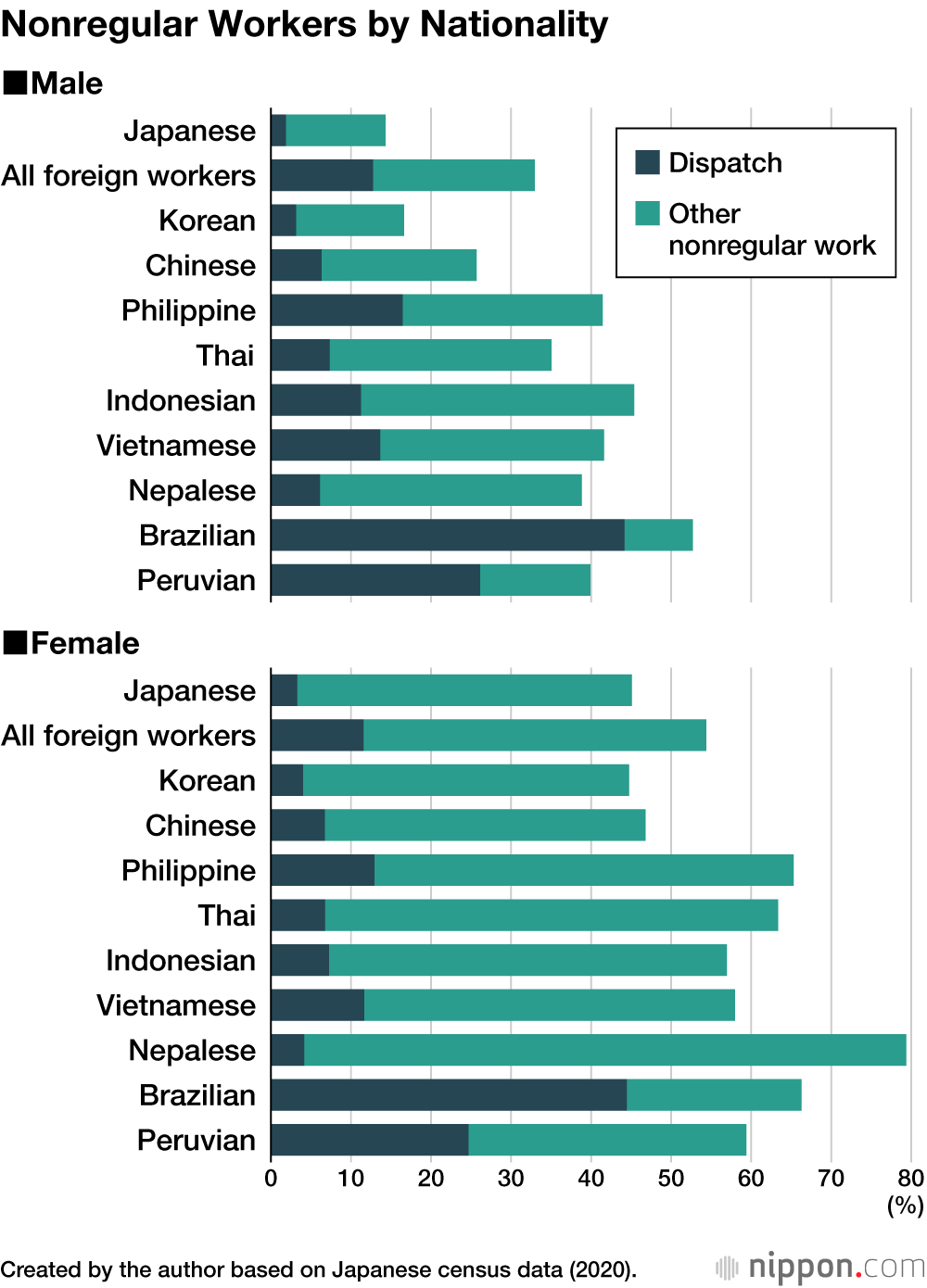
Workers in nonregular jobs are generally at higher risk for being laid off or terminated during economic slowdowns. Research has shown that foreign workers were hit hardest by layoffs and workweek cutbacks during the recessions of 2009 and 2020. In fact, many companies treat their foreign employees as a convenient safety valve with which they can flexibly adjust their workforce in response to changing business conditions. Foreign visa applicants who picture themselves as short-term migrant workers may also opt for such positions, choosing higher starting take-home pay over long-term benefits and job stability. But it is not uncommon for migrant laborers to settle permanently in the receiving country, even if that was not their original intent.
In such cases, foreign workers are likely to remain stuck in nonregular jobs. These immigrants are especially vulnerable to poverty in old age, since pension benefits in Japan are tied to one’s employment situation prior to retirement.
Risks of a Two-Tiered Society
Previous studies have shown that young people’s educational attainment correlates with their parents’ economic status. Although there has been some progress boosting high school enrollment among the children of foreign nationals, their dropout rate is high. For many, the linguistic, social, and financial obstacles to graduating and enrolling in college prove insurmountable. This raises the likelihood that they, too, will have to settle for low-paying jobs with little prospect of advancement. As the cycle of poverty continues across the generations, Japan could become a country of haves and have-nots, divided socially and economically by nationality. Entrenched inequality is a likely factor behind the social fragmentation plaguing countries that accept large numbers of immigrants.
From a long-term perspective, it is hard to see how the current system, with its emphasis on continued temporary residency, will ensure “orderly coexistence” in any meaningful sense. If the Japanese government believes that this country needs to admit foreign workers on a long-term basis, then it needs to squarely face that reality, explain it to Japanese voters, and institute the appropriate programs and systems.
(Originally published in Japanese. Banner photo: The famed scramble crossing outside Shibuya Station in Tokyo on January 20, 2026. © Kyōdō.)