Japan Love: Fad or Japonisme Reborn?
Culture- English
- 日本語
- 简体字
- 繁體字
- Français
- Español
- العربية
- Русский
Japan’s Impact on Western Culture
From the late nineteenth through the early twentieth centuries, the trend called Japonisme saw Japanese culture inspiring and influencing Western artists, who built on the cultural cues they received from this faraway land to create new forms of expression. In painting, for example, Vincent van Gogh’s use of even, vibrant colors and his close-up framing on aspects of nature were influenced by Japanese ukiyo-e.
This influence was first seen in visual arts like painting, but the trend soon filtered into other fields like literature, music, theater, fashion, and even architecture. Now, it is widely viewed as a common element of the cultural expression of the era.
How did this happen?
The first explanation is the sudden speed at which Japan became known to the world. For over 250 years, the shogunate’s policy of national seclusion kept interaction with the Western world under tight restriction. From the country’s opening in 1854, and especially after the signing of the Treaty of Amity and Commerce in 1858, Japan’s cultural output began spreading worldwide. Through activities like pavilions at World’s Fairs, the expressions of different cultural values found in Japan’s art and aesthetics soon began influencing the world and helped birth the Japonisme movement.
Another element was how Christian-based values and the forms of expression built on them were growing increasingly out of touch with contemporary sensibilities, and the discord that caused led many people to search for new ways of thinking and creating.
This helps explain how the older example of Chinoiserie, when Chinese art began entering the West in the eighteenth century, resulted in only a partial adoption of specific artworks, rather than having an impact on the more fundamental worldview. In much the same way, the Orientalisme of the early nineteenth century—sparked by heightened interest in the Middle East—failed to penetrate too deeply into Western values. In other words, even when new cultures were introduced, they would end up being mere fads of exoticism without the will to use them for self-transformation.
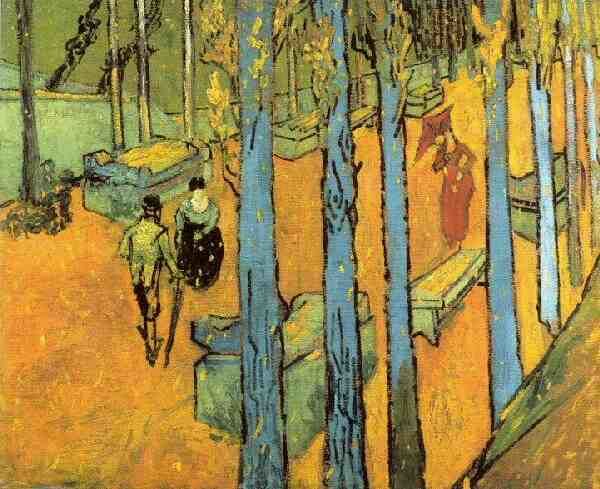
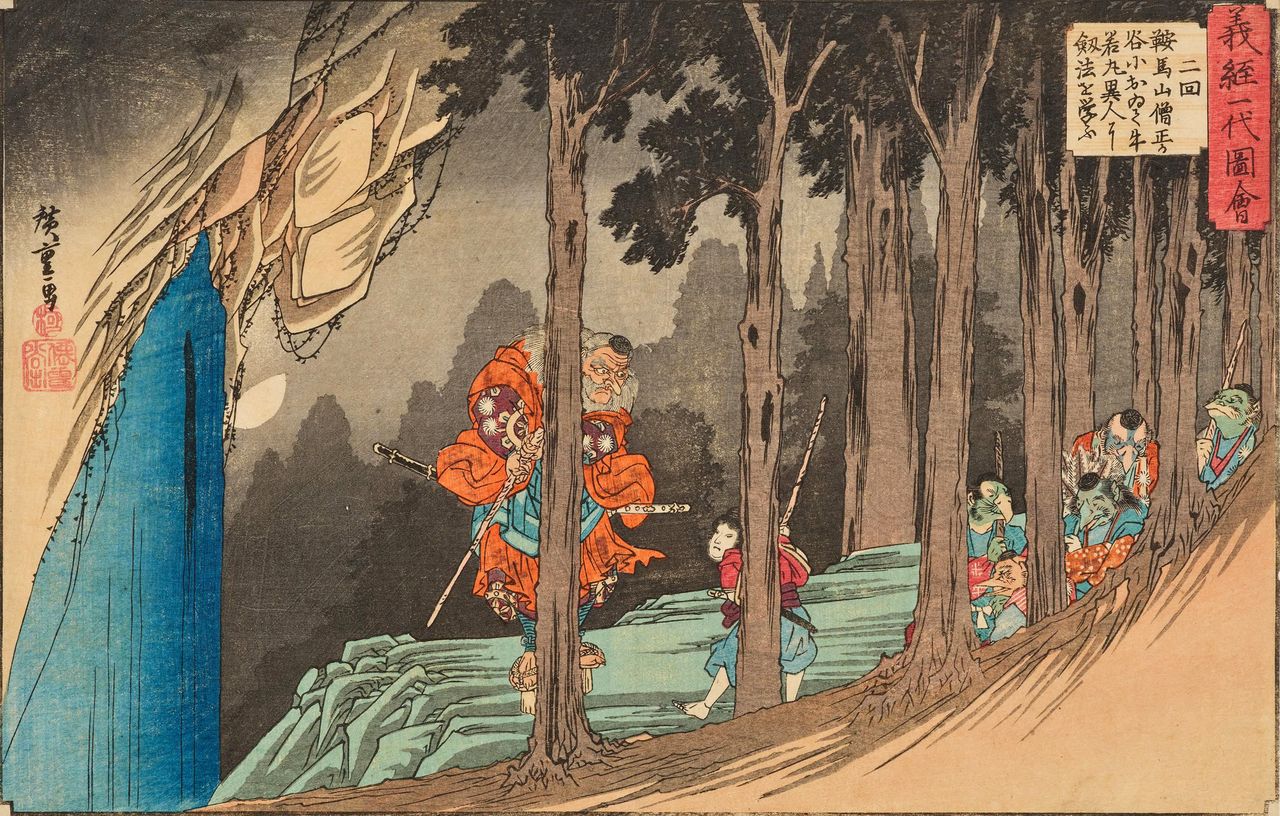
Van Gogh’s Falling Leaves (Les Alyscamps), above (1888, © Kröller-Müller Museum), deliberately excludes the sky and places the row of poplars prominently in the foreground. His treatment of the avenue, making use of the straight vertical lines of the trunks, resembles a compositional approach favored by the ukiyo-e artist Utagawa Hiroshige, below, whose similar composition can be found in Yoshitsune ichidai zue (Illustrated Guide to the Life of Yoshitsune) (c. 1834–35, courtesy ColBase).
Restoring Confidence to Young Japanese
Japonismes 2018 was a major cultural showcase in Paris and elsewhere in France spearheaded by the Japanese government. It featured early artists like Itō Jakuchū (1716–1800) and works from the seventeenth century Rinpa school of painting, as well as imports from the late nineteenth century through to modern works of manga, literature, and contemporary art. It put a huge variety of Japanese cultural works on display, but none of this had anything to do with “Japonisme.” That is simply because no French or other European artists were involved in the creation of those works.
It remains a mystery why the sponsors chose that name, rather than built off the one so often used by the government, Cool Japan. I suppose it was the government mistaking the Japonisme movement as something Japan itself led . . . or perhaps someone just found it cool.
However, before this project came to fruition, one Japanese actor who was involved with it asked me whether I would also take part, framing his request in terms of his hope that “the story of Japonisme could be a way to restore confidence to Japan’s young people.” I could certainly see how the broad idea of Japonisme could lead to straightforward, albeit misguided, conclusions, focusing on sentiments like “It shows the greatness of Japanese culture” or “It’s gratifying to see how people loved Japan.” Indeed, it would be a huge undertaking to correct these mistakes.
To reiterate, the Japonisme phenomenon did not come about because of Japan’s cultural greatness, but because it offered Westerners a chance at transforming their expressive style themselves. Japonisme was nothing more than a movement instigated by Westerners after importing a great number of Japanese goods. The Meiji government of the day neither caused it nor intended it to happen.
The Japanese government of the day was far too busy importing Western culture to even consider the idea that Japanese culture had the power to change the West. The goods sent to World’s Fairs and similar events were misguided failures, appearing as cheap imitations to Westerners who had already seen the art of Edo period (1603–1868) Japan. The semigovernmental export companies formed to handle those goods, like the Kiryū Manufacturing and Trading Company formed to export art, all met their ends in short order.
Trillions of Yen in Content Creation
In the twenty-first century, the West saw a rise in subcultures devoted to Japanese anime, manga, fashion, and music. These products were exported in huge amounts and came to play a vital role in foreign trade. The government set up the Cool Japan project with the goal of expanding the content creation industry to the scale of ¥20 trillion by 2033.
However, this massive consumption of Japanese-made subcultural products has not inspired a level of groundbreaking creativity in Westerners like nineteenth century Japonisme did. In other words, what we are seeing is a “second Japan fad” with mass consumption by Westerners of Japanese products, without any new culture yet. And yet, this fad still seems to be attracting the epithet “Neo-Japonisme.”
The term Japonisme was coined in 1872 by the French art critic Philippe Burty, but at the time it simply meant “Japan fad.” It was a general term for people who enjoyed having Japanese art around them, or artists who mimicked the styles and adopted some of the motifs, as well as others who grasped the principles of Japanese art and used them in their own creation.
Eventually, research into Impressionism and Post-Impressionism showed how artists, especially French artists, used Japanese artistic concepts in developing art in new, original ways, and Japonisme became a term applied to the creative work of Western artists.
So, again, Japonisme was not a Japanese project, but rather a creative process born when Western artists absorbed Japanese art and used it in their own work. Because France was the center of that trend, we use here the French term, but English and German had their own versions. Still, scholars outside the French-speaking world have come to adopt the French form, and it has become the global standard.
French Theories on Neo-Japonisme
Leaving the Japanese government’s own misunderstanding aside, while the term Japonisme sees little discussion, it is also by-and-large misunderstood by the public at large. This is exactly why terms like the previously mentioned Neo-Japonisme emerge to describe ill-defined phenomena.
One of the first things that turns up for me in an internet search for this word is a Japanese girl idol group, Neo-Japonism. It seems the band formed in 2017, and despite their apparently long career, they remain unknown to me, although I admit I may not be the target audience.
Still, modern French researchers have pointed out a phenomenon they call Néo-japonisme. In 2025, Sophie Basch and Michael Lucken published Le Néo-japonisme 1945–1975, applying the name to Japanese influence after the end of World War II. In this work the scholars analyze how Japanese culture was adopted in creating new culture during this period, which saw influxes of complex cultural information going far beyond anything seen in the Japonisme phase of times past.
Since it has already been 50 years since the end of the period they looked at, their book does not examine modern anima, manga, or video games, but the Néo-japonisme analysis remains a largely effective way to understand Japonisme in its broader contemporary sense. Unlike the nineteenth century phenomenon, the modern iteration sees creators with a much more cosmopolitan identity, including Japanese people with a deep affinity for the West, as well as Japanese people with multiracial backgrounds or long stays overseas, showing their complex cultural background. And, since everyone already knows the background of the original Japonisme wave, it is no longer a simple question of Japanese culture being absorbed by Western observers and creators.
In sum, I would like to emphasize that today’s “Neo-Japonism” of Japanese culture being popular in the West is a different phenomenon from the original Japonisme or the Néo-japonisme of Basch’s and Lucken’s analysis.
Finally, I should mention that the Society for the Study of Japonisme, founded by a handful of scholars in 1979, is now an international research organization with around 270 members from all around the world. Their work takes a firmly history-based approach to investigating the spread of Japonisme around the world.
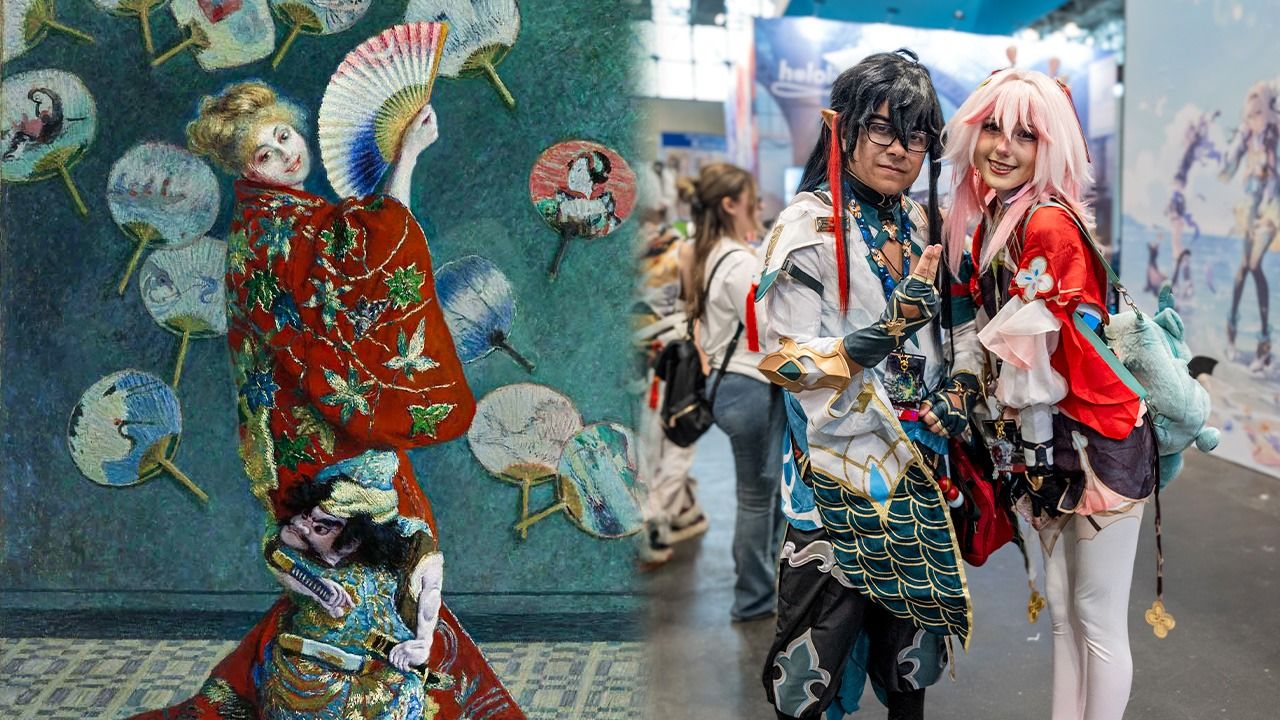
(Originally published in Japanese. Banner photo: La Japonaise [1876] by Claude Monet, at left [© Museum of Fine Arts, Boston], and cosplayers participating in the event Anime NYC in New York, 2025. [© Sipa USA/Reuters].)