The Right to Sports: The Battle with Netflix Over the World Baseball Classic
Sports Society- English
- 日本語
- 简体字
- 繁體字
- Français
- Español
- العربية
- Русский
Skyrocketing Broadcast Fees
In December 2025, Hayakawa Hiroshi, chair of the Japan Commercial Broadcasters Association, discussed live broadcasting of international sports events at a regular press conference. “It gets harder for private broadcasters every year. Broadcasting is essential for sports promotion, but we can’t ignore the question of profitability.”
The Japanese broadcast licensing fee for this year’s World Baseball Classic reportedly jumped to ¥15 billion. While all prices are estimates, the price for the first tournament in 2006, when Samurai Japan took its first championship, was said to be around ¥1 billion, and most recent tournament, in 2023, had risen only as high as ¥3 billion. A 500% increase over just three years is truly an unusual jump.
The last tournament was streamed on Amazon Prime Video, but not on an exclusive license. In Japan, the tournament went out for free on the terrestrial networks of TV Asahi and TBS. In that tournament, Samurai Japan took home the crown thanks to Ohtani Shōhei’s excellent play on the mound and the plate. The final game against the US team, shown on TV Asahi, earned a stratospheric household viewership rating of 42.4% in the Kantō region centered on Tokyo, according to the firm Video Research.
In the past, negotiations for broadcast rights and other marketing issues were handled by Yomiuri Shimbun, which also handled operations of first-round games at Tokyo Dome. This time, though, Netflix bypassed Yomiuri to negotiate directly with the rights holder and take exclusive rights.
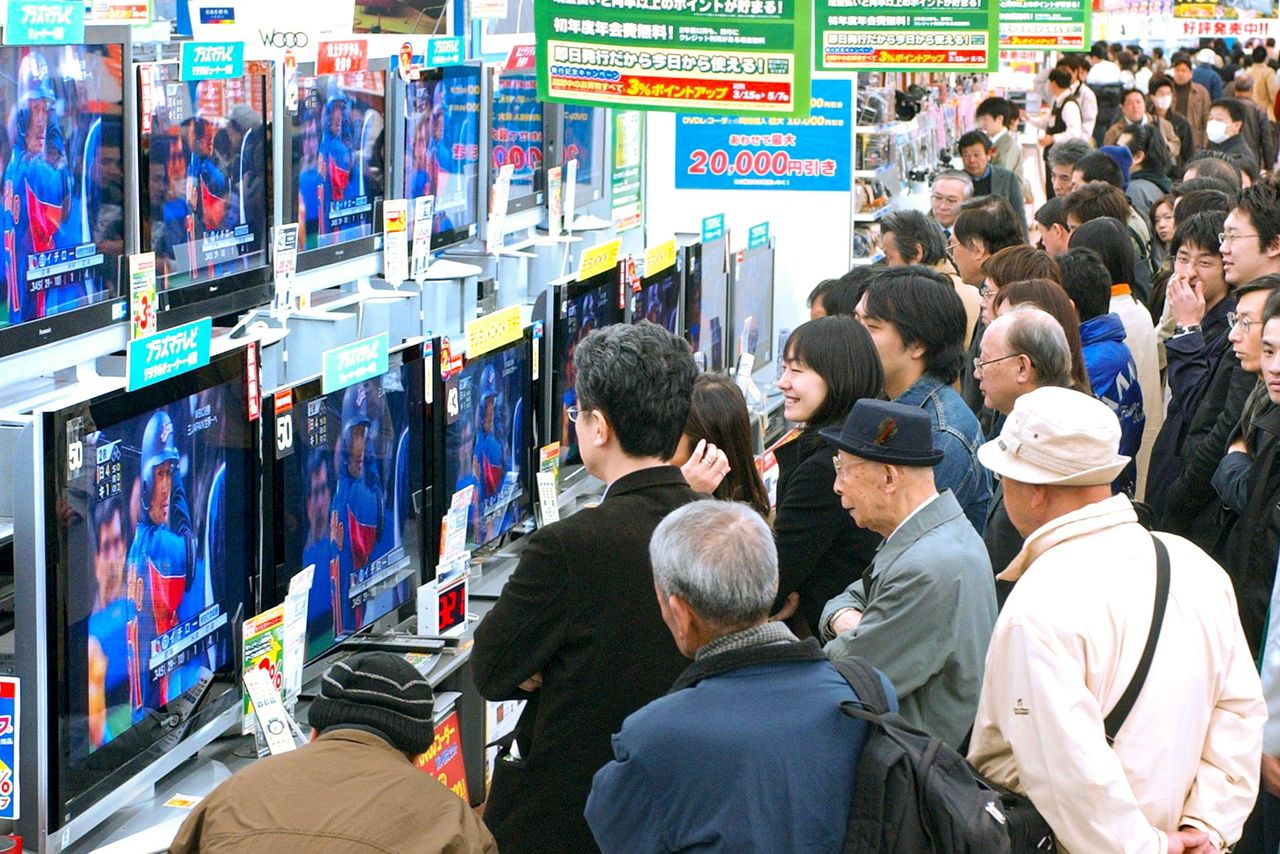
An audience enjoying a live broadcast of the 2006 WBC final match at an electronics retailer in Chiyoda, Tokyo, on March 21, 2006. (© Jiji)
NTV Relegated to Video Production
WBC rights are controlled by World Baseball Classic Inc., an organization made up of representatives from Major League Baseball and the MLB Players Association. In other words, unlike other sports competitions managed by international competitive organizations, the WBC is under the complete control of American professional baseball. And this time, Japanese broadcasters were not even allowed on the field to compete with massive American business interests.
In the United States, Fox was given exclusive broadcasting rights for the second time in a row. In the US market, though, cable television has become the norm, and a large majority of households have paid TV packages including Fox. Paid internet streaming also has a wide audience. Now Japan is dealing with the impact of that.
After a September 2025 meeting of 12 team owners, Nippon Professional Baseball commissioner Sakakibara Sadayuki emphasized the value of offering simultaneous terrestrial broadcasts of the WBC games, arguing that “preserving an environment where fans can watch freely is one of extreme importance to Japanese baseball.”
But in the end, no terrestrial broadcasts took place for the tournament. Pretournament exhibition games between Samurai Japan and the Chūnichi Dragons, Orix Buffaloes, and Hanshin Tigers were broadcast by TBS and TV Asahi, but for the main event, Japanese broadcasters are being forced to work with Netflix on video production and contracts for special pregame programming. NTV is now in the position of “promotion partner” to rouse interest, but all live broadcasts are on Netflix alone. NTV has over 70 years of pro-baseball broadcasting experience, primarily showing Yomiuri Giants games since 1953, but could only manage to get involved as an outsourcer to an America net media company.
At a regular press conference, NTV CEO Fukuda Hiroyuki said, “It might look like we’re only a subcontractor, but given that we’re in charge of video production for baseball games that every eye in Japan will be on, we’re going to do work to be proud of.” Netflix still doesn’t have the skills to produce a live sports broadcast in Japan, goes the thinking; here NTV remains confident that it retains supremacy in this area.
We may soon see the day when existing television broadcasters will be selling their video production skills to net media companies. NTV is looking to that future with this response.
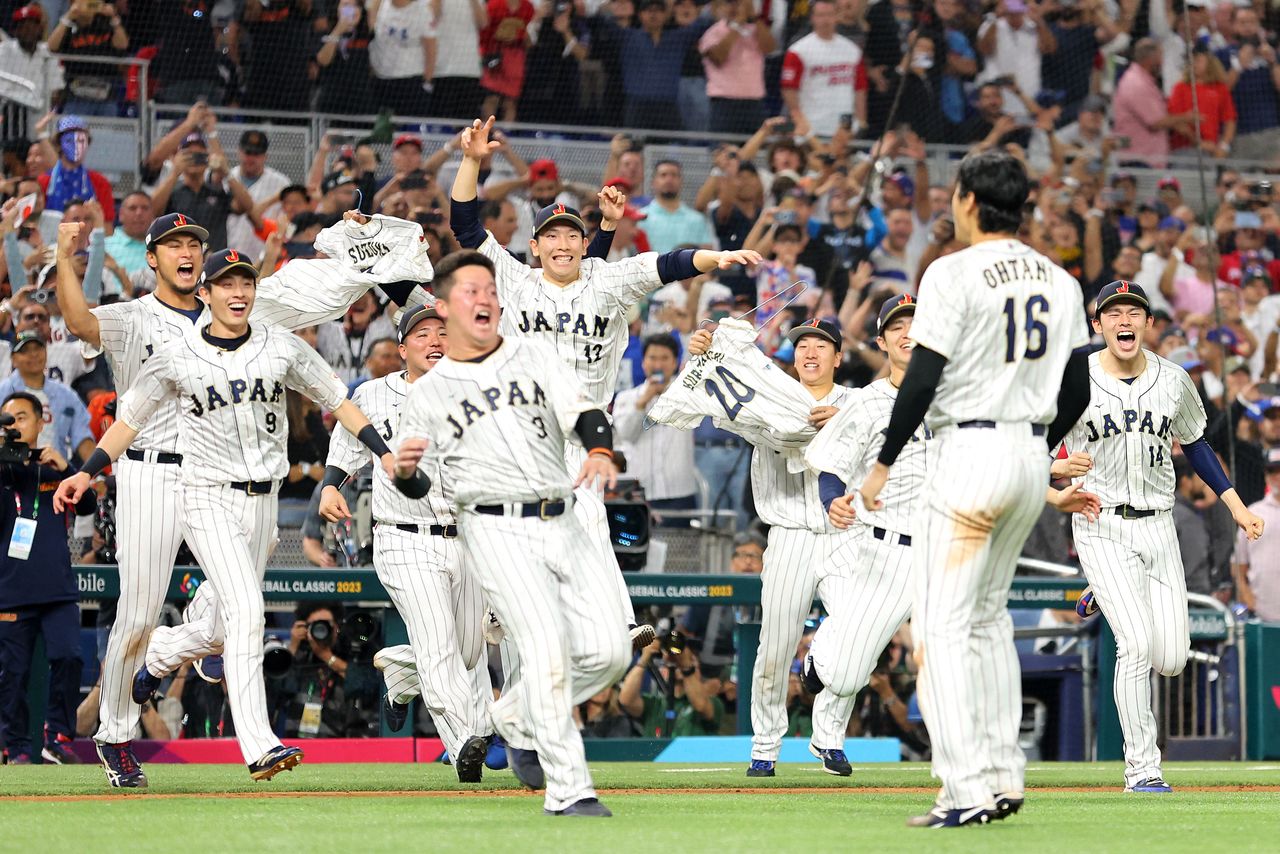
The Japanese team rushing to congratulate Ohtani Shōhei, wearing number 16, after defeating the American team in the 2023 finals held in Miami on March 21. (© Jiji)
Over 10 Million Subscribers in Japan
Netflix started service in Japan in September 2015, just over a decade ago. It gained popularity for its catalog of domestic and international content, and in recent years has begun streaming original Japanese content like Tokyo Swindlers and The Queen of Villains. One of the great advantages of net streaming is that you don’t need to be tied to a TV to watch. You can see it anywhere you have your phone, tablet, or PC.
The company offers several plans: an ad-supported tier for ¥890 a month, a standard tier for ¥1,590, and a high-definition premium tier for ¥2,290. Baseball fans have been pressed to sign up for one of these plans—with new account discounts available for the first month of service—to watch the WBC action. (Those happy with nothing more than audio coverage of the games can tune in to the free radio broadcasts on Nippon Broadcasting System channels.)
In the first half of 2024, Netflix reported it had surpassed 10 million subscribers in Japan. As of last year, the Ministry of Internal Affairs and Communications reported there were a total of 61,287,994 households in Japan. While there is no denying that Netflix is quickly gaining subscribers, this is nowhere fast enough for every household in Japan to watch the WBC. This tournament will surely fail to match the mood of the 2023 event, when huge numbers of Japanese viewers nationwide shared in the excitement.
Fears for the Future of Soccer
The soccer industry has come to view this state of affairs with a sense of crisis. The problem first appeared at the final qualifications for the 2022 World Cup in Qatar. Sports streaming media company DAZN held the broadcast rights for the Asian Qualifiers.
A television station also held rights for terrestrial broadcast of the Japan team’s home games. However, viewers could only watch the away games via DAZN. The final match to decide whether Japan would go to the World Cup ended up being an away game against Australia, so only paid DAZN subscribers were able to watch. At the time, Japan Football Association President Tajima Kōzō commented, “I’m thinking about how to make sure terrestrial broadcast happens, even if we have to pay for it ourselves.” But in the end, there were no free options to watch. Later, Tajima said that the Japanese government should follow the British example, taking legislative action to ensure that sports tournaments of public interest, like the Olympics or the World Cup, not be made exclusive to paid viewership.
In Britain, certain sports and other designated events considered of interest to the public are legally obligated to allow free terrestrial broadcast. These kinds of rules are rooted in the idea of universal access, which positions people’s ability to gain information as a universal human right. The standard for designating an event is based on the breadth and depth of the public interest.
The Japanese broadcasting rights for this year’s soccer World Cup, to be held in Canada, the United States, and Mexico in June, went for somewhere in the ¥30 billion–¥35 billion range (a considerable jump from the estimated ¥18 billion in 2022), with DAZN taking streaming rights. However, after negotiations, NHK, NTV, and Fuji TV were able to acquire terrestrial broadcast rights for important games, including those of the Japanese national side. Japan is still falling behind in preserving the right of universal access, but television stations are managing to hold some ground.
Olympics Preserving Free Broadcast
Among the world’s major events, the Olympics and Paralympics have successfully managed to preserve free terrestrial broadcast access. The recently finished Winter Games in Milano and Cortina were shown in Japan on NHK over terrestrial broadcast and satellite, with free internet streaming on NHK-One and the private service TVer.
This policy of valuing free broadcast has its roots in the Olympic Movement: the desire to foster global exchange and promote peace. The meaning of the Olympics is found in everyone around the world sharing in the emotion and excitement of the competition.
However, in our neighbor South Korea, the paid cable and satellite channel JTBC acquired the domestic live broadcast rights for the Milano Cortina games. Sublicensing negotiations with terrestrial broadcasters broke down, so in the end, only paid subscribers were able to see the events, resulting in a remarkable drop in public interest.
Terrestrial broadcasting has a role in promoting competition that has proved valuable. But there are now sports where terrestrial broadcasts have all but vanished in the shift to net streaming, like boxing in Japan. When that happens, the only people who will share in the competition are far smaller groups of passionate fans ready to spend money to watch.
The sports world in general, not soccer alone, is now starting to fear that this scenario is beginning to unfold. With the dropping birthrate, Japan has already been seeing children turn away from sports. The loss of free terrestrial broadcasting for major events is a problem that will only accelerate the loss of athletes and of sports culture. The baseball industry will need to pay close attention to the impact this year’s exclusive paid streaming of the WBC has going forward.
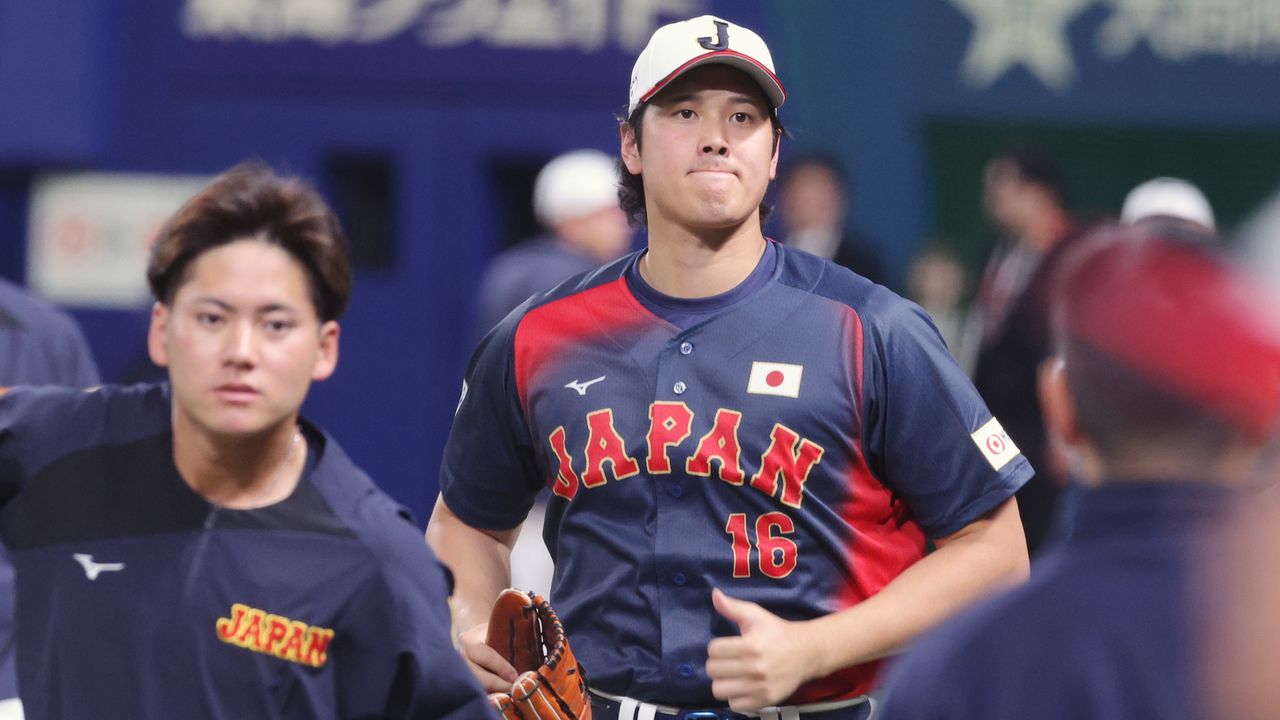
(Originally published in Japanese on March 4, 2026. Banner photo: Ohtani Shōhei during a full-team practice of Samurai Japan at Vantelin Dome Nagoya on February 26, 2026. © Jiji.)