Jidaigeki Revival? The Global Success of “Shōgun” and the Future of Japan’s Period Dramas
Culture Society History Entertainment- English
- 日本語
- 简体字
- 繁體字
- Français
- Español
- العربية
- Русский
How Jidaigeki Came to Be
The global success of the US-produced drama Shōgun—which swept the 2024 Emmy Awards with 18 wins—has sparked renewed interest in Japan’s period-drama genre, known as jidaigeki. At the same time, the independently produced film A Samurai in Time grew from a single-theater release into a nationwide hit through word of mouth. Suddenly, jidaigeki seems to be enjoying a revival.
Today, jidaigeki appears across multiple platforms: stage, film, television, streaming, manga, and anime. For decades, though, the main mediums were TV and film. As production numbers steadily declined in these areas, it prompted the once-thriving genre to be described as entering a “long winter.” To understand this trajectory, it helps to look at how jidaigeki came to be.
In Japan, films, plays, and other dramatic forms have traditionally been divided into two broad categories: jidaigeki (period drama) and gendaigeki (contemporary drama). This distinction has roots in the late nineteenth century, when Japan was rapidly embracing European values, fashions, and institutions. Some former samurai resisted these changes and launched the Freedom and People’s Rights Movement. In 1888, activist theater troupes began staging political plays called sōshi shibai to educate and mobilize the public.
After cinema arrived from the West in 1896, the focus of such plays gradually shifted from politics to popular fiction, giving rise to shinpa—“new school” drama—as opposed to the “old school” (kyūgeki) entertainment of kabuki. New forms of Western-inspired theater, called shingeki, emerged in the early twentieth century. This distinction between premodern and post-Meiji themes was adopted by Japanese cinema as well, evolving, by around 1920, into the categories of jidaigeki and gendaigeki.
Makino Shōzō: The Father of Japanese Cinema
When cinema first reached Japan, it was used mainly for documentary-style recordings of real-life events. Soon, however, filmmakers began capturing kabuki scenes on camera, creating the earliest narrative films and marking the birth of jidaigeki.
The man at the center of this transformation was Makino Shōzō (1878–1929), widely known as “the father of Japanese cinema.”
Makino, proprietor and stage director of the Senbon-za theater in Kyoto, came up with the idea of filming traveling kabuki actors not on artificial sets but in real outdoor locations—taking advantage of Kyoto’s ancient temple grounds, streets, and landscapes. In doing so, he essentially invented the grammar of jidaigeki film production.
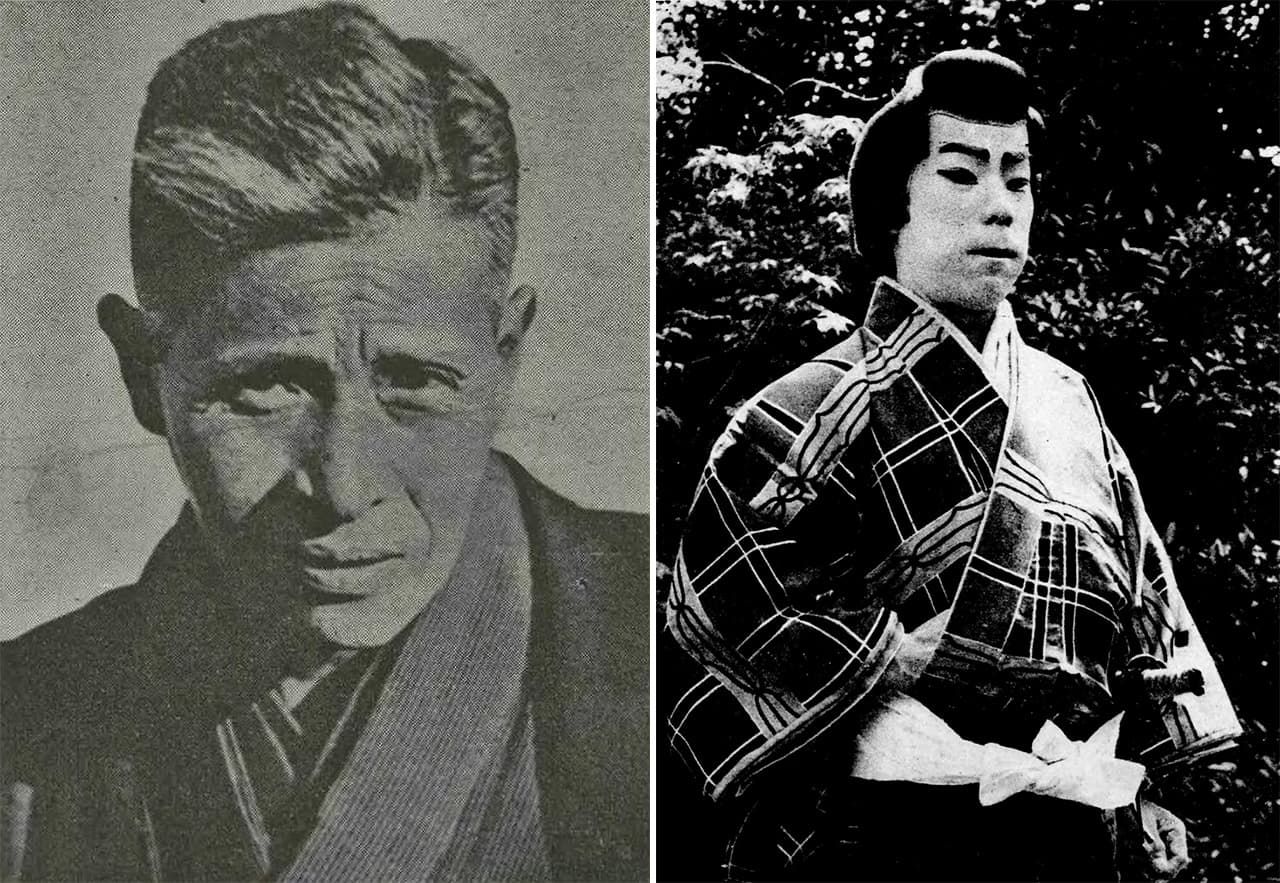
Makino Shōzō, left, and Onoe Matsunosuke (1875–1926), a journeyman stage actor who became Japan’s first movie star through Makino’s films. (Courtesy of the National Diet Library)
The stories Makino told, drawn from beloved kabuki plays and popular folk tales, resonated deeply with ordinary people, who found period settings far more familiar and comforting than the Western-inflected world of contemporary drama.
His choice not to strive for historical accuracy was another carryover from kabuki—which often dramatized contemporary events but set them in the distant past to avoid appearing critical of shogunal authority. Jidaigeki, too, creatively blended contemporary themes and trends—even science fiction or fantasy—into stories set centuries earlier.
My own working definition of jidaigeki is that it is fiction featuring (1) characters wearing topknots and kimono-like clothing, (2) people openly carrying swords and other weapons, and (3) a world where the appearance of demons, ghosts, and ninja feels natural. Within those broad parameters, the genre has always been a playground for imagination.
The Long Winter
Jidaigeki movies reached their peak during Japan’s postwar film boom of the 1950s and early 1960s. But from the mid-1960s onward, as television spread and social values shifted with urbanization and the rise of nuclear family life, audiences drifted away from theaters.
By the 1970s, major film studios were struggling financially, and the expensive studio system—with contracted actors, directors, and craftspeople, along with sets, costumes, wigs, and props—made jidaigeki increasingly difficult to produce. Battle scenes requiring armor, horses, and armies of extras were especially costly.
Television kept the genre alive for a time, with major studios spinning off TV production companies, but even TV jidaigeki began to fade in the 1990s. The genre had entered a long winter.
Cutting Costs with Digital Technology
In recent years, however, production has slowly increased. This includes not only live‑action works but also remakes, manga, and anime. Jidaigeki continues to be produced on a steady, if modest, basis, reaching audiences through newer formats such as streaming services and satellite broadcasts.
Several technological factors underpin this revival: Digital filmmaking and computer-generated imagery have dramatically reduced production costs. Large sets can be composited digitally; crowds can be generated with CGI; and elaborate sword fights and action scenes can be enhanced in postproduction, allowing actors with limited period-drama experience to look genuinely formidable. Shooting digitally also eliminates the cost of wasted film when a take goes wrong.
Advances in production technology, the growth of secondary markets such as physical media releases, the spread of satellite broadcasting, and the rise of streaming and subscription services have gradually opened new avenues for jidaigeki as visual entertainment.
Media mix strategies, where manga or anime adaptations draw in viewers with no previous interest in jidaigeki, are cultivating new fan bases. And when a show like Shōgun dominates the global conversation, curiosity naturally follows. With streaming platforms making these works easy to watch, jidaigeki does seem to have a future.
But Something Is Being Lost
The deeper truth, however, is that the same technologies that appear to be rescuing the genre may also be hollowing out the artisanal skills that long sustained it.
The jidaigeki tradition that Makino Shōzō set in motion and that generations of filmmakers, leading and supporting actors, and craftspeople refined over a century is slowly being lost.
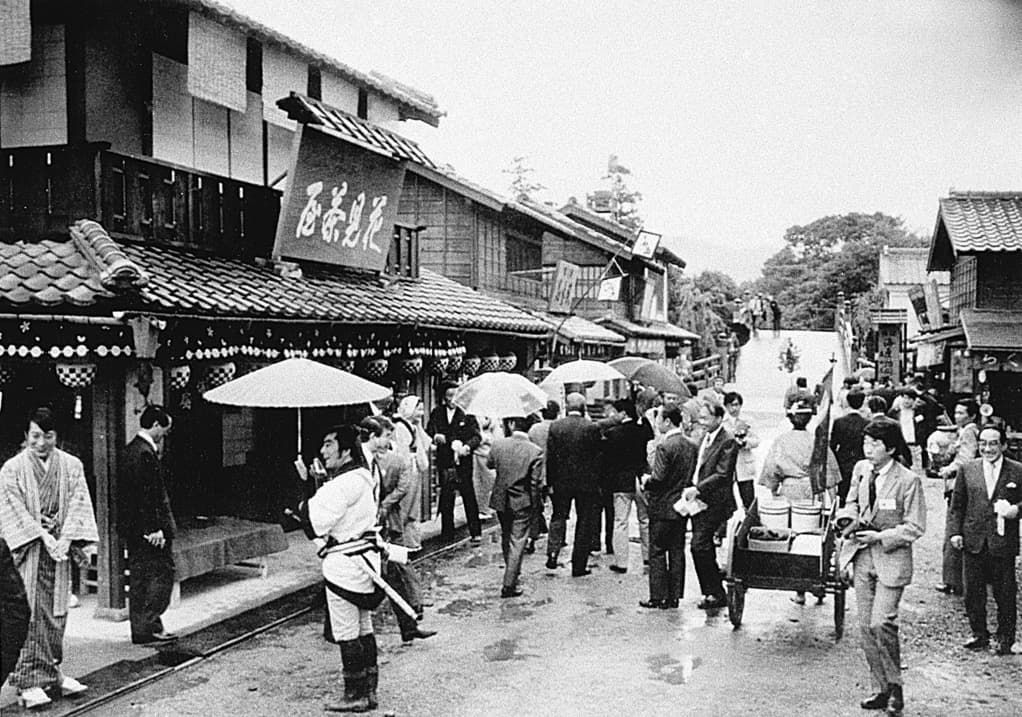
Tōei’s Uzumasa Kyoto Village soon after its opening (as Tōei Kyoto Studio Park) in 1975. The open set continues to serve both as a theme park and as an active filming location for period dramas. (© Kyōdō)
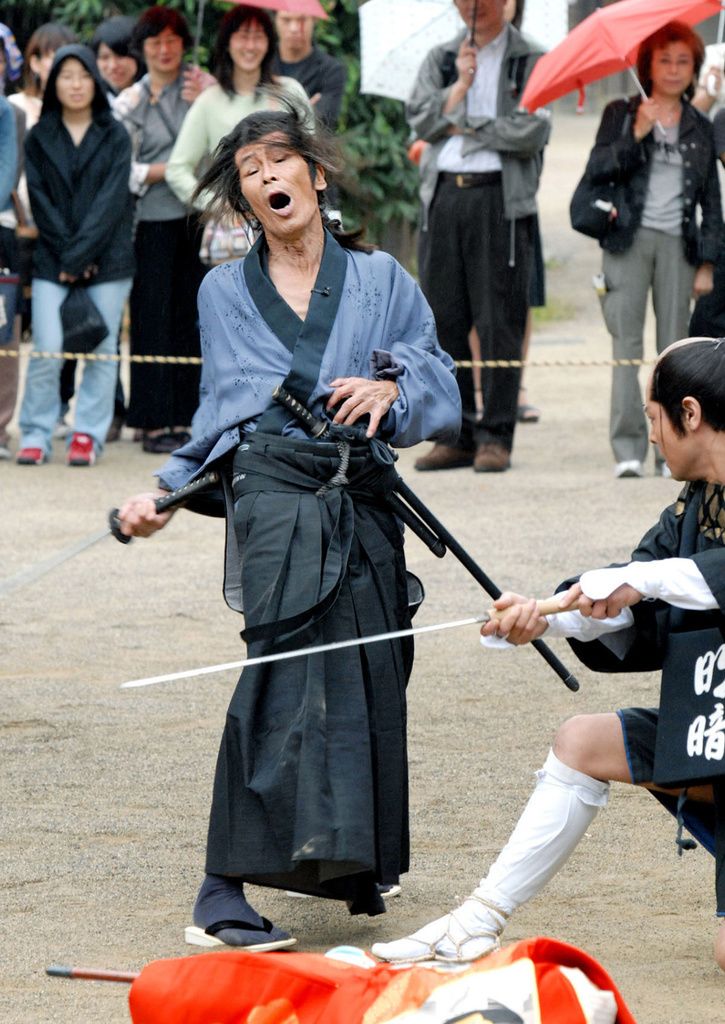
Fukumoto Seizō (1943–2021) performing as a sword-fighting extra at Uzumasa Kyoto Village. After joining Tōei as a contract actor at age 15, he appeared in countless jidaigeki productions—as well as the 2003 Hollywood film The Last Samurai—and became known as “the man who was cut down 50,000 times.” (© Kyōdō)
Period-accurate film sets—castles, daimyō estates, merchant shops, and long-house tenements—were built by hand based on blueprints drawn by the production designer. Costume departments, wig makers, and hairdressers mastered the subtle differences in social class and era. Prop-makers crafted everything from sandals to swords. These were all the work of artisans whose techniques were passed down from one generation to the next.
And then there are the performers. The quality of a fight scene depends on how precisely actors execute the role‑specific movements that define their character. Lightweight bamboo prop swords must be handled in ways that make them look like genuine blades weighing over a kilogram.
A Samurai in Time, mentioned above, follows a samurai from the late Edo period (1603–1868) who time‑travels to a modern film studio and ends up playing the role of someone being cut down in action scenes. The story traces his training in the stylized sword‑fight choreography unique to jidaigeki and his collaboration with the crew to create dynamic, convincing action sequences.
Tools and costumes used in such traditional arts as the tea ceremony, martial arts, nō theater, and classical Japanese dance still enjoy steady demand today. But items like period wigs, large wooden gates, or interiors of traditional Japanese houses are rarely needed outside of film and stage productions. If jidaigeki becomes too dependent on digital shortcuts, the technical know‑how studios have built up over generations may be lost. And if sword‑fight scenes are increasingly assembled in post‑production editing suites, the action risks becoming repetitive and formulaic.
Jidaigeki is, at its heart, a vessel for Japanese cultural memory. Its survival depends on continuous production, which allows traditional techniques to be passed down. When CGI replaces physical crafts, the knowledge embedded in those traditions will quietly disappear.
The commercial possibilities remain vast, as hits like Shōgun demonstrate. But unless more attention is paid to preserving the cultural skills and human infrastructure that have sustained it for more than a century, optimism about the future of jidaigeki is difficult to maintain.
(Originally published in Japanese on March 27, 2026. Banner photo © Pixta.)