
Affordable Despite High Tariffs? Private Rice Imports Spike in Japan
Economy Society- English
- 日本語
- 简体字
- 繁體字
- Français
- Español
- العربية
- Русский
Sharp Increase in Imports
In 1995, Japan made the decision to open up its rice market. Up to that point, there had been very few imports of rice into the country, but under the Uruguay Round Agreement, part of the General Agreement on Tariffs and Trade, Japan agreed to import a “minimum access” quota (currently 770,000 tons of unpolished rice each year) tariff-free.
Minimum access rice is imported and sold centrally by the government in order to minimize its impact on distribution of domestically produced rice. Out of the current 770,000 tons of imports, a maximum of 100,000 tons is allocated for human consumption, which equates to approximately 1.5% of the recent annual demand for staple rice (7 million tons).
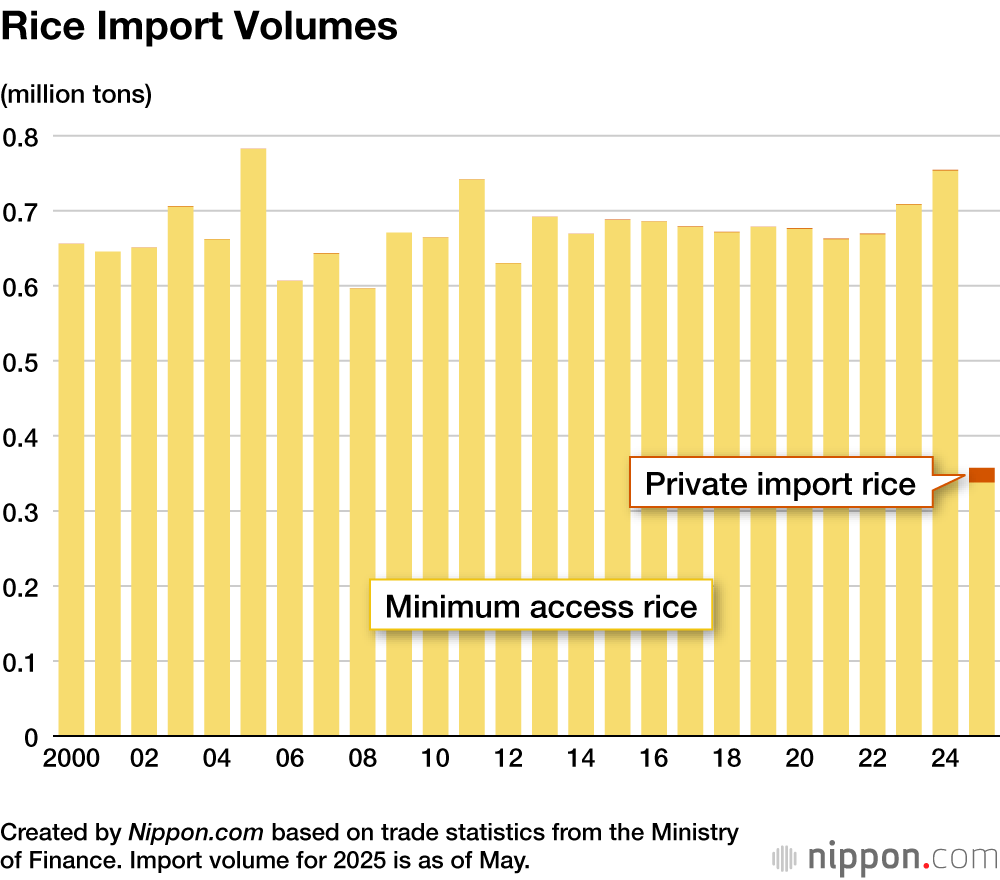
When private companies import rice, they are subject to a high tariff of ¥341 per kilogram. In recent years, these private imports have generally stayed in the range of 600 to 800 tons per year. The graph below shows rice import volumes, with yellow representing minimum access rice and red private imports, which, as can be seen, were such a small amount up to 2024 that they were practically invisible.
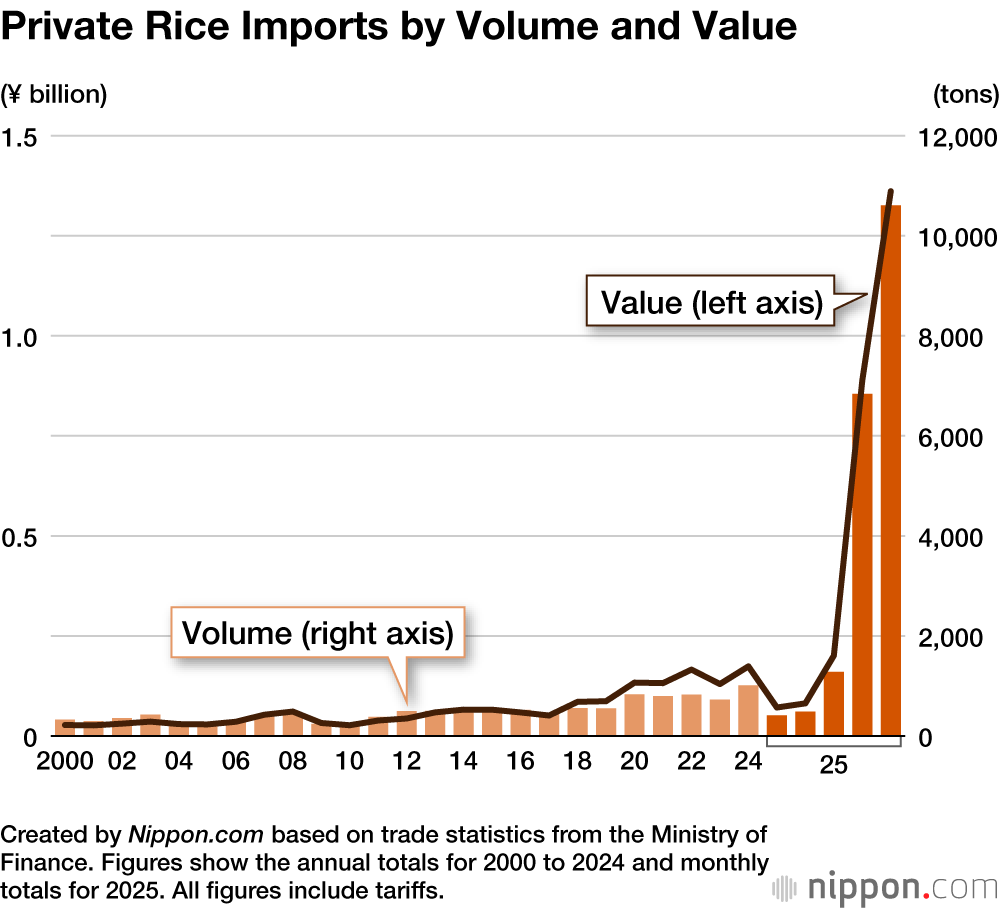
A graph of just the private imports shows a sharp increase since the start of 2025. The 1,280 tons in March exceeded the total of 1,015 tons for the whole of 2024, and this rose to 6,838 tons in April, and then 10,607 tons in May. The soaring price of domestically produced rice makes it seem that foreign rice is cheaper, even when tariffs and other import costs are taken into account. In the past, the majority of foreign rice was imported from Thailand, Vietnam, India, and other Asian countries. However, since the beginning of 2025, the ratio of rice being imported from the United States has been increasing, surpassing 70% in May.
In June, the major retailer Aeon began selling 100% US-grown rice in its stores, mainly in urban areas, while restaurant chains and other establishments are moving forward with using foreign-grown rice, as well as blends of domestic rice with US and other foreign-grown rice.
Data Sources
- Report on imported rice system (Japanese) from the Ministry of Agriculture, Forestry, and Fisheries.
- Report on import and export of rice and rice related products (Japanese) from the Ministry of Agriculture, Forestry, and Fisheries.
- Report on trade statistics by goods (Japanese) from the Ministry of Finance.
(Translated from Japanese. Banner photo: Karoyaka, 100% Californian-grown Calrose rice from the United States, being sold at Aeon on May 13, 2025. © Jiji.)