Absenteeism at Japanese Schools Rises Again
Education Society- English
- 日本語
- 简体字
- 繁體字
- Français
- Español
- العربية
- Русский
Ongoing Rise in Nonattendance
A survey on problematic behavior and nonattendance of schoolchildren by Japan’s Ministry of Education, Culture, Sports, Science, and Technology found that a record 353,970 students refused to attend school for 30 days or more during the 2024 school year. This was an increase of 7,488, or 2.2%, from the previous year and marked the twelfth consecutive annual rise. Compared to a decade earlier, nonattendance has risen 5.5-fold for elementary school students and 2.2-fold for junior high school students.
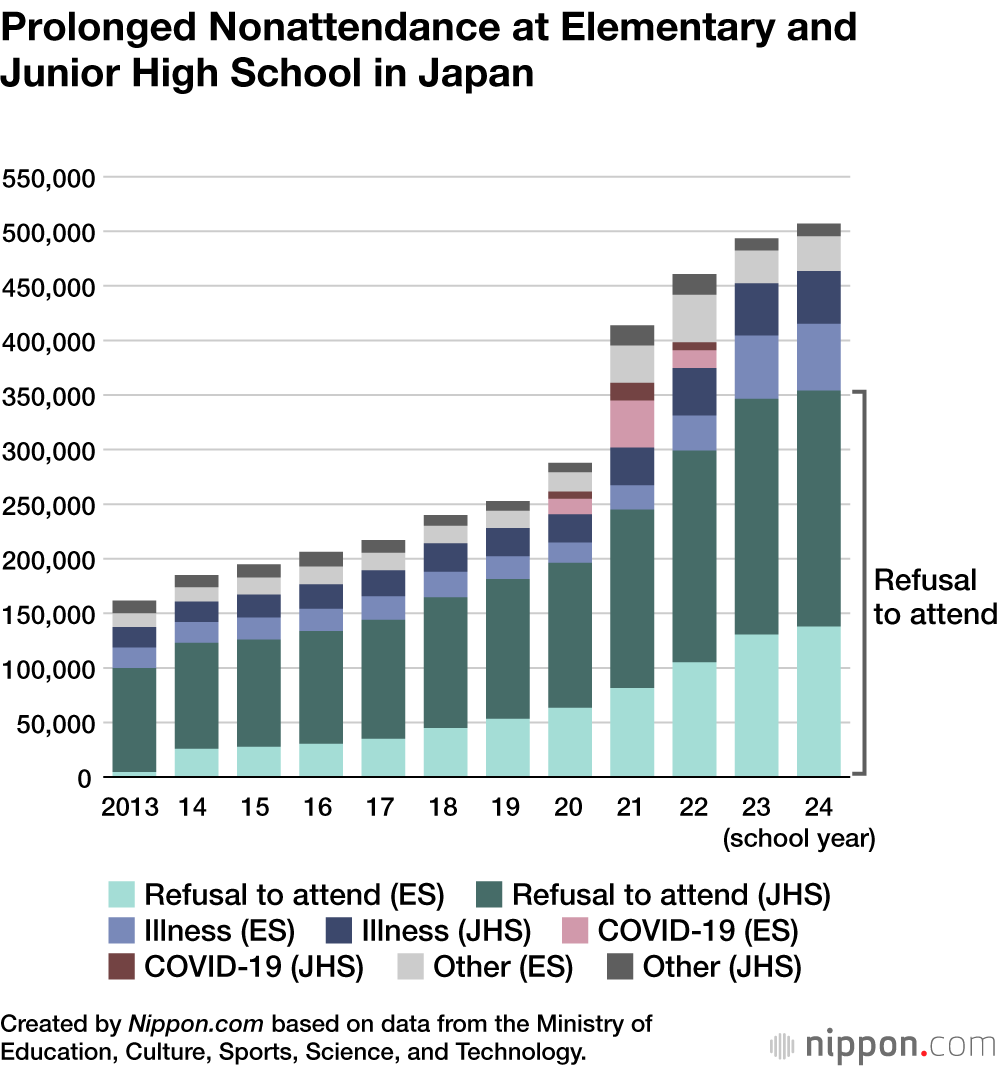
Looking at nonattendance by education level, there were 137,704 elementary school students (up 5.6% from the previous year) and 216,266 junior high school students (up 0.1%), which accounted for 3.9% of enrolled students. The most common causes schools found for nonattendance were “lack of motivation,” at 30.1%, followed by “breakdown in routines” (25.0%), “anxiety or depression” (24.3%), “poor academic performance and regular failure to submit homework” (15.6%), and “friendship issues other than bullying” (13.2%).
The disruption to routines during the COVID-19 pandemic is thought to have lowered the barrier to nonattendance, while parents and guardians have also become more open to it as a necessary form of recuperation.
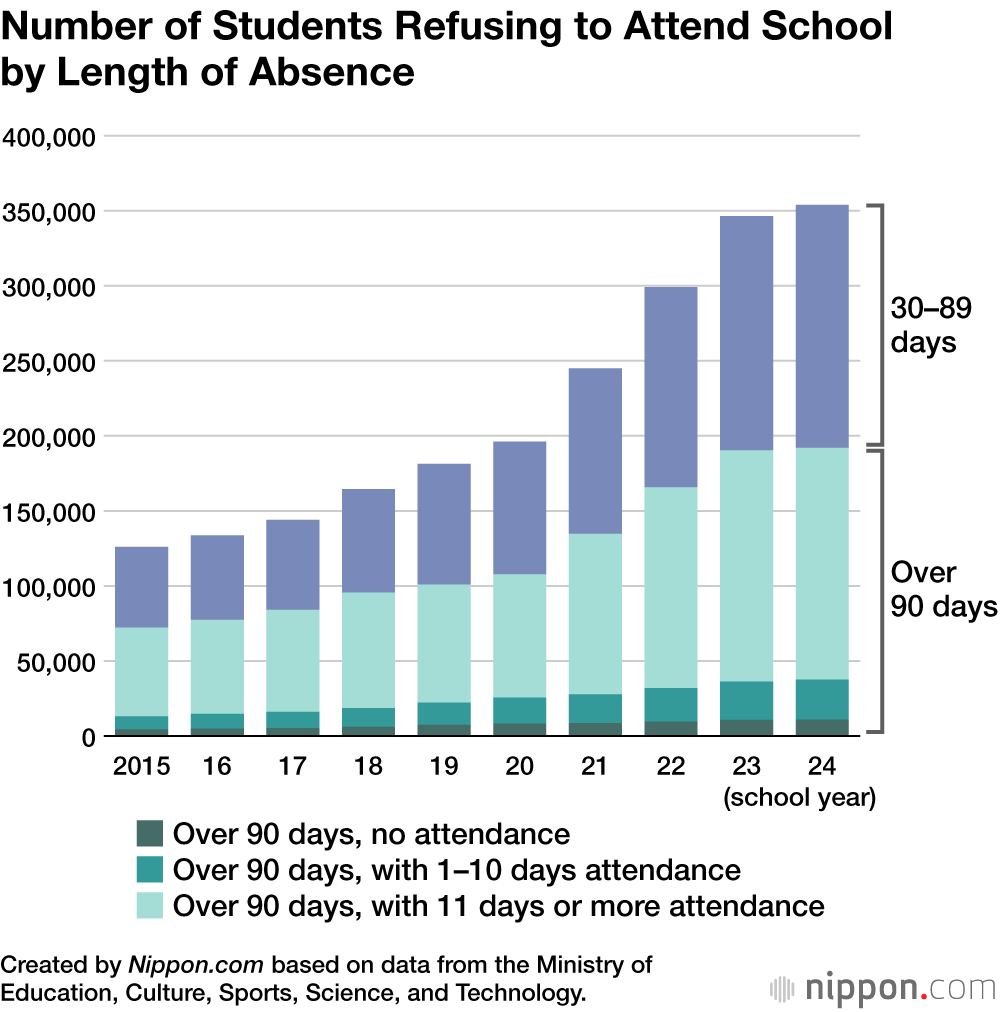
Overall, including both elementary and junior high levels, the ratio of children refusing to attend was 38.6 per 1,000 students. There were 191,958 students who were absent for over 90 days, which at 54.2% accounted for more than half of those refusing to attend school.
Data Sources
- Survey on problematic behavior and nonattendance of schoolchildren (Japanese) from the Ministry of Education, Culture, Sports, Science, and Technology.
(Translated from Japanese. Banner photo © Pixta.)