Iran Conflict: Japan Institute Produces Scenarios Assessing Economic Effects
Economy Politics- English
- 日本語
- 简体字
- 繁體字
- Français
- Español
- العربية
- Русский
Negative Impact on Japan’s Economy Expected
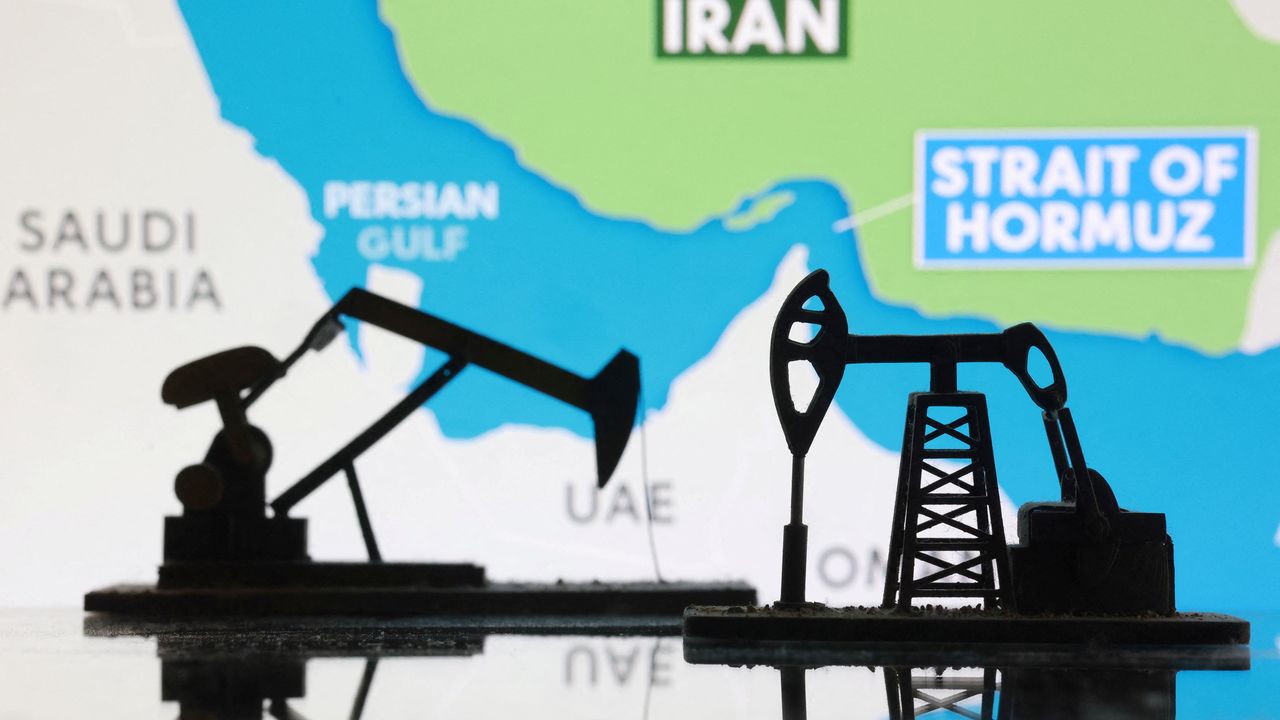
The Strait of Hormuz between Iran and the Arabian Peninsula is just 33 kilometers across at its narrowest point, making it a critical point in the shipment of crude oil and LNG from the Middle East. Japan’s economy, which is heavily reliant on imported oil from countries like Saudi Arabia and the United Arab Emirates, depends on the crucial artery remaining open. However, with Iran effectively closing the strait after military strikes by the United States and Israel, movement of tankers from various countries through the waterway have halted.
Kiuchi Takahide, an executive economist at Nomura Research Institute, has produced three scenarios as to how this situation might affect Japan. The most optimistic scenario assumes a short conflict and marginal impact on the Japanese economy, as was the case following the US and Israeli strikes on Iranian nuclear sites in June 2025, with crude oil prices rising around $10 a barrel.
In his base scenario, Kiuchi predicts a protracted military conflict, leading to increased military risks throughout the Middle East region. However, noting that a complete blockade of the strait would be equally detrimental to the Iranian economy by depriving it of vital revenue from oil exports, he says Iran is likely to commit to an extended disruption to oil shipments but not a full closure of the waterway.
In such a scenario, Kiuchi projects that crude oil prices would rise to $87 a barrel, bringing Japan’s GDP down by 0.18% and raising retail prices by 0.31%. A subsequent rise in fuel and electricity prices would increase the costs of manufacturing and shipping, spurring inflation, which had shown signs of cooling, and negatively impacting the livelihoods of Japanese residents.
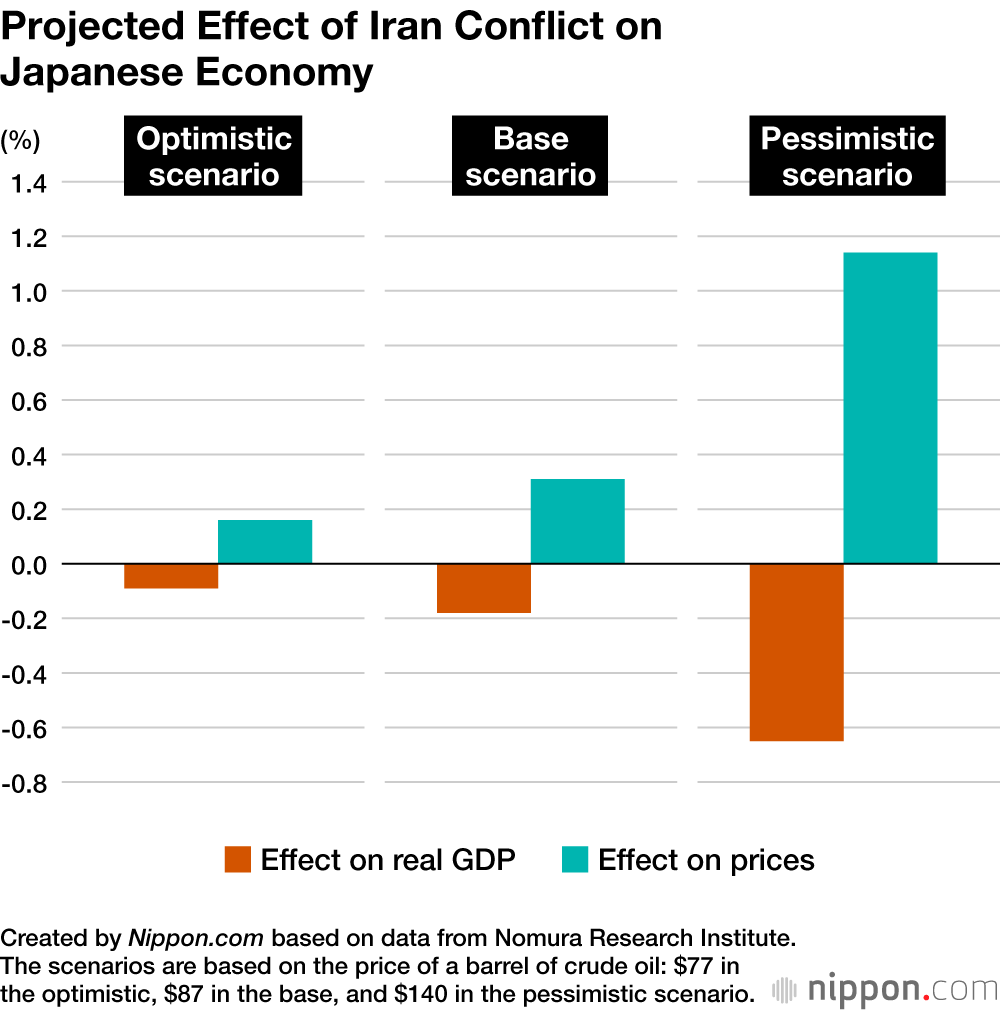
Kiuchi’s pessimistic scenario is based on a situation where anti-American sentiment soars in Iran and the country, accepting the negative consequences to its own economy, completely blocks the Strait of Hormuz for one year. In this worst-case scenario, oil prices would rise to $140, matching the 2008 peak, and Japan would see a heightened risk of stagflation (combining stagnant economic growth with high inflation) leading to recession.
Kiuchi states that with any scenario, “there will be greater need for countermeasures against rising prices,” and expects to see further discussion by the government of reducing the consumption tax and providing refundable tax credits. He also anticipates that the Bank of Japan will be hesitant to further raise interest rates, given the greater downside risks to the economy.
Data Sources
- Scenarios on how raised oil prices due to the Iran conflict could affect the Japanese economy (Japanese) from Nomura Research Institute.
(Translated from Japanese. Banner photo © Reuters.)