
As Japan’s Organized Crime Gangs Decline, Fast-Moving Tokuryū Groups Increase Presence
Society- English
- 日本語
- 简体字
- 繁體字
- Français
- Español
- العربية
- Русский
Membership Falling
A report by Japan’s National Police Agency on organized crime in 2025 showed that the number of members and associate members of designated organized crime groups (bōryokudan) fell by 1,200 from the previous year to 17,600. This is the twenty-first consecutive year that yakuza numbers have decreased, and marks a new record low. The number of fully affiliated members in these syndicates dropped by 500 to 9,400.
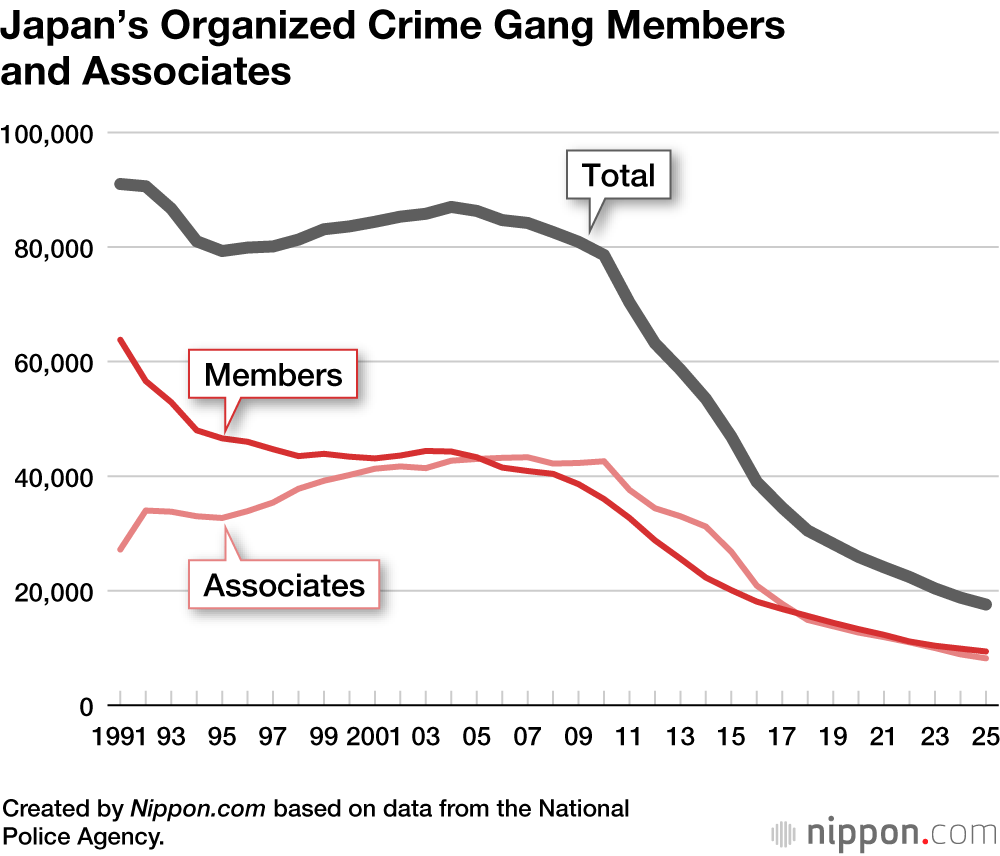
There were more than 80,000 organized crime gang members in Japan as of 2009, but numbers have plummeted in subsequent years. Factors in the decline include the increasing age of members and the spreading enactment of organized crime (bōryokudan) exclusion ordinances by local authorities across the country that have restricted economic and other associations between gangs and ordinary citizens. The membership numbers of the main syndicates as of the end of 2025 are as follows.
2025 Membership of Major Gangs in Japan
- Yamaguchi-gumi
- Members: 3,100 (–200 year on year)
- Associate members: 3,200 (–400)
- Kobe Yamaguchi-gumi
- Members: 110 (–10)
- Associate members: 170 (–30)
- Kizuna-kai
- Members: 50 (-10)
- Associate members: 70 (–10)
- Ikeda-gumi
- Members: 30 (–30)
- Associate members: 40 (–50)
- Sumiyoshi-kai
- Members: 2,100 (unchanged)
- Associate members: 1,100 (unchanged)
- Inagawa-kai
- Members: 1,600 (unchanged)
- Associate members: 1,000 (–100)
Created by Nippon.com based on data from the National Police Agency.
In August 2015, the Kobe Yamaguchi-gumi splintered from the Yamaguchi-gumi, and since 2019, a turf war between the two gangs has seen a series of firearm homicides. A number of prefectural public safety commissions have also identified ongoing rivalry between the Kobe Yamaguchi-gumi and its own breakaway groups, the Ikeda-gumi and Kizuna-kai. However, there was only one incident between the Yamaguchi-gumi and Kobe Yamaguchi-gumi in 2025.
During 2025, the police arrested 7,335 crime gang members and associate members, down 914 year on year. The largest number of arrests, at 1,478, was for violations of the Stimulants Control Act. This was followed by 938 people arrested for bodily injury, 875 for fraud, 617 for theft, 530 for violation of the Cannabis Control Act, and 253 for extortion. There were 53 people arrested for murder, down 26 year on year.
Flexible Criminality
While the power of established crime gangs is diminishing, the activities of tokuryū criminal groups are becoming a major social issue. The name tokuryū derives from the groups’ anonymous (tokumei) and fluid (ryūdō) nature, as they quickly form and disband. These groups recruit perpetrators via social media and job-search websites to perform crimes including “specialized fraud,” carried out online and via telephone, and organized robberies and thefts.
The National Police Agency has found that core tokuryū members include current and former yakuza members, former members of motorcycle gangs, people associated with the adult entertainment industry, and members of foreign gangs, who are working together on an ad hoc basis to establish illegal business models.
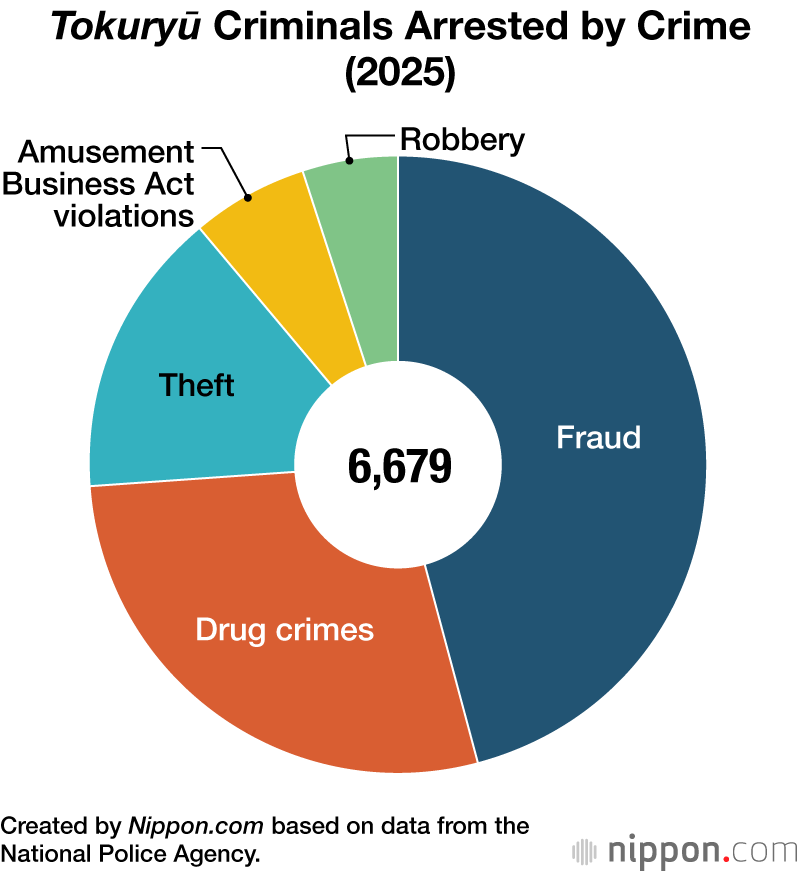
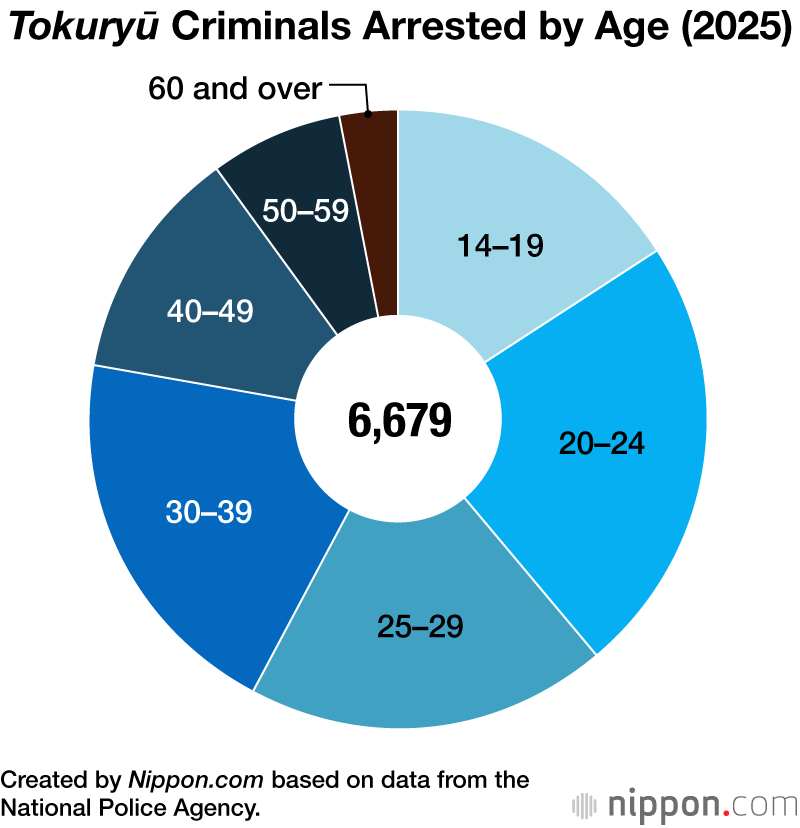
In 2025, 6,679 people thought to be connected with tokuryū groups were arrested, up 1,476 year on year. The charts below show breakdowns by crime category and age group; the gangs mainly raise funds through fraud and drug-related crimes.
Data Sources
- Data on organized crime gangs (Japanese) from the National Police Agency
(Translated from Japanese. Banner photo: Police officers prepare to search the headquarters of the Dōjinkai organized crime gang in Kurume, Fukuoka, on February 6, 2025. © Jiji.)