Number of School Students Requiring Japanese Language Support More than Doubles in 15 Years
Society Education Language- English
- 日本語
- 简体字
- 繁體字
- Français
- Español
- العربية
- Русский
Increase of 15,000 Students in Two Years
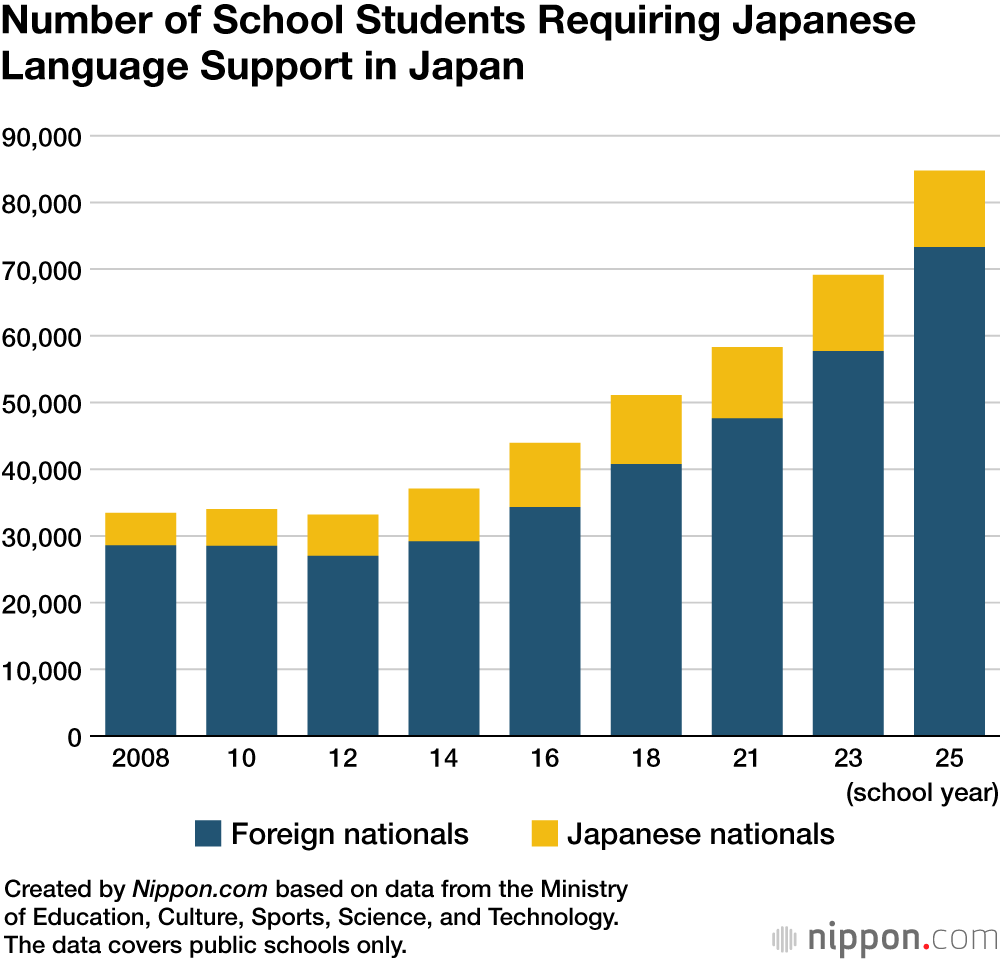
The number of public elementary, junior high, and high school students requiring Japanese language instruction rose to a record high of 84,759 in the 2025 school year. This figure has more than doubled over 15 years, and now around 40% of Japan’s public schools include such students. Some are concentrated in specific areas, while others are scattered across the whole country.
The Ministry of Education, Culture, Sports, Science, and Technology (MEXT) has compiled statistics on such students as of May 1, 2025. The students are defined as having insufficient Japanese proficiency to easily engage in everyday conversation or participate in learning activities at school.
The total increased by 15,636, or 22.6%, compared to the 69,123 students in the 2023 school year. The number of foreign nationals among these students rose by 27.0% during that same period, to 73,313, while the number of Japanese nationals requiring support rose by 0.4% to 11,446. The overall increase is attributed to the expanded intake of foreign workers in Japan, who are addressing labor shortages, and the growing number of family members accompanying these workers.
Regional Breakdown
The regional breakdown of students requiring support shows that many are concentrated in the Tōkai and Southern Kantō regions, where manufacturing and service industries are prominent. Five prefectures in particular accounted for 60% of all the students requiring support. Aichi had the largest number of students, at 15,712, which is a 12.4% increase over the figure in the previous survey. In second place was Kanagawa, with 10,373 students (up 20.8%), followed by Tokyo at 8,409 (up 33.2%), Osaka at 7,920 (up 57.1%), and Saitama at 5,924 (up 35.8%).
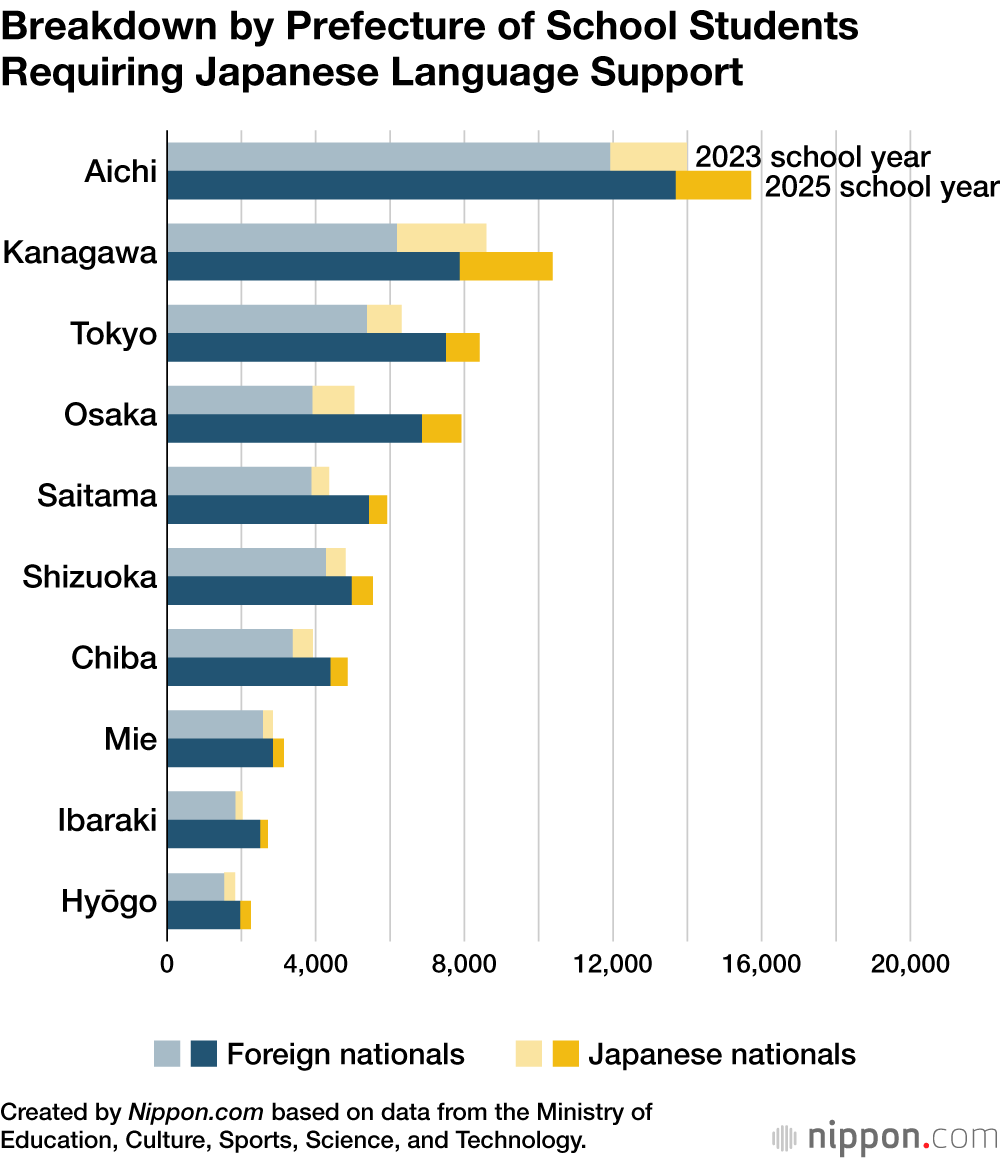
Elsewhere, prefectures with large cities—such as Fukuoka, Kyoto, and Hokkaidō—saw increases of from 40% to 50% in the number of students requiring language support. There were also some prefectures that only had a few dozen such students according to the previous survey that saw increases of 60 to 90%, including Nagasaki, Iwate, and Wakayama. Amid this fluid situation, it has become an urgent nationwide task to secure an adequate number of Japanese language instructors.
Most Schools Have Fewer than 10 Students Requiring Support
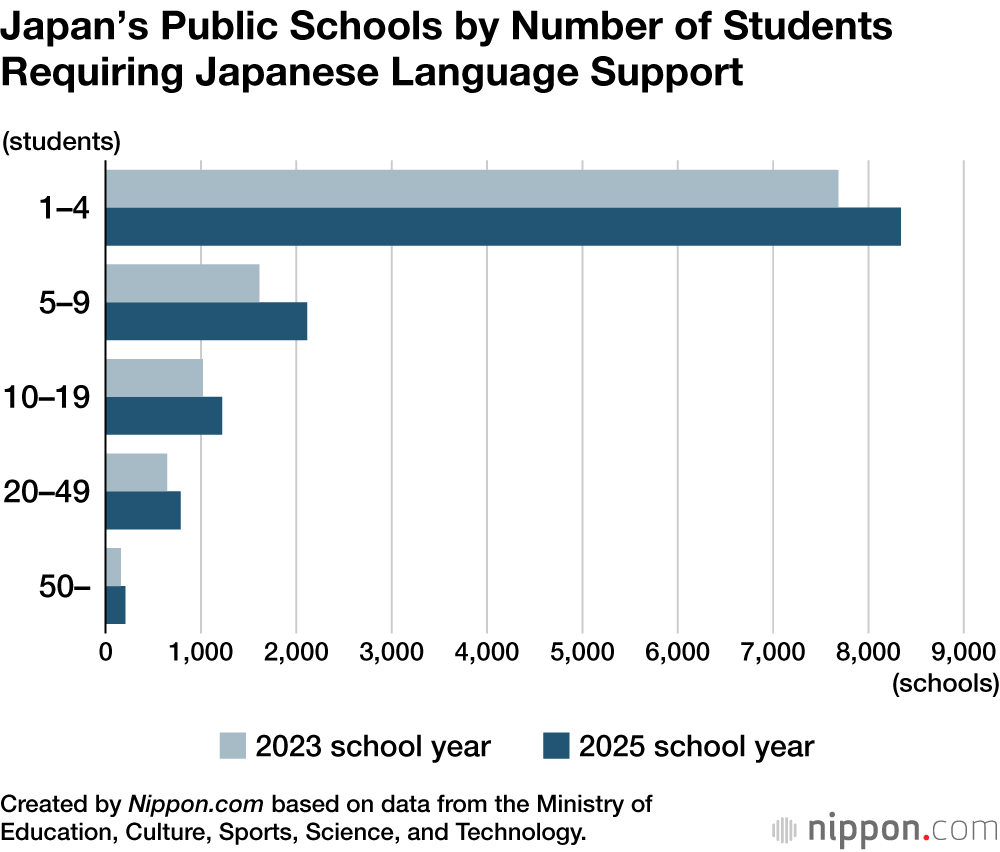
A total of 12,668 public schools (39.4%) had at least one student requiring Japanese language support, an increase of 5.3 percentage points over the previous survey.
By category, 8,339 schools had 1 to 4 students, while 2,113 schools had 5 to 9 students. Overall, 80% of schools with students requiring Japanese language support had fewer than 10 such students. The government allocates one teacher to provide Japanese language support for every 18 students who require instruction. Consequently, schools with only a small number of eligible students often cannot justify assigning a full-time specialist, which shifts the burden to regular teaching staff.
Data Sources
- Data on student numbers requiring Japanese language support (Japanese) from the Ministry of Education, Culture, Sports, Science, and Technology.
(Translated from Japanese. Banner photo © Pixta.)