Rail Congestion Edges Up in Japan, but Far from Pre-Pandemic Levels
Society- English
- 日本語
- 简体字
- 繁體字
- Français
- Español
- العربية
- Русский
Slight Rise in Tokyo
A report from the Ministry of Land, Infrastructure, Transport, and Tourism showed that the rail congestion rate in the Tokyo metropolitan area rose slightly in fiscal 2025, but still remains low compared with before the pandemic.
The average rate of congestion during peak morning hours for the Tokyo, Osaka, and Nagoya metropolitan areas was 143% (up 4 points year on year), 117% (up 1 point), and 126% (no change), respectively. After plunging in fiscal 2020 due to the pandemic, and remaining flat the following year, congestion rates have been rising since fiscal 2022.
The graph below shows the changes in rate of congestion and train capacity for 31 major train lines in the Tokyo metropolitan area. Before the pandemic, the rate was above 160%, but now it is around 20 points lower.
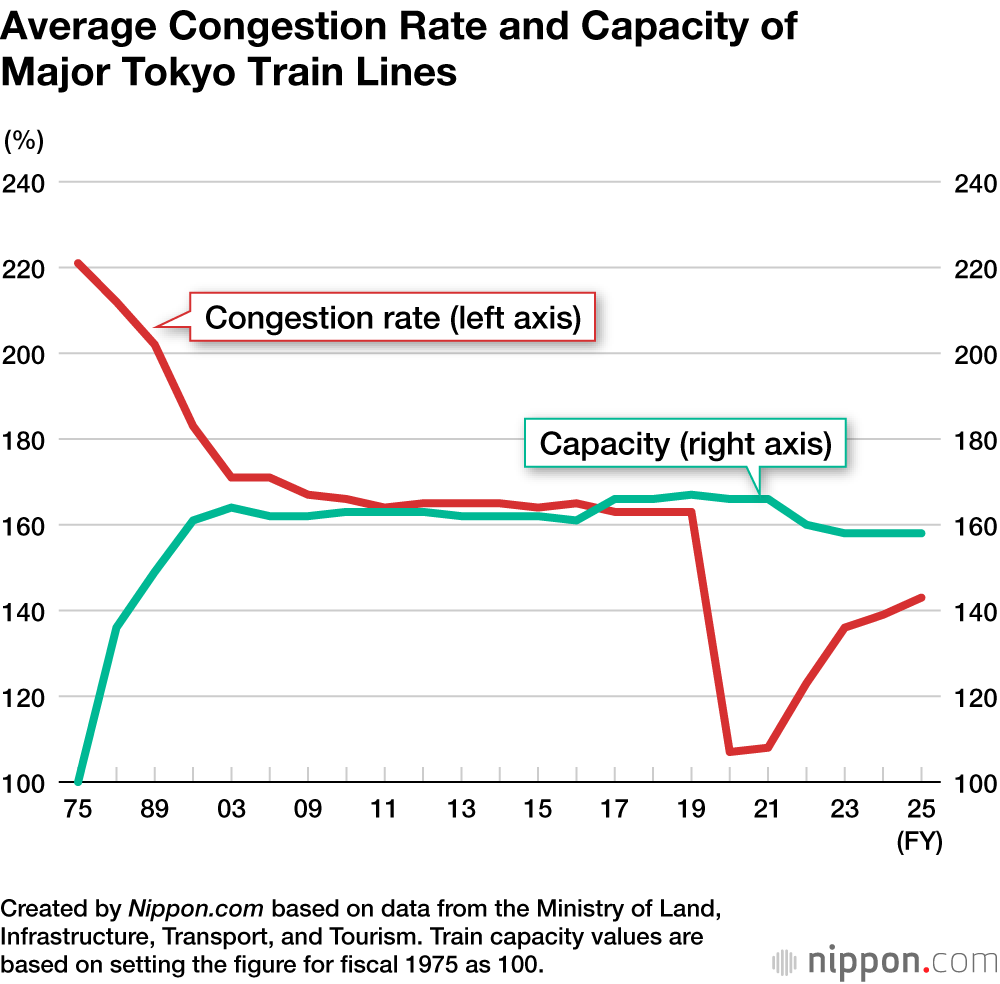
A congestion rate of 143%, or 43% more than the standard capacity, is characterized by a situation where passengers are able to either sit down, hold on to a strap, or hold on to a bar near the train door, but there is almost no direct physical contact with other riders.
On the most crowded lines, congestion rates in the Tokyo metropolitan area prior to the pandemic were close to 200%, a level at which there is considerable body contact and people near the doors are unable to move. However, the congestion rates for such lines in fiscal 2025 were much lower.
Data Sources
- Data on train congestion in fiscal 2025 (Japanese) from the Ministry of Land, Infrastructure, Transport, and Tourism.
(Translated from Japanese. Banner photo © Pixta.)