Typhoons in Japan: September is Peak Season for Damage
Disaster Society Lifestyle- English
- 日本語
- 简体字
- 繁體字
- Français
- Español
- العربية
- Русский
Average Three Make Landfall Each Year
The Japanese term taifū (typhoon) is used to describe a low-pressure, generally cyclonic, system that develops over tropical waters in the Pacific Ocean and then heads toward Japan or other parts of East Asia, with maximum sustained surface winds averaging at least 17 meters per second over a period of 10 minutes. Typhoons are carried by higher altitude winds and have the tendency to head north under the influence of the Earth’s rotation. Many of the typhoons that approach the Japanese archipelago are carried by the prevailing westerly winds in a northeastern direction at high speeds. (The text of this article is based on the Japanese definition of a typhoon, or taifū, rather than the international definition, under which taifū with slower wind speeds are labeled tropical depressions or tropical storms.)
The number of typhoons per year varies, but the annual average for the period from 1951 to 2025 was approximately 26, of which around 3 hit Japan.
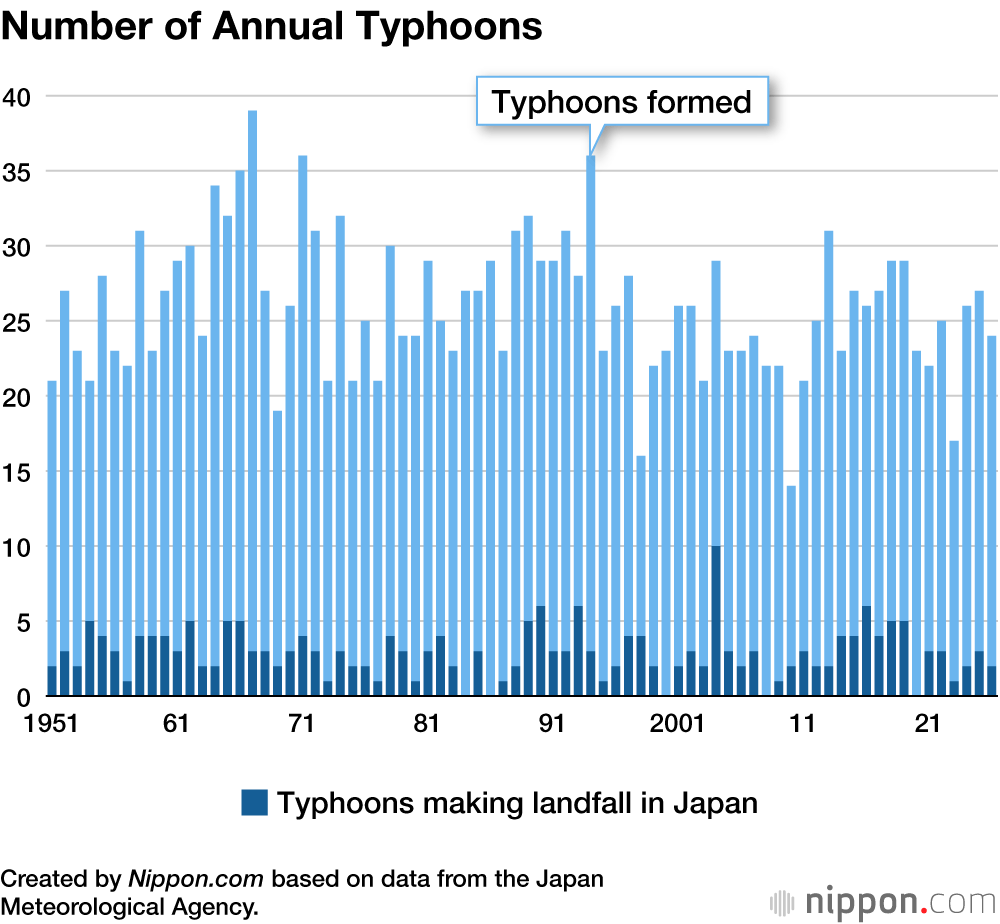
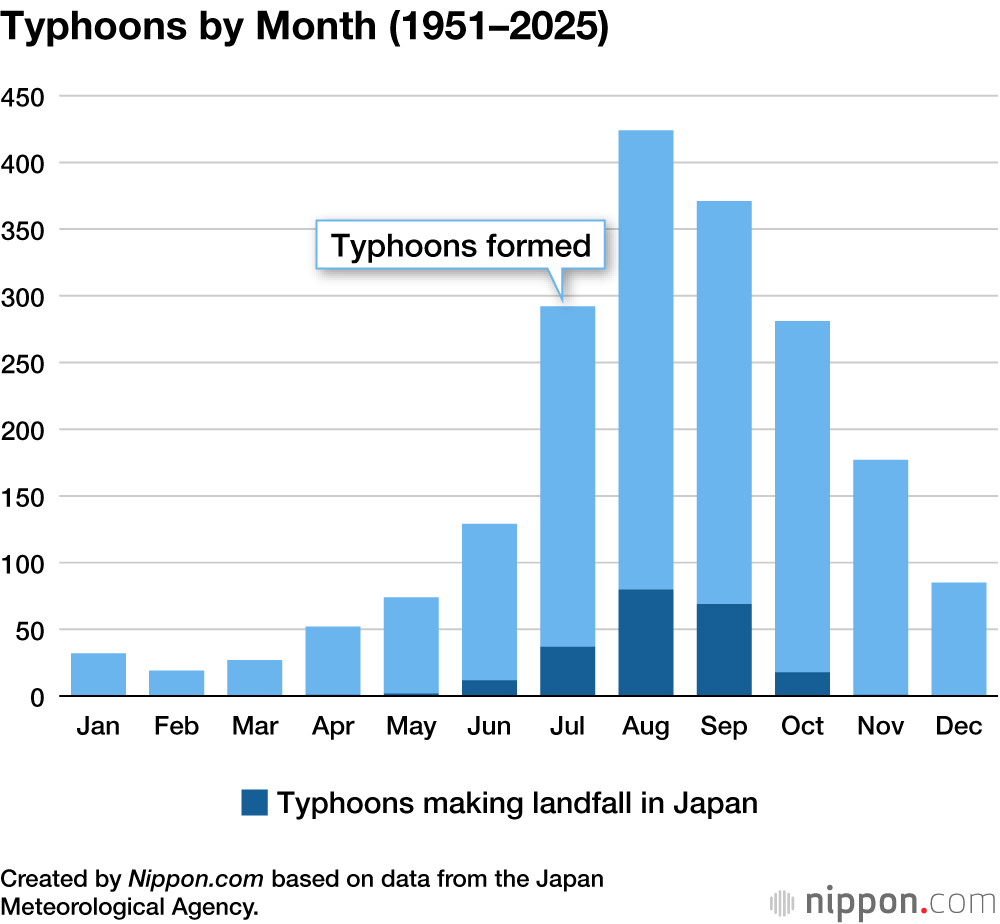
Typhoons’ development is fueled by the energy released when water vapor rising from the warm ocean surface condenses into water droplets within clouds. This is why most typhoons are formed and make landfall in Japan from July to September, when ocean temperatures are higher, and this period is also when flood damage, landslides, and other related disastrous effects are greatest.
In September particularly, there are frequently stationary autumnal rain fronts near the Japanese archipelago, and if moisture-laden air flows into these fronts from a typhoon, it can increase activity and exacerbate damage.
Major storms killed thousands of people as recently as the 1950s in Japan. Motivated by the catastrophic damage of the typhoons and other storms of this era, the Japanese government began to implement nationwide measures that have since mitigated damage from such phenomena as storm surges and flooding.
Major Typhoons in Japan
| Date of Landfall | Fatalities/ |
|---|---|
| *September 21, 1934: Muroto Typhoon | 3,036 |
| *September 17, 1945: Typhoon Ida (Makurazaki Typhoon) | 3,756 |
| *September 15, 1947: Typhoon Kathleen | 1,930 |
| *September 26, 1954: Typhoon Marie (Tōyamaru Typhoon) | 1,761 |
| *September 26, 1958: Typhoon Ida (Kanogawa Typhoon) | 1,269 |
| *September 26, 1959: Typhoon Vera (Isewan Typhoon) | 5,098 |
| *September 19, 1990: Typhoon Flo | 40 |
| *September 27, 1991: Typhoon Mireille | 62 |
| *September 3, 1993: Typhoon Yancy | 48 |
| *September 7, 2004: Typhoon Songda | 46 |
| October 20, 2004: Typhoon Tokage | 98 |
| *September 3, 2011: Severe Tropical Storm Talas | 98 |
| October 16, 2013: Typhoon Wipha | 43 |
| October 12, 2019: Typhoon Hagibis | 110 |
Created by Nippon.com based on data from the Japan Meteorological Agency. Asterisks (*) indicate typhoons that made landfall in September. The JMA highlights storms with total dead and missing exceeding 1,000 for the Shōwa era (1926–89), and exceeding 40 for the Heisei era onward (from 1989).
Data Sources
- Data on typhoons and damage from typhoons (Japanese) from the Japan Meteorological Agency
- Evacuation guidelines (Japanese) from the Cabinet Office
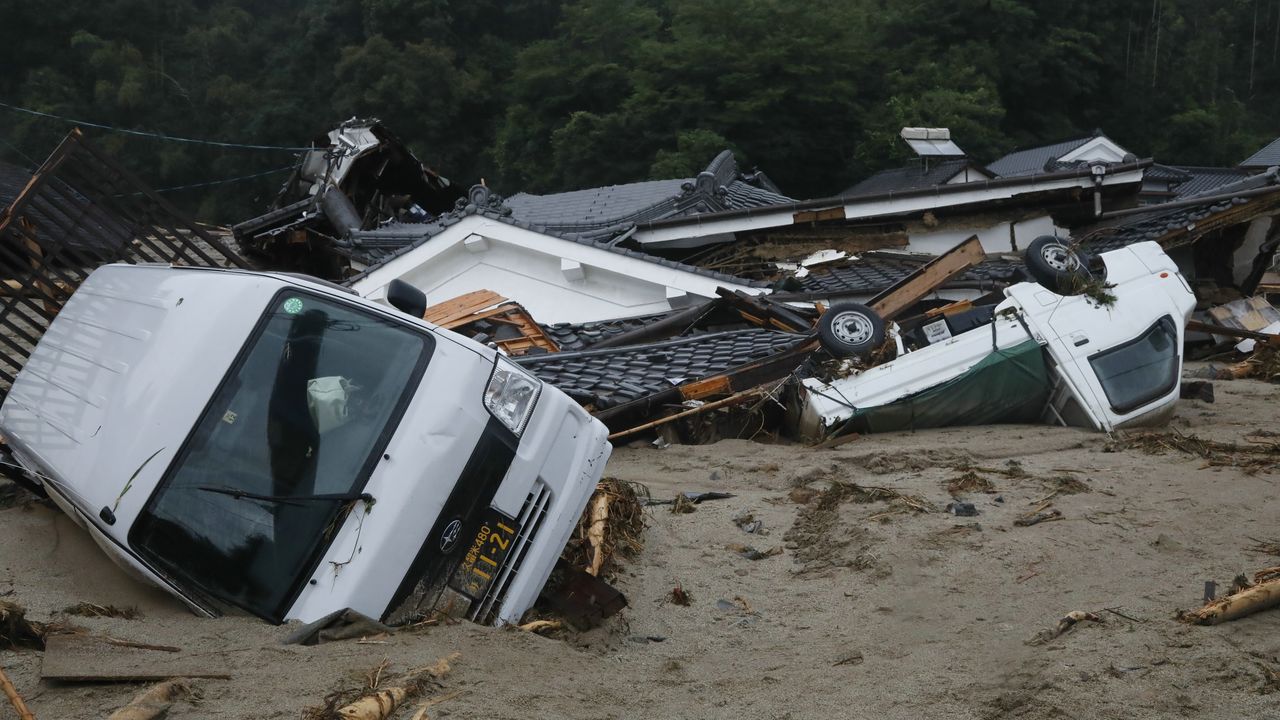
(Translated from Japanese. Banner photo: Buildings destroyed during torrential rain in Asakura, Fukuoka, on July 6, 2017. © Jiji.)