Tanizaki Jun’ichirō: A Writer in Pursuit of Transcendent Beauty
Culture Art History- English
- 日本語
- 简体字
- 繁體字
- Français
- Español
- العربية
- Русский
Among Japan’s modern writers, Tanizaki Jun’ichirō is known for his dedication to the pursuit of beauty and eroticism, and is celebrated for works like “The Tattoo,” Naomi, and The Makioka Sisters. While his early writings are steeped in the Western decadent movement, he later shifted his attention to Japanese traditions and the aesthetics of shadows. At first glance, this seems like a radical change in direction, but Tanizaki was consistent in his desire for an ideal beauty that transcends reality. Here, I will examine the development of his aesthetic sense in three stages: from the early twentieth century until the 1923 Great Kantō Earthquake, from then until World War II, and in the postwar era. At the same time, I will focus on the shared aesthetic sense that remains through those transformations.
Decadent Influence
Tanizaki was born in 1886. While he was a student at Tokyo Imperial University in 1910, his short story “The Tattoo” was published in the Shinshichō literary magazine, although it did not initially draw much attention. The following year, after Tanizaki was unable to pay his tuition fees and dropped out, praise for his works from Nagai Kafū secured his reputation as a literary prodigy; Kafū was the chief editor of the Mita Bungaku literary magazine and a leading figure among those opposed to Naturalism. With the publication of Tanizaki’s first collection The Tattoo, his writing career was off to a strong start.
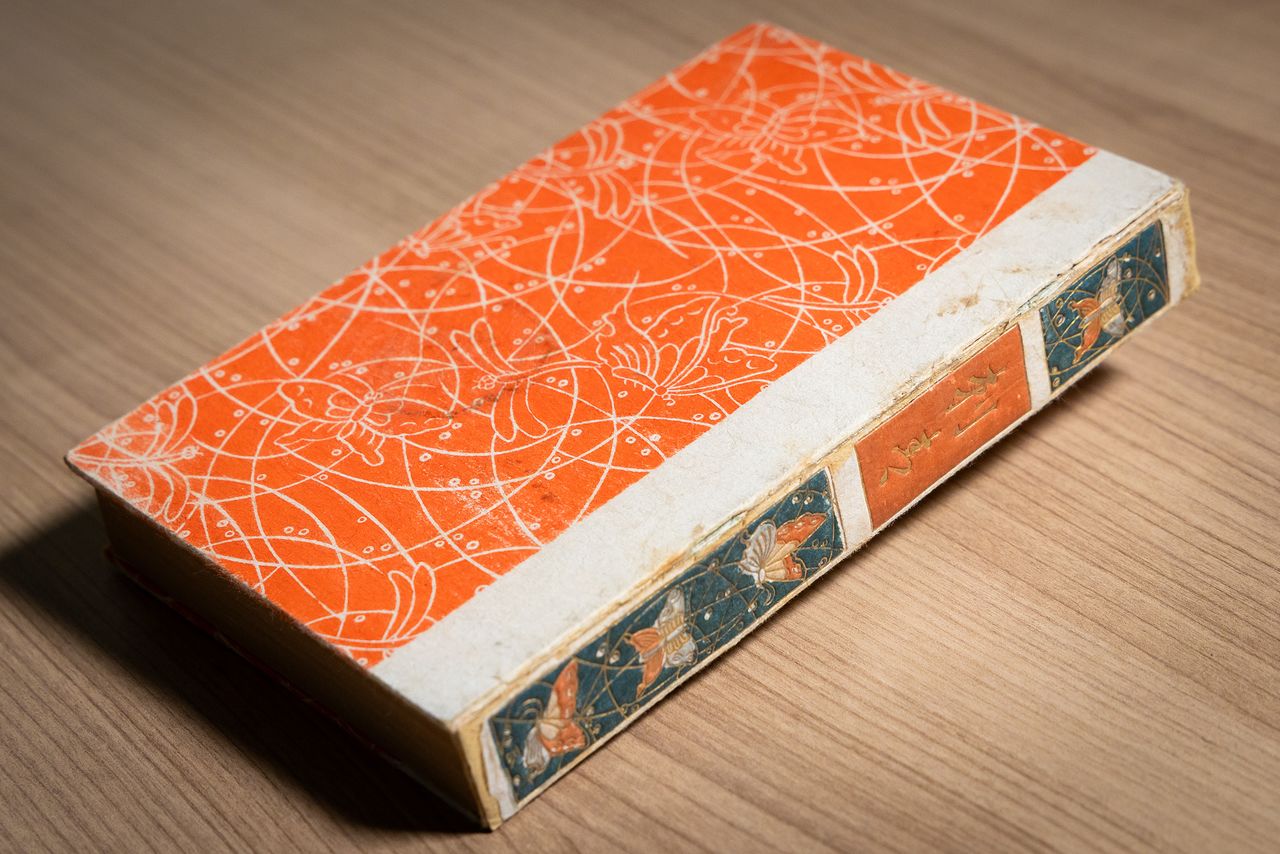
A first edition of The Tattoo, published by Momiyama Shoten in 1911 with a binding by prominent artist Hashiguchi Goyō. (© Yamanaka Takeshi)
In his early work, Tanizaki was heavily influenced by Oscar Wilde and others in Europe’s Decadent literary movement, valuing artificial over natural beauty and sensual pleasure over ethical considerations. His enthusiastic adoption of these values in his works led to it being labeled as diabolism (akumashugi). “The Children” and “The Secret,” published the year after “The Tattoo,” draw on Western studies of sexuality, depicting sensual beauty and desire in a direct manner not previously seen in Japanese literature.
In Tanizaki’s works of this period, rather than presenting women as real people, their bodies and accessories are depicted as visual and sensory objects. “The Tattoo” the main female character is an embodiment of beauty to admire, while the female character in “The Secret” acts to invite the protagonist to an unreal world. Beauty in Tanizaki’s early works is not a part of everyday life, but rather created through extraordinary departures from reality. In the early years of the twentieth century, Tanizaki sees beauty as discovered somewhere transcending the quotidian.
The Silver Screen
At this stage, Tanizaki’s passion for modern culture led him to film. He devoured movie magazines ordered from the United States, and offered his suggestions for establishing the Japanese film industry. At this stage, film was yet to be recognized as an art form in Japan, and Tanizaki played a part in the Pure Film Movement that aimed to change this. In 1920, he became a script consultant for the Taikatsu film studio, and was also involved in production. While his film works are no longer extant, he oversaw his own original scripts, as well as adaptations from writers like Izumi Kyōka and Ueda Akinari.
In the fictions of the silver screen, women never age and are eternally captivating. Movies go beyond reality, making adept use of light and composition to depict idealized figures with an unreal charm. This is in line with Tanizaki’s view of art’s role as not faithfully reproducing reality, but of bringing out the ideal form that lies hidden within, influenced by Plato’s Theory of Forms. His obsession with the ideal woman was deeply connected not only with his writings but also with his own love affairs and marriages.
Rediscovering Japan
The destruction of the Great Kantō Earthquake in 1923 led Tanizaki to leave the Tokyo region for Kansai, where he spent time living in both Kobe and Kyoto. The change in environment prompted a transformation in his sense of beauty. While Kantō was reduced to ashes from the fires that spread after the tremor, old traditions remained vigorous in Kansai. His 1929 novel Some Prefer Nettles, in which bunraku puppet theater is an important element, can be seen as representative of his shift to an appreciation for traditional Japanese aesthetics.
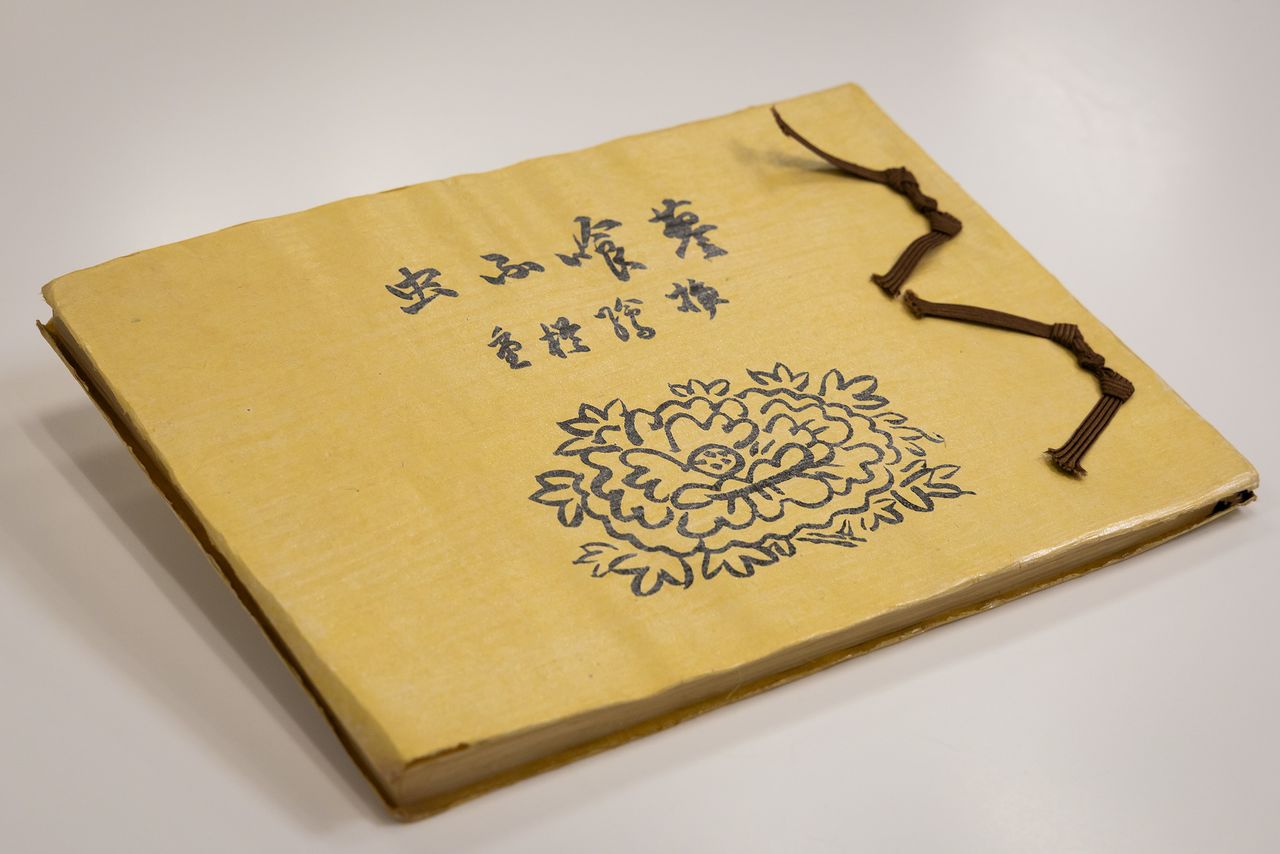
Tanizaki oversaw this deluxe edition of Some Prefer Nettles, published by Sōgensha seven years after the first edition. (© Yamanaka Takeshi)
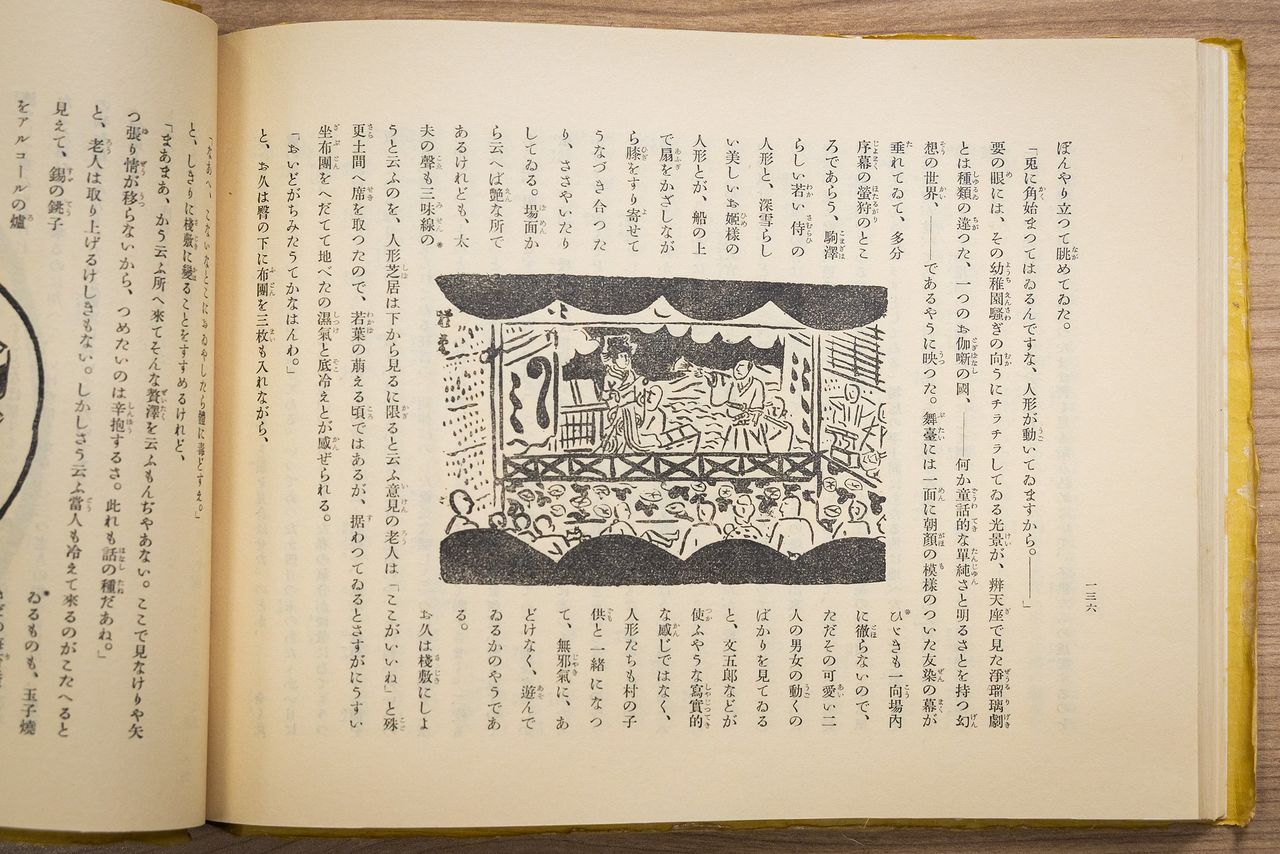
The washi paper is meticulously bound with a side-stitch, and illustrations are by Koide Narashige. (© Yamanaka Takeshi)
Away from the modern urbanized culture of Tokyo, as he encountered Kansai’s customs and traditional culture, Tanizaki’s interest turned to Japanese classic literature and history. From 1935 until shortly before his death, he made three separate translations of The Tale of Genji into modern Japanese, but this would surely not have happened if he had not relocated.
His change in interests can also be seen in his works. He turns from the depiction of modern culture in Naomi (1925) to portraying Japanese sentiments and aesthetics in A Blind Man’s Tale (1931) and The Reed Cutter (1932), set in medieval and modern times, respectively. In From the Life of Shunkin (1933), Tanizaki symbolically presents beauty as transcending reality. When the blind musician Shunkin is scarred by an attack with boiling water, losing her exquisite looks, her disciple Sasuke blinds himself with a needle before meeting with her to forever preserve the memory of her former face.
Tanizaki considered that the beauty of a book lay in more than just the words, and was completed through its form. From the middle of the 1920s, he gave detailed instructions on binding, illustrations, and even printing, turning each book into a work of art.
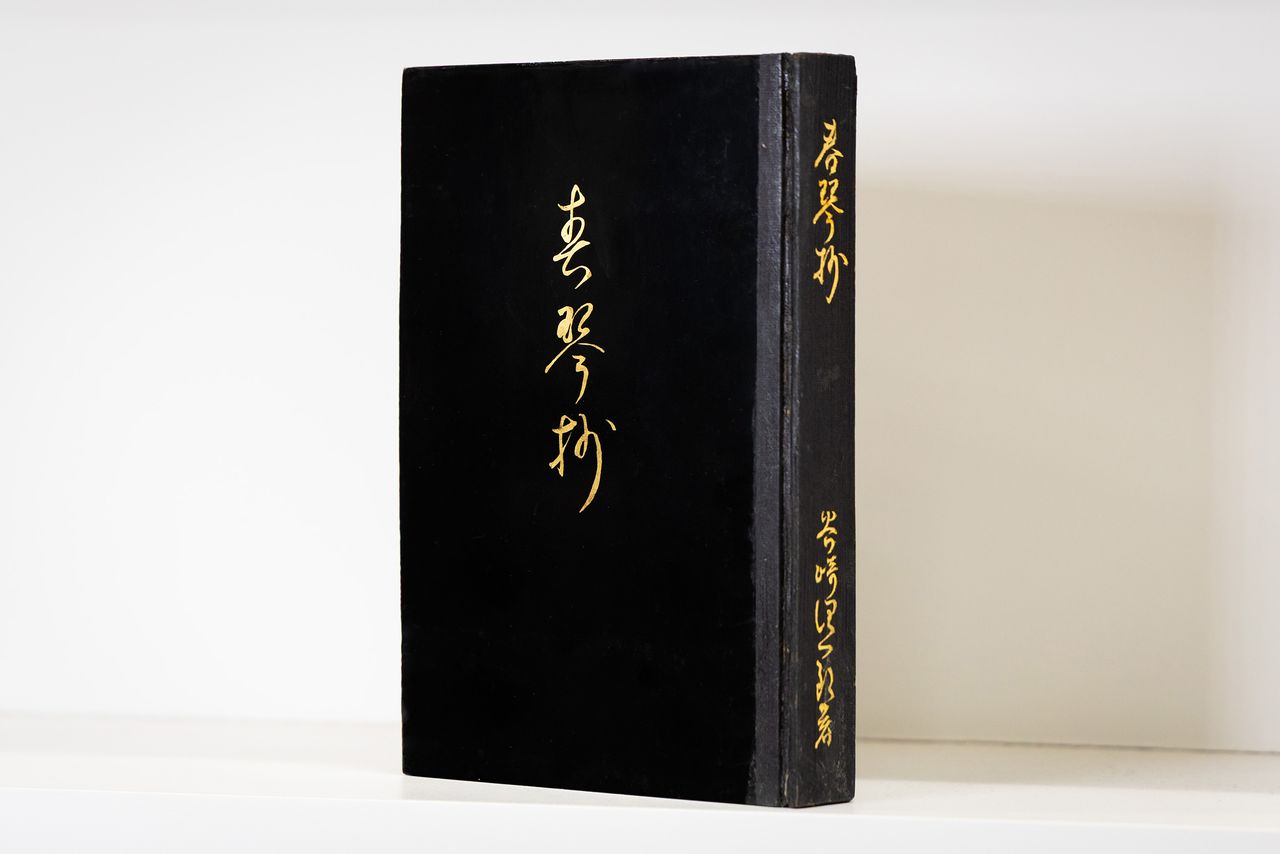
A first edition of From the Life of Shunkin, published by Sōgensha in 1933. Tanizaki had the idea to use a lacquered cover. (© Yamanaka Takeshi)
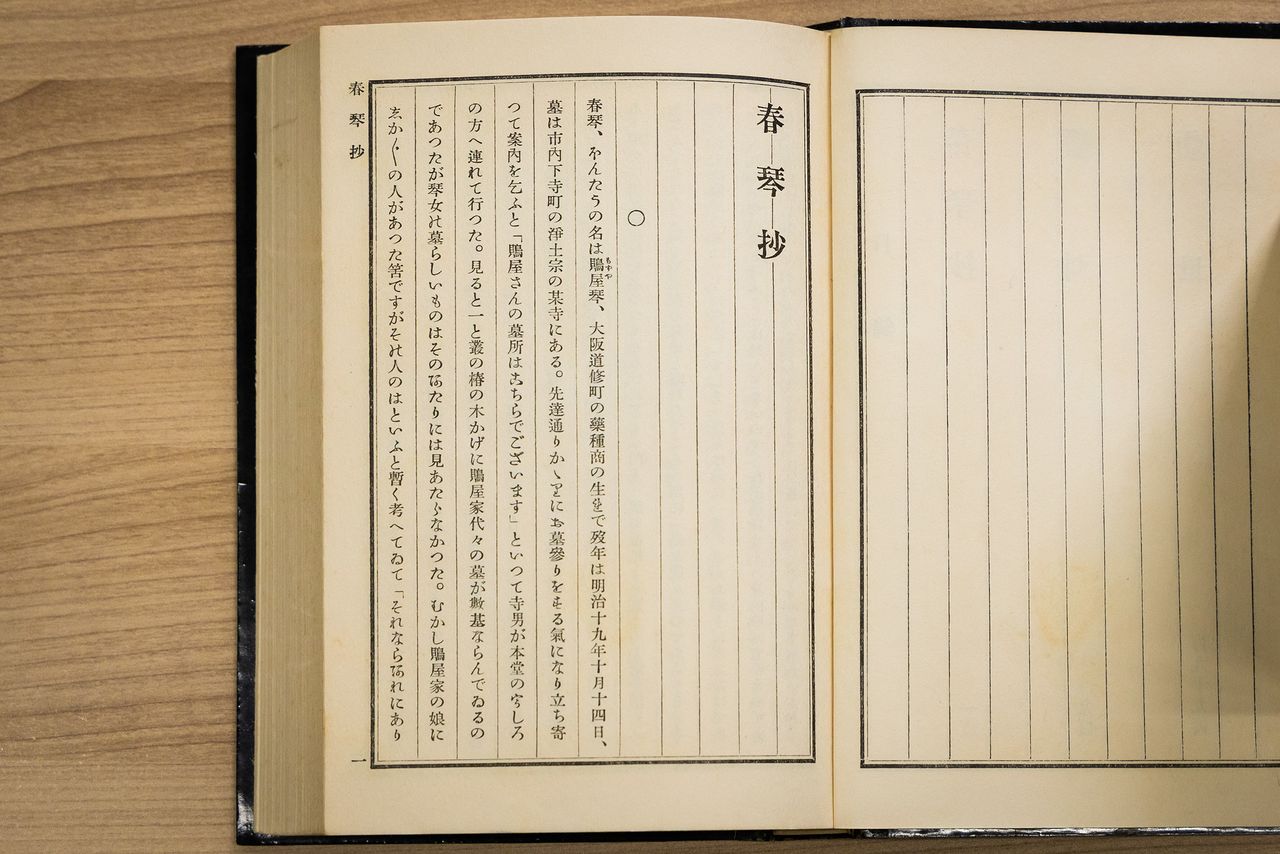
The opening page of the story. (© Yamanaka Takeshi)
In real life too, Tanizaki saw women as both actual individuals and embodiments of ideals of beauty. In a notorious scandal, he reached an agreement with his first wife Ishikawa Chiyo and his close friend Satō Haruo, another author, that she should leave him for Satō; here we see a struggle between his ideals and the reality of human relationships. He was powerfully attracted to Nezu Matsuko, who became his third wife, and she was reflected in his works in an ideal form of womanhood. This refining of reality to feed into his writing was in line with his methods in his early works.
Less Light, More Beauty
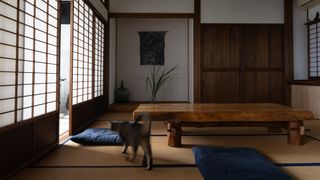
Tanizaki’s In Praise of Shadows, published from 1933 to 1934, makes a forthright case that Japanese beauty reaches its height when appreciated amid shadows, rather than under bright light. Makie gold powder and lacquerware appear dull in strong light, but take on depth and richness in a dimly lit space. In a Japanese room full of shadows, where only a faint glow passes through the shōji (paper screens), that beauty slowly manifests itself. Allowing for partial dimness, instead of bathing everything in light, intensifies aesthetic pleasures.
However, Tanizaki did not discard the West in favor of Japan. It was a stage he passed through on his way to rediscovering what he was looking for in Japanese traditions: beauty achieved by stripping away what is unnecessary from reality, or simply making it difficult to see.
Eroticism and Desire
Tanizaki began the serialization of The Makioka Sisters in 1943, when World War II at its height, but it was banned by military censors, who saw its vibrant storyline as inappropriate to the national mood. It was finally published after the war was over. The novel is centered on the daily lives of four sisters in a long-established Osaka family from 1936 to 1941, as the city loses its traditional culture amid modernization.
After the war, Tanizaki was deeply conscious of his aging, due to problems with high blood pressure and the paralysis of his right hand. However, his desire to create only seemed to grow, as he furthered his pursuit of eroticism and desire. Works like The Key (1956) and Diary of a Mad Old Man (1961) take on themes of aging and sexuality with a bold directness, and their frank sexual depictions caused uproar on initial publication. In these stories, sensual urges intensify with the physical onset of age, and through eroticism the works probe the nature of human existence. In 1965, Tanizaki died at the age of 79. Throughout his life, until his death, he sought after a beauty that lay beyond reality.
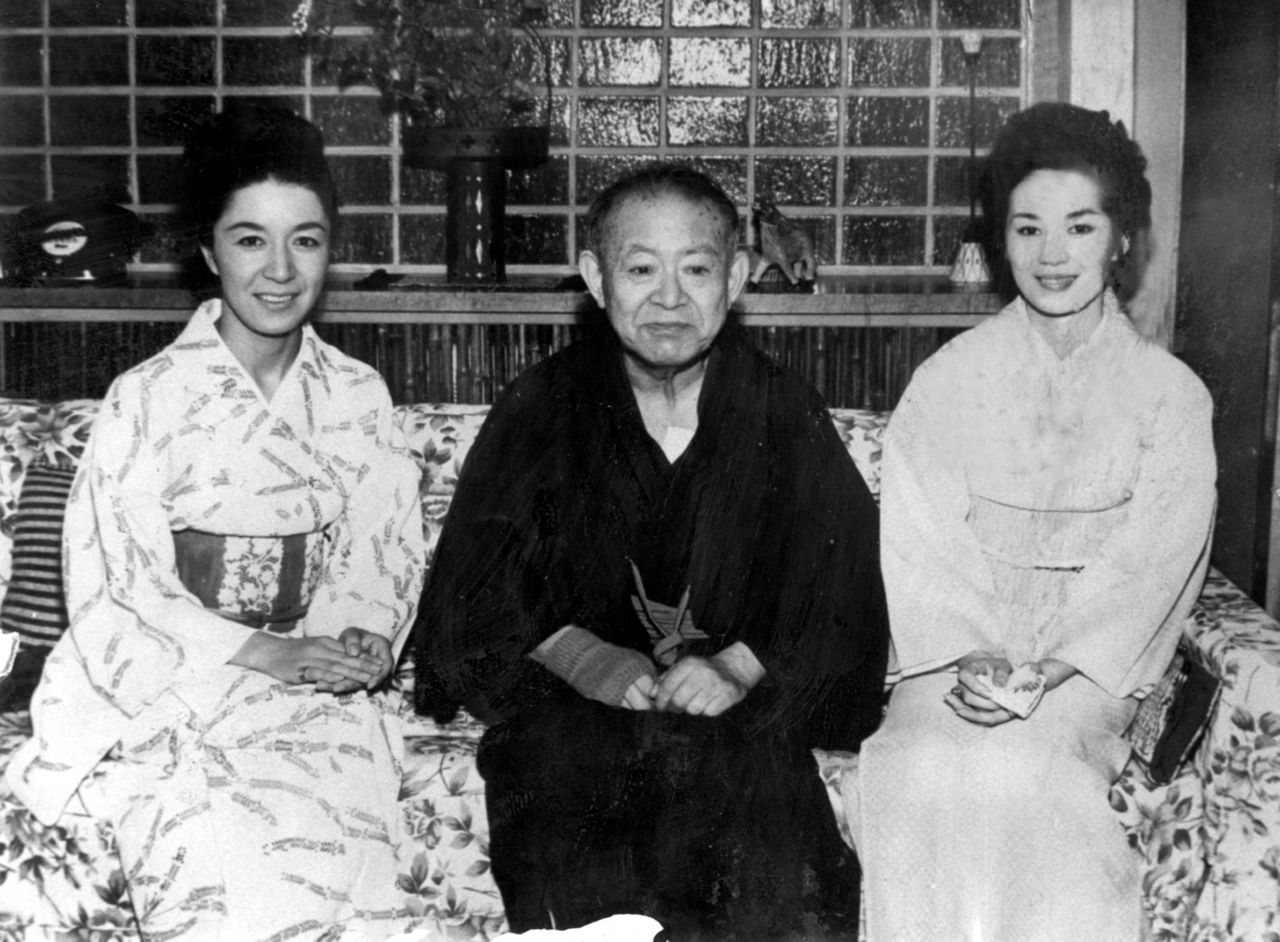
Some months before his death, Tanizaki took a photograph at his Kyoto home with the actresses Kusabue Mitsuko, at left, and Tsukasa Yōko, who had appeared in film and television adaptations of his work and become good friends with him. (© Sankei Shimbun)
Information on Works Mentioned
Some works have multiple translations, but only one is given for each here.
- “The Tattoo” (“Shisei”), “The Children” (“Shōnen”), “The Secret” (“Himitsu”), Naomi (Chijin no ai), and The Reed Cutter (Ashikari) are translated by Anthony H. Chambers
- Some Prefer Nettles (Tade kuu mushi) and The Makioka Sisters (Sasameyuki) are translated by Edward Seidensticker
- A Blind Man’s Tale (Mōmoku monogatari), The Key (Kagi), and Diary of a Mad Old Man (Fūten rōjin nikki) are translated by Howard Hibbett
- From the Life of Shunkin (Shunkinshō) is translated by J. Keith Vincent
- In Praise of Shadows (In’ei raisan) is translated by Gregory Starr
(Originally published in Japanese. Banner photo: Tanizaki Jun’ichirō at the age of 74. © Jiji.)