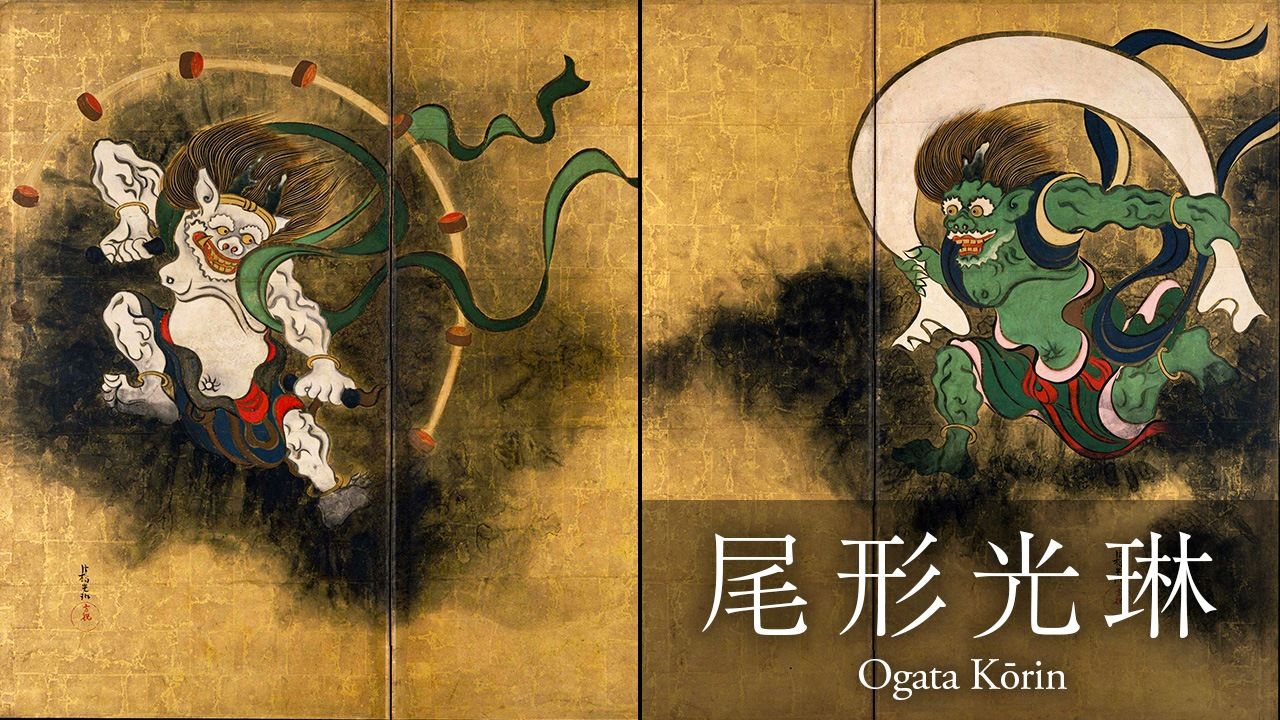
Ogata Kōrin: The Artistic Innovator Famed for His Folding Screens
Art Culture History- English
- 日本語
- 简体字
- 繁體字
- Français
- Español
- العربية
- Русский
A Squandered Inheritance
Ogata Kōrin (1658–1716) was the second son of a wealthy Kyoto merchant who ran a kimono fabric business called Kariganeya. The family was related to Hon’ami Kōetsu, who was a cultural figure active in Kyoto in the early seventeenth century, and was prestigious enough to receive commissions from the women of the imperial household. In his young days, Kōrin enjoyed an elegant lifestyle, learning about nō theater, waka poetry, calligraphy, and other arts together with his father and his brother Kenzan, who later became a potter.
However, when Kariganeya’s powerful patron Tōfukumon’in, the empress dowager, passed away, the business went into decline and had to shut down. Kōrin squandered his inheritance from his father. In his late thirties, seeking a way to support himself, he resolved to become a painter. It was around this time that he adopted the name Kōrin, by which he is commonly known today. He began learning artistic techniques from the Kanō school, and was deeply influenced by Tawaraya Sōtatsu, who worked with Hon’ami Kōetsu in the early seventeenth century.
His work Hotei Playing Kemari, produced when he was around 40, is witty in composition, arranging in a direct line from the bottom upward the painter’s signature and seal, Hotei’s sack, his belly and head, and the ball, conveying a sense of the ball’s upward movement. It also demonstrates his unconventional thinking in the juxtaposition of the legendary Chinese monk Hotei with the Japanese ball game kemari, which was popular among aristocrats from the Heian period (794–1185) onward. In the humorous handling of Hotei, one feels the influence of Kanō Tan’yū. The line drawing is light and rhythmical, and charms viewers who can imagine the brush in action.
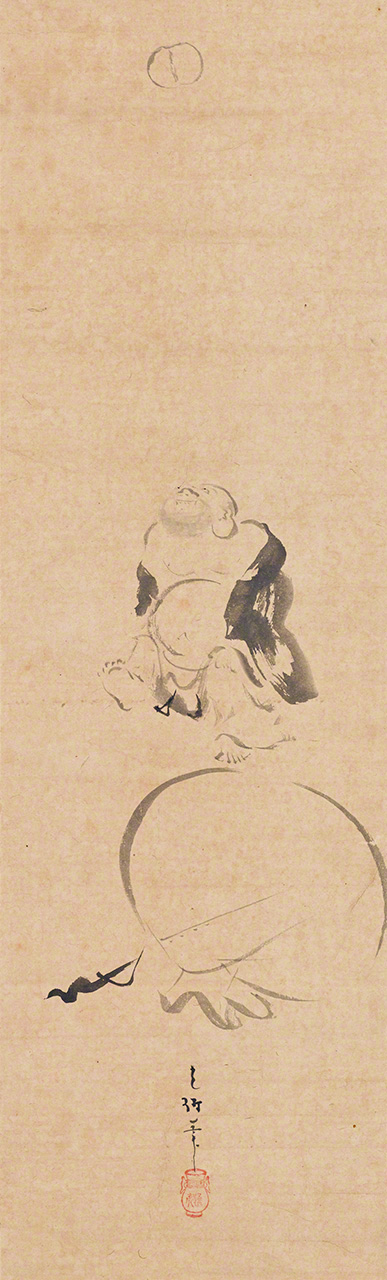
Kemari Hotei zu (Hotei Playing Kemari). (Courtesy Idemitsu Museum of Arts)
Irises an Elegant Motif
In 1701, Kōrin received the honorary title of hokkyō——originally a Buddhist appellation, later granted to artists, physicians, and other eminent figures—after which he signed his works “Hokkyō Kōrin.” Not long after this, he painted his most famous work, Irises, on a pair of folding screens. High-quality blue azurite and green malachite mineral pigments shine against the gold leaf background, creating a simple yet powerful effect. The irises derive from an episode in the literary classic, The Tales of Ise, written around the tenth century, and are an elegant, fragrant motif. Although they depict a scene where the hero and his companions observe exuberantly blooming wild irises and are inspired to compose poetry, Kōrin takes a fresh approach by including only the flowers in an elaborate arrangement, with no human presence. The screens were long held at the Kyoto temple of Nishi Honganji.
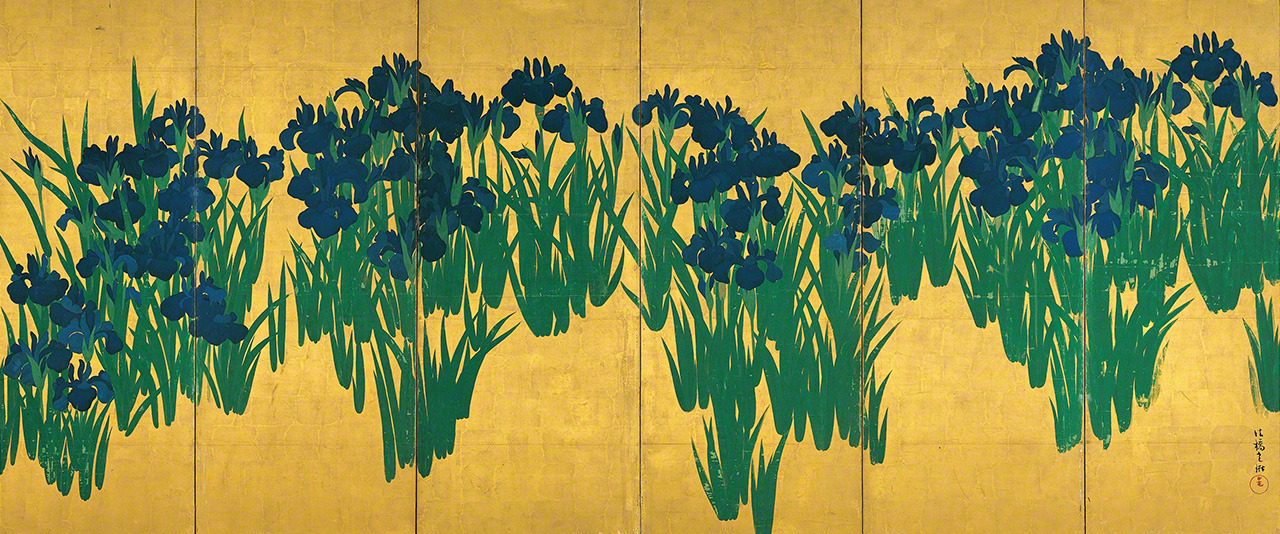
The right screen of the pair of folding screens Kakitsubata zu byōbu (Irises), a national treasure. The artwork is owned by Nezu Museum, which displays it only from mid-April until the start of May each year. (Courtesy Nezu Museum)
A Craftsman Too
In the Western tradition, painting and sculpture are viewed as distinct from practical products based on craftmanship. In Japan, however, items like tea bowls and inkstone boxes have been valued as artworks from ancient times. Kōrin displayed his talents in craft as well as painting. He created Writing Box with Eight Bridges, which takes on the same Tales of Ise theme as Irises, around his early forties—in the episode, the flowers bloom near where eight bridges come together. The bold design combines elements like lead for the bridges, silver for their posts, gold lacquer for the leaves of the iris plants, and mother-of-pearl for the blossoms, and is groundbreaking in lacquer art. Kōrin’s originality shines through in the way he has the bridges meeting on five of the six sides of the box. His lacquerware designs are characterized by their themes from literary classics, compositions zooming in on a limited number of motifs, and the use of materials including metal plates. While he entered into the tradition of the lacquer technique known as Kōetsu makie after his famous predecessor, he attained greater complexity and ingenuity, incorporating changes in design over the different sides of three-dimensional objects while maintaining a sense of overall unity.
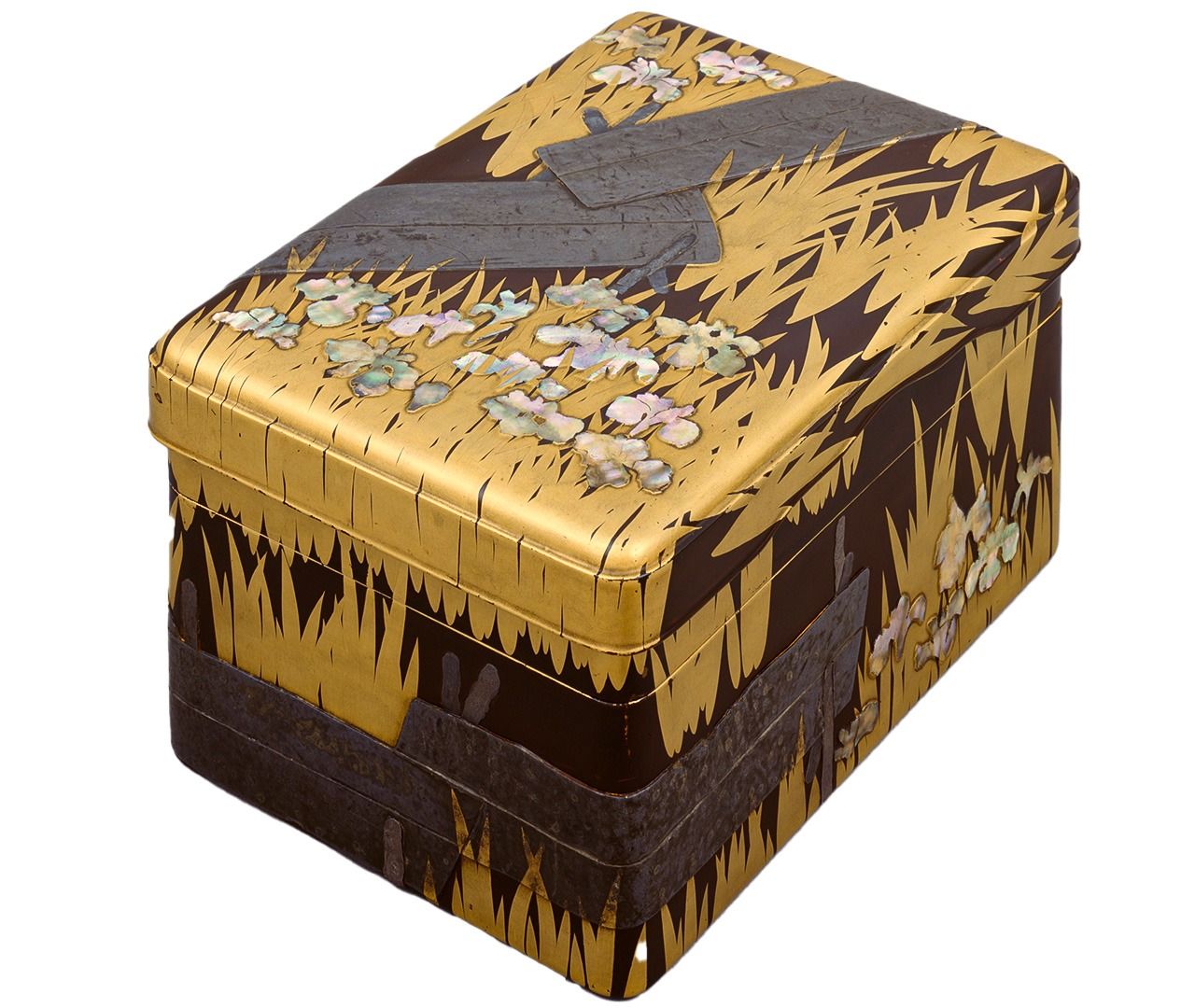
Yatsuhashi makie raden suzuribako (Writing Box with Eight Bridges), a national treasure. (Courtesy Tokyo National Museum/Colbase)
New Challenges in Edo
Kōrin achieved some success in Kyoto, but with the goal of making greater progress, he traveled to Edo (now Tokyo) in the winter of 1704. While Kyoto was the capital and had been for centuries, Edo rivaled it as the flourishing political center of the Tokugawa shogunate. Under the sankin kōtai (alternate attendance) system, regional leaders known as daimyō from across the country were required to spend every other year in Edo. They built residential estates in the city, and leading merchants also began to operate Edo branches. Kōrin’s main aim was to secure commissions from these political and business figures. His Kimono with Autumn Grasses was produced on a robe of white twill-weave silk for the wife of an Edo merchant called Fuyukiya. The kimono composition, which leaves space around the waist for tying the obi amid what appears like an autumn field, and the refined color palette are magnificent.
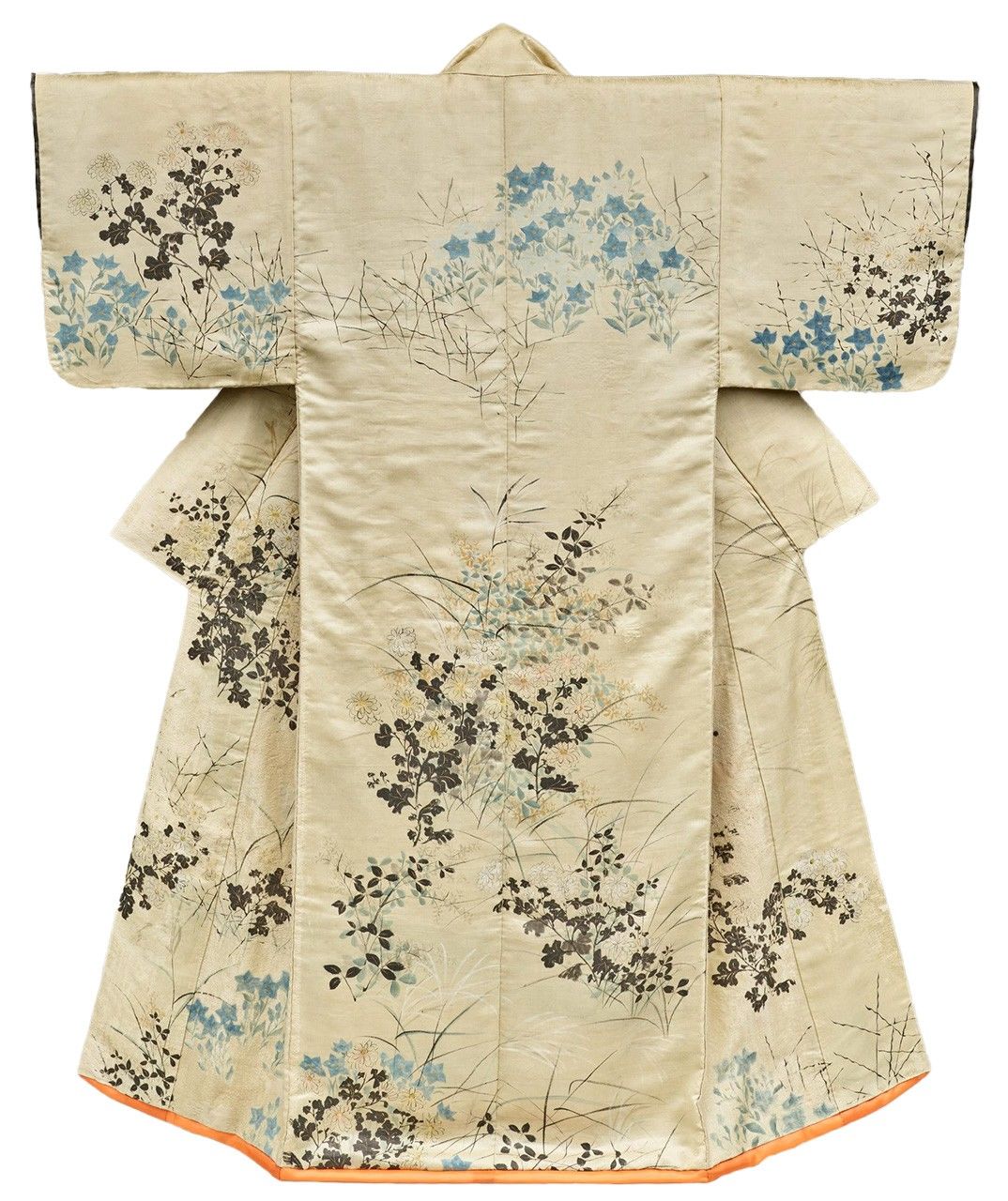
Shiroayaji akikusa moyō kosode (Kimono with Autumn Grasses). (Courtesy Tokyo National Museum/Colbase)
Just before relocating to Edo, Kōrin painted his only portrait. This was of Nakamura Kuranosuke, an official at the Ginza mint who became Kōrin’s greatest patron. His formal attire of a black kimono with a family crest and his straight-backed posture convey a dignified personality.
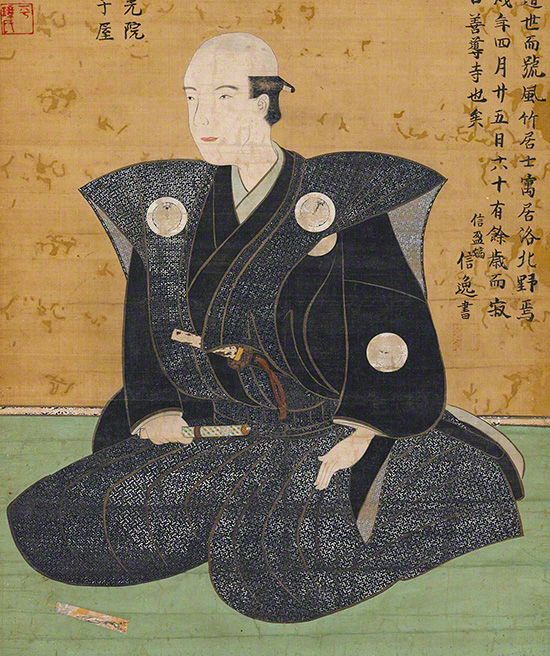
Nakamura Kuranosuke zō (Portrait of Nakamura Kuranosuke). (Courtesy The Museum Yamato Bunkakan)
Sōtatsu’s Influence
Kōrin took on many new challenges while in Edo. One was learning painting techniques from medieval Zen monk artists like Sesshū and Sesson. The violent, surging waves surrounded by an intense, deep blue in his screen painting Rough Waves are reminiscent of these painters’ style. Meanwhile, there is the influence of Sōtatsu’s excellent ink paintings in the rhythmic movement of soft, delicate lines, as well as the adroit brushwork, apparently using the renpitsu method, where several brushes are joined together. Based in Kyoto in the early seventeenth century, Sōtatsu was known for his revival of the yamato-e style, updated for the early modern period, with rich townspeople and court nobles as his patrons. Kōrin became increasingly intent on mastering Sōtatsu’s style, and used it as a starting point for developing his own individual expression.
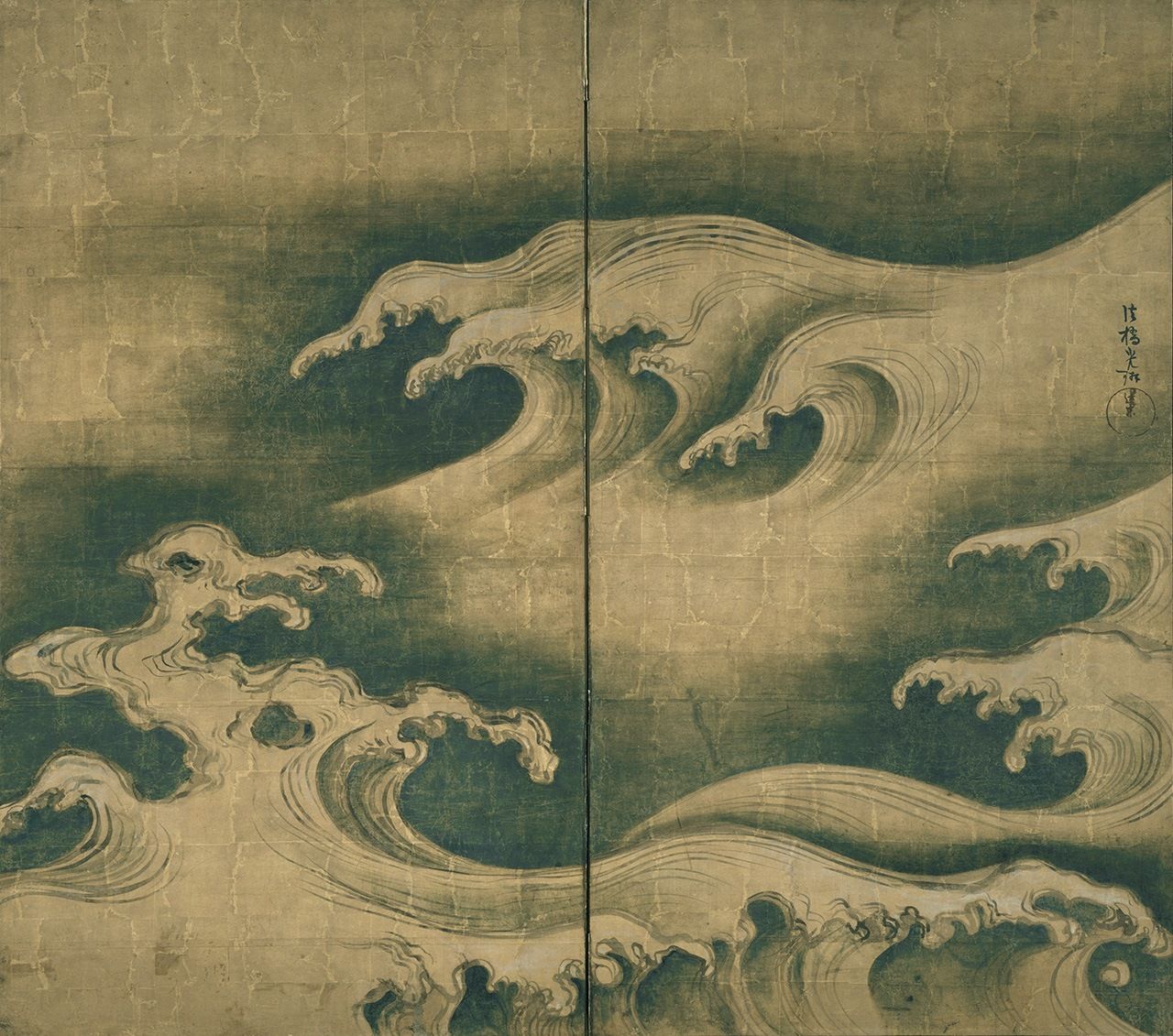
Hatō zu byōbu (Rough Waves), a painting on a folding screen. (Courtesy Metropolitan Museum of Art)
In his Waves at Matsushima, Kōrin almost exactly copied a folding screen painting of the same name by Sōtatsu before making some small changes to the right panel. There is some visible retouching on parts like the rocky outcrop to the right, but Kōrin’s distinctive style is most apparent in the strengthened focus on the foreground and the powerful rendering of waves crashing together. The US art historian Ernest Fenollosa, who was a key figure in introducing Japanese art to the world, purchased Kōrin’s screen while he was in Japan. After his return to the United States, he became curator of the department of Japanese art at the Museum of Fine Arts in Boston—the screen has been part of the museum’s collection since 1911.
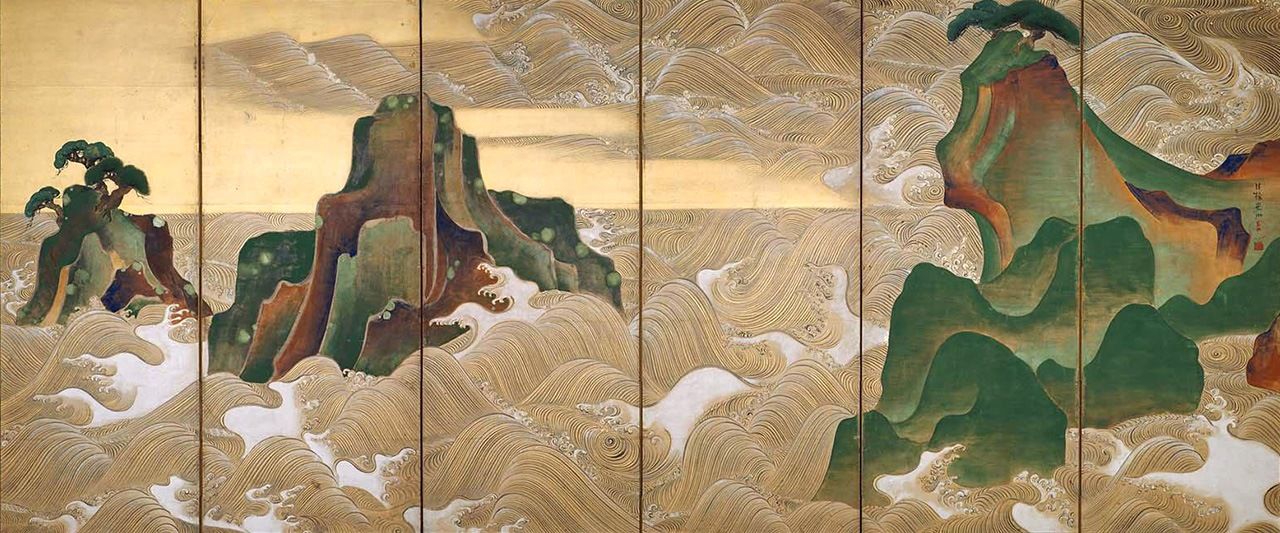
Matsushima zu byōbu (Waves at Matsushima), a painting on a folding screen. (Courtesy Museum of Fine Arts, Boston)
Late Masterpieces
In the spring of 1709, having spent several years moving back and forth between Kyoto and Edo, Kōrin settled in Kyoto, where he created numerous gold folding screens over the seven years until his death. His well-known Wind God and Thunder God screen dates from this period. Again, he used a Sōtatsu original as his model, but his firm, powerful outlines and emphasis on the contrast between the vivid red and green makes the gods stand out in sharp relief as a more solid presence.
The artist Sakai Hōitsu (1761–1829) later painted his Natsuakikusa zu byōbū (Flowering Plants of Summer and Autumn) on the reverse side of Kōrin’s Wind God and Thunder God. Tokugawa Harusada, the father of then Shōgun Ienari, who wielded considerable influence behind the scenes, is said to have asked Hōitsu, a deep devotee of Kōrin, to create this artwork. This episode demonstrates that Kōrin’s works were valued even in the upper echelon of the samurai class.
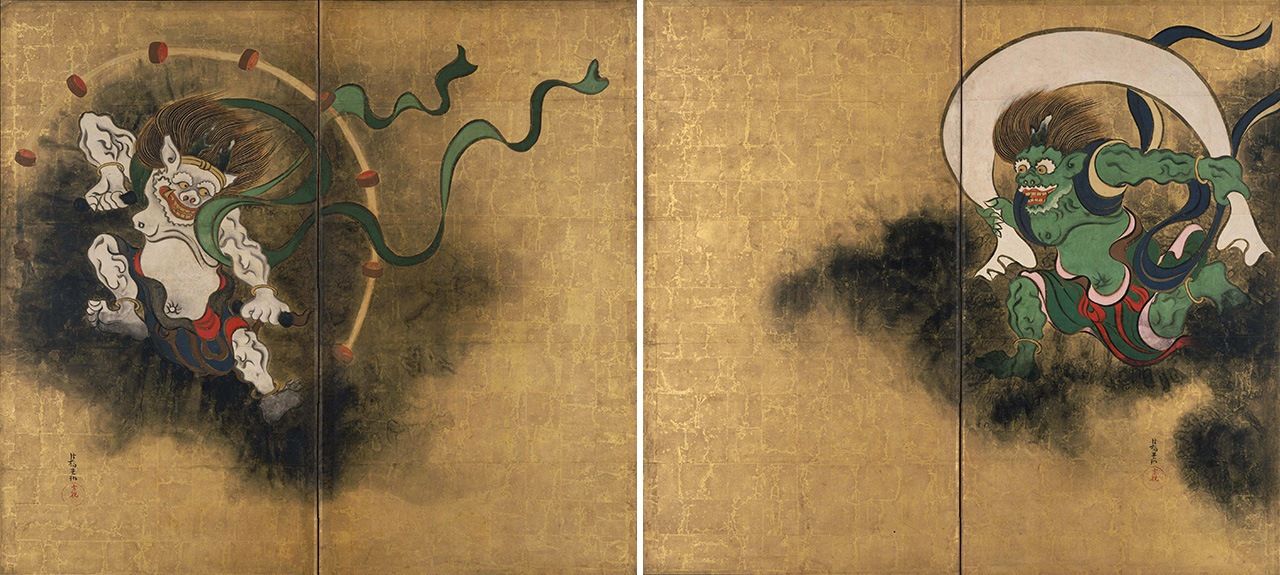
Fūjin raijin zu byōbu (Wind God and Thunder God), a painting on a folding screen. (Courtesy Tokyo National Museum/Colbase)
Amid the court nobles and wealthy merchants of Kyoto again, Kōrin produced the work Bamboo and Tiger. While the tiger is glaring, it is not at all frightening, and in fact rather lovable. In this lighthearted ink painting, Kōrin seems to appear in the aspect of a sociable and witty talker. When he attended nobles at their residences, it was generally as an otogi or conversational companion. The signature and seal “Seisei Kōrin” was designed by his brother Kenzan, inspired by the flow of Kyoto’s Kamo River. Although vastly different in character, the two brothers had a close relationship.
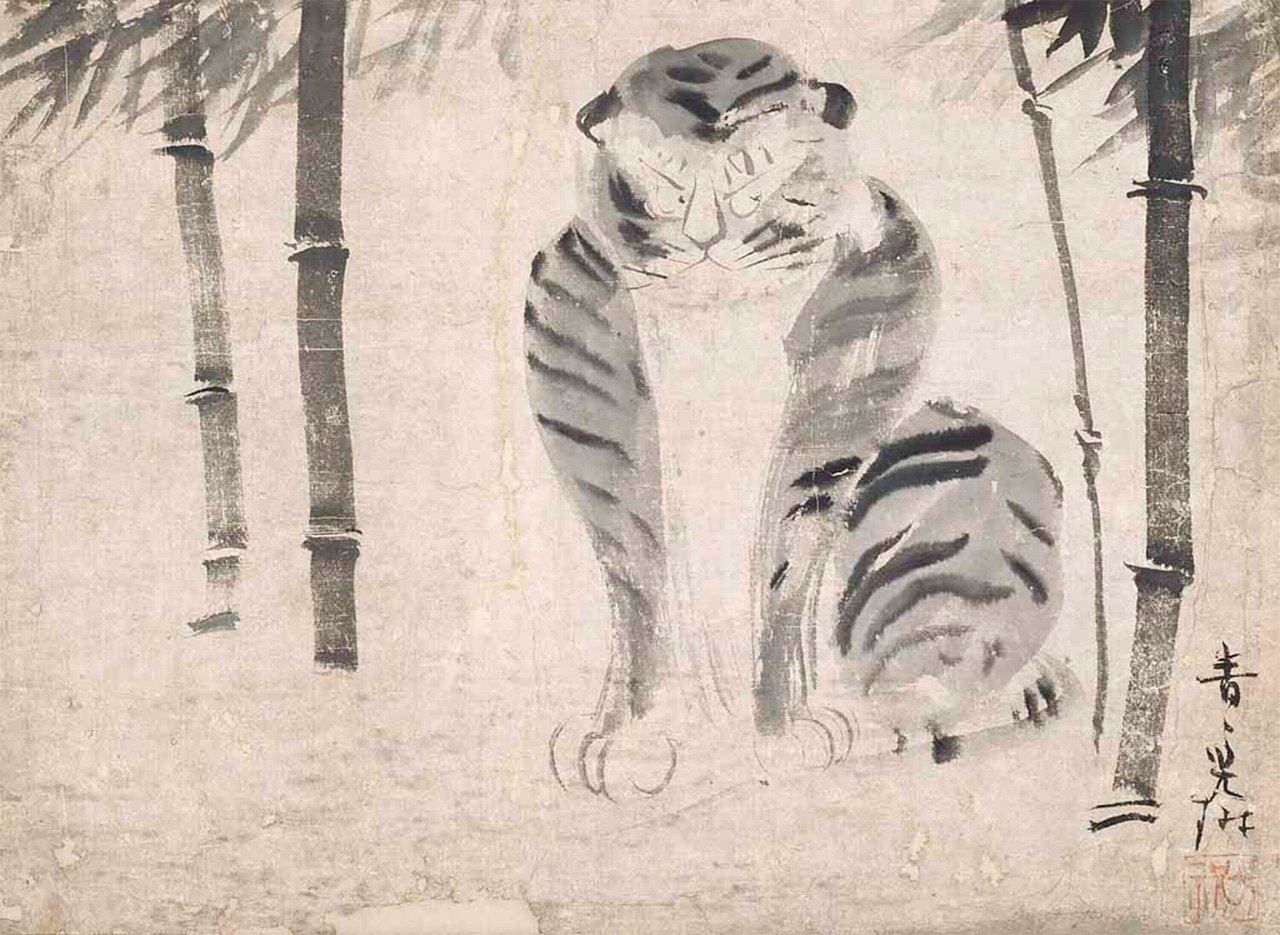
Taketora zu (Bamboo and Tiger). (Courtesy Kyoto National Museum/Colbase)
Red and White Plum Blossoms was the masterpiece of Kōrin’s later years. Waterside plum trees were a traditional topic in art, as well as a common theme in waka since the Heian period. Kōrin creates a surprising juxtaposition of realistic plum blossoms and stylized flowing water. Bearing in mind the ornamental role of folding screens, he aimed to create a richly decorative space adding depth to the flat surface presented by them. The curving branches of the red plum tree are in the yamato-e style, dating back to the Heian period, while the sharp angles of the white plum branches follow the tradition of Chinese painting brought to Japan in the Kamakura period (1185–1333). Set against the ancient tree trunks, the red and white flowers are a delicate harbinger of spring. The central water is thought to have had its dark color applied through the chemical treatment of silver foil, and the deep hue conveys the complex state of mind of the aging artist. The work was passed down through the Tsugaru clan.
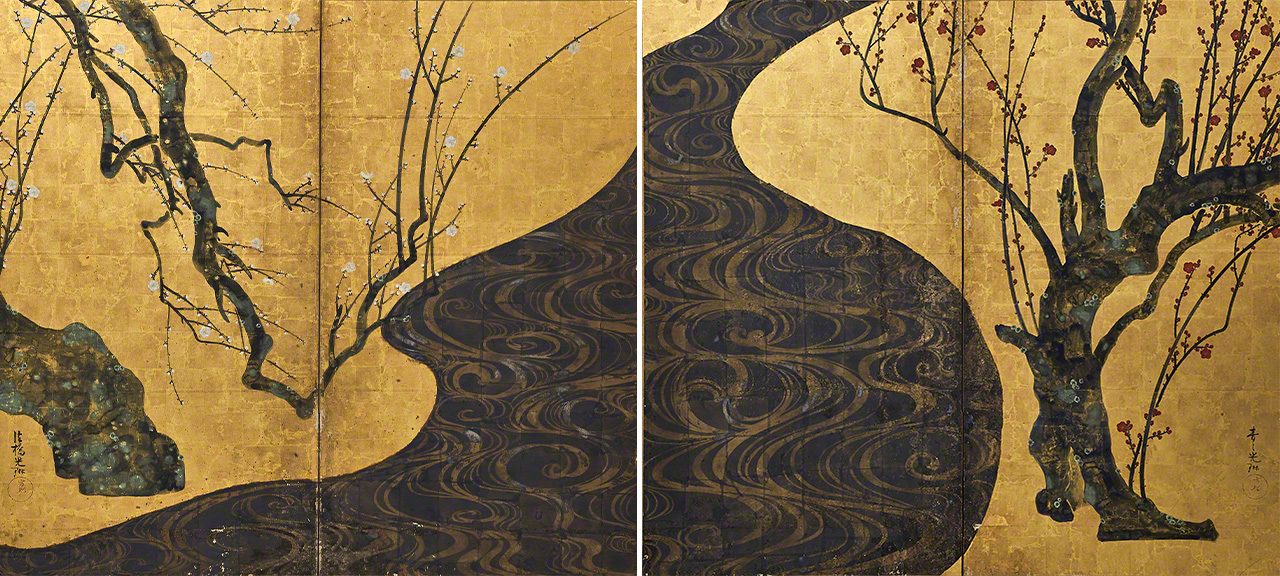
Kōhakubai zu byōbu (Red and White Plum Blossoms), a painting on a folding screen and a national treasure. The artwork is owned by the MOA Museum of Art, which displays it around February each year. (Courtesy MOA Museum of Art)
Today, it is common to talk about Kōrin’s richly decorative screens, his bold compositions, and his unconventional use of color in critical terms developed in the second half of the nineteenth century. People who had experienced the artistic innovations of modern Europe since impressionism applied value to Kōrin’s works through a modern aesthetic lens, creating the image of the painter as representative of Japanese art. It was not until the twentieth century that the idea of a Rinpa school—including Sōtatsu, Kōrin, and Hōichi—became commonplace. It is no exaggeration to say that acclaim in the West for such painters led to a renewed enthusiasm for the Rinpa school within Japan.
(Originally published in Japanese on August 22, 2025. Banner image based on Fūjin raijin zu byōbu [Wind God and Thunder God]. Courtesy Tokyo National Museum/Colbase.)