Manga Worth Having on Your Shelves
Manga “Nippon Sangoku” Asks if Speech Alone Can Bring Peace
Culture Society Anime Manga Entertainment- English
- 日本語
- 简体字
- 繁體字
- Français
- Español
- العربية
- Русский
A Mission Driven by Love
At the imagined end of the Reiwa era, Japan is crushed by foreign powers in the AI Industrial Revolution. Its population decline accelerates, as well as its education levels, all driving Japan’s collapse as an international power. And then come global nuclear war, pandemic, massive earthquakes, and political corruption. After disaster on disaster, the people of Japan explode in fury, and the nation falls following a violent revolution. The population falls by 90% and society reverts to a preindustrial state last seen centuries before. The Japanese archipelago is divided among three nations: Yamato in the west, ruled from Osaka; Buō in the east, ruled from Odawara in Kanagawa; and Sei’i in the north, ruled from Niigata.
The story begins in Yamato’s Ehime-gun, equivalent to real-world Ehime Prefecture. Idealistic agricultural official Misumi Aoteru, only 15 years old, is devastated when his newlywed bride Saki is executed out of hand by Minister Taira Denki, who has journeyed from the capital to collect taxes. Taira claims she “resisted a tax collection official.” Yet Aoteru shows no anger at the unreasonable, brutal killing of his wife. Instead, he builds logical arguments proving impropriety by this official, prompting Denki to execute him as well. Denki asks Aoteru if he is satisfied, and the young man answers without expression: “Not at all. I merely revealed the truth.”
Aoteru has absorbed knowledge of Japanese history, as well as memorizing Sun Tzu’s The Art of War and the third-century Chinese history Records of the Three Kingdoms. But Saki grounds Aoteru’s over-intellectualism, saying, “If you have the courage, you can unite Japan, end this age of three kingdoms, and bring peace to the world.” After Saki’s death, her wishes for peace on earth continue to resonate in his heart, and he progresses using intellect and eloquence as weapons, rather than strength. And so Aoteru, who will go on to be praised as a tactical genius, begins his struggle to reunite Japan.
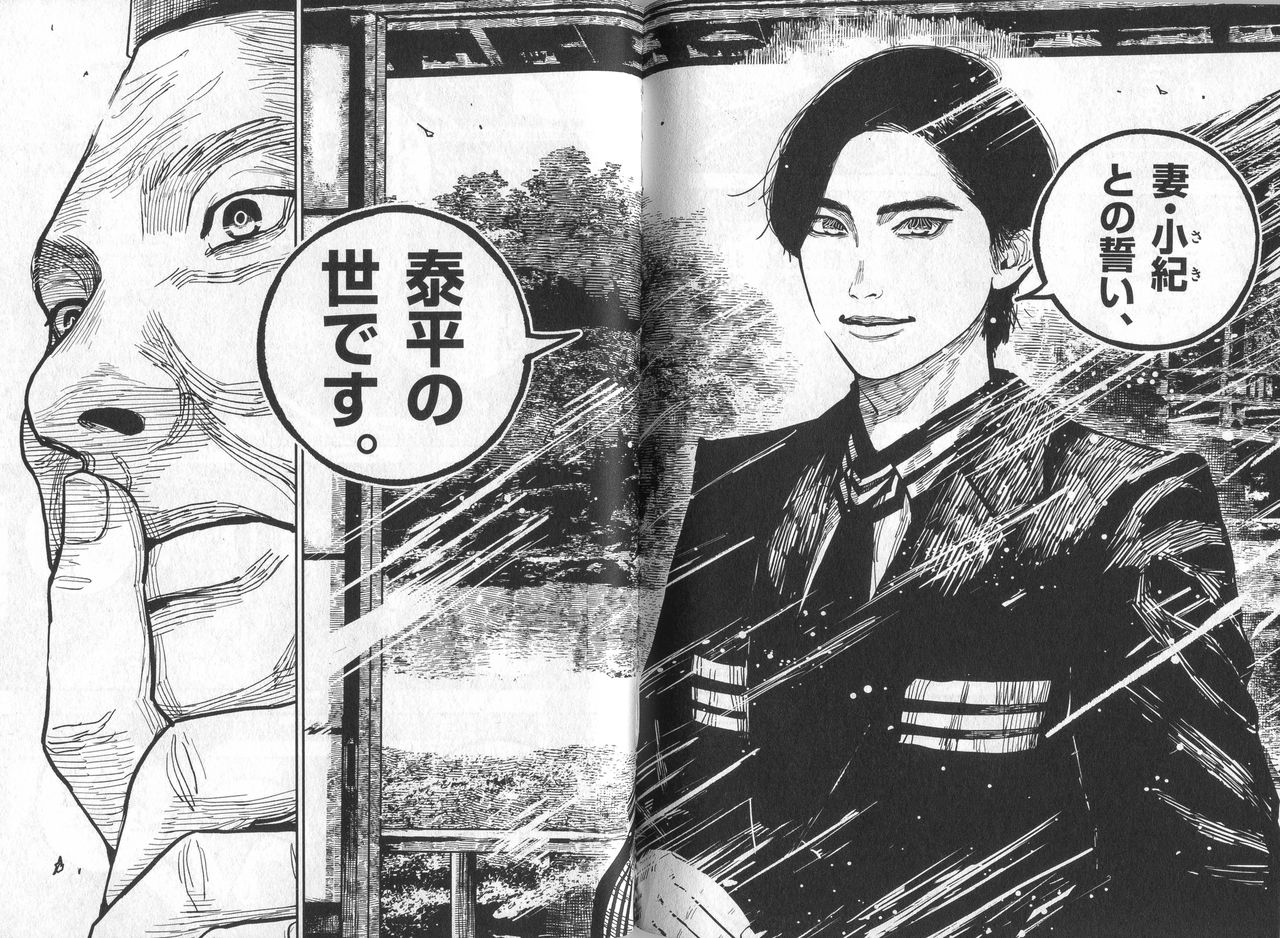
Misumi Aoteru, right, explains his pledge to his wife as Taira Denki, left, listens. From Volume 5, chapter 24, of Nippon Sangoku. (© Matsuki Ikka/Shōgakukan)
Drawing Skill and Dialect
The first thing that catches the eye in this manga is the creativity in the art. The lines and fills are so deep and black they almost look like wood-block prints, and shading is done with crosshatching instead of using screen tones. People are drawn realistically, and both men and women have deeply lined faces. It has a style that might be divisive, but the art conveys real beauty.
The characters also speak in intense dialect, an impactful choice for the work. Aoteru speaks the Ehime-ben dialect, but Osaka-ben of the Yamato capital is set as the standard. The diverse dialects become a way to show off the characters’ personality differences, further emphasized by the frequent use of modern youth slang woven through the dialect in an amusing mismatch.
After Saki’s funeral, Aoteru abandons his hometown and leaves for Osaka to take the exam to serve Frontier General Ryūmon Mitsuhide, known for his nobility. There is one passing condition: Get Mitsuhide’s knee to touch the ground within 10 minutes. While the other test takers all turn to physical strength, Aoteru alone passes the exam using a psychological strategy. It is an iconic scene that clearly shows off the work’s intent.
Japan’s Great Civilization
In the time of this story, cars have become scrap, and transport is primarily by foot or horse. There is no electricity, no telephones, and of course no internet. It is a war-torn dystopia where a handful of powerful people control nations. In that sense, it reflects, if in extreme distortion, the haze of anxiety surrounding today’s young people.
You could also call it a satirically emphasized representation of the sense of restriction plaguing Japan today, with the declining and aging population, rising cost of living, and difficult international position. And it is in this worst of all possible conceivable futures for Japan that our protagonist Aoteru dreams of rebuilding a unified state, in memory of his wife.
The methods he applies toward that dream draw on his accumulation of the wisdom that Japan once held. There is one scene where Aoteru reflects in surprise, “Japan used to be a great civilization.” There is a hint of yearning for past glory and nationalism in that, but I think it is praiseworthy that, on the whole, this manga does not stick to any clear-cut ideology. The work also offers multilayered entertainment value, with bloody battles, astounding schemes, and serious scenes balanced on a razor’s edge with silly gags.
The Value of Speech in an Age of War
What is the justice that Aoteru seeks? In the latest volume, the seventh, he is asked how he plans to change the world without using violence. His answer is, quite simply, “Speech.” Aoteru states firmly that the first step toward peace on earth is to achieve democracy, the true wisdom of humanity.
His proclamation might come across as over-idealistic, particularly as Aoteru himself plays a role in Yamato’s war of aggression as a public servant. And yet, as we see wars spreading and democracy in decline here in the real-world twenty-first century, perhaps we should accept this as the author speaking through his protagonist.
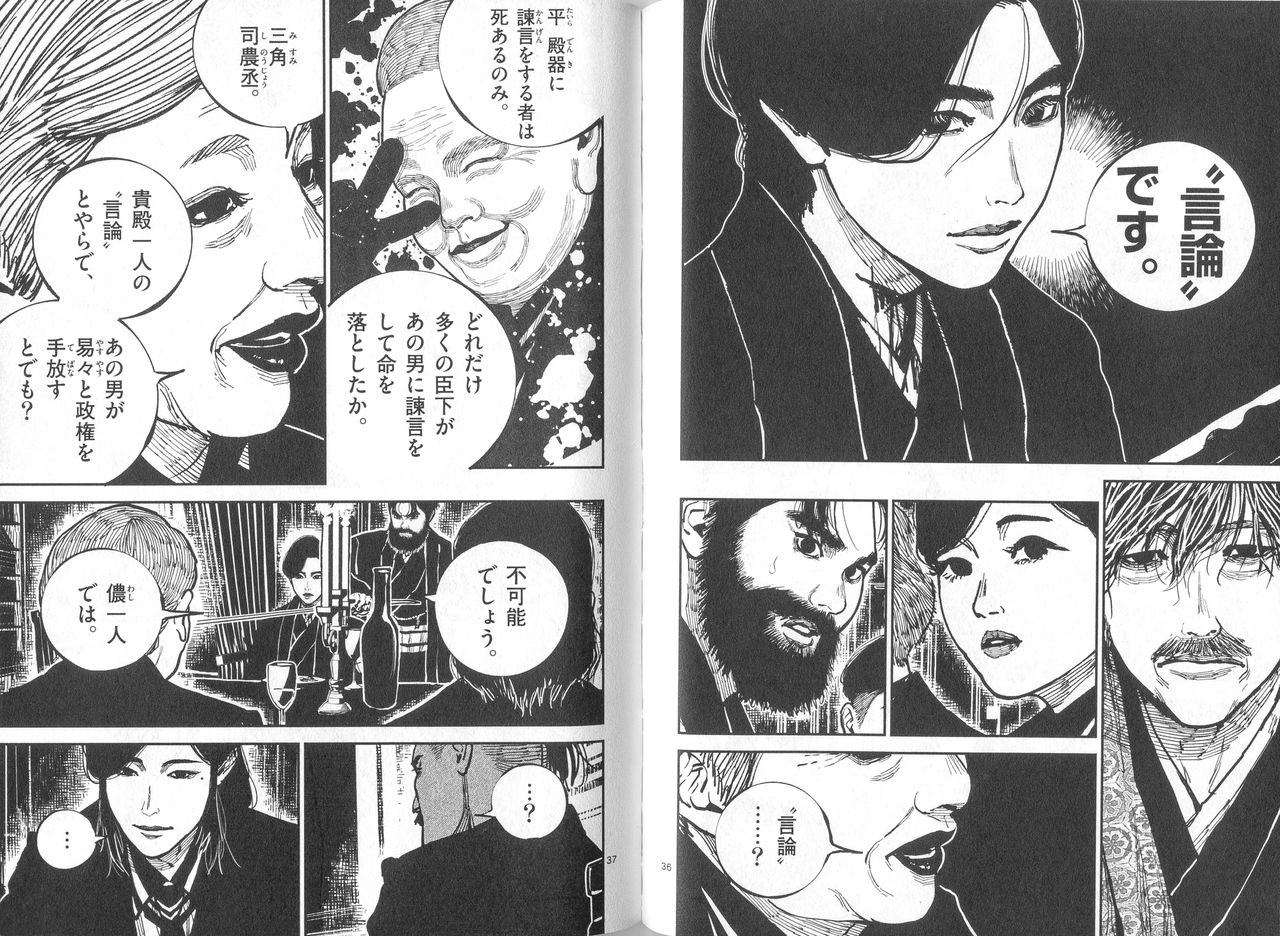
The defeat of Taira Denki alone is not enough to end corruption. Aoteru seeks to bring about a revolution for the sake of the people relying on words alone. From Volume 7, Chapter 46 of Nippon Sangoku. (© Matsuki Ikka/Shōgakukan)
This work feels like the author’s response to Hara Yasuhisa’s manga Kingdom, which was serialized from 2006. That work depicts the emperor Qin Shi Huang’s battle to unite China. It became hugely popular by emphasizing powerful duel scenes in the shōnen manga style typically aimed at young male readers. The difference between Kingdom and Nippon Sangoku demonstrates the shift from strength toward dialogue-driven conversion in the move from the Heisei era (1989–2019) to the current Reiwa era.
Influences from History and Games
The Nippon Sangoku manga began serialization via app in 2021, at the height of the COVID-19 pandemic. Author Matsuki Ikka, born in 1994, is a native of Ehime Prefecture, just like Aoteru. His inspiration for this work goes back to elementary school, when he found himself hooked on Romance of the Three Kingdoms and the action video game it inspired, Dynasty Warriors. In an interview with an Ehime magazine, Matsuki describes how he felt reluctant to write about another country’s history, so he decided to use Japan’s future as his setting instead. He explains that he decided the divisions of the three nations based on topography and wrote a detailed timeline of their imaginary history. But at the same time, he says, “I wouldn’t really say I’m all that interested in history.”
The Japanese love for the stories of the Three Kingdoms may not surpass China’s, but it almost rivals the native nation. The 1970s and 1980s saw a flood of manga inspired by the story, kicked off by Yokoyama Mitsuteru’s Sangokushi. In the 2000s, Kawaguchi Kaiji’s manga Taiyō no mokushiroku (A Spirit of the Sun) moved the setting to near-future Japan. It is a genre that seems utterly saturated, but the appearance of this unusual piece has been a shock.
The characters are based on ones from the Sangokushi story, or on warriors from Japan’s own Warring States period (1467–1568). But the choice of a public servant like Aoteru as protagonist, rather than any mighty hero like Cao Cao or Liu Bei, is unprecedented in this battle-focused genre. The author mentioned in an interview that the model for him was Deng Ai, a peasant who rose to be a great general of the kingdom of Cao Wei. Deng Ai had a stutter, but Matsuki speculated that if he had been a better orator, he might have been unbeatable. And so Aoteru was born.
Compelling Generals and Villains
Still, one of the truly interesting parts comes as the various generals appear one after another, each as eccentric as the last. Up through volume four, the story follows Yamato’s Frontier General Ryūmon Mitsuhide and his underling, the brilliant strategist Kaku Yasuaki. But Wajima Ōga, the woman who rises to become the leader of Sei’i after a coup d’etat, is also depicted with fierce charisma. Even the lowest ranked soldiers are depicted as meaningful characters, rather than as simple filler on the side. It makes the work something of an ensemble piece.
But the story might not have become as interesting as it is without truly despicable antagonists. Taira Denki is practically an incarnation of corruption and malice, committing incomparable cruelty while never losing his smile. His inhumanity, displayed through his demands for instant executions without a second thought, could not be any better suited for Aoteru’s unique revenge story.
But this is certainly no simple story of good triumphing over evil. Matsuki notes that he received many comments from readers asking him to “hurry up and kill Taira,” but he explains, “I don’t think the people asking to kill him are on the side of good.” The good and evil, the right and wrong depicted here, are always subjective. Everyone in the story has their own light and dark. It even becomes clear that Taira Denki himself was the kind of hero demanded by his age. The readers are probably just eager, thinking that Taira’s defeat will open the way for the next monster. It’s a sign that no one can keep their eyes off the coming climax.
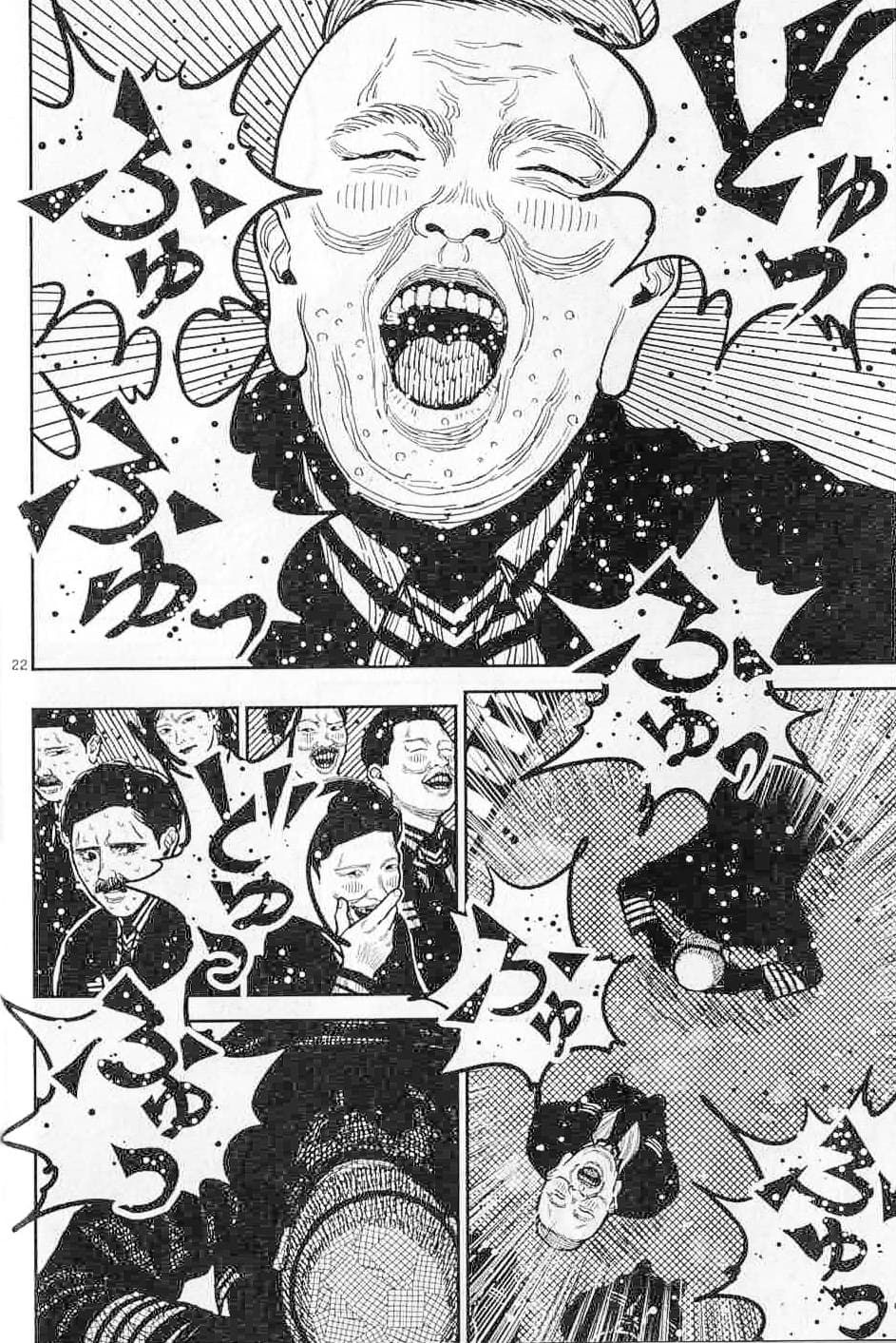
Taira Denki smiles. The unpleasantness of that smile is sure to go down in manga history. From Volume 2 of Nippon Sangoku. (© Matsuki Ikka/Shōgakukan)
Anime a Global Hit
The TV anime adaptation was broadcast from April to June 2026 on Tokyo MX, BS Nippon Television, and other channels, and is being streamed internationally on Amazon Prime Video. As of the end of May, its global viewership on Amazon ranked tenth among all TV series, and second in non-English speaking regions. Its international popularity might well be down to its sincere approach to real issues.
Can Aoteru’s silver tongue stop the ones using violence? Can speech alone bring peace? The battle to embody Aoteru’s ideal “unity of knowledge and action” might well have bearing on our own world.
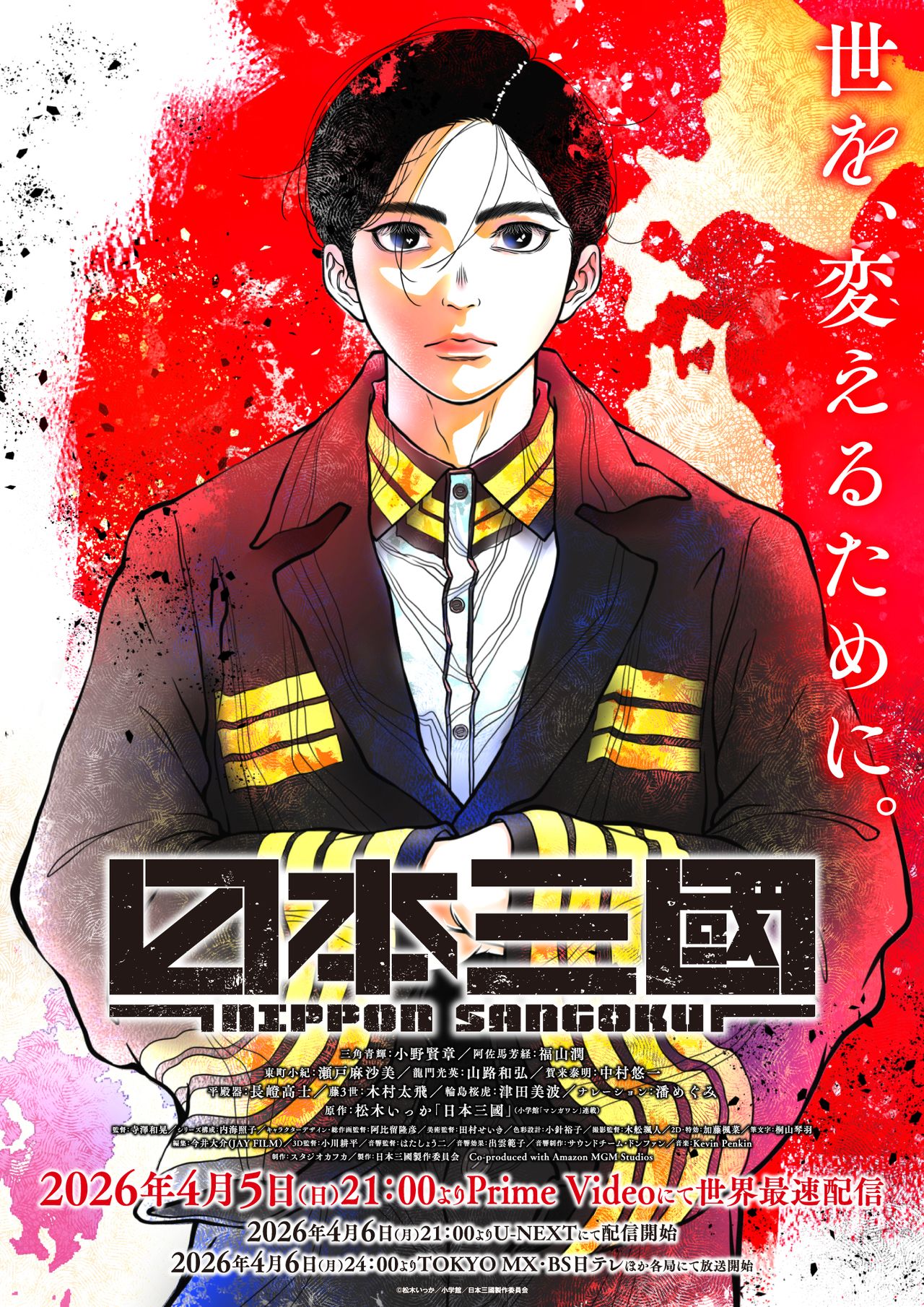
A poster advertising the anime adaptation. (© Matsuki Ikka/Shōgakukan/Nippon Sangoku Production Committee; courtesy PRtimes)
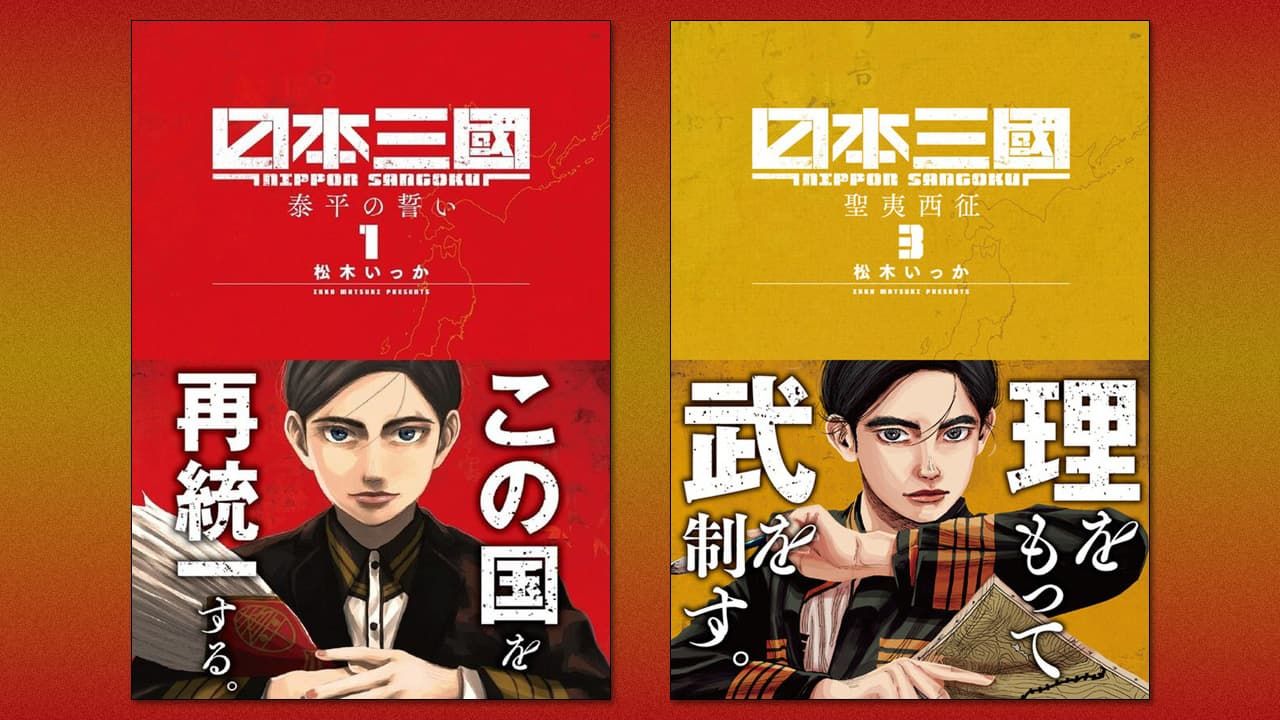
(Originally published in Japanese. Banner photo: The covers to volumes one and three of Matsuki Ikka’s Nippon Sangoku. © Matsuki Ikka/Shōgakukan.)