
“Baka’s Identity”: Director Nagata Koto’s Tale of Crime and Male Camaraderie
Cinema Society
Nagata Koto
Film director, born in Osaka. Made her theatrical debut in 2004 with a segment in the anthology film Koibumi biyori. Other works include the film Little DJ (2007) and the TV series Dead Ringers. Baka’s Identity is her eighth feature film.
- English
- 日本語
- 简体字
- 繁體字
- Français
- Español
- العربية
- Русский
Casual Brutality
The movie Baka’s Identity depicts young men working in the black market moving inexorably toward more brutal criminality. It is based on Nishio Jun’s novel Orokamono no mibun (A Fool’s Identity), which grew out of an earlier short story.
Director Nagata read the initial short story and followed along as it was expanded into a full-length novel with richer background and developments.

Lead character Takuya, played by Kitamura Takumi, is a member of a loose gang of identity brokers and internet criminals calling itself Media Group. (© 2025 Baka’s Identity Film Partners)
The novel begins with 25-year-old Mamoru as he uses smartphones to pose as young women and messages with random men. The targets are all in desperate money trouble. His job is the first stage of “registry brokering,” the underground business of buying and selling real identities.

Mamoru, played by Hayashi Yūta, grew up in an abusive household. Takuya introduces him to the criminal underworld. (© 2025 Baka’s Identity Film Partners)
Mamoru takes orders from Takuya, who is higher up in the organization. When they get a solid target, they dispatch a young woman to meet up and offer a deal that is, of course, too good to be true. Takuya serves as a go-between between buyers and sellers, but above him is a minor criminal gang that keeps tight control on this black market. Takuya is eventually dragged into ever more dangerous work by the gang as he approaches complete ruin. Through five chapters, the novel follows other characters, as well, including one of the women who hooks the targets; a man who sold his identity and a detective looking for him; and Kajitani, the man who got Takuya into the business.

Takuya pays off Kisara (Yamashita Mizuki), one of the women sent to convince Mamoru’s targets to sell. (© 2025 Baka’s Identity Film Partners)
Nagata says, “When I read the novel, I thought ‘I can work with this!’ It’s a brutal criminal suspense story, but also has a light touch about it. It felt like it would be something that let me work with the heavy themes I want to handle while using the entertainment value to better convey the message.”
A Second Debut
Nagata made her directorial debut in 2001 with the direct-to-video The Hole and has helmed six feature-length films since, including her most recent Go! Go! Stupid Woman! in 2020. In the interim she has also directed television programs and commercials.
“Whether it’s film, television, or commercials, I just throw myself completely into the work. But of course, a TV show belongs to the station and the producers. And there’s this sense that once it airs, it’s gone. I always had to deal with this sense of emptiness after all that hard work.”
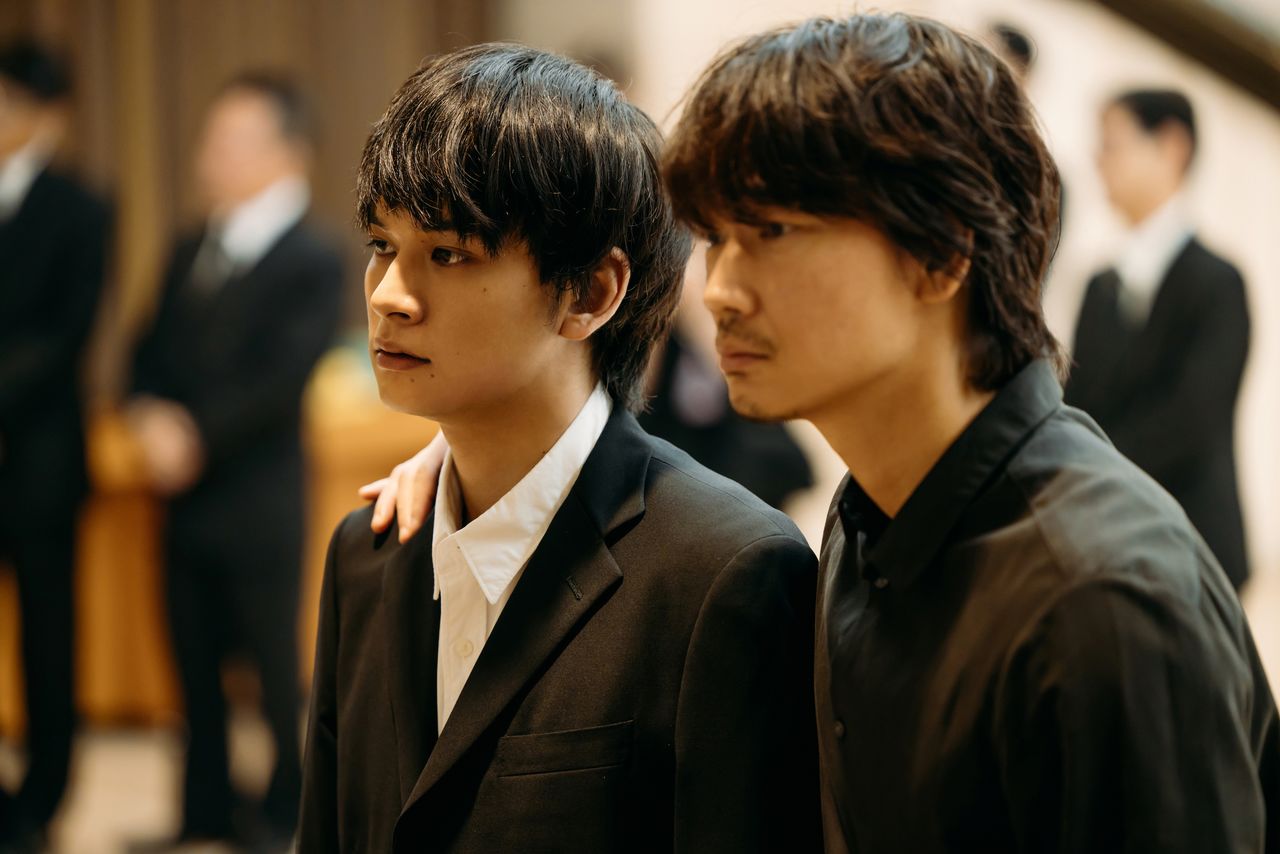
Takuya was pulled into the underground by Kajitani (Ayano Gō). (© 2025 Baka’s Identity Film Partners)
She finally began to make her own plan for a film in the winter of 2021, just as she finished a television project.
“I’m not getting any younger, and I want to leave something behind in film. I couldn’t let this go unfinished. I was worried, though, about what I would do if it never came to anything despite all my resolve. Still, I went around shamelessly telling everyone, ‘I’m working on the piece of my life!’ and ‘This is my second debut!’ (Laughs). And that got a producer friend interested.”

(© Hanai Tomoko)
Underworld Trap
Even before encountering this book, Nagata says she had been reading articles and watching documentaries about juvenile detention centers and underground economies. The point that she and the producer both agreed on was dealing with the issue of youth poverty.
“Why are so many young people turning to crime? I know that kids who get arrested for illegal work just say they wanted the money, but is that the truth? Isn’t the money only a superficial motive? I have to wonder what else they might be searching for. That’s what I keep thinking about.”

Takuya shows concern for Egawa (Yamoto Yūma), who has sold his registry. (© 2025 Baka’s Identity Film Partners)
Nagata says she even went to Tōyoko, the infamous spot by the Shinjuku Tōhō Building in the Kabukichō red light district, to talk to a girl involved in sex work.
“Young people these days have such close access to the darker side of society. They don’t feel safe at home so they gather at Tōyoko, and before they know it they’re talking with underworld types. There’s also this idea floating around that if they step across some final line, there’s no way back. Japan’s population is dropping. We should be treasuring our young people, not throwing them away so easily.”
Three Men, One Path
In adapting the novel into a movie, Nagata says they simplified the story.
“The original story had lots more people involved. We pared it down to the trio of Takuya, Mamoru, and Kajitani. From the start, I wanted to depict a single life through these three. One young person steps into the underworld. Over time, he grows from a beginner to a veteran. And eventually, he starts to wonder if he should stay in, or if he can get out. I wanted to show that progression using these three people from different generations.”

(© 2025 Baka’s Identity Film Partners)
The three actors, Kitamura Takumi, Hayashi Yūta, and Ayano Gō, shared the Best Actor award at the Busan International Film Festival, which serves as proof of the approach’s success.
The story that Baka’s Identity offers is one built out of realistic depictions of criminal methods and brutal violence, but also the mutual betrayals of gang life and their opposite, the camaraderie of those who find trusted partners.

How will things turn out between Takuya and Kajitani? (© 2025 Baka’s Identity Film Partners)
Among all the works of Japanese cinema dealing with the blood-drenched world of the lawless, few have come out from a woman director. But Nagata slides past the men/women issue to discuss how she brought her own touch to the work.
“The impetus is always to cut as much unnecessary material as possible to minimize shooting time on location. Staff are always asking to cut more and more. But lots of times, they’re asking to cut something that I feel is really important. I don’t just want to keep the story moving, I want to invoke that delicate emotional response that comes when two people are interacting. I would not budge on that. Looking back, that’s where my personal expression comes out. One of the producers told me, ‘I struggled to imagine how this one would come out when I read the script, but in the end it’s a real Koto work.’”

Takuya treats Mamoru, who has no family of his own, like a brother. (© 2025 Baka’s Identity Film Partners)
Most likely, that producer was thinking about how far removed this script was from Nagata’s past work, given her reputation for focusing on romantic comedies. The secret of this new film’s originality might well be found in how it casually slips in some unorthodox touches.
“The important thing in romantic comedy is making sure the audience likes the characters. That should happen in this one, too. I told the actors that in scenes showing the bonds between these men, they could treat each other like they were in a love story. I think I was able to use all the experience I’ve built in all kinds of places over the last twenty years.”

(© Hanai Tomoko)
Trailer (Japanese)
(Originally published in Japanese. Banner photo: The film director Nagai Koto. © Hanai Tomoko.)