Japan’s Words of the Year for 2025
Culture Language Society- English
- 日本語
- 简体字
- 繁體字
- Français
- Español
- العربية
- Русский
The Words Telling the Story of the Year
It’s that season once again, and Jiyū Kokumin Sha—publisher of Gendai yōgo no kiso chishiki (Basic Knowledge on Contemporary Terminology), an annual overview of changes in and additions to the Japanese language—has released its full list of nominees for the word (or words) of the year. On November 5, 2025, the publisher issued its list of the following 30 terms, drawn from food, sports, politics, economics, and popular culture, that paint a picture of the year that Japanese people experienced.
Below we explain the terms as they have been used by Japanese communicators this year. The finalists and winners will be announced on December 1; check back for our coverage then.
Nominees for the Words of 2025
エッホエッホ — Ehho ehho. A 2021 picture by Dutch photographer Hannie Heere of a baby owl running became a 2025 meme in Japan, associated with the huffing and puffing sound of exertion ehho ehho that was added along the way. This phrase took on a life of its own, becoming a staple of social media posts about being in a hurry.
オールドメディア — Ōrudo media. In the online age, newspapers and television may be classified as “old media.” Amid a rising tide of opinion that dismisses these as biased, politicians and others are turning to social media and short videos, but there are also growing concerns about a lack of critical judgement of online content.
おてつたび — Otetsutabi. This portmanteau word, combining otetsudai (short-term casual work) with tabi (travel), is the name of a service that links people wanting to take a working holiday with regional accommodation facilities or farms that are struggling to secure labor.
オンカジ — Onkaji. An abbreviation for “online casinos.” Using these is illegal in Japan, but there have been countless cases of athletes and entertainers being found to have done so. As the foreign sites themselves are legal within their own jurisdictions, it may not feel like a crime to access their services. A study found that Japanese gamblers are betting a total of more than ¥1 trillion a year on such sites.
企業風土 — Kigyō fūdo. This was a year when “corporate culture” came under the spotlight with stories about companies not showing support for women or sufficient concern about safety.
教皇選挙 — Kyōkō senkyo. The May “papal election” of Pope Leo XIV drew attention in Japan as in the rest of the world, and particularly because the 2024 film Conclave was showing in Japanese movie theaters around this time.
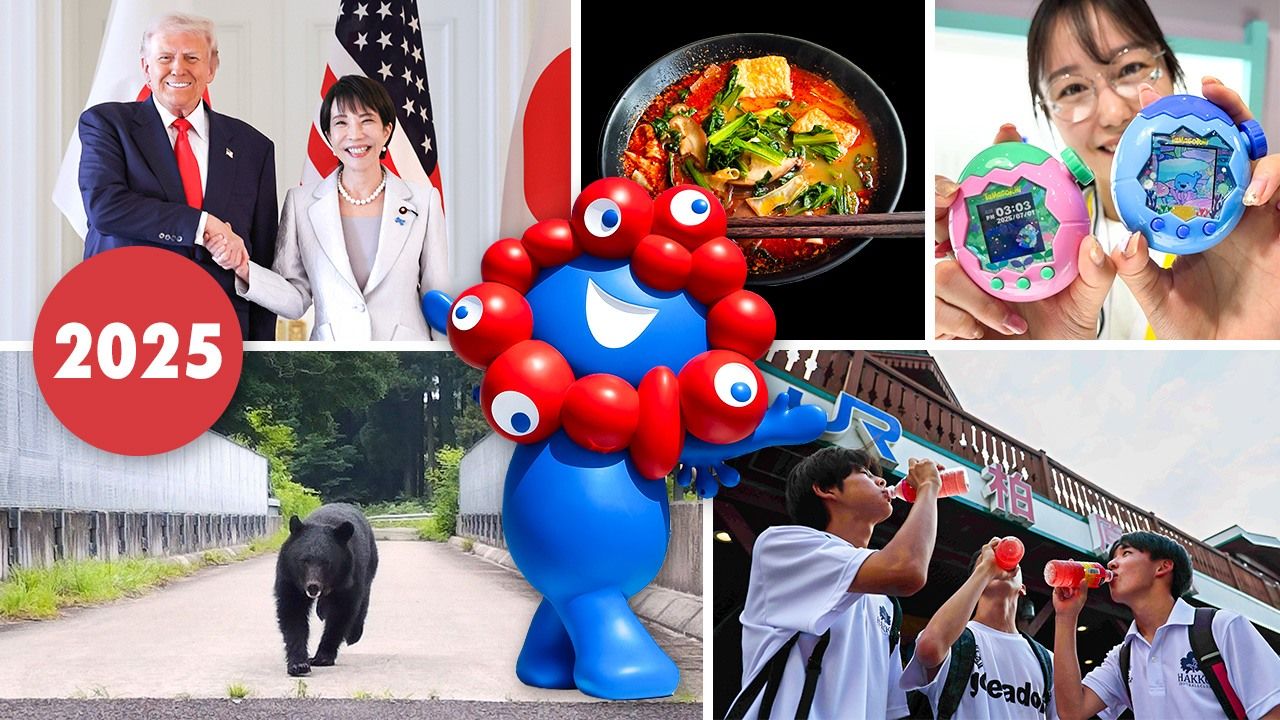
緊急銃猟/クマ被害 — Kinkyū jūryō/kuma higai. On September 1, new “emergency hunting” (kinkyū jūryō) legislation was introduced allowing for shooting of bears, boars, and other dangerous animals that enter populated areas, based on the decision of the mayor. The term kuma higai refers to damage or injuries caused by bears, which has been more common in 2025 than in typical years.
国宝(観た) — Kokuhō (mita). The kabuki-themed movie Kokuhō has become a massive hit—at the time of writing, it looks set to become the highest grossing Japanese live action film ever in its home country. The buzz has been such that “Have you seen Kokuhō?” (Kokuhō mita?) became a common question.
古古古米 — Kokokomai. With rice prices soaring, the release of government stockpiles prompted talk of komai (literally “old rice”), as well as kokomai (“old old rice”) and kokokomai (“old old old rice”). A crop is described as “old rice” from November 1 of the year after it is harvested, with a subsequent ko or “old” added for every subsequent year every subsequent year.

7月5日 — Shichigatsu itsuka. “July 5” this year was the date predicted for a massive earthquake and tsunami, according to a rumor based on a manga storyline. There was no scientific basis for the disaster prophecy, but its wide dissemination, particularly in Hong Kong, led to a reduction in tourism from some areas.
戦後80年/昭和100年 — Sengo 80 nen/Shōwa 100 nen. This year marked the eightieth anniversary of the end of World War II and eould have been year 100 of the pivotal Shōwa era, which began with 1926 as Shōwa 1, with broadcasters, publishers and other media organizations releasing an abundance of retrospectives on major events and their lasting legacies.
卒業証書19.2秒 — Sotsugyō shōsho 19.2 byō. A local political scandal grabbed national attention after Takubo Maki, the mayor of Itō in Shizuoka Prefecture, was accused of falsely claiming that she had graduated from Tōyō University when in fact she had been expelled. When asked during a subsequent investigation whether she had shown her graduation documents to the necessary authorities, she gave the unusually precise response of, “Yes, for 19.2 seconds.” The city assembly later overwhelmingly passed a no-confidence motion.
チャッピー — Chappī. This abbreviation of ChatGPT became standard among Japanese users of OpenAI’s now ubiquitous generative artificial intelligence chatbot.
チョコミントよりもあ・な・た — Chokominto yori mo a na ta. AiScReam (a trio of Japanese voice actresses that is part of the multimedia franchise Love Live!) made a splash on TikTok and other social media platforms, capturing the imagination of listeners with their debut song “Ai Scream!” (a play on words in Japanese of “ice cream” and “love scream”), with the refrain “I love you more than chocolate mint.”
トランプ関税 — Toranpu kanzei. Japan was among a number of US trade partners slapped with “Trump tariffs,” sending the government scrambling to negotiate a deal to reduce the economic impact, particularly to the auto industry.
長袖をください — Nagasode o kudasai. Comedian Tsuda Atsuhiro, half of the duo Daian, tickled the funny bone of viewers of a popular sketch comedy show when he pleaded in vain during a bit to be given “something with long sleeves” before being sent to frigid Niigata for business.
二季 — Niki. A growing number of experts warn that as climate change alters weather patterns, Japan’s much loved four seasons (shiki) will dwindle to just two (niki) as the climate swings between winter and summer, pushing spring and autumn entirely out of the picture.
ぬい活 — Nuikatsu. In this new iteration of “katsu,” meaning to engage in some purposeful activity, fans of stuffed toys (nuigurumi) take their prized plushies out with them to shops, restaurants, and elsewhere, sharing their photos with likeminded people on social media.
働いて働いて働いて働いて働いてまいります/女性首相 — Hataraite, hataraite, hataraite, hataraite, hataraite mairimasu/joseishushō. Japan’s first female prime minister Takaichi Sanae expressed her commitment to “work, work, work, work,” drawing criticism from many for sending a message out of step with the country’s push for residents to strike a better work-life balance.
ビジュイイじゃん — Biju ii jan. The boy band M!LK climbed the charts with its single “Ii jan” (meaning something akin to “it’s fine” or “it’s ok”), with the line “Looking great today” (the biju comes from “visual”), striking a particular chord with fans.
ひょうろく — Hyōroku. The comedian Hyōroku made a splash this year with his appearances on variety shows, particularly those playing pranks on guests, in which he made full use of his deadpan expression that left those around him wondering whether he was acting or responding naturally to the situations he was placed in. In recent years he has branched out from the slapstick side of things to appear in more serious dramatic programs as well.
物価高— Bukkadaka. After long years of Japan’s deflationary trend, “prices are on the rise” again, confronting consumers with the problem of higher costs for goods and services while their paychecks seem to be falling behind. Global strife is putting upward pressure on energy and food prices, leaving Japanese shoppers in an ongoing state of uncertainty.
フリーランス保護法 — Furīransu hogohō. The “freelance protection act,” formally the Act on Ensuring Proper Transactions Involving Specified Entrusted Business Operators, went into effect in November 2024 as part of government efforts to prevent freelancers and other individual operators from being treated unfairly by business counterparts wielding more power in the dealings between them.
平成女児 — Heisei joji. The “girls of the Heisei era,” who attended elementary school in the late 1990s and early 2000s, are now in their twenties and thirties and driving consumer and cultural trends looking back nostalgically to that formative era. Their “Heisei retro” preferences tend toward pastel colors, ribbons and hearts, and other aspects of the youth culture of their younger days.
ほいたらね — Hoitara ne. The serial NHK drama Anpan, focusing on Komatsu Nobu, the wife of Anpanman creator Yanase Takashi, brought this phrase—meaning “see you again soon,” in the Tosa dialect of Kōchi Prefecture—into the public consciousness. Other phrases gaining popularity thanks to their use in this program included tassui gā (meaning something like “can’t take any more of this”) and tamaru ka ( an expression of surprise or shock).
麻辣湯 — Mārātan. The Japanese pronunciation for the Sichuan soup malatang, this term rose in the public eye as more diners sought out this spicy, taste-bud-numbing treat. Restaurants offered customers the chance to customize the ingredients and spiciness level of the dish, boosting its popularity considerably from late 2024 onward.
ミャクミャク — Myaku Myaku. The official mascot of the 2025 World Expo held in Osaka, this colorful being started off being viewed as a weird, somewhat frightening figure, but won the hearts of Expo-goers to become one of the more popular yurukyara in recent memory, driving significant souvenir sales.
薬膳 — Yakuzen. The latest health-food fad focused on “medicinal meals,” combining fresh seasonal ingredients with herbs and other additives purported to heal whatever might be ailing you. When the manga Shiawase wa tabete nete mate (Eat, Sleep, and Wait for Happiness to Arrive) was made into a drama on NHK, its focus on this healthy approach to eating boosted awareness of it and triggered a fresh wave of cookbooks sharing its secrets.
ラブブ — Rabubu. The Labubu characters, created by Hong Kong–born designer Lung Kasing, were a global hit thanks to their promotion by K-pop stars and other celebrities around the world. They also found favor among young consumers in Japan, helping to trigger a renaissance of the student fashion of dangling plushies off of school bags and backpacks.
リカバリーウェア — Rikabarī uea. “Recovery wear” got its start as high-tech gear for athletes looking to bounce back after a competition or tough training session. The inclusion in the fabric of ceramic elements delivering far-infrared radiation to the body is said to warm muscle tissue and boost circulation, thus enhancing recovery from fatigue. These products have found favor among not just athletes, but the average person looking for sleepwear promising a bit more functionality.
(Originally published in English. Banner photo, clockwise from top left: Prime Minister Takaichi Sanae met with US President Donald Trump and sought to soften the blow of the “Trump tariffs” [© Jiji]; malatang soup was a popular menu choice [© Pixta]; Tamagotchi are a part of the resurgent culture of the “Heisei girls” [© Nippon.com]; Tanba, Hyōgo Prefecture, hit an all-time high for Japan of 41.2ºC on July 30, symbolizing the country’s two-season new normal [© Jiji]; Myaku Myaku, the popular mascot for the Osaka Expo [© Nippon.com]; wild bears made their presence felt this year [courtesy Akita Prefecture, © Jiji].)