Lessons from the 1961 Sanriku Fire: More Relevant Than Ever
Disaster Environment- English
- 日本語
- 简体字
- 繁體字
- Français
- Español
- العربية
- Русский
Drought, Strong Winds Recipe for Disaster
The Sanriku Fire broke out on May 29, 1961. According to the Miyako City Disaster Archive, at the time, the region was experiencing its worst drought in 75 years. The conflagration is also attributed to the Foehn effect (which causes hot, dry winds), meaning that similar conditions were in place six decades ago as those observed at the time of the major wildfires in Southern California in January 2025 and on a smaller scale in Japan’s Ōfunato, Iwate, in March 2025. Southern California did not experience its usual autumn wet season last year, and in fact had not seen significant rainfall since April 2024. In much of Japan, too, last winter was the driest since statistics began in 1946.
A report on the May 1961 wildfires on the Sanriku coast, the Pacific shore of the prefectures of the Tōhoku region, issued by the Ministry of Agriculture’s forestry laboratory states that a low-pressure front that formed in the aftermath of Typhoon Betty was accompanied by a cold front, which whipped up dry winds gusting up to 110 kilometers per hour. It was in such conditions that fires broke out in 14 different locations, enveloping not only forest but also fields, houses, and mines. The fires claimed five lives, injured 122, and completely destroyed 587 buildings. In total, an area of 260 square kilometers was destroyed—even more than the 200 square kilometers razed by the recent California fires.
While in the case of Sanriku, the first fires actually broke out before May 29, they appeared to have been extinguished, only to be reignited by dry, gale-force winds. Of the 11 fires that started on May 29, five were caused by bonfires, one started when a tree was blown over onto a charcoal pile, and the rest are of unknown cause, although the investigation report conjectures that some were caused by cigarettes. The fires were not fully extinguished until June 1. Light rain at the time is credited with helping quell the blazes.
Warning Future Generations
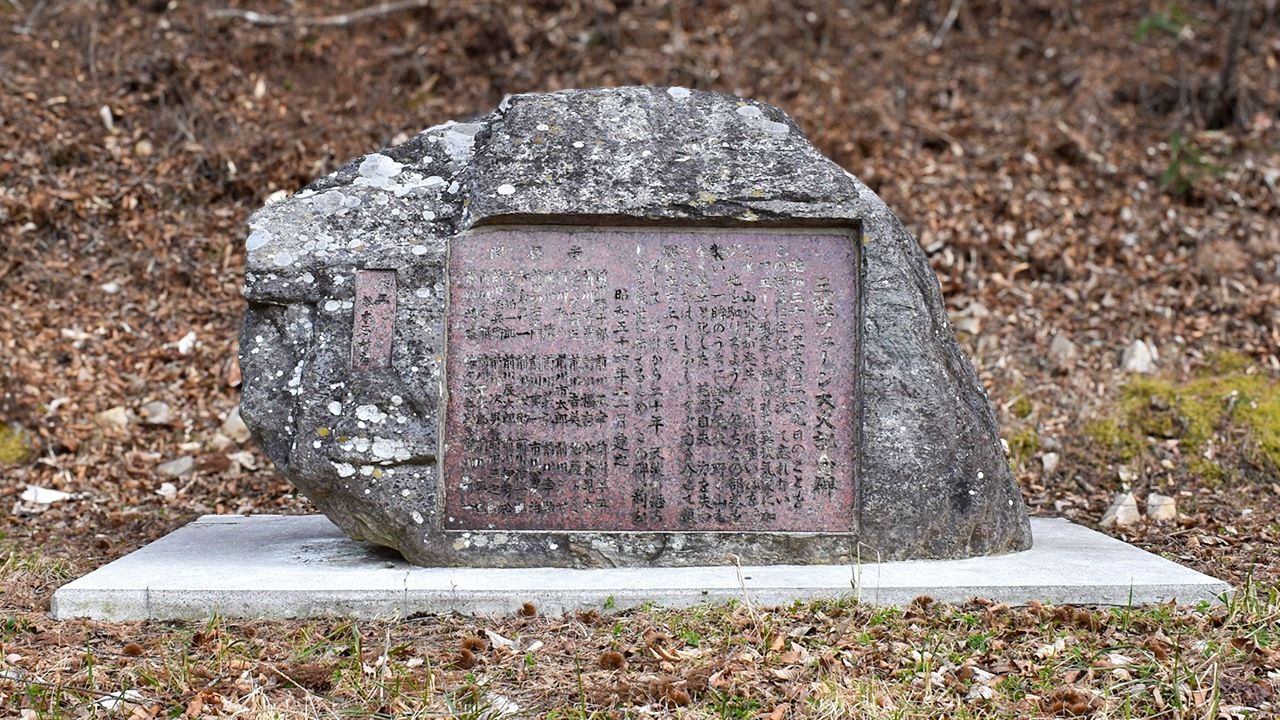
Two Sanriku Fire Memorials stand in the city of Miyako today, with one on the side of the road around half a kilometer from the sea in the Sakiyama district, and another on a wooded hillside just over three kilometers inland, near Prefectural Route 40. Local residents erected the stone tablets in 1981, on the twentieth anniversary of the fire, as a warning to future generations.
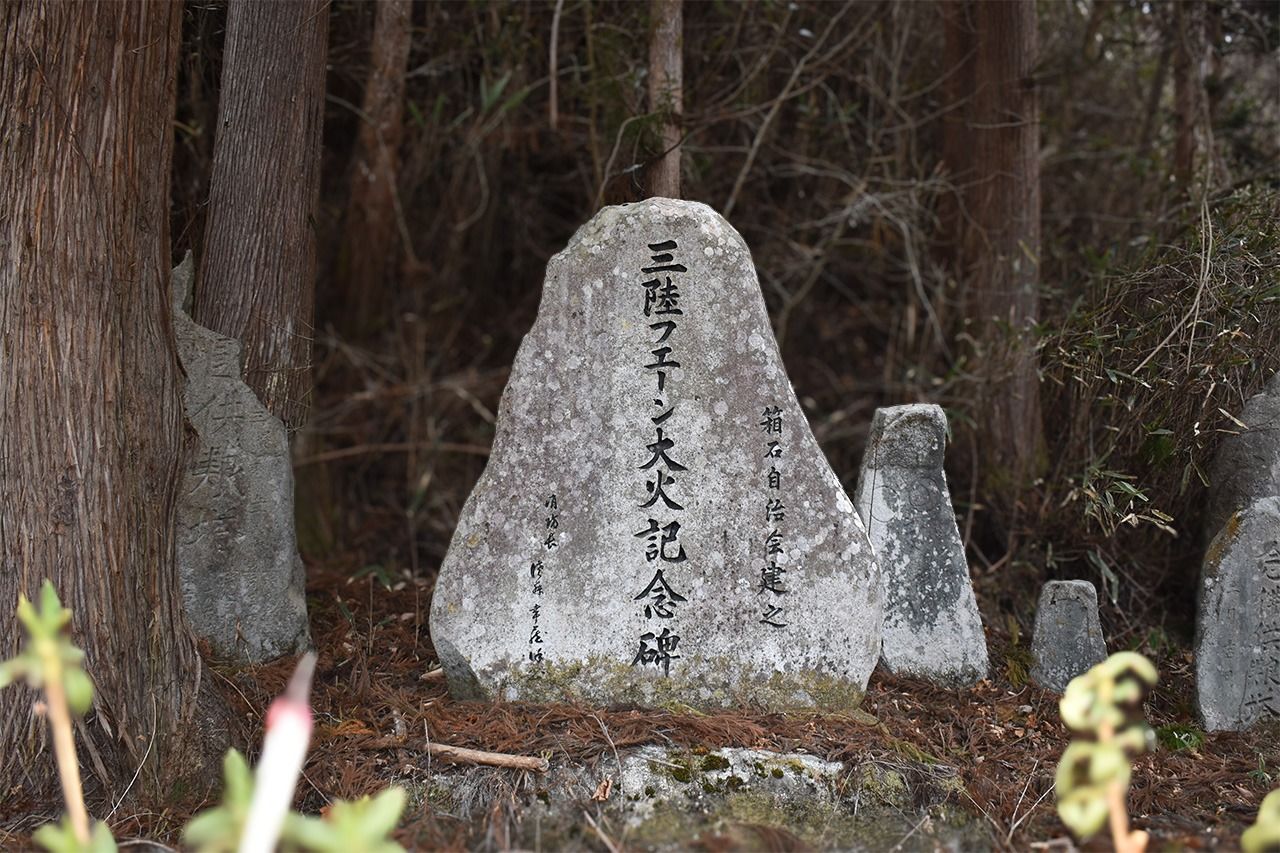
The hillside memorial to the fire in Miyako, Iwate. (© Abe Haruki)
Worst-hit was the northern part of the Sakiyama district, then part of the town of Tarō, which merged into the city of Miyako in 2005. At the time, the area was known for the Tarō mine, a large excavation that produced copper, iron sulfide, and zinc. The mining township had a population of around 4,000 and boasted shops, a movie theater, a school, and a doctor’s clinic. All were destroyed in the fire, prompting the miners to consider shutting down the mine or leaving their jobs. However, the operator reopened the site in December 1961 at a tremendous cost for the era of over ¥1.1 billion.
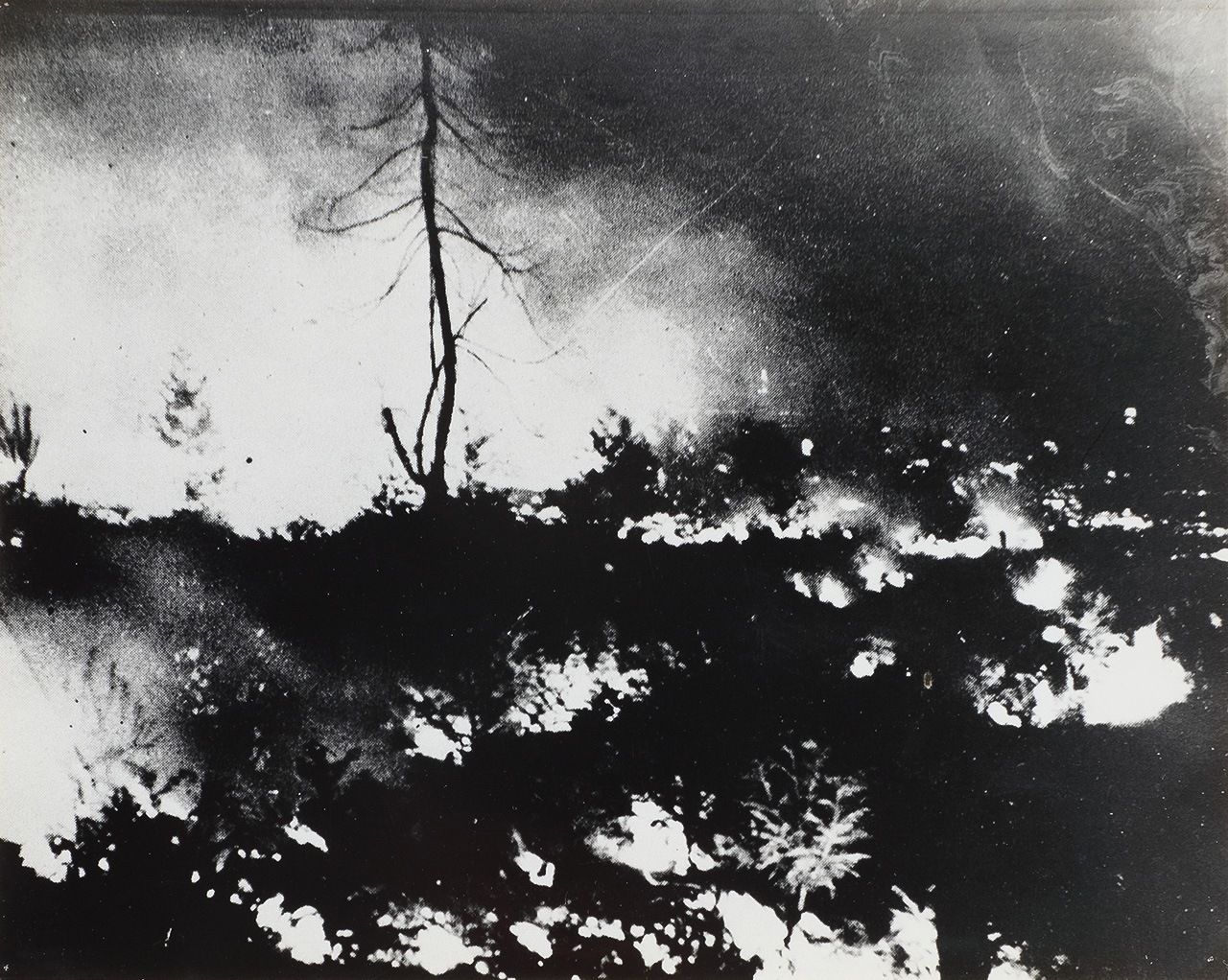
A photograph of the Sanriku Fire in the Miyako City Disaster Archive. (Courtesy Miyako municipal government)
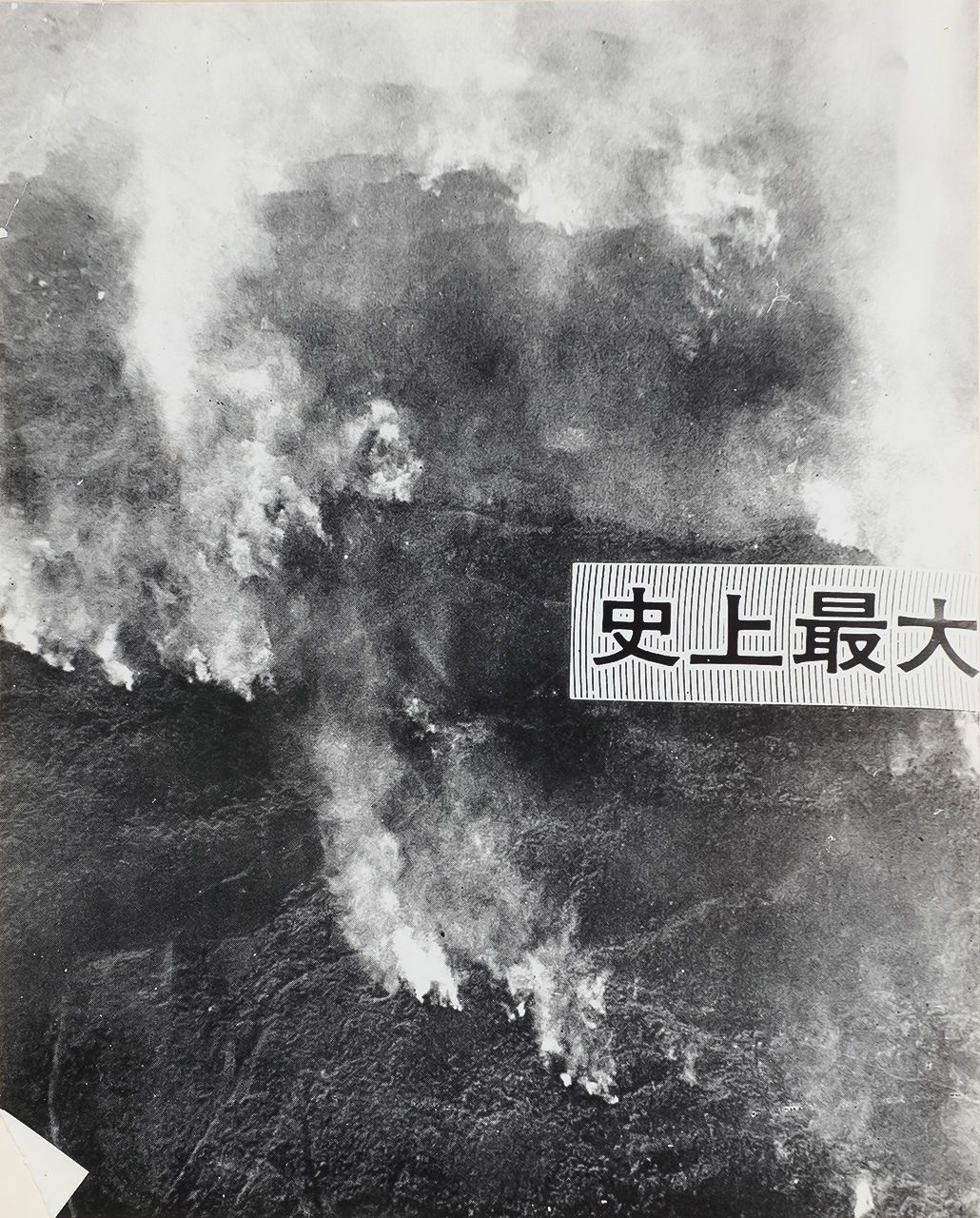
The flames stormed up the dry, wooded hillsides. (Courtesy Miyako municipal government)
Running for Their Lives
Maekawa Hisashi, now 77, grew up in the Tarō district of Onatsupe, where the roadside memorial stands today. He was 13 at the time of the Sanriku Fire. On his way to school on the morning the flames broke out, Maekawa saw smoke rising from the hills, but did not pay much attention to it. However, when he arrived home from school, he found a note from his mother telling him not to light the stove.
The forest fire was visible before nightfall. Maekawa and the rest of his family began stockpiling water from a nearby river, but the fire was rapidly approaching Onatsupe, leaving the coast as the only route of escape. When the villagers set off for the coast, the winds were so strong they could not stand up. At one point, the flames spread to a hill standing before them, near the shore. Hisashi recounts being petrified, unable to breathe due to the dust and smoke.
Late at night, the wind died down and the villagers took the opportunity to move to a safer location. When Hisashi returned the next day, he was astonished to find that the hills were bare and there was nothing to see but white ash and blackened trees. On the ground were the burnt corpses of chickens, cows, goats, other livestock, and their pet dog. Only the family cat returned alive, albeit with burnt ears, about a month later.
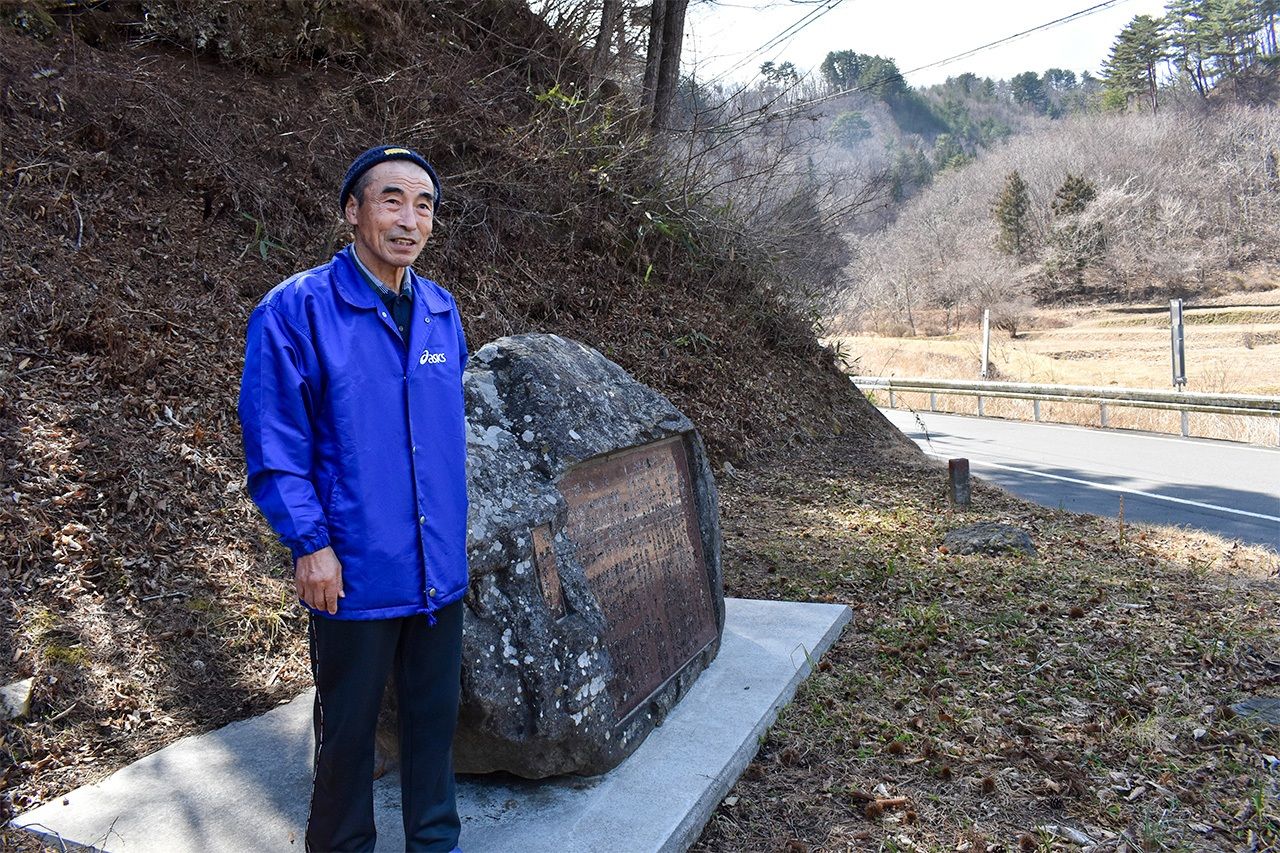
Maekawa Hisashi at the roadside memorial to the fire. (© Abe Haruki)
Maekawa and his family still rely on the local creek for water for washing and other uses, but he says it is particularly low this year. He commonly heads into the nearby forest to gather firewood, checking on conditions as he goes, but he feels that the forest is especially dry now. He says emphatically: “You’ve got to be really careful with open flame. You must never drop cigarette butts.”
Wildland-Urban Interfaces Require Different Strategies
Farther to the south in Iwate, I walk through the port district of Ryōri in Sanrikuchō, in the city of Ōfunato, where 26 houses burned down in March 2025. Gutted homes, storehouses reduced to walls, and buildings reduced to steel frames are evidence of the fire’s intensity. Sometimes, next door to a destroyed house will be another house that is virtually unharmed, an unexpected sight to people who view forest fires as all-destroying.
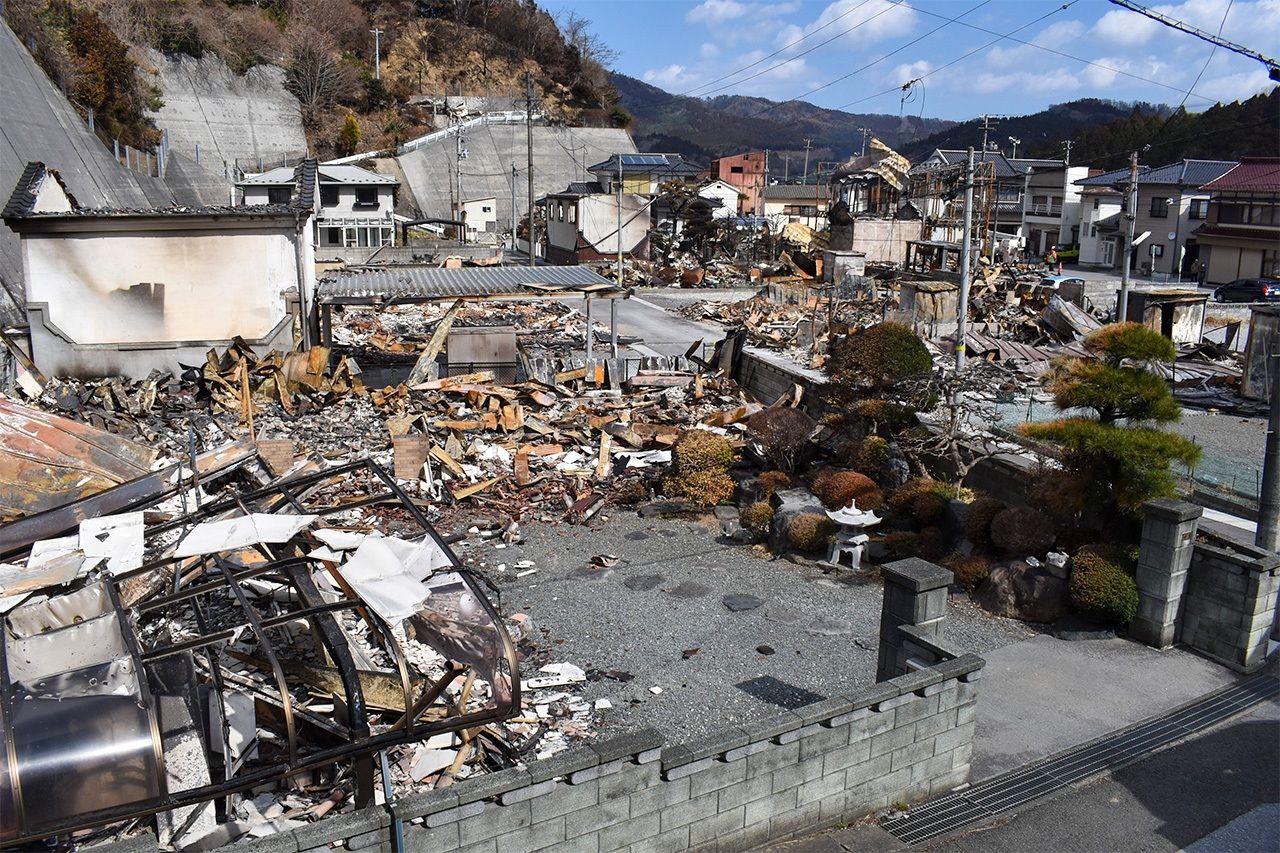
The Ryōri port area in Ōfunato after the March fire. (© Abe Haruki)
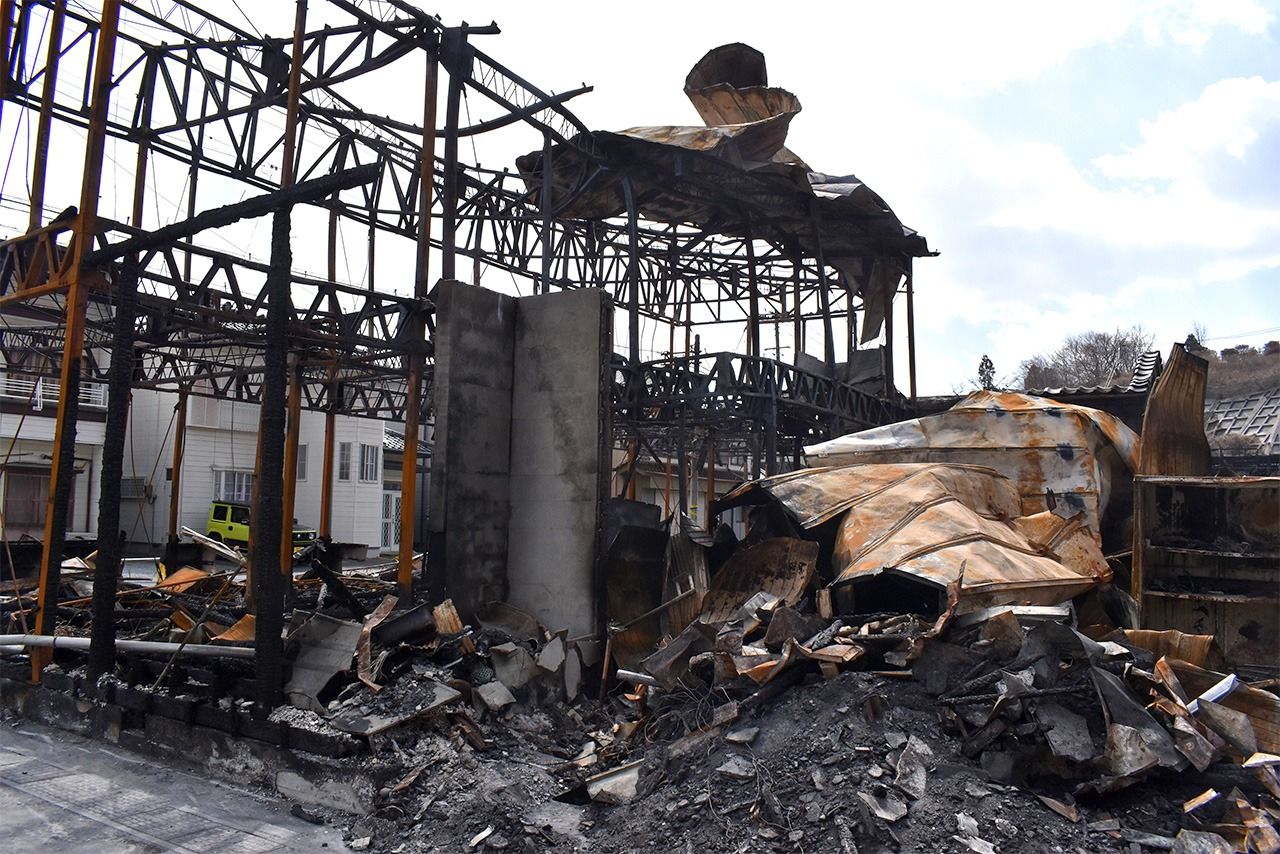
Little remains but metal frames for many structures in the area. (© Abe Haruki)
In Western countries, so-called WUI fires taking place in wildland-urban interfaces, where residents live right next door to forested areas, have become a major issue in recent years, with many calling for action. The January South California wildfires reminded us just how urgent this is. It strikes me that the wildfire that ravaged Ōfunato in March, along with another series that torched some 900 hectares in Okayama and Ehime Prefectures in the same month, should be categorized not as forest fires but as WUI fires, and investigated and analyzed to help inform future fire prevention. I believe that the 1961 Sanriku Fire, which destroyed many homes and businesses, should also be categorized as a WUI fire.
The WUI fire researcher Samuel Manzello, a visiting professor at Tōhoku University, says there is a need to make a clear distinction between wildland fires and wildland-urban interface events. While wildfires tend to arise in unpopulated areas, destroying mainly vegetation, blazes in WUI areas obliterate structures like houses, cars, and more in inhabited areas. The presence of varied fuel sources, including gasoline in vehicles and various household or industrial chemicals, means that traditional approaches to firefighting are often unsuccessful. Manzello is a central figure in initiatives by the ISO, or International Organization for Standardization, to create a universal standard for WUI fires. His team’s work has been summed up as the report ISO TR/24188, titled Large Outdoor Fires and the Built Environment—Global Overview of Different Approaches to Standardization. Manzello says that Japan is not prepared for WUI fires.
In Japan, the January fires in Los Angeles tended to be reported as affecting an exclusive, faraway area inhabited by Hollywood celebrities, with hardly any mention of the fact that similar fires in wildland-urban interfaces could affect Japan. Manzello says the Japanese population needs to take more seriously the risk of a forest fire reaching a populated area. His comments reminded me of the word satoyama, a reference to natural woodlands that coexist with human settlements. Suddenly it all made sense.
Two thirds of Japan is covered in forest, and for centuries, Japanese people have lived adjacent to mountainous, forested areas and benefited from the bounty of nature. The classic Japanese fairytale in which an old man goes into the forest to gather firewood while his wife goes to the river to wash clothes expresses the nature of liminal zones between forests and settlements—namely, wildland-urban interfaces.
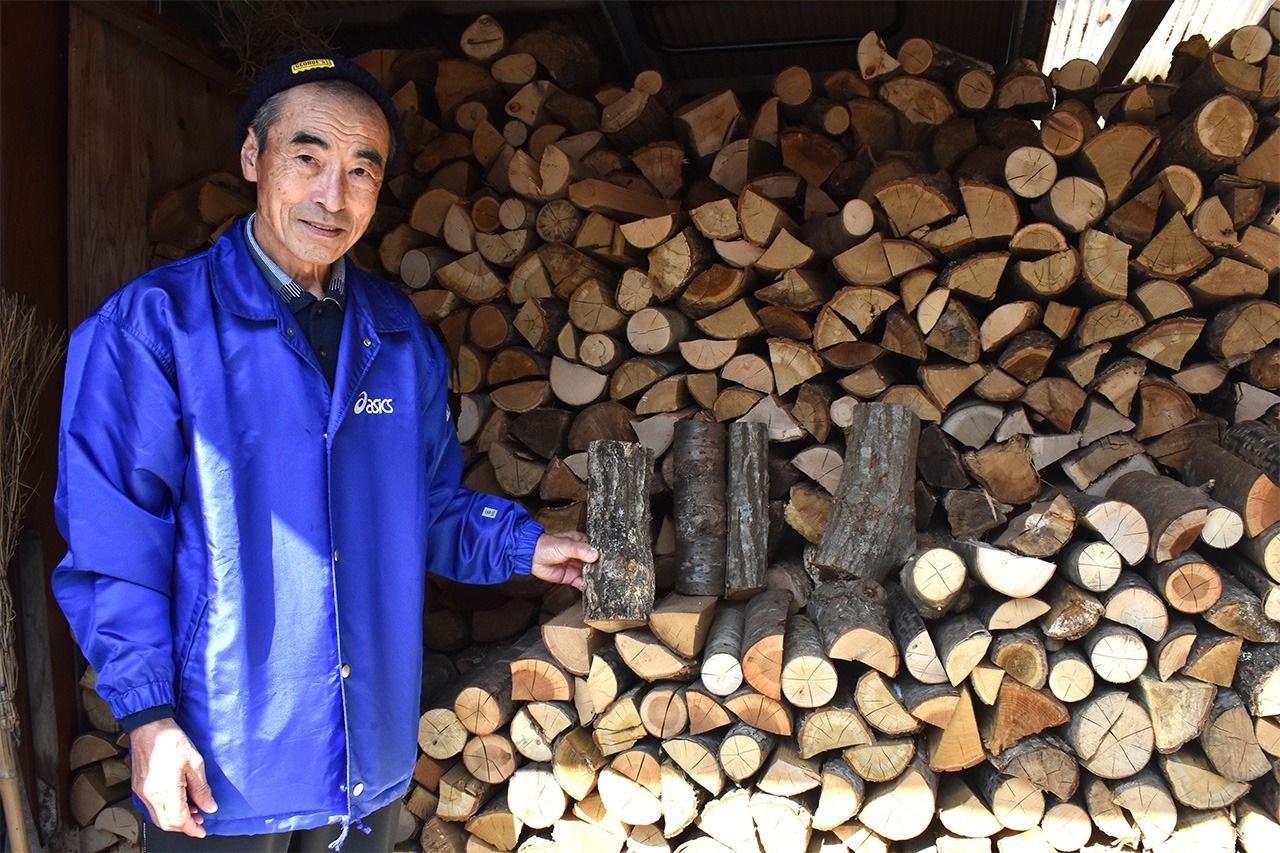
Maekawa Hisashi with firewood gathered in the forest. (© Abe Haruki)
A Need for Rules and Standards
Japan’s Forestry Agency’s website lists six rules for preventing forest fires:
- No open fires near dry vegetation or other fire-prone areas.
- Bonfires and other naked flames should be supervised at all times and extinguished completely before they are left behind.
- Do not light fires when it is windy or dry.
- Only light fires after obtaining permission.
- Only smoke in designated areas, always extinguish cigarette butts, and never drop butts.
- Don’t play with fire.
The US government, in contrast, recommends specific countermeasures, giving specific examples. For example, a May 2020 pamphlet issued by the US Fire Administration and Federal Emergency Management Agency, Creating a Community Welfare Protection Plan, gives examples of causes of fires that can break out in the various parts of a house, providing specific solutions.
The section on fences, for instance, states that at least 1.5 meters of any fence connected to a house should be built of a fireproof material, even if the rest of the fence is wood or something flammable like wood. The section on awnings warns that large gaps between awnings and buildings can allow airflow that fans flames, and should therefore be sealed.
As global warming continues to get worse, scientists say that we should expect still more fires in wildland-urban interfaces. It is surely time for Japan to adopt a more international approach to forest fires.
(Originally published in Japanese. Banner photo: The roadside Sanriku Fire Memorial in Miyako, Iwate. © Abe Haruki.)