Japan’s First Female Prime Minister No Friend to Feminists
Politics Economy Society Lifestyle- English
- 日本語
- 简体字
- 繁體字
- Français
- Español
- العربية
- Русский
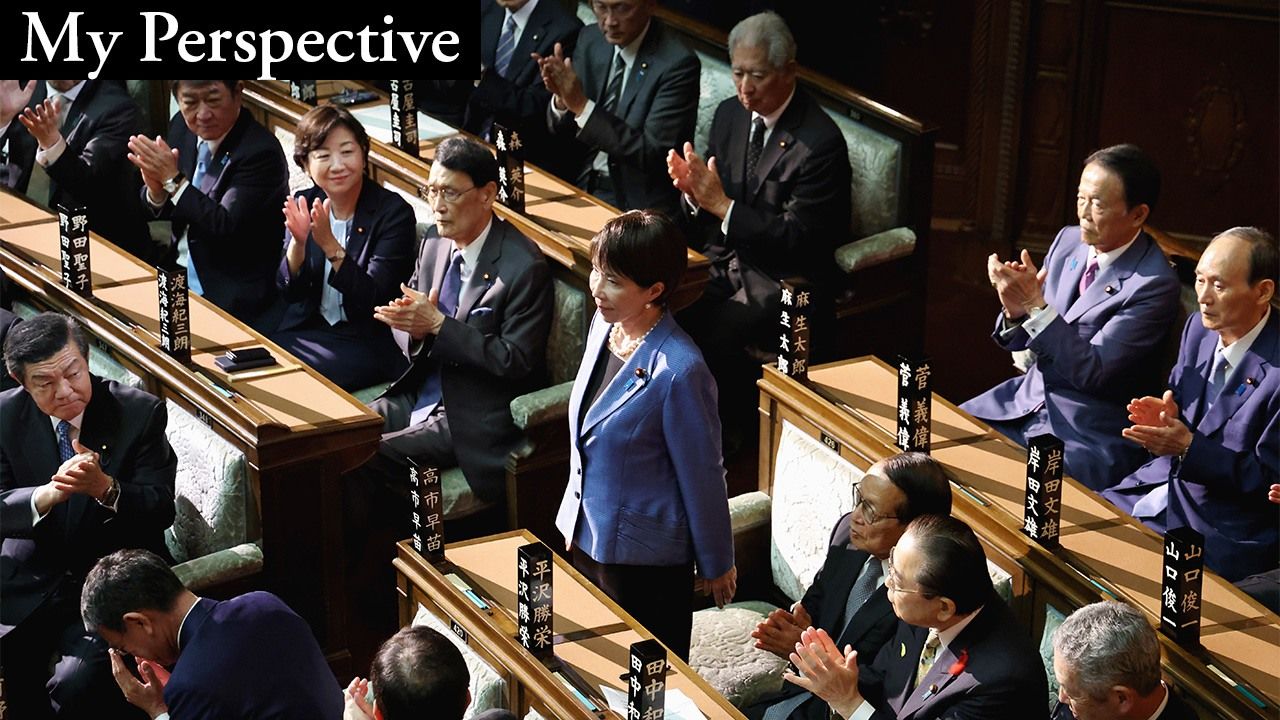
On October 21, 2025, Takaichi Sanae became Japan’s first female prime minister. I was among those who had flocked to the National Diet to witness the historic moment, but seated in the gallery of the House of Representatives that afternoon I did not feel any elation. When the outcome of the Diet vote was announced, the chamber erupted in applause. But not all of the lawmakers joined in, and I, for one, felt a coldness grip my heart as I shifted uncomfortably in my hard, narrow seat.
Feminism as a Labor Issue
I say this as someone who has been outspoken about the need for more women in Japanese politics. Indeed, I devoted an entire book (published in 2023) to the achievement of Ōiso in Kanagawa Prefecture, which has maintained gender parity in its municipal assembly for more than 20 years. I feel strongly about this because I myself, as a single middle-aged female, have fallen through the cracks of a social structure built on the male-earner model—a society in which women rightly view marriage as a vital safety net. As I explain in my book, I want “women politicians who will work within the system to address the root of these structural problems” and build a society where single women like me can enjoy a basic level of economic security.
Any hope I may have had that Japan’s first female prime minister would bring us closer to those goals was shattered on October 20, when the Liberal Democratic Party, which Takaichi heads, and the Japan Innovation Party (also known as Nippon Ishin) released their coalition agreement. For while the document outlined the two parties’ understanding on a range of economic measures, it made no mention at all of labor reform.
The main reason single middle-aged and older women face such economic hardship in Japan is that they are stuck in low-paying nonregular jobs with substandard benefits. Today’s middle-aged women are at a particular disadvantage, having graduated from school smack in the middle of the “employment ice age” that followed the collapse of the 1980s economic bubble. Their only option at the time was nonregular employment (freelance, temporary, and part-time work). And no matter how much time and effort they subsequently invested in re-skilling, that is generally where they stayed, often going without a raise or a promotion for decades. The idea of developing women’s potential has never even occurred to most employers. I have looked to women politicians to initiate the changes needed to improve this abysmal labor environment, but Takaichi has expressed not the slightest interest in such reform.
Not What I Had in Mind
In 2012, Takaichi made this telling statement at a meeting of LDP conservatives: “People greedily taking every available handout, profiting by pretending to be underprivileged . . . . A country overrun with people like that is doomed to perish. Let’s take our nation back and once again make Japan a society where you don’t impose on others.” She later insisted that she was referring only to people who commit welfare fraud, but improperly distributed benefits amount to only about 0.3% of the total, and most of that is the result of procedural errors. So what is all this about the country being doomed?
Meanwhile, Takaichi has said nothing since the September LDP presidential election about political funding irregularities in her party, despite the huge public fallout from the 2023–24 slush fund scandal. Talk about greedily taking handouts! Of the 46 scandal-tainted LDP lawmakers who ran in the October 2024 House of Representatives election, 28 were voted out of office. The people have spoken on this issue, yet there remain a host of unanswered questions about the flow of unreported funds within the LDP’s factions. And as for preventing similar abuses in the future, a decision on banning corporate and industry-group donations has been deferred indefinitely. When I said I wanted more women in the Diet, I didn’t mean more women engaged in dirty politics.
A common reaction to these sentiments is that feminists like me should celebrate the appointment of Japan’s first woman prime minister—someone who, moreover, was born and raised in ordinary circumstances and rose to prominence through sheer hard work and dedication—even if her ideology diverges somewhat from our own. On my X account, I received quite a few posts from people outside my immediate circle, saying, “How can you call yourself a feminist and not cheer her on?”
I can understand the sentiment. The problem is, this is our prime minister. If she were the first woman elected to a local assembly that had been controlled by old men since the end of World War II, I would be inclined to celebrate regardless of her ideological orientation (providing she was not an outright bigot). But this is our nation’s leader, and our livelihoods are at stake.
Backpedaling on Work-Life Balance
Upon winning the LDP leadership election, Takaichi announced that she personally intended to “abandon the idea of work-life balance” in pursuit of her duties. Moreover, immediately after taking office as prime minister, she instructed her labor minister to launch a policy review of the regulations limiting overtime hours (even though there was no mention of this in the aforementioned coalition agreement). Japan’s notoriously long working hours are part and parcel of a system that has long relied on women as unpaid domestic care workers. What will happen if the country shifts into reverse on this issue?
Another matter of great concern to women is the minimum wage, which varies by prefecture. The government has previously pledged to raise the national average minimum wage to ¥1,500 per hour by the end of the decade. In today’s inflationary environment, ¥1,500 an hour is barely enough for a single person to live on. But I worry that the current administration will backtrack on even that modest commitment, given Takaichi’s lack of sympathy for those of us struggling to make ends meet.
Today, of course, the typical reaction to such complaints is, “Isn’t that your own responsibility?” My response to that is this statement by Ueno Chizuko at the University of Tokyo’s 2019 matriculation ceremony: “The ideology of feminism demands that the vulnerable be respected for who they are.” As a feminist myself, I find it impossible to celebrate the installation of a prime minister whose political agenda calls for bolstering a social structure that denies the vulnerable their right to be who they are.
(Originally published in Japanese. Banner photo: Takaichi Sanae, center, stands after being elected prime minister at the National Diet Building on October 21, 2025. © Jiji.)